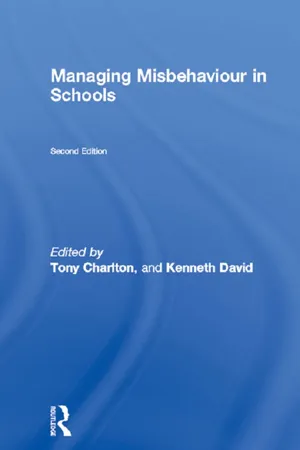
Fully revised and updated, this second edition of the successful Managing Misbehaviour in Schools presents a wide-ranging survey of both the theoretical and the practical ideas and suggestions for the efficient management of behaviour problems in the school and classroom. It is invaluable for student and practising teachers, as well as their colleagues in other supporting professions.
- 264 pages
- English
- ePUB (mobile friendly)
- Available on iOS & Android
eBook - ePub
Managing Misbehaviour in Schools
About this book
Information
Part I
The theoretical background
In Chapter 1, ‘Ensuring Schools are Fit for the Future’, Tony Charlton and Kenneth David reflect on the influence of schools and of teachers on the behaviour of pupils, and discuss what exactly is meant by misbehaviour—how it can be defined and what the extent of misbehaviour is in actual fact. The link between teachers’ perceptions of bad behaviour, the quality of teaching and the ethos of the school are considered. There are then many factors which combine to make essential a ‘whole school’ approach when considering the behaviour of pupils.
Tony Charlton and John George in Chapter 2 consider the development of behaviour problems. They emphasize the intricate interaction between factors, internal and external to pupils, which influence aspects of the pupils’ behaviour, and argue for the effect of specific situations on much behaviour. They discuss the range of biological and environmental factors which have been shown to influence pupils’ behaviour at home, in school and elsewhere, and consider and update the considerable research which has taken place.
Ronald Davie continues to develop the theoretical basis for behaviour problems in Chapter 3, ‘Assessing and Understanding Children’s Behaviour’. He considers the link between assessment and the process of dealing with behaviour problems in school, in the classroom and elsewhere. He then clearly describes the major theoretical models which attempt to provide explanations of children’s behaviour problems. He questions how far they are mutually inconsistent and incompatible and the practical implications of this. Finally he questions the efficacy of basing practice on a single theoretical model, or on a more eclectic approach.
Chapter 1
Ensuring schools are fit for the future
SCHOOLS MAKE A DIFFERENCE
The increasing challenge to schools is to examine what they are offering their pupils, how it is offered and whether it meets the needs of the pupils and the public. This is reflected in the demands of the National Curriculum and the assessments at different ages now being required by the Education Reform Act of 1988. Inevitably linked with this is the question of behaviour in schools. Numerous studies, such as those by Coleman et al. (1966) and Rutter et al. (1970), show that most children present behaviour problems in school or at home, but not necessarily in both. Behaviour is therefore specific to situations, which suggests that misbehaviour can best be resolved in the situation where it occurs. It is seldom satisfactory then always to look outside the school when considering misbehaviour in school.
Much evidence clearly shows that schools do affect their pupils’ behaviour within school (Hargreaves 1967; Rutter et al. 1979; Galloway and Goodwin 1987; Reynolds and Cuttance 1992). What schools offer, and how they offer it, helps determine whether pupils respond in desirable or undesirable ways, and the reasons for pupils’ misbehaviour may have as much (if not more) to do with their experiences at school as those they encounter in the home, or with aspects of their personality. Factors which seem to affect the influence of schools have been researched in many studies including Mortimore et al. (1988), and are explored in later chapters.
Frude and Gault (1984), commenting on school-based causes of behaviour problems, reported:
Many of the incidents reported to us indicated some weakness in the school organisation, sometimes relating to the use of buildings, sometimes in the curriculum, or timetable, and sometimes in the teaching or pastoral context.
(p. 36)
Along similar lines Galloway et al. (1982) suggested that:
knowledge of a school’s policies and its teachers’ attitudes is often as important in understanding disruptive behaviour as knowledge about family stress and intellectual weakness.
(p. 63)
Obviously not all behaviour problems in schools emanate from within the school. Pupils from disadvantaged homes can, of course, bring their problems with them, though it is very risky to link disadvantaged homes with disturbed children, for some who are extremely disturbed come from good homes and have parents, as Stott (1972) reminds us:
whom one has to rate not only as stable and affectionate, but as having shown almost superhuman patience and tolerance.
(p. 43)
He also points out that many well adjusted and successful pupils come from extremely adverse backgrounds.
LOOKING AT OURSELVES
Many readers will remember with affection the cartoon showing a large and fearsome teacher towering over a miscreant, bellowing:
Some people will blame your genes, some people will blame your environment, some people will blame your teachers, but I blame you, Wimpole, pure and simple.
Many of us become defensive and irritated when confronted by pupils’ misbehaviour, and find it difficult to look hard at ourselves and our methods and attitudes. But if we take pride in the successes that we know of when we affect pupils’ attitudes, feelings, actions and academic achievements, then we must logically accept that the reverse can happen—we can affect pupils in unacceptable or undesirable ways, for perfection eludes many of us. Lawrence and Steadman (1984) noted in their research that:
Many teachers are understandably reluctant to acknowledge that the reasons for pupils’ misbehaviour may be found as often in their teaching as in the pupils’ inability or failure to learn.
(p. 24)
The most effective way of managing behaviour problems must surely be to work to prevent them arising, and to minimize their occurrence. In a well-known study Kounin (1970) reported that when attempting to differentiate between more and less successful teachers, he found no difference between the two groups in terms of their effectiveness in dealing with behaviour problems, but successful teachers were seen to be far more adept at preventing them.
Much of the stress of teaching is related to problem behaviour in the classroom. Sometimes these problems manifest themselves as physical or verbal abuse, yet more often they present themselves as minor yet disruptive behaviour. In the Elton Report (DES and Welsh Office, 1989), 97 per cent of primary and secondary teachers reported they were called on to deal with behaviour such as ‘calling out’ and ‘distracting others by chattering’. Lawrence and Steadman (1984) reminded us that disruptive behaviour of this type is often:
frustrating, irritating and stressful, in extreme cases it may lead to complete breakdown of the classroom order and, more seriously, of the teacher’s health.
(p. viii)
From another perspective HMI (1987) stress:
Good behaviour is a necessary condition for effective teaching and learning to take place, and an important outcome of education which society rightly expects.
Society is expecting good order and good results from teachers, and will be increasingly impatient and lacking in understanding if we do not provide them. So looking hard at ourselves, our teaching, our institutions, our rituals and our effect on pupils is becoming obligatory rather than just advisable, as we seek to eradicate or prevent pupils’ behaviour problems by various forms of intervention.
THE EXTENT OF MISBEHAVIOUR
Public concern about pupil misbehaviour in school is often widespread. The popular media has not been slow to disseminate (and, at times, misrepresent) this concern to its readership. This type of publicity, which has been paralleled in literature from teachers’ unions and—to a lesser extent—in educational journals, has brought unprecedented levels of debate among the teaching profession, parents and the wider public. Prominent in such debate has been the controversy as to whether or not current levels of ‘misbehaviour’ in school have increased significantly during recent years.
Those convinced that the incidence of pupil misbehaviour has escalated have argued the need for a variety of resources, additional to those already available in schools, to meet both the behavioural needs of practising (and potential) miscreants and the professional needs of those who teach them. However, with reference to disruptive pupils Galloway (1987) comments that there is no evidence to suggest an increase in such behaviour even though:
It is a standard piece of educational folklore that such pupils have increased in numbers, and that the problems these pupils present have become more severe.
(p. 29)
In a similar vein Hargreaves (1989) remarks that:
there is little to suggest that there is a major problem of pupil misconduct on a large scale in our schools or that the situation has deteriorated in recent times. Most teachers have (and always had) routine problems of class management and meet the occasional difficult child who cannot easily be contained…. It seems, then, that it is a small number of individual teachers, who have substantial problems in relation to pupil misbehaviour.
(p. 3)
More moderate opinion considers the concern over misbehaviour in school to be a reaction to a perennial problem in society itself. Human nature being what it is, individuals are expected to differ from each other in a plethora of ways including the extent to which they practise behaviours deemed to be acceptable, or unacceptable, according to the demands and expectations of the particular community/society within which they function. Supporters of this thinking recognize the existence of misbehaviour in school but contend, for example, that an unequitable focus upon the misbehaviour of a few ignores and obscures the acceptable behaviour practised by the vast majority of children and youngsters attending school.
DEFINING MISBEHAVIOUR
It is unfortunate that at least some of the controversy has arisen from semantic confusion concerning the term ‘misbehaviour’. This imprecision about behavioural description has been responsible, at times, for generating confusion and misinformation among the public and—to a lesser extent—the teaching profession.
To some the term has been construed as analogous with maladjustment; a term of limited value, as Galloway and Goodwin (1987:31) admit, which ‘is neither a clinical diagnosis nor even a descriptive term but an administrative category’. Others have perceived it as behaviour (usually bereft of the excessive ‘disturbing’ or ‘disturbed’ connotation attached to the first interpretation) manifested verbally, or physically, which overtly challenges—to varying degrees and in a variety of ways—the authority of the teacher or school. At variance with their colleagues are those who define it for the most part as a catalogue of comparatively minor misdemeanours which, whilst not immediately challenging the authority of the teachers, demand the expenditure of inordinate amounts of teacher time and energy.
Clearly a need exists for yet more research to be undertaken in order to clarify what teachers construe as ‘misbehaviour’, and to ascertain the extent to which those misbehaviours prevail both in classrooms and the broader school context. Whilst it is logical, and defensible, to argue that any enquiry investigating the nature, and extent, of school misbehaviour should consult closely with teachers, it is of paramount importance that such investigations are bereft of methodological flaws such as those which have often characterized enquiries undertaken by teachers’ professional associations (see Jones 1989).
TEACHERS’ PERCEPTIONS OF MISBEHAVIOUR
In March 1988 Lord Elton led an enquiry into discipline in schools in England and Wales and made recommendations in the light of his committee’s findings. As part of their enquiry the Elton Committee commissioned the Educational Research Centre, at the University of Sheffield, to examine teachers’ perceptions and concerns about discipline. The results from this research (DES and Welsh Office 1989) provide an absorbing and much-needed insight into the nature and extent of the problem behaviours reported by primary—and secondary-school teachers. Contrary to the beliefs of some teachers’ unions the most ‘disturbing’ misbehaviours encountered by teachers were not found to be physical or verbal abuse but, in accordance with the last of the definitions referred to earlier, a variety of minor—but nevertheless ‘disruptive’—incidents including:
• | talking out of turn |
• | hindering other pupils |
• | making unnecessary noises |
• | calculated idleness or work avoidance |
• | not being punctual |
• | getting out of seat without permission |
The survey also found that teachers did encounter problem behaviours of a more serious nature such as:
• | verbal abuse towards teachers |
• | physical aggression tow... |
Table of contents
- Cover Page
- Title Page
- Copyright Page
- Contents
- Contributors
- Foreword
- Part I: The theoretical background
- Part II: Theory and practice
- Part III: Classroom and school practices
- Appendix: Legislation and reports in recent years
- Index
Trusted by 375,005 students
Access to over 1.5 million titles for a fair monthly price.
Study more efficiently using our study tools.
Frequently asked questions
Yes, you can cancel anytime from the Subscription tab in your account settings on the Perlego website. Your subscription will stay active until the end of your current billing period. Learn how to cancel your subscription
No, books cannot be downloaded as external files, such as PDFs, for use outside of Perlego. However, you can download books within the Perlego app for offline reading on mobile or tablet. Learn how to download books offline
Perlego offers two plans: Essential and Complete
- Essential is ideal for learners and professionals who enjoy exploring a wide range of subjects. Access the Essential Library with 800,000+ trusted titles and best-sellers across business, personal growth, and the humanities. Includes unlimited reading time and Standard Read Aloud voice.
- Complete: Perfect for advanced learners and researchers needing full, unrestricted access. Unlock 1.5M+ books across hundreds of subjects, including academic and specialized titles. The Complete Plan also includes advanced features like Premium Read Aloud and Research Assistant.
We are an online textbook subscription service, where you can get access to an entire online library for less than the price of a single book per month. With over 1.5 million books across 990+ topics, we’ve got you covered! Learn about our mission
Look out for the read-aloud symbol on your next book to see if you can listen to it. The read-aloud tool reads text aloud for you, highlighting the text as it is being read. You can pause it, speed it up and slow it down. Learn more about Read Aloud
Yes! You can use the Perlego app on both iOS and Android devices to read anytime, anywhere — even offline. Perfect for commutes or when you’re on the go.
Please note we cannot support devices running on iOS 13 and Android 7 or earlier. Learn more about using the app
Please note we cannot support devices running on iOS 13 and Android 7 or earlier. Learn more about using the app
Yes, you can access Managing Misbehaviour in Schools by Tony Charlton,Kenneth David in PDF and/or ePUB format, as well as other popular books in Education & Behavioural Management. We have over 1.5 million books available in our catalogue for you to explore.