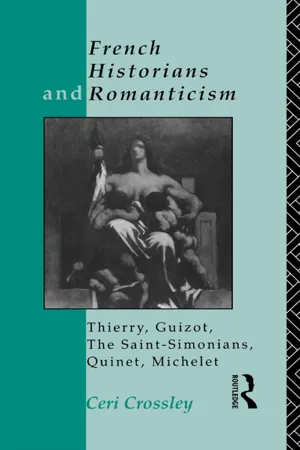
eBook - ePub
French Historians and Romanticism
Thierry, Guizot, the Saint-Simonians, Quinet, Michelet
- 296 pages
- English
- ePUB (mobile friendly)
- Available on iOS & Android
eBook - ePub
French Historians and Romanticism
Thierry, Guizot, the Saint-Simonians, Quinet, Michelet
About this book
The French Revolution had a profound influence on perceptions of the past as well as setting the agenda for modern political culture. This book examines the ways in which the past was rediscovered, retrieved and represented in post-revolutionary France, concentrating upon the Restoration and the July Monarchy, the period which witnessed the promotion of history as a grand discourse of legitimation.
1 Introduction: history and the post-revolutionary context
DOI: 10.4324/9780203161692-1
The philosopher R.G.Collingwood once observed that the past as past was wholly unknowable. What was knowable was something different: the elements of the past which had been residually preserved in the present.1 In other words, what we take to be knowledge of past reality derives in fact from those texts, artefacts, buildings, belief systems, memories and traditions which have somehow survived and are amenable to investigation—and interpretation. History can only be written from the standpoint of present reality and can never encompass either the totality of events or the fullness of meaning. The historical consciousness inevitably selects and orders its material in accordance with contemporary concerns which consciously or unconsciously determine the frame of reference of its operations. However, while the being of the past may be unknowable in an absolute sense its effects remain relentlessly present; its traces surround us and form the theatre of our actions; it is through our relation to history (personal, family, collective) that we acquire an individual identity within culture. The activity of the individual self is inscribed within groups and cultures, themselves historically constructed, and these in turn legitimise certain forms of social relations. Unknowable the past may be, but the discourse on the past possesses a truth value in so far as it acts as a principle of legitimation, sanctioning political power, justifying social hierarchies, determining rights and responsibilities. The past, retrospectively reconstructed as history, functions as a source of authority, overtly in the shape of jurisprudence and covertly in the form of the ways of feeling, the attitudes of mind, the norms of behaviour which are transmitted to future generations and are internalised by them through the process of socialisation.
My aim in this book is to describe the major components of the French Romantic construction of the past, with its dominant sense of purposeful movement, energy and potentiality. My point of departure is the notion that foremost among the cultural attributes which are the defining characteristics of collective entities is the relation which a given culture entertains with the passing of time. A culture’s self-definition is inscribed within its understanding of the collective past, of how it came to be what it is, and how it conceives of its development. I shall look at some of the ways in which the past was rediscovered, retrieved and represented in French thought broadly between 1815 and 1851 through the writings of Guizot, Thierry, Cousin, Quinet, Michelet and others. I shall be concerned with the assumptions which governed their different readings of the past and with the ways in which their theory and practice of history were themselves influenced by historical circumstance.
History continues to occupy a remarkably central position in French cultural life, more so certainly than in the United Kingdom. In France the discourse on the past is an essential component of the discourse on society and politics in general. Why should this be so? In my view this desire to use the past as a point of reference illuminating present reality has to do with the fact of the Revolution and its still unresolved consequences. Arguments over the meaning and value of the Revolution persist despite the decline of orthodox marxist readings and the dominance of François Furet and his disciples. What needs to be emphasised here is the degree to which the Revolution problematised the whole relation to the past while at the same time setting the agenda for modern political culture. The Revolution initially created in France an awareness of the uniqueness of the present. The past was rejected. New institutions were to be established which would correspond to genuine human needs and actualise the universal rights of man. This mood of renewal was recaptured by Michelet in his lyrical evocation of the great Fête de la Fédération of 1790; the event seemed to stand outside time, an eternal, a timeless moment of hope and potentiality. However, while it is no exaggeration to say that in the wake of the French Revolution the nation stood in a new relation to time—the rhetoric of renewal taking concrete form in the revolutionary calendar—events demonstrated the power of the past to overwhelm the promise of the present. The hope of 1789–90 was followed by division, civil war, the Terror, the despotism of Napoleon and finally defeat at Waterloo. The old centres of spiritual, political and moral authority were destroyed but no stable new order emerged. After 1815 the desire to understand the recent period of instability developed into a more general reflection on the past, its direction and its meaning.
As the nineteenth century unfolded the English idea of progress, like the Whig interpretation of history, became identified by many with a belief in the inevitability of gradual improvement. In France, by the very nature of things, the idea of progress was more directly linked to political struggles for individual and collective freedom and to the seemingly inevitable oscillation between revolution and reaction. British history is reformist whereas French history is revolutionary.2 For Frenchmen, the grandeur—or the horror—of 1789 lay in its repudiation of the past, in its attempt to create a new world of values, boldly to actualise a heroic ideal. In this way the relation of post-revolutionary France to 1789 can be viewed as the relation to a founding origin. The Revolution was more than a revolt, more than the outbreak of violence against authority. It created a new relation between before and after, a temporal disjunction which called into question the nature and purpose of human action. The Revolution was a violently transgressive act of regicide which sundered the nation from its past, an act of collective parricide which nevertheless inaugurated a new order and established the nation-state.3 But while the Revolution transformed the relation to the past this relation was experienced and theorised in different ways as the nineteenth century unfolded. The work of the Romantic historians is to be seen in this context. Their writing is worthy of searching study because it reveals the degree to which the recovery of national history was coextensive with the attempt to understand and account for the French Revolution.
Ideas of the past—and the future—are not fixed. They are historically and culturally formed. Historians do more than conserve the object of their attention; they endow history with meaning as their narrative unfolds. The work of Hayden White has done much to open up this area by describing the different tropes which govern the plotting of the historical field.4 In the present study, however, my main concern does not lie with the literariness of historical discourse, with the extent to which it conforms or does not conform to particular structures or forms of textual organisation which in turn govern the production of meaning. Most of my attention will involve more traditional methods of analysis and be devoted to matters of intellectual history and social and political theory. This Introduction aims to present the reader with a view of the different currents of historical explanation which dominated intellectual debate in France from the Directory to the end of the Restoration. Subsequent chapters will, for the most part, concentrate upon individual writers and thinkers. My aim is to show how a new set of governing ideas concerning the nature of history altered the understanding of the relationship between individual and social reality, and led in some instances to a new sense of the sacred.
The central concern of liberal French intellectuals after 1815 was the relation of the present to the inheritance of the Revolution.5 The leaders of the Revolution had believed that human nature could be remade, refashioned, and that the past could in effect be rejected, disowned. Looking back over French history in his Politique libérate (1875) Charles de Rémusat saw in this rejection of the national past an essential component of the French revolutionary spirit. In Rémusat’s eyes France represented the unique case of a country which had turned against its past to the extent of denigrating and disowning the collective memories of a thousand years. No other nation had gone so far in attempting to eliminate and eradicate the sense of the past. No other nation, concluded Rémusat, ‘had made so great a sacrifice of its past to its future’.6 Rémusat’s stance was in fact that of the liberal intellectuals of the years 1815–30 who rapidly abandoned the outright rejection of the past professed by the revolutionaries. They recognised that the disavowal of the collective past was an error which had in effect confirmed the reactionary view that the Revolution was an aberration, a disruption of the natural order of things. Restoration liberal historians set out to appropriate the historical field, to discover and celebrate precursors of their cause. As we shall see, it was with this aim in view that Thierry, Guizot and Mignet described the emancipation of the Communes and the rise of the Third Estate. Their writing was in tune with the times for it largely accorded with the interests and aspirations of the middle classes who would seize the political initiative in 1830.7 History furnished them with a sense of collective development which allowed them to disentangle the constitutionalism of 1789 from the radical republicanism of 1793. Following the lead given by Madame de Staël in her posthumously published Considérationssur la Revolutionfrançaise (1818), liberals argued that the disruption of history caused by 1789 took on meaning when set within a more general movement of national history. They explained that liberty was not invented in 1789; its presence could be found in earlier centuries. In their view history embodied not submission to authority but resistance to arbitrary rule.
In this way history became integral to liberal doctrine. Henceforward it was to be the reference to history—rather than any appeal to abstract rights (which smacked of the revolutionary republic and the destruction of freedom in the name of democracy)—which furnished liberals with persuasive arguments in favour of reform and civil equality. The writing of history was a mobilising project which ascribed authority and legitimacy to the revolutionary nation-state and which contained an implicit critique of social and political reality. The Restoration witnessed the displacement of politics into history. The strength of such history, written against the established order (albeit in defence of the constitutional monarchy), was that it was predicated upon an idea of the future. The collective dynamic discovered in the past was also at work in the present, creating the future. The discourse on the past which emerged was a direct response to conditions prevailing in France in its new post-revolutionary cultural configuration. Such discourse was symbolic in character, carrying not only facts and memories but values, recognitions and aspirations. National unity needed an idea of tradition and continuity which somehow explained the Revolution and invested it with meaning. The collective memory was no longer to be jettisoned in favour of the claims of political theory.
The years between 1815 and 1830 corresponded to a period of intense historical activity in France. The reason for this, as Stanley Mellon has explained in a seminal study, was that during the Restoration history became in effect the language of politics.8 The Charter of 1814 sought to bring about a degree of reconciliation by dividing sovereignty between the king and the nation. Liberals who argued in favour of the extension of rights and freedoms defended this constitutional compromise which they saw as incorporating the true spirit of the Revolution. Against them were ranged the conservative monarchists, the Ultras, the returning émigrés whose objective was a complete reversion to the Ancien Régime. In their vengeful eyes the Revolution was a criminal act. It was to be rejected as a block. They were suspicious of all liberalcalls for reform since in them they detected a covert resurgence of Jacobinism. The intellectual cohesion of the Ultras was provided by the writings of the traditionalist school: Joseph de Maistre (1753–1821), Louis de Bonald (1754–1840) and Félicité de Lamennais (1782–1854). The central element of the traditionalist critique of Enlightenment philosophy was that the philosophes had mistakenly ascribed priority and superiority to the individual over society. In the eighteenth century sensationalist psychology had combined with moral relativism to produce an abstract notion of the individual which had subsequently been manipulated by the universalist rhetoric of the Revolution to support the causes of freedom, equality and democracy.9 In the opinion of de Maistre eighteenth-century rationalism was an abomination; it eroded the social fabric and led directly to the dislocation of 1789. That was also Lamennais’s thesis in the Essai sur l’indifférence (1817–23). According to Joseph de Maistre the great error of the Enlightenment had been to believe that men had the power to create laws and invent institutions. In reality society was not a construction of the rational will of individuals but rather the manifestation of a power which both transcended and sustained the collective entity concerned. Individuals were formed by society and only existed in and through social relationships. At the very heart of social reality lay religion. In the Génie du christianisme (1802) Chateaubriand argued persuasively that human beings had genuine religious needs. Religion was inseparable from collective life; it lent duration, continuity, identity and meaning to society.
The Revolution, on the other hand, was the agent of the forces of unbelief; it had disrupted the natural processes of history. For de Maistre the Revolution was radically evil, satanic. But at the same time it possessed an awesome power and energy.10 In his Considérations sur la France (1797) he wrote that the Revolution was a divinely ordained punishment meted out to the French nation for failing to serve the cause of throne and altar. History was at once the unfolding of a divine purpose and a story of blood and violence, explicable by reference to the theory of reversibility according to which the sufferings of the innocent atoned for the sins of the guilty. History was not explicable in purely human terms. This darkly uncompromising providentialist interpretation of history—which none the less accommodated the idea that France had a special mission to fulfil—had analogies with some of the republican theories I shall be examining later. However, deMaistre’s views were clearly incompatible with a truly developmental philosophy of history. All positive valorisation of change as progress was avoided. The objective of the Ultras was the restoration of throne and altar and not the establishment of a different order (which by their definition would collapse into impurity). Neither was this conservative metaphysic of history which rejected constitutions in favour of reverence for tradition really identical with the superficially similar understanding of the power of custom and organic processes proposed by Burke.
The keynote was the rejection of the liberal notion of rights in favour of submission to an intransigent and intolerant authority. The Reformation’s appeal to individual conscience had been crushed in the course of the wars of religion and by the Revocation of the Edict of Nantes. However, the Revolution had given rights to Protestants—and to Jews. Authoritarian Catholicism, on the other hand, was hostile to both groups. Traditionalism regarded liberal freedoms in general (freedom of the press, of worship) as unacceptable challenges to the sacred nature of an organic society which was grounded in truths transmitted from the collective past. Difficulties arose because Restoration political life rested on the Charter of 1814 which represented a compromise of sorts between royalism and liberalism. There was also the problem that divisions existed within the political Right: between the Ultras and more moderate conservatives, between the émigrés returning after 1815 and those who had come back during the Empire, between outright monarchists and those who defended the role of the aristocracy (such as Montlosier who revived Boulainvilliers’s explanation of French history as a conflict between Gauls and Franks). There was the additional and inescapable fact that the monarchy had only fully regained power in the nineteenth century thanks to the invasion of French territory by foreign armies. Nevertheless, the Ultras felt they had right and history, as well as God, on their side and the political project of the Right rested on the paradoxical belief that it was possible to organise a return to an ordered monarchy in which social relations would once again be governed by largely unconscious beliefs and practices. The causes of the Revolution were explained with reference back to the Reformation and to Enlightenment philosophy but these subversive intellectual currents were castigated as errors, not seen as manifestations of an alternative tradition. The Revolution was held to be evil but it was above all seen as an aberration. The argument which Barruel had advanced in 1797 to the effect that the Revolution was a criminal conspiracy against throne and altar was revived. The profound changes which France had undergone during the Revolution and Empire could seemingly in large measure be reversed by force. The Right maintained its outright hostility to the Revolution in all its forms.11
A new generation of writers emerged, influenced by the Génie du christianisme, and in their work feeling for nature joined with historical sensibility to produce texts which reinforced the spirit of reaction, albeit in a mood tinged with melancholy and a sense of loss. French Romanticism in its early legitimist phase looked back to an idealised vision of the Middle Ages. For the Right the monarchy had been the constant ordering and unifying principle throughout French history until 1789. The society of the future was to be a return to a lost past symbolically organised around the king and the church. The future would be the perpetuation of the past. Such a view drew strength from its power to integrate individuals into social life (while denying them participation and rights) and from its sense of the importance of the past. But it was essentially a static vision which ultimately valorised sameness. Liberals came to a different accommodation with the collective dimension and inscribed it in a developmental theory of history. Traditionalist thought contained elements susceptible of a more dynamic interpretation—for example Lamennais’s reliance on the notion of universal consent—but, as Lamennais’s own evolution indicated, history as progress soon became heterodoxy. Catholic royalism, convinced of the absolute truth of its dogmas, proceeded in the manner of the Counter-Revolution, by excluding from its definition of France and Frenchness all who disagreed with its central tenets. Traditionalist Catholicism appealed to a lost sense of ontological security and branded as loathsome the post-traditional order of modernity which seemed devoid of any enduring metaphysical principle. De Bonald, for example, was not interested in the formation of self-identity. What mattered to him was the reconstruction of the ontological framework which determined social norms and human conduct. This patterning underpinned the distribution of power and guaranteed the principle of authority which preserved social cohesion despite the pressures of conflicting individual wills.
At first sight de Bonald’s affection for an idealised feudal monarchy suggested a significant interest in the past; after all, it provided a useful prop for the Catholic identity in the present. He also elaborated a cyclical theory of political change which had analogies with Vico: power was originally personal (the monarchy), then public (the feudal monarchy) and finally popular (this last condition eventually produced the Revolution; de Bonald hoped that the reimposition...
Table of contents
- Cover Page
- Title Page
- Copyright Page
- Table Of Contents
- Acknowledgements
- Abbreviations
- 1 Introduction: History and the Post-Revolutionary Context
- 2 Augustin Thierry (1795–1856) and the Project of National History
- 3 François Guizot (1787–1874) and Liberal History: The Concept of Civilisation
- 4 The Historical Vision of Saint-Simon (1760–1825) and the Saint-Simonians (1825–1832)
- 5 Edgar Quinet (1803–1875): History, Nature and Religion
- 6 Jules Michelet (1798–1874): History as Resurrection
- 7 Conclusion
- Notes
- Bibliography
- Index
Trusted by 375,005 students
Access to over 1.5 million titles for a fair monthly price.
Study more efficiently using our study tools.
Frequently asked questions
Yes, you can cancel anytime from the Subscription tab in your account settings on the Perlego website. Your subscription will stay active until the end of your current billing period. Learn how to cancel your subscription
No, books cannot be downloaded as external files, such as PDFs, for use outside of Perlego. However, you can download books within the Perlego app for offline reading on mobile or tablet. Learn how to download books offline
Perlego offers two plans: Essential and Complete
- Essential is ideal for learners and professionals who enjoy exploring a wide range of subjects. Access the Essential Library with 800,000+ trusted titles and best-sellers across business, personal growth, and the humanities. Includes unlimited reading time and Standard Read Aloud voice.
- Complete: Perfect for advanced learners and researchers needing full, unrestricted access. Unlock 1.5M+ books across hundreds of subjects, including academic and specialized titles. The Complete Plan also includes advanced features like Premium Read Aloud and Research Assistant.
We are an online textbook subscription service, where you can get access to an entire online library for less than the price of a single book per month. With over 1.5 million books across 990+ topics, we’ve got you covered! Learn about our mission
Look out for the read-aloud symbol on your next book to see if you can listen to it. The read-aloud tool reads text aloud for you, highlighting the text as it is being read. You can pause it, speed it up and slow it down. Learn more about Read Aloud
Yes! You can use the Perlego app on both iOS and Android devices to read anytime, anywhere — even offline. Perfect for commutes or when you’re on the go.
Please note we cannot support devices running on iOS 13 and Android 7 or earlier. Learn more about using the app
Please note we cannot support devices running on iOS 13 and Android 7 or earlier. Learn more about using the app
Yes, you can access French Historians and Romanticism by Ceri Crossley in PDF and/or ePUB format, as well as other popular books in History & 19th Century History. We have over 1.5 million books available in our catalogue for you to explore.