- 216 pages
- English
- ePUB (mobile friendly)
- Available on iOS & Android
eBook - ePub
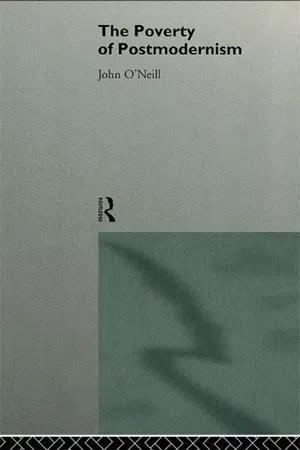
The Poverty of Postmodernism
About this book
The Poverty of Postmodernism rejects the current celebration of knowledge and value relativism. This is on the grounds that it renders critical reason and commonsense incapable of resisting the superifical ideologies of minoritarianism that leave the hard core of global capitalism unanalyzed. In this book John O'Neill examines the postmodern turn in the social sciences. From a phenomenological standpoint (Husserl, Merleau Ponty, Schutz, Winch), he challenges Lyotard's postrationalist reading of Wittgenstein and Habermas in order to defend commonsense reason and values that are constitutive of the everyday life-world. In addition he argues from the standpoint of Vico and Marx on the civil history of embodied mind that the post-rationalist celebration of the arts of superificiality undermines the recognition of the cultural debt each generation owes to past and post-generations. In a positive way O'Neill develops an account of the historical vocation of reason and of the charitable accountability of science to commonsense that is necessary to sustain the basic institutions of civic democracy.
Information
Part I
The politics of disciplinary knowledge
Chapter 1
Postmodernism and (post) Marxism
A postmodern essay cannot avoid its own exemplarity with respect to the modernity it seeks to situate as an after effect or an abject of its own success. Its exemplarity consists in its wounded subjectivity, its deterritorialization due to its recognition that it lacks any ground outside of its own construction. Nevertheless, the postmodern essay remains a satellite of modernity which in turn remains a star recognized by its distance from the medieval world and the ancient cosmos. In this sense the essayist is a travelling theorist who like Montaigne discovers that all the while he has moved around himself looking for a niche in which to resettle his home.
Nothing much is to be gained from definitions of postmodernism whether as a period concept or as a counter concept. Certainly, nothing can be laid down from the start in such thickets since the pretence of initial clarity would either founder along the way or else catch nothing from its explorations. Postmodernism is a discursive practice with sites in art, architecture, music, literary criticism and the social sciences.
The word postmodernism is not only awkward and uncouth; it evokes what it wishes to surpass or suppress—modernism itself. The term thus contains its enemy within, as the terms romanticism, classicism, baroque and rococo, do not. Moreover, it denotes temporal linearity and connotes belatedness, even decadence, to which no postmodernist would admit. But what better name are we to give this curious age?1
We must recognize the will to power at least as much as the will to knowledge in the naming game. Thus any definition will risk the embarrassment of imprecision because of its promise of possession.
The poorest map will do provided it can be used to legitimate land sales to eager prospectors. Academics are no less immune to gold-digging than anyone else. So the signs go up: post-historical, post-civilization, postmodernity. Wherever they lead to, such signs lead ‘beyond’ and naturally recruit followers. One sign alone seems to warn them off the great beyond: anti-modernity. This appears to be the last stop on the autobahn of modern culture: think before you go on, or turn-off!
Well, what sort of cultural highway have we been on and does our culture have alternative paths along which we might just as well proceed? We need to pay some attention to such imagery. We are likening our culture, with all its usages which thicken here and there in our institutions, cities and villages, to a highway along which certain stops stand for places at a remove from the centre of symbolic production. At each stop a phrase in our cultural grammar defines the landscape through which runs the highway of modernism to the left and the road to postmodernism at the right. At best, the two routes function to tell us which road we have been travelling along in our cultural life once a certain number of signs begin to cluster, to become expectable places (topoi) in our thought-style.
It may well be that I will not honour my topic. This will depend upon your point of view. In earlier times, I might have presumed upon its direction. Today, however, Marxists are less sure of themselves and postmodernists would be offended by any other certainty than uncertainty. Here is a dilemma we have inherited from modernism, namely, that we cannot start from any certain sense of the public’s authority nor of its morality. This is so because a modern public cannot resist the seduction of its own decentring, of its irrelevance and its dispersion. So you would be no more satisfied if I were to presume upon your postmodernism as a perspective upon your Marxism than if I were to treat your Marxism as an antidote for your postmodernism. So I will try to keep the reflections that follow within and against the tradition of modernity, weighing its hopes while marking its melancholy. This, then, is an attempt to honour the question of their relationship by avoiding any dogmatic account of either postmodernism or of Marxism while nevertheless striving within the limits of each perspective to put oneself in question.
I will, however, set forth certain bold assertions at the outset so that they may serve either as a guide to or as a summary review of the places (topoi) at which one must engage argument.2 At the same time, nothing requires that one’s development of these issues should be concerned with them in any sequence or priority. They are, then, reminders or remainders of the postmodern condition (Hassan 1971).
THESES ON POSTMODERNISM
- Novelty is the new conformity; yet
- the return to history is rather an escape from history.
- The norms of subjectivity and pleasure are conscriptions of repressive jouissance; at the same time as
- the open history of fashion and style is the end of all histories mirrored in our own.
- Fashion rewrites the body, assigns its moods, movements, and manageability in order to distract us from the corpse of politics.
- Style rewrites the mind, appropriates authority and narrativity in order to subject writing to writing—grammatology without end.
- No attempt to épater la bourgeoisie can satisfy the bourgeois capacity for shock, violence, and deception.
- Alienation and youth are no longer shocking in themselves or even together; this is because alienated youth is the norm—but without any sense of its alternatives.
- All such observations are met with indifference; this is because—
- we no longer have the will to difference. Begin again at point one above…repeat until the cycle separates into Stations of the Cross but with no Easter.
What is difficult in thinking about postmodernism is that it deprives us of the very resource of parody needed to situate it. This is because postmodernism celebrates the neutralization of all conviction from which even mimicry derives. Our predicament is that neither socialist realism nor bourgeois fictionalism will show our society to itself because its soup cans and its tractors are neither more dead than alive. Moreover, their reproduction actually confirms the production of the ideology of repetition and so convinces us of the foreclosure of history in the narrow future of the self’s immediate future. Socialism appears no less to confirm our capacity for boredom than does capitalism. For whether alienation is banned or bastardized, it still eats away at our insides, voicelessly. Thus we are condemned to the present as our future, and no wind truly waves the bright flags of postmodernism or Marxism. The fact is that our neo-liberalism will not allow institutional substructures to determine cultural superstructures any more than it will allow history to work behind our backs. And the same is true of our liberal politics. We will not prefer class to race or to gender, even if it means moving the political struggle indoors, floating it in the imaginary settings of commissions, television, and the university where insurrection is about as obscene as an erection. This is probably more true of North American practice than of European politics, even though such practice nicely fits with the linguistic excesses and the withering of truth and history celebrated in poststructuralist theory. The awful thing is that our political space has been foreclosed in the name of both theory and practice. Under these circumstances the common sense of British Marxists is little better than the hedonism of their French counterparts or the postmodern puritanism of their American commentators.
However we refer to it, there can be little doubt that we now experiment with postmodernism. Indeed, this may so far be the case that no one can recall—let alone be recalled to—modernism. Yet we know enough to know that despite its mock seriousness, postmodernism could hardly be responsible for itself. Postmodernism displays energy that is frivolous and wasteful. We know that it has solved no historical problem, that it has not come into any Utopian end of history and that, above all, it is prematurely aged with its own pretence that youth has neither a past nor a future. Yet there is a complaint, however thin its voice, that postmodernism cannot fail to bring against its parent. It is the charge that it is, after all, nothing but the child of modernism. It therefore cannot be understood unless the compulsion that drove modernism to yield to its own after-effect can be understood. Why do parents weaken themselves with the hope of their offspring who are in turn burdened with a future for which they lack strength and against which they must rage? Viewed in this way, postmodernism wastes itself with the reproduction of the past in an infantile hope of monumentalizing a moment outside of its own memory that might somehow trigger its identity, its past and future now. Postmodernism is therefore extremely verbal, despite its weak capacity for language; it is a master of gesticulation but otherwise inarticulate. Architecture is its empty soul; and film and literature its wandering ghosts.
Yet it appears that modernity (or pre-postmodernism, if you will) has been sick all along with its own dead end. Now it is mocked by its own children for not having delivered their development, their endless progress, their reasonableness, their polymorphous bodies of desire, their love and peace, their seals and whales. The children divide their complaint into consumerism on the right and anti-communism on the left and in between the older children rejuvenate themselves momentarily in Live Aid concerts. Everything testifies to the insanity of postmodernism. Politics, art, and the economy turn into fragments of light spinning off a glass globe at the centre of a dark world where the children dance to their own deafness. Everything glitters in a world without vision. Language fractures in the same way. Our stories do not hold but instead they proliferate without priority. Unable even to order their own elements, our narrative arts begin nowhere, end nowhere, and are a puzzle to their own fictional inhabitants. The farm, the factory, and the family are wastelands of character, order, and progress and no longer serve the engine of postmodernity any better than a disco. Terrorism, racism, and the unofficial wars in Afghanistan, Nicaragua, Lebanon, and Ireland (tomorrow’s list will alter the scene but not the horror) divide the political realm, scatter its sites and scramble the language of revolution in the disorders of the disfigured but twin enterprises of capitalism and communism. In such observations we, of course, overwhelm ourselves, entangling ourselves in the ceaseless flux of events without a history or a space—or rather of events that have been deterritorialized and dehistoricized by the failure of modernity to include them in its geopolitical order.
The question that postmodernism turns upon is, how do we justify the repudiation of the past that gives modernism its sense and yet not accept everything around us in the present—including modernism and its generation of anti-modernism, if not postmodernism? Can we really set aside our Cartesianism and Kantianism, or our positivism, as though they haven’t withstood our Hegelianism, our structuralism, our mediations and totalities, and although these, too, are worn around the edges, ought we to discard them into the bargain? If the bourgeois humanist tradition is bankrupt, shouldn’t we also call in our loans to socialist humanism? Of course, the Left continues to be braver in its philosophy than in its politics. What I mean is that anti-humanism may look well on one’s office door while the university enjoys civil liberties and good salaries in exchange for its responsible academic irresponsibility. But where the political consequences of anti-humanism are practised by soulless bureaucracies and state machineries of confinement, censorship, and torture—such a notice would merely mark one’s own disappearance. Between the alternatives of philosophical bravado and political impotence, there lies the intermediate realm of the economy, class, race, and illness, as well as the outer horizons of colonialism and nuclearism, where it is harder to pronounce the death of humanism and yet difficult to hold on to the birth of socialism. In a sense, we exclude ourselves through the very practice of such panoramic surveys which are to the intellectual what the supermarket is to the consumer—our ersatz freedom of choice exchanged for abandoning productive choices in the economy and the polity. Of course, the university and the rest of our mass-media culture supplement the shopping centre in the maintenance of a society without history, where everything jostles everything else in an unseasonable present. We suffer our moral poverty as that embarrass de richesse we call pluralism and perspectivism because we no longer assign to the self and its situations any authority beyond its own renunciation, and then we fall into style.
There is in postmodernism a certain will to willessness—a failure of nerve that gives it its nerve. How is that? It reveals itself in the primacy of language, in the objectivity of institutions resistant to intention, affect, and hope. Such institutions turn language against itself, making it an autonomous discourse resistant to context and common sense. The dead end of history, the foreclosure of community, and the trivialization of the self and family are the rubble upon which we construct our glass corporations. Here speculation is doubly spectacular. We have gambled against ourselves while constructing glass towers to reflect everything we have lost—a corporate Babel where language holds to no centre. Reflecting our reduced polytheism, the glass corporation miniaturizes us with its welcome, its disposability, its accommodation of our wants generated on its behalf. Such events, so far from being extralinguistic, are inconceivable without a similar incorporation of language in a self-sufficient structure. Paradoxically, it is then the language paradigm to which appeal is made in order to comprehend the objectivity of our corporate institutions, whose self-contained discourse is productive of our deepest alienation from meaning, context, and purpose. The naturalization of the language paradigm is the ideological counterpart to the dehistoricization and the depoliticization of the capitalist process. Thus meaning-and-value-production exceed us as much as the ordinary labour of work; and in each case we are dispossessed by what we need. The implicit complaint in this observation, however, cannot be articulated once our language has gone on a post-structuralist holiday, abandoning its own history to the rituals of meaning without values.
The cry that there is nothing outside of language or that there is not extratextuality (hors texte) is insufferable because it is we who are outside of language once the flow of its signifiers exceeds our attempts to identify their referents. It is our history, our community, our hope that is abandoned with the embrace of the quasi-natural language reproduced in the discursive machines of our corporate and governmental institutions. Our commercialism, like our intellectualism, mesmerizes us and, precisely because we make ourselves central to its spectacles, we thereby lose our historical and social bearings. Thus the power of the media over us is the power we have in the media, providing we surrender to its desires as our wants. What else we might truly need will also be supplied by the media in morality plays and subsidized corporate high culture. In the latter, the struggles of the family and the individual with some authority are specularized in compensation for their abandonment in the commercialized and politicized ethics that rule the day. Thus the culture industry produces an ethics of nostalgia which spiritualizes us as passive spectators of the world we have lost, while simultaneously foreclosing any insight into how our past morality might be rendered continuous without future moral needs. The result is that fundamentalism prevails over utopianism. Or else we have to refurbish our religions, and in this regard, Marxism and Christianity are on the same footing in needing to reconnect the ...
Table of contents
- Cover Page
- Title Page
- Copyright Page
- The Poverty of Postmodernism
- Social Futures
- Figures and Tables
- Acknowledgements
- Introduction: The Two Politics of Knowledge—Alterity and Mutuality
- Part I: The Politics of Disciplinary Knowledge
- Part II: The Politics of Mutual Knowledge
- Conclusion: The Common-Sense Case Against Post-Rationalism
Trusted by 375,005 students
Access to over 1.5 million titles for a fair monthly price.
Study more efficiently using our study tools.
Frequently asked questions
Yes, you can cancel anytime from the Subscription tab in your account settings on the Perlego website. Your subscription will stay active until the end of your current billing period. Learn how to cancel your subscription
No, books cannot be downloaded as external files, such as PDFs, for use outside of Perlego. However, you can download books within the Perlego app for offline reading on mobile or tablet. Learn how to download books offline
Perlego offers two plans: Essential and Complete
- Essential is ideal for learners and professionals who enjoy exploring a wide range of subjects. Access the Essential Library with 800,000+ trusted titles and best-sellers across business, personal growth, and the humanities. Includes unlimited reading time and Standard Read Aloud voice.
- Complete: Perfect for advanced learners and researchers needing full, unrestricted access. Unlock 1.5M+ books across hundreds of subjects, including academic and specialized titles. The Complete Plan also includes advanced features like Premium Read Aloud and Research Assistant.
We are an online textbook subscription service, where you can get access to an entire online library for less than the price of a single book per month. With over 1.5 million books across 990+ topics, we’ve got you covered! Learn about our mission
Look out for the read-aloud symbol on your next book to see if you can listen to it. The read-aloud tool reads text aloud for you, highlighting the text as it is being read. You can pause it, speed it up and slow it down. Learn more about Read Aloud
Yes! You can use the Perlego app on both iOS and Android devices to read anytime, anywhere — even offline. Perfect for commutes or when you’re on the go.
Please note we cannot support devices running on iOS 13 and Android 7 or earlier. Learn more about using the app
Please note we cannot support devices running on iOS 13 and Android 7 or earlier. Learn more about using the app
Yes, you can access The Poverty of Postmodernism by John O'Neill in PDF and/or ePUB format, as well as other popular books in Social Sciences & Epistemology in Philosophy. We have over 1.5 million books available in our catalogue for you to explore.