eBook - ePub
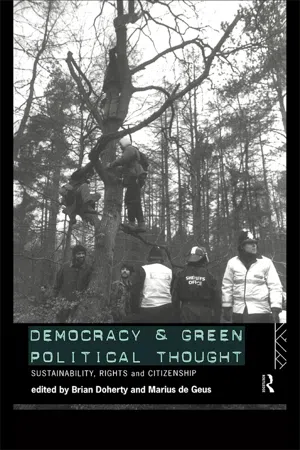
Democracy and Green Political Thought
Sustainability, Rights and Citizenship
- 256 pages
- English
- ePUB (mobile friendly)
- Available on iOS & Android
eBook - ePub
Democracy and Green Political Thought
Sustainability, Rights and Citizenship
About this book
The green movement has posed some tough questions for traditional justifications of democracy. Should the natural world have rights? Can we take account of the interests of future generations? But questions have also been asked of the greens. Could their idealism undermine democracy? Can greens be effective democrats?
In this book some of the leading writers on green political thought analyze these questions, examining the discourse of green movements concerning democracy, the status of democracy within green political thought and the political institutions that might be necessary to ensure democracy in a sustainable society.
Information
Part I
THE DISCOURSE OF GREEN MOVEMENTS
1
PARADOXES OF COMMUNITY
Michael Kenny
The concept of community is one of the most widely used, but least analysed, terms in green political discourse. Whilst community is interpreted and applied in a variety of ways by greens, it can be depicted in a more universal, or ideal-typical, manner in terms of the role it plays within ecological discourse and the types of problems which are connected with its usage. Theoretical tensions arise from the normative claims attached to community and from the tendency to confuse different kinds of arguments when community is invoked.
Community is frequently seen as a core value within the ecologically sound society which greens hope to create. As Michael Saward puts it, ‘commonly, the hope and the belief is that truly ecological societies will be small, decentralized communities with decision-making procedures based on “direct” rather than “representative” democracy’ (1993:63). In addition, community is repeatedly presented by some ecologists as a political means toward this goal (Dobson 1990: 199). For a minority in the green movement, the construction of ecologically sustainable communes constitutes the most meaningful political strategy that greens can pursue (Bahro 1986). Small-scale communities, according to this perspective, will provide a social form more conducive to the values of ecology than other forms. This argument is echoed by commentators who regard the ends-means interpenetration of ecological communitarianism as a source of intellectual strength: ‘the principal advantage of community strategies for change is that they anticipate the advertised Green future, particularly its decentralized communitarian aspects’ (Dobson 1990:149).
Unfortunately, the claim that community sits neatly within the value-set of political ecology, and is thus a necessary precondition of a society founded on ecological principles, is weaker than it first appears. Ecological communitarians rarely consider possible tensions between community and the core principles of ecology, or how these different imperatives might be ‘traded’ against each other. What, for example, would prevent the principles of ecology requiring that a particular society abandon a communitarian ethos because of the ‘higher’ demands of ecological security? One of the most popular justifications for the place of community within the value-set of ecology provides little help here: the claim that values appropriate to ecology can be derived from nature does not provide a solid epistemological foundation for naturalistic political arguments, as Saward demonstrates (1993). Despite these problems, many greens—not just deep or dark ones—refer to a naturalistic ideal of community and suggest that it would be ecologically and socially advantageous if we lived in tightly knit, solidaristic communities akin to those which characterised pre-industrial society. This impression is reinforced by the prevalence of organic metaphors in the varieties of green political thought. The communal life of the sustainable future is presumed to be one where the individual’s fate will depend on a close symbiotic relationship with a clearly defined social (or ecological) telos.
When greens cite community as one of the normative preconditions for sustainability, however, it is not clear that they can justify this claim. In fact, community can be only contingently related to ecology. This point is especially pertinent in the context of debates about how sustainability might be connected to democracy. Contrary to the views of many political ecologists, community is not necessarily linked to either; nor can it guarantee a relationship between them.
Confusion is also generated by the interweaving of normative and empirical arguments typical of ecological communitarianism. Greens, like other radicals, use community to advance a number of critical observations about the weaknesses of contemporary society—especially the trend towards the alienation of the individual in modern industrial society—without separating out the different senses of this concept. Three interpretations are routinely confused: a nostalgic historical reading of community as a principle which underpinned social relations in the past; a sociological assertion that the bonds of community are under threat from the market; and a normative view that the ethics of community ought to determine the political and economic shape of contemporary society. For greens, community carries extra implications. It encourages the imaginative blurring of the boundaries between human and other members of the larger biotic community and expresses the distinctive commitment many greens feel for a ‘politics of place’—a sense that the natural environment in which people live has been underrepresented in conventional political ideologies and traditions.
Community is therefore firmly established in the green political lexicon, though its different senses are routinely confused and conflated. Its rather vague metaphorical status encourages greens to evade difficult questions about its normative implications, some of which are traced below. As we shall see, its current usage not only confuses different kinds of arguments but also carries some highly undemocratic implications. The difficulties connected with ecological communitarianism need careful consideration. In the process of rethinking the relationship between communitarianism and ecology, greens would benefit from attention to the insights offered by some leading (non-ecological) communitarian thinkers, as well as from insights drawn from the ongoing debates about the concepts of difference and alterity.
Before we assess these non-ecological ideas, however, we need to understand the connections between conventional green usages of community and some of the weaknesses which commentators have observed in green political arguments more generally.
PROBLEMS OF COMMUNITY IN GREEN DISCOURSE
Community may well constitute the ‘locus’ of some of the paradoxes which characterise green politics. This argument runs counter to the arguments of those critics who view the ends-means interpenetration of ecological communitarianism as a strength: community, it seems to me, is more likely to exacerbate than resolve the weaknesses of green political thought. The most important problems to have surfaced in the literature on this subject include: first, the tension between the libertarian and authoritarian sides of ecologism (Lewis 1992); second, the conflict between homogeneity and diversity within the green political imagination (Dobson 1990:121–2); third, the fundamentalist hostility towards the world of conventional politics which ecologism often encourages (Jones 1993); and fourth, the ambivalence towards democracy which characterises ecologism (Saward 1993). Taking these criticisms in turn, each can be connected to the implications of green usages of community.
First, community for many greens combines a libertarian emphasis upon decentralisation, self-government and the absence of external restraint— particularly the state—with a belief that these communities will uphold an ecological version of the ‘good life’. When combined with a strong sense of the ecological good, green communitarianism engenders some controversial policy preferences. These are implicitly justified by a conception of the ‘ecological general will’ within particular communities. This leads greens to neglect the dangers of superimposing the values of ecology on to a gemeinschaft model of community and to reproduce some of the most troubling aspects of ‘general will’ theory—the lack of emphasis on minorities and inattention to individual rights (Crick 1962).
Andrew Dobson’s discussion of the support for strong immigration policies which some greens have enunciated is a striking example of the indifference to minority rights which ecological communitarianism encourages (1990:82; 96–7). Support for immigration controls is one policy outcome of the commitment to population reduction—and the latter is stressed by some commentators as a litmus test for ‘true’ greens (Eckersley 1992:157–60). Whilst many greens would not support such measures (most famously, the German greens) this defence of minority rights could be submerged beneath the gemeinschaft logic of ecological communitarianism. This trades on tight-knit and organic images of communal life which seem at odds with the ethnic and religious diversity of multi-cultural and multi-community modern societies. As Dobson shows, the green commitment to people living ‘in place’, in stable, well-defined and self-reliant communities, generates suspicion about external influences, alien presences and the cosmopolitan and destabilising aspects of gesellschaft. This explains the hostility enunciated by eco-utopians such as Rudolf Bahro to the idea of excessive trade and external travel in the sustainable communities of the future. Similarly, some commentators suspect that ‘deviants’ or criminals in the sustainable society would receive unduly severe punishment (Lewis 1992).
Of course, greens believe that these problems are more likely to characterise modern industrial society where fleeting and unsatisfying ‘wants’—epitomised and artificially stimulated by the growth of an advertising nexus —engender a culture of greed and individual acquisition. This assumption, however, ignores the coercive possibilities arising from the connection between ecological goals and communitarian politics. Members of minority or ‘deviant’ groups have little reason to be reassured by these ideas. Like other ‘strong’ communitarians, greens prefer the cohesion and solidarity of community to liberal conceptions of individual rights. But the community which lacks a language of rights and denies access to a higher legal authority, beyond the community, runs the risk of becoming, in Gorz’s words, ‘a prison’ (Frankel 1987:59). Whilst some greens are aware of these tensions and foresee some reconciliation between community and individual rights (Harvey 1993:21–2), it is interesting to note the authoritarian connotations which opponents often attach to environmentalist ideas (Dobson 1993:234–5). This seems perplexing to greens, yet is, to some degree, the consequence of the ideological and symbolic resonances of small-scale communitarian politics.
Second, the sustainable world conjured up by ecologism can appear one-dimensional, dull and monolithic. Greens seem to confuse their critique of choice in a modern industrial context—which, they argue, often arises from artificial and wasteful wants—with the notion of individuality itself. An important debate has emerged out of the crisis facing the left in western Europe since the 1980s, concerned with the wide range of social, political and cultural variables which shape individual identity in modern society (Giddens 1991). Yet, in contrast, ecological communitarianism suggests that the processes of ‘overdetermination’ can be transcended by a new, dominant identity—the ecological. In practice greens accept that these other identities will not wither away in the sustainable future and will play a key role in constituting the vitality and plurality of community life. Ultimately, though, they remain subordinate to the ‘general ecological will’ of the community. This puts greens at odds with a range of other critical and radical theoretical currents, including feminism and the arguments of radical democrats. Consequently, it is hard to envisage ecologists connecting their strong political goals with the prevailing desire for social and cultural diversity and pluralism—a problem which socialism has also encountered (Rustin 1985).
Third, a number of commentators have remarked upon the absence of a sustained body of political theory within the green repertoire. Some of the most influential ecological philosophers have argued that greens must reject the structure, assumptions and framework of the conventional world of politics as inimical to any genuine emancipatory future (O’Riordan 1981). Only a fundamental reordering of this realm, it is argued, will bring about a more sustainable and socially solidaristic future. This fundamentalist response to the political world has left many greens out of touch with the arguments and practices of other radical movements which are committed to the wholesale democratisation and ‘politicisation’ of civil life (Frankel 1987:230).
Thus, although greens benefit from the notion of the expansion of politics into everyday life which movements such as feminism have generated, in practice ecological communitarianism gives little emphasis to the idea of broadening and deepening political life. Unlike other radical currents, greens rarely prioritise the democratisation of civil life, preferring instead to imagine a world where competing interests and power relationships have disappeared (Frankel 1987:230). Emphasis on community serves to conjure up a utopian future where present-day struggles and conflicts have no place, and downplays strategic assessment of the balance of forces arrayed against ecological emancipation. As a description of the complexity of current political economy and a strategic guide for political intervention, this metaphor remains singularly unhelpful. Its repeated usage in some green circles encourages the belief that power relationships can be transcended once humans and nature are operating harmoniously; the idea that networks of power operate throughout society, at all levels of community life, remains alien to many greens, though not because they possess a coherent alternative theory. Indeed, the absence of a distinctively ecological theory of power may constitute one of the central weaknesses of political ecology.
Significantly, despite their attention to the local and small scale, greens have also failed to explore the realm of micro-politics. Here individuals interact with each other and confront the boundaries of community life, processes which may result in the continual redefinition of individual interests and needs. The communitarianism of most greens is unable to incorporate this dimension of social life because it seeks to aggregate individual needs, suggesting that the community shapes its members’ identities and defines the value-set engendered by the common good of ecology. Beneath this level, however, ecological thinkers have said little about the political dimensions of the micro-relations of communal life, presenting this realm as one in which individual co-operation and ecological harmony obviate political questions (Naess 1989). This kind of communitarianism omits critical consideration of the process by which individual aspirations and interests are to be aggregated.
Fourth, as different commentators have observed, the relationship between democracy and ecology is more problematic than the rhetoric of political ecology generally allows. Community is understood in some green thinking to constitute a vital intermediate link between these two goods, securing the connection between them (Bookchin 1982:335–6). The argument here is that community is the form of human organisation most amenable to the delivery of sustainable policies and that, in theoretical terms, it is the form of human organisation most attuned to the imperatives of ecology. Consequently, greens have frequently tried to displace the difficult questions about the connections between democracy and ecology on to the apparently more promising terrain of communitarian arguments, supposing that these provide natural conduits to democratic practices. In fact, if community can be only contingently connected to ecological values, as I have argued above, then it cannot play the role of securing the necessary relationship between democracy and ecology. This is especially pertinent because ecological communitarianism carries some apparently undemocratic implications in terms of minority rights, pluralism and social differences.
Should greens, therefore, abandon community altogether in their political arguments? The answer to this question depends on whether community can be reworked to generate a different set of political meanings and images, which may be more amenable to the requirements of democratic principles.
NON-ECOLOGICAL COMMUNITARIANS
The problems associated with ecological communitarianism echo some of the central themes of the so-called liberal-communitarian debate. In fact, this is more accurately construed as an argument between liberal individualists and liberal communitarians, since much of it takes place within a shared epistemological framework and cannot be reduced to a simple binary division between two opposed sets of ideas (Schwarzenbach 1991). The work of some of the leading communitarian theorists—Alasdair MacIntyre, Michael Sandel, Charles Taylor and Michael Walzer—is full of insight into the nature and demands of community ties and identities. In this section I sketch several overlaps with green political thought and outline the possibilities which some of their ideas provide for the reinterpretation of this principle.
Much overlap exists between communitarian arguments and green ideas. Both currents believe ‘that [classical] liberalism does not sufficiently take into account the importance of community for personal identity, moral and political thinking, and judgement about our well-being in the contemporary world’ (Bell 1993:4). Both reject three aspects of the liberal inheritance: its overly individualistic conception of the self (especially Rawls’ notion that the self is antecedently individuated); the unfounded universalism of liberal ethical beliefs—particularly the idea that ...
Table of contents
- COVER PAGE
- TITLE PAGE
- COPYRIGHT PAGE
- EUROPEAN POLITICAL SCIENCE SERIES
- CONTRIBUTORS
- SERIES EDITOR’S PREFACE
- ACKNOWLEDGEMENTS
- INTRODUCTION
- PART I: THE DISCOURSE OF GREEN MOVEMENTS
- 1: PARADOXES OF COMMUNITY
- 2: GREEN PARTIES, NONVIOLENCE AND POLITICAL OBLIGATION
- 3: WORKER CO-OPERATIVES AND GREEN POLITICAL THEORY
- PART II: GREEN POLITICS AND DEMOCRATIC THEORY
- 4: MUST DEMOCRATS BE ENVIRONMENTALISTS?
- 5: GREEN DEMOCRACY THE SEARCH FOR AN ETHICAL SOLUTION
- 6: SUSTAINABILITY, POLITICAL JUDGEMENT AND CITIZENSHIP CONNECTING GREEN POLITICS AND DEMOCRACY
- 7: DEMOCRATISING GREEN THEORY PRECONDITIONS AND PRINCIPLES
- PART III: THE INSTITUTIONS OF A GREEN DEMOCRACY
- 8: ECOLOGICAL CITIZENS AND ECOLOGICALLY GUIDED DEMOCRACY
- 9: SUSTAINABILITY, COMMUNITY AND DEMOCRACYM
- 10: THE ECOLOGICAL RESTRUCTURING OF THE STATE
- 11: GREENING LIBERAL DEMOCRACY THE RIGHTS DISCOURSE REVISITED
Trusted by 375,005 students
Access to over 1.5 million titles for a fair monthly price.
Study more efficiently using our study tools.
Frequently asked questions
Yes, you can cancel anytime from the Subscription tab in your account settings on the Perlego website. Your subscription will stay active until the end of your current billing period. Learn how to cancel your subscription
No, books cannot be downloaded as external files, such as PDFs, for use outside of Perlego. However, you can download books within the Perlego app for offline reading on mobile or tablet. Learn how to download books offline
Perlego offers two plans: Essential and Complete
- Essential is ideal for learners and professionals who enjoy exploring a wide range of subjects. Access the Essential Library with 800,000+ trusted titles and best-sellers across business, personal growth, and the humanities. Includes unlimited reading time and Standard Read Aloud voice.
- Complete: Perfect for advanced learners and researchers needing full, unrestricted access. Unlock 1.5M+ books across hundreds of subjects, including academic and specialized titles. The Complete Plan also includes advanced features like Premium Read Aloud and Research Assistant.
We are an online textbook subscription service, where you can get access to an entire online library for less than the price of a single book per month. With over 1.5 million books across 990+ topics, we’ve got you covered! Learn about our mission
Look out for the read-aloud symbol on your next book to see if you can listen to it. The read-aloud tool reads text aloud for you, highlighting the text as it is being read. You can pause it, speed it up and slow it down. Learn more about Read Aloud
Yes! You can use the Perlego app on both iOS and Android devices to read anytime, anywhere — even offline. Perfect for commutes or when you’re on the go.
Please note we cannot support devices running on iOS 13 and Android 7 or earlier. Learn more about using the app
Please note we cannot support devices running on iOS 13 and Android 7 or earlier. Learn more about using the app
Yes, you can access Democracy and Green Political Thought by Brian Doherty, Marius de Geus, Brian Doherty,Marius de Geus in PDF and/or ePUB format, as well as other popular books in Politics & International Relations & Democracy. We have over 1.5 million books available in our catalogue for you to explore.