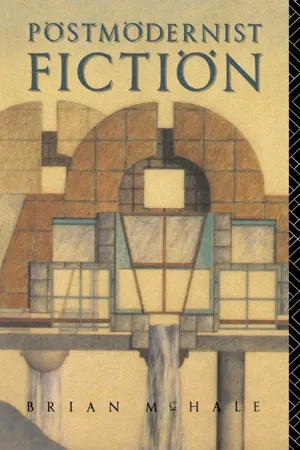
In this trenchant and lively study Brian McHale undertakes to construct a version of postmodernist fiction which encompasses forms as wide-ranging as North American metafiction, Latin American magic realism, the French New New Novel, concrete prose and science fiction. Considering a variety of theoretical approaches including those of Ingarden, Eco, Dolezel, Pavel, and Hrushovski, McHale shows that the common denominator is postmodernist fiction's ability to thrust its own ontological status into the foreground and to raise questions about the world (or worlds) in which we live. Exploiting various theoretical approaches to literary ontology - those of Ingarden, Eco, Dolezel, Pavel, Hrushovski and others - and ranging widely over contemporary world literature, McHale assembles a comprehensive repertoire of postmodernist fiction's strategies of world-making and -unmaking.
- 288 pages
- English
- ePUB (mobile friendly)
- Available on iOS & Android
eBook - ePub
Postmodernist Fiction
About this book
Information
PART ONE: PRELIMINARIES
The Cognitive Questions (asked by most artists of the 20th century, Platonic or Aristotelian, till around 1958):
“How can I interpret this world of which I am a part? And what am I in it?”
The Postcognitive Questions (asked by most artists since then):
“Which world is this? What is to be done in it? Which of my selves is to do it?”
(Dick Higgins, A Dialectic of Centuries, 1978)
1: FROM MODERNIST TO POSTMODERNIST FICTION: CHANGE OF DOMINANT*
I don’t think the ideas were “in the air”…rather, all of us found ourselves at the same stoplights in different cities at the same time. When the lights changed, we all crossed the streets.
(Steve Katz, in LeClair and McCaffery [eds], Anything Can Happen, 1983)
“Postmodernist”? Nothing about this term is unproblematic, nothing about it is entirely satisfactory. It is not even clear who deserves the credit—or the blame—for coining it in the first place: Arnold Toynbee? Charles Olson? Randall Jarrell? There are plenty of candidates.1 But whoever is responsible, he or she has a lot to answer for.
“Postmodernist”? Nobody likes the term. “Post,” grouses Richard Kostelanetz,
is a petty prefix, both today and historically, for major movements are defined in their own terms, rather than by their relation to something else…. No genuine avant-garde artist would want to be “post” anything.2
John Barth finds the term
awkward and faintly epigonic, suggestive less of a vigorous or even interesting new direction in the old art of storytelling than of something anti-climactic, feebly following a very hard act to follow.3
And even more pungently, the term “postmodernist,” for Charles Newman, “inevitably calls to mind a band of vainglorious contemporary artists following the circus elephants of Modernism with snow shovels.”4 Nobody likes the term, yet people continue to prefer it over the even less satisfactory alternatives that have occasionally been proposed (such as Federman’s “Surfiction,” or Klinkowitz’s “Post-Contemporary fiction”). And it becomes more and more difficult to avoid using it.
“Postmodernist”? The term does not even make sense. For if “modern” means “pertaining to the present,” then “post-modern” can only mean “pertaining to the future,” and in that case what could postmodernist fiction be except fiction that has not yet been written? Either the term is a solecism, or this “post” does not mean what the dictionary tells us it ought to mean, but only functions as a kind of intensifier. “In a world which values progress,” says John Gardner, “‘post-modern’ in fact means New! Improved!”5; and Christine Brooke-Rose says that “it merely means moderner modern (most-modernism?) .”6
“Postmodernist”? Whatever we may think of the term, however much or little we may be satisfied with it, one thing is certain: the referent of “postmodernism,” the thing to which the term claims to refer, does not exist. It does not exist, however, not in Frank Kermode’s sense, when he argues that so-called postmodernism is only the persistence of modernism into a third and fourth generation, thus deserving to be called, at best, “neomodernism.”7 Rather, postmodernism, the thing, does not exist precisely in the way that “the Renaissance” or “romanticism” do not exist. There is no postmodernism “out there” in the world any more than there ever was a Renaissance or a romanticism “out there.” These are all literary-historical fictions, discursive artifacts constructed either by contemporary readers and writers or retrospectively by literary historians. And since they are discursive constructs rather than real-world objects, it is possible to construct them in a variety of ways, making it necessary for us to discriminate among, say, the various constructions of romanticism, as A.O.Lovejoy once did.8 Similarly we can discriminate among constructions of postmodernism, none of them any less “true” or less fictional than the others, since all of them are finally fictions. Thus, there is John Barth’s postmodernism, the literature of replenishment; Charles Newman’s postmodernism, the literature of an inflationary economy; Jean-François Lyotard’s postmodernism, a general condition of knowledge in the contemporary informational regime; Ihab Hassan’s postmodernism, a stage on the road to the spiritual unification of humankind; and so on.9 There is even Kermode’s construction of postmodernism, which in effect constructs it right out of existence.
Just because there are many possible constructions of postmodernism, however, this does not mean that all constructs are equally interesting or valuable, or that we are unable to choose among them. Various criteria for preferring one construction of postmodernism over the others might be proposed—the criterion of self - consistency and internal coherence, for instance. Or the criterion of scope: postmodernism should not be defined so liberally that it covers all modes of contemporary writing, for then it would be of no use in drawing distinctions, but neither should it be defined too narrowly. (If there is no true postmodernist poet except Paul Celan, as someone once proposed to me, then why not simply talk about the poetics of Paul Celan and eliminate this distracting term “postmodernism” altogether?) Another criterion might be productiveness: a superior construction of post modernism would be one that produces new insights, new or richer connections, coherence of a different degree or kind, ultimately more discourse, in the form of follow-up research, new interpretations, criticisms and refinements of the construct itself, counter-proposals, refutations, polemics. Above all, a superior construction of postmodernism would be one that satisfied the criterion of interest. If as literary historians we construct the objects of our description (“the Renaissance,” “romanticism,” “postmodernism”) in the very act of describing them, we should strive at the very least to construct interesting objects. Naturally I believe that the fiction of postmodernism which I have constructed in this book is a superior construction. I have tried to make it internally consistent; I believe its scope is appropriate, neither indiscriminately broad nor unhelpfully narrow; and I hope it will prove to be both productive and interesting.
“Postmodernist”? Since we seem to be saddled with the term, whether we like it or not, and since postmodernism is a discursive construct anyway, why not see if we can make the term itself work for us, rather than against us, in constructing its referent? Ihab Hassan helps us move in this direction when he prints the term so as to emphasize its prefix and suffix:
POSTmodernISM10
This ISM (to begin at the end) does double duty. It announces that the referent here is not merely a chronological division but an organized system—a poetics, in fact—while at the same time properly identifying what exactly it is that postmodernism is post. Postmodernism is not post modern, whatever that might mean, but post modernism; it does not come after the present (a solecism), but after the modernist movement. Thus the term “postmodernism,” if we take it literally enough, à la lettre, signifies a poetics which is the successor of, or possibly a reaction against, the poetics of early twentieth-century modernism, and not some hypothetical writing of the future.11
As for the prefix POST, here I want to emphasize the element of logical and historical consequence rather than sheer temporal posteriority. Postmodernism follows from modernism, in some sense, more than it follows after modernism. If the statements from Richard Kostelanetz, John Barth, and Charles Newman are any indication, it is this POST that has most bothered people about the term “postmodernism.” It need not have. After all, the presence of the prefix post in literary nomenclature—or of pre, for that matter— merely signals the inevitable historicity of all literary phenomena. Every literary-historical moment is post some other moment, just as it is pre some other moment, though of course we are not in the position to say exactly what it is pre—what it precedes and prepares the way for—except retrospectively, while we are always able to say, in principle, what it is post— what it is the posterity of. Postmodernism is the posterity of modernism— this is tautological, just as saying that pre-romanticism is the predecessor of romanticism would be tautological. But there is more than mere tautology to the relation between modernism and postmodernism if we can construct an argument about how the posterior phenomenon emerges from its predecessor—about, in other words, historical consequentiality.
To capture this consequentiality, the POST of POSTmodernISM—which is this book’s primary objective—we need a tool for describing how one set of literary forms emerges from a historically prior set of forms. That tool can be found in the Russian formalist concept of the dominant, to which I now turn.
The dominant
Jurij Tynjanov probably deserves the credit for this concept, but it is best known to us through a lecture of Roman Jakobson’s, dating from 1935.I quote from the 1971 English translation:
The dominant may be defined as the focusing component of a work of art: it rules, determines, and transforms the remaining components. It is the dominant which guarantees the integrity of the structure…a poetic work [is] a structured system, a regularly ordered hierarchical set of artistic devices. Poetic evolution is a shift in this hierarchy… The image of... literary history substantially changes; it becomes incomparably richer and at the same time more monolithic, more synthetic and ordered, than were the membra disjecta of previous literary scholarship.12
“Hierarchical”? “Monolithic”? To pre-empt the deconstruction that such deterministic and imperialistic language, with its overtones of power and coercion, seems to call for, let me try to salvage Jakobson’s dominant for my own uses by deconstructing it a bit myself. Or rather, let me observe that Jakobson has in effect already deconstructed it somewhat himself.
Despite his claim about the monolithic character of a literary history organized in terms of a series of dominants, Jakobson’s concept of the dominant is in fact plural. In this brief but typically multifaceted lecture, Jakobson applies his concept of the dominant not only to the structure of the individual literary text and the synchronic and diachronic organization of the literary system, but also to the analysis of the verse medium in general (where rhyme, meter, and intonation are dominant at different historical periods), of verbal art in general (where the aesthetic function is a transhistorical dominant), and of cultural history (painting is the dominant art-form of the Renaissance, music the dominant of the romantic period, and so on). Clearly, then, there are many dominants, and different dominants may be distinguished depending upon the level, scope, and focus of the analysis. Furthermore, one and the same text will, we can infer, yield different dominants depending upon what aspect of it we are analyzing: as an example of verse, it is dominated by one or other of the historical dominants of verse; as an example of verbal art, its aesthetic function is dominant; as a document of a particular moment in cultural history, it is dominated by its period’s dominant; as a unique text-structure, it possesses its own unique dominant; and so on. In short, different dominants emerge depending upon which questions we ask of the text, and the position from which we interrogate it.
Having defused somewhat the overly deterministic implications of Jakobson’s language, we can now see, I think, what kinds of advantages the concept of the dominant offers. Many of the most insightful and interesting treatments of postmodernist poetics have taken the form of more or less heterogeneous catalogues of features—the membra disjecta of literary scholarship, as Jakobson calls them. While such catalogues do often help us to begin ordering the protean variety of postmodernist phenomena, they also beg important questions, such as the question of why these particular features should cluster in this particular way—in other words, the question of what system might underlie the catalogue—and the question of how in the course of literary history one system has given way to another. These questions cannot be answered without the intervention of something like a concept of the dominant.
Catalogues of postmodernist features are typically organized in terms of oppositions with features of modernist poetics. Thus, for instance, David Lodge lists five strategies (contradiction, discontinuity, randomness, excess, short circuit) by which postmodernist writing seeks to avoid having to choose either of the poles of metaphoric (modernist) or metonymic (antimodernist) writing. Ihab Hassan gives us seven modernist rubrics (urbanism, technologism, dehumanization, primitivism, eroticism, antinomianism, experimentalism), indicating how postmodernist aesthetics modifies or extends each of them. Peter Wollen, writing of cinema, and without actually using either of the terms “modernist” and “postmodernist,” proposes six oppositions (narrative transitivity vs. intransitivity, identification vs. foregrounding, single vs. multiple diegesis, closure vs. aperture, pleasure vs. unpleasure, fiction vs. reality) which capture the difference between Godard’s counter-cinema (paradigmatically postmodernist, in my view) and the poetics of “classic” Hollywood movies. And Douwe Fokkema outlines a number of compositional and semantic conventions of the period code of postmodernism (such as inclusiveness, deliberate indiscriminateness, non-selection or quasi-nonselection, logical impossibility), contrasting these generally with the conventions of the modernist code.13 In all these cases, the oppositions tend to be piecemeal and unintegrated; that is, we can see how a particular postmodernist feature stands in opposition to its modernist counterpart, but we cannot see how postmodernist poetics as a whole stands in opposition to modernist poetics as a whole, since neither of the opposed sets of features has been interrogated for its underlying systematicity. Nor can we see how the literary system has managed to travel from the state reflected in the catalogue of modernist features to the state reflected in the postmodernist catalogue: these are static oppositions, telling us little or nothing about the mechanisms of historical change.
Enter the dominant. With the help of this conceptual tool, we can both elicit the systems underlying these heterogeneous catalogues, and begin to account for historical change. For to describe change of dominant is in effect to describe the process of literary-historical change. Here is Jakobson again:
In the evolution of poetic form it is not so much a question of the disappearance of certain elements and the emergence of others as it is the question of shifts in the mutual relationship among the diverse components of the system, in other words, a question of the shifting dominant. Within a given complex of poetic norms in general, or especially within the set of poetic norms valid for a given poetic genre, elements which were originally secondary become essential and primary. On the other hand, the elements which were originally the dominant ones become subsidiary and optional.14
If we interrogate modernist and postmodernist texts with a view to eliciting the shifts in the hierarchy of devices—remembering, of course, that a different kind of inquiry would be likely to yield a different dominant—then what emerges as the dominant of modernist fiction? of postmodernist fiction?
Let us try out our tool on Douwe Fokkema’s formulation of the period code of modernism, taking as our exemplary modernist text William Faulkner’s Absalom, Absalom! (1936), a high-water mark of modernist poetics. According to Fokkema, the compositional and syntactical conventions of the modernist code include textual indefiniteness or incompleteness, epistemological doubt, metalingual skepticism, and respect for the idiosyncrasies of the reader. Its semantic aspects are organized around issues of epistemological doubt and metalingual self-reflection.15 All of these conventions, with the possible exception of the convention of respecting the reader’s idiosyncrasies (which seems to me a poor and debatable formulation), are reflected in Absalom, Absalom! The story of the rise and fall of the Sutpen dynasty comes down to Quentin Compson and his room-mate Shreve in a state of radical incompleteness and indefiniteness—“a few old mouth old mouth-to-mouth tales” as Quentin’s father says, “letters without salutation or signature”16—its indefini...
Table of contents
- Cover Page
- Half Title Page
- Title Page
- Copyright Page
- Dedication
- Contents
- Acknowledgments
- Preface
- Part One: Preliminaries
- Part Two: Worlds
- Part Three: Construction
- Part Four: Words
- Part Five: Groundings
- Part Six: How I Learned to Stop Worrying and Love Postmodernism
- Notes
- Index
Trusted by 375,005 students
Access to over 1.5 million titles for a fair monthly price.
Study more efficiently using our study tools.
Frequently asked questions
Yes, you can cancel anytime from the Subscription tab in your account settings on the Perlego website. Your subscription will stay active until the end of your current billing period. Learn how to cancel your subscription
No, books cannot be downloaded as external files, such as PDFs, for use outside of Perlego. However, you can download books within the Perlego app for offline reading on mobile or tablet. Learn how to download books offline
Perlego offers two plans: Essential and Complete
- Essential is ideal for learners and professionals who enjoy exploring a wide range of subjects. Access the Essential Library with 800,000+ trusted titles and best-sellers across business, personal growth, and the humanities. Includes unlimited reading time and Standard Read Aloud voice.
- Complete: Perfect for advanced learners and researchers needing full, unrestricted access. Unlock 1.5M+ books across hundreds of subjects, including academic and specialized titles. The Complete Plan also includes advanced features like Premium Read Aloud and Research Assistant.
We are an online textbook subscription service, where you can get access to an entire online library for less than the price of a single book per month. With over 1.5 million books across 990+ topics, we’ve got you covered! Learn about our mission
Look out for the read-aloud symbol on your next book to see if you can listen to it. The read-aloud tool reads text aloud for you, highlighting the text as it is being read. You can pause it, speed it up and slow it down. Learn more about Read Aloud
Yes! You can use the Perlego app on both iOS and Android devices to read anytime, anywhere — even offline. Perfect for commutes or when you’re on the go.
Please note we cannot support devices running on iOS 13 and Android 7 or earlier. Learn more about using the app
Please note we cannot support devices running on iOS 13 and Android 7 or earlier. Learn more about using the app
Yes, you can access Postmodernist Fiction by Brian McHale in PDF and/or ePUB format, as well as other popular books in Literature & Literary Criticism. We have over 1.5 million books available in our catalogue for you to explore.