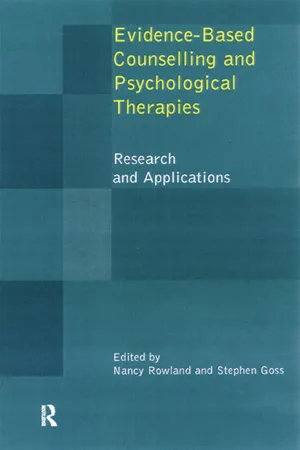
Evidence-Based Counselling and Psychological Therapies assesses the impact of the international drive towards evidence-based health care on NHS policy and the provision of the psychological services in the NHS.
An outstanding range of contributors provide an overview of evidence-based health care and the research methods that underpin it, demonstrating its effect on policy, provision, practitioners and patients. Their thought-provoking chapters look at a variety of relevant issues including:
* generating and implementing evidence
* cost-effectiveness issues
* practical guidelines
* practitioner research
Evidence-Based Counselling and Psychological Therapies is essential for mental health professionals and trainees concerned with this movement which is having, and will continue to have a huge impact on the purchasing, provision and practice of health care.
eBook - ePub
Evidence Based Counselling and Psychological Therapies
Research and Applications
- 234 pages
- English
- ePUB (mobile friendly)
- Available on iOS & Android
eBook - ePub
Evidence Based Counselling and Psychological Therapies
Research and Applications
About this book
Information
Part 1
What is evidence-based health care?
Chapter 1
Evidence-based psychological therapies
INTRODUCTION
Those who work in the NHS need no reminding that health care reform is an international epidemic which shows no sign of abating (Klein, 1995). Keeping up with and managing the changes that come about as a result of health care reform is an all too familiar part of the job. Health care reforms spawn policies which invariably affect the pattern and provision of services, the professional practice of those who work in the NHS, and patient care. Much policy change is understood through the experience of implementing it. However, it is important to understand the origins of a particular health care reform, its aims, methodologies, the organisation and structures which support it, and the policies that it engenders.
This book is written for those with an interest in counselling and psychological therapies in the NHS – the clinical psychologists, counsellors, nurses and other professionals who provide mental health care, and the managers and service co-ordinators who plan services and implement policies. We aim to assess the impact of the evidence-based health care movement on NHS policy and the provision of psychological therapies in the NHS, as well as discussing the implications for professional practice. It is essential for psychological therapists to be well informed about the evidence-based health care movement, to understand its rationale and the methodologies which underpin it, so as to gain a clearer understanding of how evidence-based health care (EBHC) affects policy, provision, professional practice and, above all, patients.
DEFINITIONS
It is impossible to write a book about psychological therapies without first explaining what we mean by them. For years, authors and practitioners have been taxed with the question of where counselling ends and psychotherapy begins, whether there are more similarities or differences between them and where psychology and behavioural therapies fit in. In this book, which includes contributions from a range of practitioners and researchers reflecting diverse therapeutic and theoretical orientations, we have used the phrase ‘psychological therapies’ as an umbrella term to refer to the broad range of psychological treatments, including psychotherapy, counselling, cognitive behavioural treatments and problem-solving approaches. Although the practitioners offering these interventions may differ, and the interventions themselves may diverge, psychological treatments offered by psychological therapists all attempt to bring about improvements in mental health – for the purposes of this book, the terms and treatments are interchangeable.
Another bone of contention in the mental health field is whether those who receive treatment are called patients or clients. Once again, in this book, the terms are used interchangeably.
In defining evidence-based health care, it is perhaps fair to start with evidence-based medicine, as the drive towards evidence-based health care started within the medical profession. Sackett et al. (1996) define evidence-based medicine (EBM) as the conscientious, explicit and judicious use of current best evidence in making decisions about the care of individual patients. The practice of evidence-based medicine means integrating individual clinical expertise with the best available external clinical evidence from systematic research (Sackett et al., 1996). Thus, evidence-based health care (EBHC) is defined as the conscientious, explicit and judicious use of current best evidence in making decisions about any aspects of health care (Li Wan Po, 1998). Like psychological therapies, evidence-based health care is another umbrella term which includes evidence-based medicine, evidence-based nursing and evidence-based mental health, as well as evidence-based practice, evidence-based patient choice and so on. The list of terms is almost endless. Although there may be controversy about the various definitions, particularly in relation to the type of evidence which is admissible, which type of evidence is best and how inclusive the evidence ought to be (Li Wan Po, 1998), the definition of evidence-based health care, above, takes a neutral stance in these respects. We leave our contributors to debate the methodological issues in later chapters of the book.
OVERVIEW
This book is written in three parts. The first gives a broad overview of the evidence-based health care movement, including its origins, its aims and the policies and structures that embed it in the NHS. The second part focuses on the methods used to generate the evidence, and debates the strengths and weaknesses of research methods which contribute to our knowledge about psychological therapies. The third part deals with synthesising the evidence, through systematic reviews and the development of guidelines. Implementation – or the relationship of policy to practice – is one of the major themes of the book, and, we hope, is evident throughout.
WHAT IS EVIDENCE-BASED HEALTH CARE?
In Chapter 2, Mark Baker and Jos Kleijnen describe the revolution beginning in the fields of health research leading to the movement for evidence-based health care. They describe the NHS R&D strategy and the agencies which support it. The purpose of the R&D strategy is to build a knowledge base to inform all decisions made by NHS managers, clinicians and practitioners. The policy involves an information strategy to assemble and interpret the results of completed research and to draw conclusions, a research-commissioning strategy to pose and address important unanswered questions and an implementation strategy to transfer reliable research findings into everyday practice. Baker and Kleijnen describe how research is commissioned, produced and disseminated and how it is assessed and accessed. They also depict the infrastructures, such as the Cochrane Collaboration, the NHS Centre for Reviews and Dissemination, and the National Institute for Clinical Excellence, which support evidence-based health care. Their focus on the difficulties of getting evidence into practice is taken up by other authors throughout the book, and highlights the need to develop implementation strategies. We will look at this initiative from the practitioner perspective in the concluding chapter.
Baker and Kleijnen’s chapter is both practical, in that it gives a range of information about the world-wide industry of EBHC, and political, in that it criticises aspects of current UK mental health policy. Suggestions are made on how to improve the management of mental health services and research into mental health problems. As the authors point out in their conclusion, government policy provides a framework to drive evidence-based health practice on a national basis, by linking the outputs of reliable research to recommendations for effective practice, by setting up a monitoring agency (Commission for Health Improvement) and a focus on health.
Brian Ferguson and Ian Russell begin Chapter 3 by developing a philosophy of evidence-based health care and by defining its goals and the principles that underpin it. Drawing on work from the NHS Directorate of the Welsh Office, they focus on the goals of health gain, people centredness and resource effectiveness. Thus they highlight the need for evidence about individual and population health, the values and preferences of patients, carers and staff, and the optimal use of a range of resources. Ferguson and Russell offer a new definition of evidence-based health care: ‘the collaborative process of generating, synthesising and implementing rigorous and relevant evidence about the effectiveness, fairness and efficiency of all forms of health care’. Alan Maynard takes up the theme of fairness and efficiency in his chapter on economics-based health care.
Ferguson and Russell introduce the case for deriving evidence about psychological therapies through randomised trials, presaging the current methodological debate about the strengths and weakness of experimental and observational methods in the evaluation of psychological interventions. This debate reflects pressing concerns among researchers and practitioners in the field. In the second part of the book a range of contributors expand and expound upon the issues raised here by Ferguson and Russell.
The authors next outline the threats to evidence-based health care. Once again, they introduce the preoccupations of other contributors, all of whom voice concern about the difficulties of implementing evidence. Indeed, in acknowledging the efforts that have been made to improve the knowledge base, there is a growing body of opinion that suggests a halt should be put to gathering evidence, and that efforts should now be put solely into implementing what is already known. While Ferguson and Russell do not advocate such a radical step, they do describe some of the problems of implementation, including the need for a shift in culture in the NHS, its staff and its patients, and highlighting the lack of adequate information technology systems to produce valid and reliable audit data on clinical performance. The authors warn against the mechanistic tendencies of EBHC through guidelines development compared with the inherent uncertainties of clinical practice. In their concluding section, Ferguson and Russell review the national policy initiatives that encourage evidence-based health care, such as setting objectives for health improvement and the development of National Service Frameworks. They focus in detail on clinical governance, with its emphasis on quality and accountability across primary and secondary care, suggesting that the NHS has now incorporated evidence-based health care into the statutory process of clinical governance. The role of the Health Authority is important here. Health Authorities (HA) in England and Wales are responsible for co-ordinating clinical governance across all local NHS organisations, including the newly formed (April 1999) Primary Care Groups. In summary, local clinical governance arrangements oblige HAs to ensure that commissioning and provision of health care is based on the available evidence.
Chapter 4 focuses on economic issues. Alan Maynard proposes that practitioners reframe their approach to health care, which focuses on treating patients if there is a benefit to them, and to think about a different perspective: population health. This involves an emphasis on the health of the community, rather than on the health of the individual being treated. Maynard argues that economics-based health care (EcBHC) is the most appropriate form of EBHC, in that it forms a transparent and rational basis from which to determine resource allocation criteria and evidence of cost-effectiveness. Interventions that are cost-effective will be clinically effective – although the reverse is not always true – and purchasing clinically cost-effective health care maximises population health gain. Such a commissioning strategy would have the added advantage of reducing variability in service patterns, whether for psychological or other services.
Maynard suggests that as the social objective of the health care system is the maximisation of health gains from a finite budget, rationing should be carried out explicitly on the basis of cost-effectiveness, not mere clinical effectiveness. He advocates the use of guidelines based on evidence of cost-effectiveness to determine clinical practice and further suggests that this demands a shift away from the individual practitioner–patient relationship and the individual interests of the patients, to a focus on the social interest of economics-based health care. Maynard introduces the methods of economic evaluation and discusses the challenge to practitioners and managers of EcBHC guidelines. His chapter may raise some uncomfortable questions for practitioners.
In the final chapter of this section, Glenys Parry summarises many of the arguments made in previous chapters, giving an overview of evidence-based psychotherapy, and anticipates some of the methodological issues discussed in more detail in the second part of the book. Parry argues that using research to inform the practice of psychological therapies is important, necessary – and problematic. Parry describes models of evidence-based psychotherapy, emphasising collaboration between researchers, clinicians and those commissioning services. Marshalling the arguments which illustrate the need for evidence-based psychotherapy, Parry goes on to review the nature of the evidence base for psychological therapies and to assess the applicability of different kinds of research evidence to practice. This critical examination leads to a summary of the case against evidence-based psychotherapy. Translating evidence that is valid into clinically valid recommendations for practice is problematic. The chapter concludes with an exploration of how the best aspects of evidence-based practice in the psychotherapies can be achieved, whilst avoiding the worst of the problems.
Parry advocates the development of service relevant research, including a range of research methods (both quantitative and qualitative) and the utilisation of practice research networks (PRNs) to take this forward. PRNs are a relatively new concept – typically, they consist of several NHS depa...
Table of contents
- Cover Page
- Halftitle Page
- Title Page
- Copyright Page
- Dedication
- Table of Contents
- List of Boxes
- List of Tables
- List of contributors
- Preface
- PART 1 What is evidence-based health care?
- PART 2 Generating the evidence
- PART 3 Synthesising the evidence
- Index
Trusted by 375,005 students
Access to over 1.5 million titles for a fair monthly price.
Study more efficiently using our study tools.
Frequently asked questions
Yes, you can cancel anytime from the Subscription tab in your account settings on the Perlego website. Your subscription will stay active until the end of your current billing period. Learn how to cancel your subscription
No, books cannot be downloaded as external files, such as PDFs, for use outside of Perlego. However, you can download books within the Perlego app for offline reading on mobile or tablet. Learn how to download books offline
Perlego offers two plans: Essential and Complete
- Essential is ideal for learners and professionals who enjoy exploring a wide range of subjects. Access the Essential Library with 800,000+ trusted titles and best-sellers across business, personal growth, and the humanities. Includes unlimited reading time and Standard Read Aloud voice.
- Complete: Perfect for advanced learners and researchers needing full, unrestricted access. Unlock 1.5M+ books across hundreds of subjects, including academic and specialized titles. The Complete Plan also includes advanced features like Premium Read Aloud and Research Assistant.
We are an online textbook subscription service, where you can get access to an entire online library for less than the price of a single book per month. With over 1.5 million books across 990+ topics, we’ve got you covered! Learn about our mission
Look out for the read-aloud symbol on your next book to see if you can listen to it. The read-aloud tool reads text aloud for you, highlighting the text as it is being read. You can pause it, speed it up and slow it down. Learn more about Read Aloud
Yes! You can use the Perlego app on both iOS and Android devices to read anytime, anywhere — even offline. Perfect for commutes or when you’re on the go.
Please note we cannot support devices running on iOS 13 and Android 7 or earlier. Learn more about using the app
Please note we cannot support devices running on iOS 13 and Android 7 or earlier. Learn more about using the app
Yes, you can access Evidence Based Counselling and Psychological Therapies by Nancy Rowland, Stephen Goss, Nancy Rowland,Stephen Goss in PDF and/or ePUB format, as well as other popular books in Psychology & Mental Health in Psychology. We have over 1.5 million books available in our catalogue for you to explore.