Is the world of appearances the real world?
Are there facts that exist independently of our minds?
Are there vague objects?
Russell on Metaphysics brings together for the first time a comprehensive selection of Russell's writing on metaphysics in one volume. Russell's major and lasting contribution to metaphysics has been hugely influential and his insights have led to the establishment of analytic philosophy as a dominant stream in philosophy. Stephen Mumford chronicles the metaphysical nature of these insights through accessible introductions to the texts, setting them in context and understanding their continued importance. Russell on Metaphysics is both a valuable introduction to Bertrand Russell as a metaphysician, and an introduction to analytic philosophy and its history.
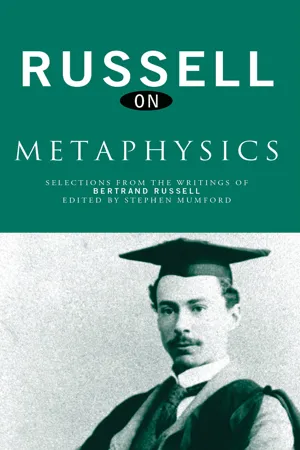
eBook - ePub
Russell on Metaphysics
Selections from the Writings of Bertrand Russell
- 264 pages
- English
- ePUB (mobile friendly)
- Available on iOS & Android
eBook - ePub
Russell on Metaphysics
Selections from the Writings of Bertrand Russell
About this book
Information
Part I
Idealism
We may use metaphysics, like poetry and music, as a means of producing a mood, of giving us a certain view of the universe, a certain attitude towards life.
“Seems Madam? Nay, It Is”
1
Greek Exercises
Extracts 1888
After Russell’s parents died, against their wishes he was given a religious Victorian upbringing mainly by his formidable grandmother, Lady Russell. He was educated well but, on certain matters, freedom of speech was limited. This was why he decided, aged fifteen, to write down his thoughts in a coded diary. It was in transliterated Greek characters with “Greek Exercises” written as the title. In it, Russell could question convention and religious orthodoxy without fear of intrusion or concern from his people. He mentions a former tutor in §1, Mr Ewen, who was an acquaintance of Marx’s daughter Eleanor (see Papers 1: xvi). With Ewen’s departure, Russell could only consider these questions in soliloquy so that appears to be the event that immediately prompted Russell’s earliest surviving philosophy. Russell refers, in the selection, to a work by Argyll (1866). This is ignored by contemporary metaphysicians.
Free will and determinism was a chief concern of the author of “Greek Exercises” and this led him to consider issues of causation and laws of nature. God’s existence was accepted at this stage but only because there was a “scientific” argument for it. If matter and force were created, they could only have been so by divine power. Even if they were not created, they are regulated by laws of nature, which entails a divine controller. It followed from this argument that the God of reason could not be expected to love us or answer our prayers. Further, there would be no immortality and no miracles, for both these and free will would entail constraints on God’s omnipotence.
Some of the argument is less than rigorous and would not be considered serious metaphysics by any professional contemporary philosopher. But it is still advanced for an adolescent and sets the scene for a number of Russell’s papers that follow. Papers 2, 3 and 14 make an interesting comparison with the juvenile reasoning here.
He manages by the later sections, after reading Argyll, to produce the following “solution” to his concerns about free will. God’s omnipotence is said (§20) to be the same thing as the reign of (natural) law and the determination of actions by motives is the form the reign of law takes in man. He is thus doubtful that there is any room for free will. We are biological machines and there is no sharp dividing line between man, protozoa and trees. Why should we have free will if trees do not?
We can see these early efforts as evidence of a fertile mind undergoing development and self-reflection yet concerned with the basic metaphysical nature of the universe and the place of human beings in it.
1
Eighteen eighty-eight. March 3. I shall write about some subjects especially religious ones which now interest me. I have in consequence of a variety of circumstances come to look into the very foundations of the religion in which I have been brought up. On some points my conclusions have been to confirm my former creed, while on others I have been irresistibly led to such conclusions as would not only shock my people, but have given me much pain. I have arrived at certainty in few things but my opinions, even where not convictions are on some things nearly such. I have not the courage to tell my people that I scarcely believe in immortality. I used to speak freely to Mr. Ewen on such matters, but now I cannot let out my thoughts to any one, and this is the only means I have of letting off steam. I intend to discuss some of my puzzles here.
[…]
3
19th. I mean today to put down my grounds for belief in God. I may say to begin with that I do believe in God and that I should call myself a theist if I had to give my creed a name. Now in finding reasons for belief in God I shall only take account of scientific arguments. This is a vow I have made, which costs me much to keep and to reject all sentiment. To find then scientific grounds for a belief in God we must go back to the beginning of all things. We know that if the present laws of nature have always been in force, the exact quantity of matter and energy now in the universe must always have been in existence; but the nebular hypothesis points to no distant date for the time when the whole universe was filled with undifferentiated nebulous matter. Hence it is quite possible that the matter and force now in existence may have had a creation, which clearly could be only by divine power. But even granting that they have always been in existence, yet whence come the laws which regulate the action of force on matter? I think they are only attributable to a divine controlling power, which I accordingly call God.
4
March 22. In my last exercise I proved the existence of God by the uniformity of nature, and the persistence of certain laws in all her ways. Now let us look into the reasonableness of this reasoning. Let us suppose that the universe we now see has as some suppose grown by mere chance. Should we then expect every atom to act in any given conditions precisely similarly to another atom? I think if atoms be lifeless, there is no reason to expect them to do anything without a controlling power. If on the other hand they be endowed with free will we are forced to the conclusion that all atoms in the universe have combined in the commonwealth and have made laws which none of them ever break. This is clearly an absurd hypothesis, and therefore we are forced to believe in God. But this way of proving his existence at the same time disproves miracles and other supposed manifestations of divine power. It does not however disprove their possibility for of course the maker of laws can also unmake them. We may arrive in another way at a disbelief in miracles. For if God is maker of the laws, surely it would imply an imperfection in the law if it had to be altered occasionally, and such imperfection we can never impute to the divine nature. (As in the Bible, God repented him of the work.)
5
April 2nd. I now come to the subject which personally interests us poor mortals more perhaps than any other. I mean, the question of immortality. This is the one in which I have been most disappointed and pained by thought. There are two ways of looking at it. First, by evolution, and comparing man to animals, second by comparing man with God. The first is the more scientific, for we know all about the animals, but not about God. Well, I hold that, taking free will first to consider, there is no clear dividing line between man and the protozoon. Therefore if we give free will to man, we must give it also to the protozoon. This is rather hard to do. Therefore unless we are willing to give free will to the protozoon, we must not give it to man. This however is possible, but it is difficult to imagine, if, as seems to me probable, protoplasm only came together in the ordinary course of nature, without any special providence from God, then we and all living things are simply kept going by chemical forces and are nothing more wonderful than a tree (which no one pretends has free will) and even if we had a good enough knowledge of the forces acting on anyone at any time, the motives pro and con, the constitution of his brain at any time, then we could tell exactly what he will do. Again from the religious point of view, free will is a very arrogant thing for us to claim for of course it is an interruption of God’s laws, for by his ordinary laws all our actions would be fixed as the stars. I think we must leave to God the primary establishment of laws which are never broken and determine everybody’s doings. And not having free will we cannot have immortality.
6
[…]
Monday April 9. I do wish I believed in the life eternal. For it makes me quite miserable to think man is merely a kind of machine endowed unhappily for himself with consciousness. But no other theory is consistent with the complete omnipotence of God, of which science I think gives ample manifestations. Thus I must either be an atheist or disbelieve in immortality. Finding the first impossible, I adopt the second, and let no one know. I think, however disappointing may be this view of man, it does give us a wonderful idea of God’s greatness to think that he can in the beginning create laws which, by acting on a mere mass of nebulous matter perhaps merely ether diffused through this part of the universe, will produce creatures like ourselves, conscious not only of our existence but even able to fathom to a certain extent God’s mysteries! All this with no more intervention on his part! Now let us think whether this doctrine of want of free will is so absurd. If we talk about it to any one, they kick their legs or something of that sort. But perhaps they cannot help it, for they have something to prove and therefore that supplies a motive to them to do it. Thus in anything we do we always have motives which determine us. Also there is no line of demarcation between Shakespeare or Herbert Spencer and a Papuan. But between them and a Papuan there seems as much difference as between a Papuan and a monkey.
7
April 14th. Yet there are great difficulties in the way of this doctrine that man has not immortality, nor free will, nor a soul, in short, that he is nothing more than a species of ingenious machine endowed with consciousness. For consciousness in itself is a quality quite distinguishing men from dead matter. And if they have one thing different from dead matter, why not another, free will? (By free will I mean, that they do not for example obey the first law of motion, or at least that the direction in which the energies they contain is employed depends not entirely on external circumstances.) Moreover, it seems impossible to imagine that man, the great man, with his reason, his knowledge of the universe; and his ideas of right and wrong, man, with his emotions, his love and hate, and his religion, that this man, should be a mere perishable chemical compound, whose character, and his influence for good or for evil, depends solely and entirely on the particular motions of the molecules of his brain, and that all the greatest men have been great by reason of some one molecule hitting up against some other a little oftener than in other men! Does not this seem utterly incredible, and must not any one be mad who believes in such an absurdity? But what is the alternative? That (accepting the evolution theory, which is practically proved), apes having gradually increased in intelligence, God suddenly, by a miracle, endowed one with that wonderful reason which it is a mystery how we possess. Then is man, truly called the most glorious work of God, is man destined to perish utterly, after he has been so many ages in evolving? We cannot say; but I prefer that idea to God’s having needed a miracle to produce man, and now leaving him free to do as he likes.
[…]
10
April 25th. I have begun reading Argyll’s Reign of Law, and have read about half his chapter on the supernatural. I am much interested by it, but I think there are lots of fallacies in it. For example he seems to assume that there are lots of laws of nature, of which God chooses the ones necessary for his purpose, and by suitably choosing them performs an apparent miracle. But I think, very likely, that first, there is only one ultimate law of nature (since fresh discoveries tend to diminish their number, as gravitation reduced Kepler’s laws to one, and as I hope before long all the inverse squares will be reduced to one law, and as I hope all elements will reduce to one, ether, their differences, on the vortex theory, being caused by different kinds of vortices), which law of nature is really pretty much the same as God (bearing about the same relation as the Logos in the gospel according to John); secondly, God, I should say, lets his laws act for themselves, and choosing them out in that way would be in itself an act of divine intervention, which I should have called a miracle. Many other things in the book struck me as unsound but perhaps I didn’t understand them.
[…]
12
[…]
May 3. I am beginning to understand a possibility of the existence of free will. I am reading over again Argyll’s chapter on the supernatural. I am much interested by his idea of miracles. He says they may be produced not by breaking through the laws of nature, but by the use of laws not commonly brought into play, i.e. of peculiar circumstances. Now may not we apply this argument to man and the animals? May we not say, in the ordinary course of nature, when the constituent parts of protoplasm came together, by a law at present quite beyond us, the compound formed was endowed with a germ of consciousness certainly and possibly of free will? This germ, if it existed in the protozoon, may easily be conceived of as developing itself more and more until it has evolved into the marvellous product of nature which we behold in man. Even man may be only a prelude to something grander and more gifted still, which may even now be in process of evolution. I don’t believe in the Duke when he says there is an obvious purpose running through all animals, which received its final attainment in man. For is there not just as much an evolution from the Papuan to a philosopher or a Newton, as from the monkey to the Papuan? May not this process of evolution continue until a being is evolved differing greatly from the man of today? A being perfectly reasonable, without superstition? (able possibly to comprehend the infinite), and in many other, perhaps as yet inconceivable ways, superior to the greatest of modern philosophers? This loophole about free will, (which does not at all convince me of its actual existence, but only of its possibility) does not however affect my views on immortality. For there is another very strong argument which I did not insert in its place, namely, that the soul here below seems so inseparably bound up with the body, growing with it, weakened with it, sleeping with it, and affecting the brain and affected in return by anything abnormal in the brain. Wordsworth’s “Intimations” are humbug, for it is obvious how the soul grows with the body, not as he says, perfect from the first.
[…]
20
30th July 1888. In numbers fifth, sixth and seventh I have treated of free will and immortality. Now however I should not say what I then said, that without free will, immortality is impossible. Force and matter are most likely wanting in free will, yet they have immortality. So that argument is done for. In fact, since then, the question of free will has only grown clearer and clearer to me, while immortality remains wrapped in uncertainty. I will here make an exposition of my views about free will …
There are about three different, though comerging, ways of looking at this question of free will, first, from the omnipotence of God, second, from the reign of law, and third, from the fact that all our actions, if looked into, show themselves as caused by motives. These three ways we see at once to be really identical, for God’s omnipotence is the same thing as the reign of law, and the determination of actions by motives is the particular form which the reign of law takes in man. Let us now examine closely each of these ways.
First, from the omnipotence of God. What do we mean, in the first place, by free will? We mean that where several courses are open to us, we can choose any one. But according to this definition, we are not ruled by God, and alone of created things, we are independent of him. That appears unlikely, but is by no means impossible, since his omnipotence is only an inference. Let us then pass on to the
Second, from the reign of law. Of all the things we know, except perhaps the higher animals, it is obvious, that law is completely the master. That man is also under its dominion, appears from a fact such as Grimm’s law, and again from the fact that it is possible sometimes to predict human actions. If man, then, be subject to law, does not this mean, that his actions are predetermined, just as much as the motions of a planet or the growth of a plant? The Duke of Argyll indeed speaks of freedom within the bounds of law, but to me that’s an unmeaning phrase, for subjection to law must mean a certain consequence always following in given conditions. No doubt different people in the same circumstances act differently, but that is only owing to difference of character, just as two comets in the same position move differently because of differences in their eccentricities.
The third, from the consideration of motives, is about the strongest. For if we examine any action whatsoever, we find always motives, over which we have no more control than matter over the forces acting on it, which produce our actions. The Duke of Argyll says we can present motives to ourselves, but is not that an action, determined by our character, and other unavoidable things.
The argument for free will from the fact that we feel it, is worthless, for we do not feel motives which we find really exist, nor that mind depends on brain, etc. But I am not prepared dogmatically to deny free will, for I have often found that good arguments don’t present themselves on one side of a question till they are told one. My nature may incline me to disbelieve free will, and there may be very excellent arguments for free will which either I have never thought of, or else have not had their full weight with me. All my arguments may be answerable, but my present opinion is that free will is a delusion, arising from the imperceptibility of the bonds that hold us. It is however a hard thought, and one which causes one at first much pain, for it reduces man to the level of a conscious steam engine or electric battery. It is impossible for us to imagine, although we find we must be, that we are
… only cunning...
Table of contents
- Cover
- Title
- Copyright
- Contents
- Acknowledgements
- Introduction
- PART I Idealism
- PART II Ontology (I)
- PART III Universals
- PART IV Causality and laws
- PART V Ontology (II)
- Bibliography
- Index
Trusted by 375,005 students
Access to over 1.5 million titles for a fair monthly price.
Study more efficiently using our study tools.
Frequently asked questions
Yes, you can cancel anytime from the Subscription tab in your account settings on the Perlego website. Your subscription will stay active until the end of your current billing period. Learn how to cancel your subscription
No, books cannot be downloaded as external files, such as PDFs, for use outside of Perlego. However, you can download books within the Perlego app for offline reading on mobile or tablet. Learn how to download books offline
Perlego offers two plans: Essential and Complete
- Essential is ideal for learners and professionals who enjoy exploring a wide range of subjects. Access the Essential Library with 800,000+ trusted titles and best-sellers across business, personal growth, and the humanities. Includes unlimited reading time and Standard Read Aloud voice.
- Complete: Perfect for advanced learners and researchers needing full, unrestricted access. Unlock 1.5M+ books across hundreds of subjects, including academic and specialized titles. The Complete Plan also includes advanced features like Premium Read Aloud and Research Assistant.
We are an online textbook subscription service, where you can get access to an entire online library for less than the price of a single book per month. With over 1.5 million books across 990+ topics, we’ve got you covered! Learn about our mission
Look out for the read-aloud symbol on your next book to see if you can listen to it. The read-aloud tool reads text aloud for you, highlighting the text as it is being read. You can pause it, speed it up and slow it down. Learn more about Read Aloud
Yes! You can use the Perlego app on both iOS and Android devices to read anytime, anywhere — even offline. Perfect for commutes or when you’re on the go.
Please note we cannot support devices running on iOS 13 and Android 7 or earlier. Learn more about using the app
Please note we cannot support devices running on iOS 13 and Android 7 or earlier. Learn more about using the app
Yes, you can access Russell on Metaphysics by Bertrand Russell, Stephen Mumford in PDF and/or ePUB format, as well as other popular books in Philosophy & Analytic Philosophy. We have over 1.5 million books available in our catalogue for you to explore.