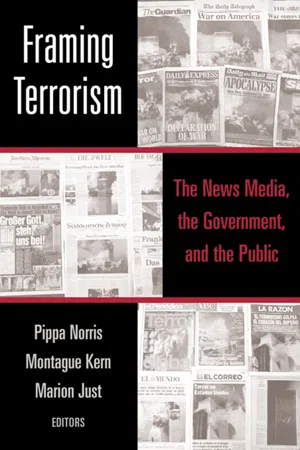
Terrorism now dominates the headlines across the world-from New York to Kabul. Framing Terrorism argues that the headlines matter as much as the act, in political terms. Widely publicized terrorist incidents leave an imprint upon public opinion, muzzle the "watchdog" role of journalists and promote a general one-of-us consensus supporting security forces.
eBook - ePub
Framing Terrorism
The News Media, the Government and the Public
- 344 pages
- English
- ePUB (mobile friendly)
- Available on iOS & Android
eBook - ePub
Framing Terrorism
The News Media, the Government and the Public
About this book
Information
PART I Generating Terrorism Frames
DOI: 10.4324/9780203484845-3
CHAPTER 2 Terrorism, Censorship and the 1st Amendment: In Search of Policy Guidelines
DOI: 10.4324/9780203484845-4
When important values clash in democracies, policy makers and publics face a typical trade-off dilemma. Which should prevail? The dilemma is starkest when the clashing values are national security threatened by terrorism or war, endangering the survival of large numbers of citizens, if not the nation itself, and freedom of the press, which is an indispensable ingredient of democracy. Arguments about whether a free press is actually essential to democracy are beyond the scope of this chapter. Many observers believe that it is and that press freedom is particularly vital in crisis periods because decisions made at that time are apt to produce profound consequences for the nation and its people.
In the post-World War II era, national security risks have appeared in a number of guises. Formal declarations of war have become less common while military confrontations involving terrorism, counter-terrorism, guerilla warfare, peacekeeping operations, and similar so-called ‘low intensity conflicts’ have increased. Government deliberations, like congressional hearings on the Anti-Terrorism Act of 2001, make it clear that public officials equate the dangers posed by such low-intensity operations with the dangers posed by open warfare.
Many such military missions are comparatively brief with little advance planning and require complete secrecy to succeed. They would be compromised by premature disclosure, especially since reporters are now able to send messages, including pictures, from remote locations at lightening speed. Hence it seems reasonable to consider the history of press restraints during anticipated or actual war as precedent for press freedom policies during periods of anticipated and actual terrorism and subsequent military operations. Periods of ideological onslaught, like the Cold War following World War II, also belong in this category of extreme dangers that generate calls for the suspension or dilution of constitutional guarantees.
The Patterns of Past Solutions
There are basically three approaches to the dilemma of reconciling the conflicting aspects of press freedom and survival security. The ‘formal censorship’ approach has been most common. It involves legislation that sets forth what may or may not be published. Such laws vary in the terms and scope of the censorship operations and often stipulate severe penalties for violations. The press may still be allowed to decide what is publishable within the government’s guidelines. Alternatively, the decision about what may be published may be in the hands of official censors who use their discretion about the sensitivity of particular information at a specific time. In either case, freedom of the press is in abeyance, as American constitutional lawyers generally interpret it, including the traditional reluctance of American courts to permit prior censorship of potentially harmful news reports (Silverberg 1991).
The opposite ‘free press’ approach leaves journalists free to decide what is or is not safe to publish under the circumstances. Journalists may choose to follow guidelines provided by the government or respond to specific requests by public officials. But reporters make the ultimate decision free from formal pressure by public officials, although there are always ethical mandates to be risk-averse when national security is at stake.
The third approach, the ‘informal censorship’ scheme, is an ingenious combination of the two: There are no censorship laws and the press is left officially free to decide what it does or does not wish to publish. But pronouncements by high-level government leaders constitute informal censorship because they create a coercive climate that forces the press into self-censorship in line with the wishes of public officials. Criticism of government policy is castigated as unpatriotic, flirting with treason. This form of pressure is often enhanced by a barrage of glowing reports about government progress in coping with the crisis. Self-censorship by the press is complemented by self-censorship by government officials who have been admonished by their leaders to keep their lips tightly sealed. Such “voluntary” constraints, as social scientists have documented, can be just as potent as official censorship laws (Aukofer and Lawrence 1995; Carter and Barringer 2001a).
In a 1987 speech at Hebrew University in Jerusalem, Associate U.S. Supreme Court Justice William J. Brennan Jr. reviewed what he called the “shabby treatment” that America’s vaunted freedoms have received in times of war and threats to national security (Brennan 1987). He attributed these lapses to the crisis mentality that Americans develop when faced with danger intermittently, rather than living with it constantly. America’s decision-makers have been inexperienced in assessing the severity of security threats and in devising measures to cope with them in ways that respect conflicting rights and liberties.
Brennan might also have added that the equally inexperienced American public has traditionally supported restraints on First Amendment rights and civil liberties when it has been polled during crises, especially if it feels militarily or ideologically threatened (Blendon et al. 2002; Fleischer 2001; Kinsley 2002; Pew 2001). For example, 53 percent of the respondents to a Pew poll reported in the press on November 29, 2001, in the aftermath of the September terrorist attack on U.S. sites, agreed that the government should be able to censor news that “it deems a threat to national security” (Pew 2001). The pollsters asked which was more important: the government’s ability to censor or the media’s ability to report what seemed in the national interest. Four percent of respondents volunteered that both were equally important.
It is important to note that the vote in favor of government censorship hardly constitutes overwhelming agreement. Besides, a bare majority (52 percent) indicated that the media should dig hard for the news rather than accept government refusals to release it, and 54 percent agreed that media’s criticism of leaders keeps them from misbehaving. On balance, however, trust in government trumped trust in the media. Sixty-one percent of respondents expressed a fair amount of confidence that the government was giving the public an accurate picture about its response to terrorism, and 70 percent thought that public safety and protection of American military forces were the main reasons for censorship.
The ‘Shabby' Record of Protecting Press Freedom
In a nutshell, press freedom has routinely succumbed to national security concerns on the home front as well as on foreign battlefields. Customarily, in the United States and other democracies with strong traditions of press independence from government, this has been accomplished through legislation or orders by the chief executive or administrative agencies. A quick journey through some of the relevant events in U.S. history is instructive. In democracies where the government owns or otherwise controls the press, wartime situations are more amenable to routine press management procedures (Sajó and Price 1996).
On the verge of war with France in 1798, Congress enacted the Alien and Sedition Acts, claiming that home front censorship was essential to forestall enemy espionage and sabotage. The Sedition Act made it unlawful to “write, print, utter or publish … any false, scandalous and malicious writing” against government officials intending “to bring them … into contempt or disrepute” (1798, 1 Stat. 570). There were 25 arrests, 15 indictments, and 10 convictions under the act, mostly involving newspaper editors and politicians from the party in opposition to the government. Legal challenges to the act were unsuccessful at the time. But when party fortunes changed, the convicted were pardoned, most fines were returned, and it was widely acknowledged that the laws had been an unnecessary aberration. The dangers had been exaggerated.
Still, when the Civil War presented a major test in 1861, the story was quite similar. As soon as armed conflict started, President Lincoln took drastic measures to neutralize disaffected citizens and potential traitors in the name of national security. Through executive orders, he blocked the distribution of dissenting newspapers and, during the latter part of the war, seized control of the telegraph lines that transmitted war news. The most drastic step was the suspension of habeas corpus. Thousands of people were arrested on suspicion of disloyalty and held in military custody, often without charges. Trials were before military tribunals that lacked the procedural safeguards available in civilian courts. Such steps were bound to intimidate reporters. The public, by and large, approved these actions and condemned judges who questioned their constitutionality.
Another example of censorship legislation comes from the First World War. Congress enacted the Espionage Act, making it a crime to utter, print, write, or publish any “disloyal, profane, scurrilous, or abusive language” or any language intended to bring the U.S. form of government or the Constitution or the flag “into contempt, scorn, contumely, or disrepute” (1918, 40 Stat. 553). More than 2000 individuals, including journalists, were prosecuted under the act. Convictions were mostly for criticizing U.S. participation in the war. In Abrams v. United States (1919, 250 U.S. 616) the U.S. Supreme Court upheld such convictions.
The constitutionality of the act was also indirectly sanctioned in the 1919 Schenck v. United States case. The Court supported the right of free speech except in case of “clear and present danger” of severe adverse consequences. Wars, in the mind of Justice Oliver Wendell Holmes, obviously constituted such a danger when national security concerns must take precedence over first amendment rights. “When a nation is at war many things that might be said in time of peace are such a hindrance to its effort that their utterance will not be endured so long as men fight” (1919, 242 U.S. 52). In 1943, in Hirabayashi v. United States, the Supreme Court clearly indicated that it is the president’s prerogative to determine when a threat to national security exists. Internment of Japanese-Americans was appropriate “if those charged with the responsibility of our national defense have reasonable ground for believing that the threat is real” (1943, 320 U.S. 95). Decades later, in the Pentagon Papers case, the Supreme Court contrary to its earlier ruling refused to stop publication of the contents of a classified Defense Department study relating to the Vietnam War despite the administration’s contention that the disclosure posed a grave, immediate danger to national security (New York Times Co. v. United States, 1971, 463 U.S. 713; Rudenstine 1996).
During the early years of the nation’s history, when foreign policies were often highly controversial, the American government considered the media primarily as an obstacle to war that had to be kept under control through strict censorship legislation. That perception had changed by the time World War II started. Impressed by the successful use of propaganda by authoritarian governments, democratic governments had begun to appreciate the power of the press to rally mass publics. They now deemed it a potentially powerful ally in their struggle against the enemies of Western democracies.
The government wanted a policy that would yield ample favorable coverage of the war without risking adverse stories by roaming correspondents. This was to be accomplished by facilitating reporters’ access to news about the war, including ongoing battles, but binding them to a gentleman’s agreement that they would not reveal anything that might interfere with the military’s mission. Instead of the harsh censorship laws of the past, there would be voluntary cooperation. Most reporters knew and complied with the unstated terms of the compact because it gave them broad access to war information; they censored themselves to live within the terms (Thompson 1991; Thrall 2000). This was easy because, unlike the situation in earlier wars, the objectives of World War II were never controversial in the United States.
In addition to these unwritten understandings, there were more formal arrangements as well to provide guidance to reporters about the limits of safe reporting. On December 19, 1941, President Franklin D. Roosevelt established an Office of Censorship under the First War Powers Act, which operated with a staff of more than 10,000 censors as a home front security guardian until August 15, 1945. The office was authorized to censor mail, cables, newspapers, magazines, films, and radio broadcasts. It issued non-enforceable honor codes of acceptable wartime practices for print and broadcast media. Breaches required prior approval by the Office of Censorship. Compliance with these guidelines was excellent (Aukofer and Lawrence 1995; Thompson 1991). Military authorities in the war zones were authorized to conduct their own censorship operations, which tended to be more restrictive than the civilian censorship at home.
With the Korean War, which began in 1950, the country moved back to the conditions of earlier years when foreign policies had been controversial and civilian and military government leaders feared that hostile reporters might undermine the war effort. The controversial nature of the war made it difficult for the press to keep their stories supportive of the military action while also reflecting the political controversy. Military commanders complained that the system of voluntary self-censorship allowed news sources to publish stories that endangered the war effort. They therefore urged the Defense Department to provide compulsory guidelines. An official censorship code for war correspondents was issued shortly thereafter, in December 1950. Leaders from the journalism community and the military had agreed, following extensive discussions, that all future reports from Korea should first be cleared with Army headquarters. Stringent screening ensued that caused long delays in the transmission of news from the front and frustrated the press. As is usually the case, many provisions of the code were vague, such as the prohibition of stories that might “injure the morale” of American or Allied forces or stories that might ‘embarrass’ the United States, its Allies, or neutral countries. That made controversies over the administration of the codes inevitable.
By the time of the Vietnam War, the notion that news stories were likely to harm government efforts had regained full currency. Knowing that its policies in Vietnam would be highly controversial, the American government did not wish to alert the public to the extent of U.S. involvement or to the shortcomings of the South Vietnamese government, which it was supporting. Withholding of news so that it could not be published, exaggerating successes to make policies more palatable, and some outright falsifications of potentially damaging data, became accepted policy tools. News people and their reports would not be formally censored. Instead, correspondents would simply be kept in the dark or government sources would feed them carefully selected, and sometimes doc...
Table of contents
- Cover Page
- Half Title Page
- Title Page
- Copyright Page
- Table Of Contents
- Preface
- Introduction
- Part I: Generating Terrorism Frames
- Part II: Comparing Terrorism Frames
- Part III: The Public's Response
- Conclusion
- Select Bibliography
- List of Tables and Figures
- List of Contributors
- Index
Trusted by 375,005 students
Access to over 1.5 million titles for a fair monthly price.
Study more efficiently using our study tools.
Frequently asked questions
Yes, you can cancel anytime from the Subscription tab in your account settings on the Perlego website. Your subscription will stay active until the end of your current billing period. Learn how to cancel your subscription
No, books cannot be downloaded as external files, such as PDFs, for use outside of Perlego. However, you can download books within the Perlego app for offline reading on mobile or tablet. Learn how to download books offline
Perlego offers two plans: Essential and Complete
- Essential is ideal for learners and professionals who enjoy exploring a wide range of subjects. Access the Essential Library with 800,000+ trusted titles and best-sellers across business, personal growth, and the humanities. Includes unlimited reading time and Standard Read Aloud voice.
- Complete: Perfect for advanced learners and researchers needing full, unrestricted access. Unlock 1.5M+ books across hundreds of subjects, including academic and specialized titles. The Complete Plan also includes advanced features like Premium Read Aloud and Research Assistant.
We are an online textbook subscription service, where you can get access to an entire online library for less than the price of a single book per month. With over 1.5 million books across 990+ topics, we’ve got you covered! Learn about our mission
Look out for the read-aloud symbol on your next book to see if you can listen to it. The read-aloud tool reads text aloud for you, highlighting the text as it is being read. You can pause it, speed it up and slow it down. Learn more about Read Aloud
Yes! You can use the Perlego app on both iOS and Android devices to read anytime, anywhere — even offline. Perfect for commutes or when you’re on the go.
Please note we cannot support devices running on iOS 13 and Android 7 or earlier. Learn more about using the app
Please note we cannot support devices running on iOS 13 and Android 7 or earlier. Learn more about using the app
Yes, you can access Framing Terrorism by Pippa Norris,Montague Kern,Marion Just in PDF and/or ePUB format, as well as other popular books in Politics & International Relations & International Relations. We have over 1.5 million books available in our catalogue for you to explore.