- 352 pages
- English
- ePUB (mobile friendly)
- Available on iOS & Android
eBook - ePub
About this book
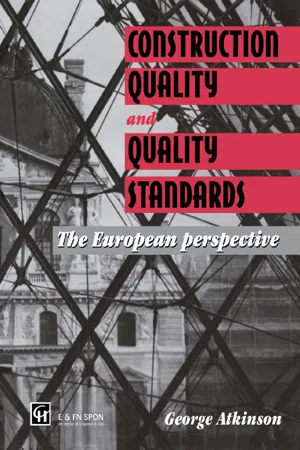
Quality is a vital issue to be addressed by all constuction professionals working in Europe today. This book provides clear, concise guidance to the making and use of codes, regulations and technical specifications in Europe.
Information
PART 1
Construction Quality and its Achievement
1
Building well
In Architecture, as in all other Operative Arts, the End must direct the Operation. The End is to Build well. Well Building hath three Conditions; Commodity, Firmness, and Delight.
The Elements of Architecture collected by
Sir Henry Wotton Knt (1624)
Sir Henry Wotton Knt (1624)
Sir Henry Wotton drew for Elements of Architecture on contemporary and earlier works in an extensive architectural library, formed when he was English ambassador to the Venetian Republic during the early years of the 17th century. He was two years old when Palladio’s Quattro Libri del’ Architettura was published, a book that he owned with the 1556 Barbaro translation of Vitruvius, and an almost contemporary treatise by Philbert de l’Orme, one of the first books to discuss a key issue in quality—how a client may distinguish between a wise and a foolish architect.
Wotton would have seen Palladio’s Venetian churches and his villas on the Venetian terra firma in their first youth, and his book includes comments on Italian building traditions. Wotton’s Elements are, therefore, an appropriate introduction to an attempt to give a European perspective to construction quality. His much quoted ‘The End is to Build Well’ sums up, in six words, the theme of this book.
1.1
MEANING OF QUALITY
Quality is one of the aims of standardization…the quality of a product or a complete building or other construction is the totality of its attributes that enable it to perform a stated task or to fulfil a given need satisfactorily for an acceptable period of time.
For building and civil engineering…a satisfactory product, although essential in itself, is not on its own sufficient. It must be incorporated in the design and construction in a correct manner.
In buildings, more defects and failures arise from inadequacies in the treatment of products in design and construction than from shortcomings in the products themselves.
BS PD 6501: Part 1:1982.
BOX 1.1
QUALITY IN DESIGN, CONSTRUCTION AND USE
QUALITY IN DESIGN, CONSTRUCTION AND USE
Quality of design process derives from:
- reliability of initial brief
- reliability of all information used as basis of the design, and selection of products
- reliability of design solution and detailed specification
- reliability of estimates of quantities of materials and labours required and their costs, of management and site overheads, and predictions of possible contingencies
- reliability of calculations relating costs to benefits, including tangibles like economies in energy consumption
- experience of designer in judging whether estimate of total cost of project is realistic, and will meet requirements of client
Quality of construction process derives from:
- reliability of organization, procedures and skills of builder to interpret the design, marshal required resources and provide the end product in accordance with design and specification, and at contracted price
- a workforce of appropriate skills
- products of specified quality
Quality of products derives from:
- reliability of all the materials, products, components and equipment supplied to the site, and their handling, storage and protection on site
Quality of building in use derives from:
- reliability of commissioning of installations and inspection of work on handing over, and making any corrections required
- reliability of the maintenance programme
- reliability of management of building in use, including assurance that any alteration to building or modification to installations will not impair performance or quality achieved
From classical times, writers like Vitruvius have attempted to define the meaning of quality, usually in fairly general terms. More recently, interest in construction quality has brought into more or less general use a range of definitions, some specific to the increasingly wide international and European use of the ISO 9000/ EN 29000/BS 5750 series of standards for quality systems; others from concern with the quality of construction products.
The term ‘quality’ has different meanings for different people. There are subtleties in the word’s use in the English language. It has been used to describe people, their skills and, in earlier centuries, rank in society; but also the quality of things, where two uses merit quotation. The first is appropriate to both buildings and construction products: ‘a particular class, kind or grade of anything, as determined by its quality’, dated 1656 in the Shorter Oxford English Dictionary. The second, quoted from George Bernard Shaw’s John Bull’s Other Island, is particularly apposite for quality assurance: ‘There are only two qualities in the world: efficiency and inefficiency’..
The French use qualité as a term meaning ‘property’, as well as an indication of degree of excellence. It is left to the Germans to reserve qualität for a suggestion of grade, e.g. erste qualität (prime quality), and to use eigenschaft when referring to an attribute, characteristic or property.
The quality of a building derives not only from the quality of its design and of the process through which the design was developed, from the quality of the construction process and the care taken in translating the design into practical shape, and from the quality of products used and equipment installed, but also from the way it is used, and the quality of building management and maintenance.
In this part of the book, achievement of quality at the building level is discussed: first, against the findings of a BRE survey of quality and value in building; then, in looking at how quality was achieved in four major European buildings, and the interaction between commissioning of their designers and achievement; and, finally, against the issue of quality in traditional construction.
1.2
QUALITY AT THE BUILDING LEVEL
Although the preparation of the brief and the layout design are crucial, all subsequent parts of the design, construction and use of the building have to be done well to ensure quality and value.
The achievement of quality and value is therefore intrinsic to the whole process and cannot be regarded…as an optional extra.
A survey of quality and value in building,
BRE Report (1978)
BRE Report (1978)
Concern with the achievement of quality at the building level is not new. In the last century, Alfred Bartholomew, architect and early editor of The Builder, prefaced his Specifications for PracticalArchitecture with an essay on ‘the decline of excellence in the structure and in the science of modern English buildings; with proposals of remedies for those defects’. Despite the excellent materials that ‘the English Architect has in modern times at his disposal,…the actual practical building of this country retrogrades sadly both in goodness and wisdom’.
If such was the situation in Victorian England when the traditional building crafts still flourished, how much more critical is the situation today, when avoidance of latent defects has become a first priority. Bartholomew’s solution was ‘the Foundation of a Great National College, for the Study and Regulation of Architecture throughout the British Dominions, for the Examination of Students and Professors of Architecture, and Artificers in Building, for the granting Honorary Degrees to Proficients therein of various stages of Maturity, and for the Conservation of Public Buildings’.
Solutions promoted today range from the joint training of the construction professions, and mandatory continuing professional development, to peer reviews and quality assurance not only of products, but of management systems of firms and performance of personnel during the whole construction process: briefing, design and construction. These matters, and the standards and other technical specifications needed for support, are central themes in this book.
1.3
BRE STUDY: A SURVEY OF QUALITY AND VALUE INBUILDING
In the late 1970s, helped by several colleagues, M.E.Burt, then deputy director of the UK Building Research Establishment, set out a framework for establishing criteria for quality, performance and value. As far as was possible, he showed how these criteria could be evaluated against each other. Quality was defined as ‘the totality of the attributes of a building which enables it to satisfy needs, including the way in which individual attributes are related, balanced and integrated in the whole building and its surroundings’. Its attributes are summarized in Box 1.2.
An important section was devoted to the role of the client, and his contribution in the initial decision-making process, starting with commissioning. The client might be an individual needing a house, or other modest building, who was, in the words of P.Peter writing on the French decennial guarantee, ‘un profane (layman) en matière de construction’. The client might be a substantial organization with a clear idea of the functional needs of the building commissioned, but with no capability in-house for design or construction. The client might be a public authority or what in French is termed une personne morale: a major property owner or developer, experienced in commissioning works, and having substantial professional resources for specifying requirements and ensuring their satisfaction.
Whichever his status and experience, the client alone has to make the first, and the most critical decisions affecting quality: what are his requirements, and in what way, and with what resources, are they to be satisfied? Excluding the decision to rent or buy works already constructed, he has a number of choices:
- appoint an independent practitioner to take his instructions and prepare a design, and, if the design appears to meet his needs, entrust him as the client’s agent with its execution;
BOX 1.2
THE ATTRIBUTES OF QUALITY IN A BUILDING
THE ATTRIBUTES OF QUALITY IN A BUILDING
The totality of the attributes of a building that enable it to satisfy needs, including the way in which individual attributes are related, balanced and integrated in the whole building and its surroundings.
Three groupings are defined:
- external attributes—relating to the effects of the site and its surroundings on the building, and the effects of the building on its surroundings;
- performance attributes—mainly related to the interior of the building which makes it operationally efficient and provides reasonable conditions for users (e.g. accommodation, environment, safety and security, use);
- aesthetic and amenity—terms used to describe both external and internal attributes of a standard higher than just needed to meet mandatory and performance requirements (e.g. external appearance, and internal appearance, and internal standards of comfort)
Some clients may require a degree of amenity, not only for its own sake, but because they feel that it may make some contribution to the competitiveness of their business, perhaps by improving public or staff relations.
Attributes of quality could alternatively be grouped under five heads:
- applicability—are they related to the needs of a single building or applicable to buildings?
- whose benefit—client and occupier, users, the community?
- whose decision—client, the community or State through legislation and regulations?
- are attributes quantifiable, difficult to quantify, or subjective?
- to what extent are they governed in time by the client’s brief, the design, construction, or use?
- entrust design and supervision of execution to an in-house organi-zation— existing or formed for the project; or
- contract with a commercial firm to provide a design, execute its construction, and possibly furnish services like arranging finance, and supplying equipment and furniture.
Each approach has its merits; each its drawbacks. For experienced clients, choice may not be difficult. But the inexperienced layman has no clear route to obtaining objective advice on the approach best suited to his needs. If, for example, he decides to entrust the work to an independent practitioner, or to an ‘all-in’ design-build contractor, he faces the problem of how best to choose the one likely to give good value and do a satisfactory job. Professional institutions, through their client advisory services, may offer impartial advice which, however, is likely to be restricted to practitioners who are members of that institution. To assess designs offered by different contractors against estimates of cost, and the contractor’s capability of delivery of a building of specified quality on time, is not an easy task. That the firm has been quality assured, and is subject to surveillance, is a help; but it does not guarantee the quality of the product, only the quality of its management and that of the process of production.
1.4
IMPORTANCE OF THE DESIGN BRIEF
Each route to commissioning a building can, but may not, result in work that satisfies a client’s needs. Whichever route is chosen, these needs have to be made explicit in a design brief. The form and degree of elaboration of briefmaking will vary. It will be influenced on the initial decision on commissioning, and whether the development of the brief, first into a design, and then into detailed specifications and drawings, are entrusted to an in-house team, to an independent practitioner as the client’s agent, or a design-management contractor. Because quality of decisions at the briefing stage is crucial, where the client is a public authority or major property owner with a large building programme, he should see that procedures for briefing his own designers and outside consultants are included in the organization’s quality management system.
The four European buildings described in Chapter 2 may, because of their public character and quality, be atypical, yet they present lessons in commissioning. Of special interest is the distinction drawn in the case of the Grand Louvre between the maîtrise d’ouvrage—the client organization, representing the French government through a special Etablissement Public du Grand Louvre within which there are services with financial, contractual and insurance responsibilities as well as personnel with responsibilities for programming, briefing and overseeing the works—and the maîtrise d’oeuvre—which included not only the chief architect I.M.Pei and his team, the official conservation architect for the Louvre, and a team of archaeologists but also a number of technical offices (bureaux d’études techniques) with responsibilities for detailed design work.
FURTHER READING
Definitions of quality and associated terms in English, French and German are given in Part Two, Chapter 16 of this book.
Sir Henry Wotton’s Elements of Architecture were collected from ‘the best Authors and Examples’ while he was English Ambassador to the Venetian Republic at the end of the sixteenth century. The first theoretical work on the subject in English, his Elements were published in 1624, two months after his return to England. The extract given here is ...
Table of contents
- Cover Page
- Title Page
- Copyright Page
- Foreword
- Introduction
- Part 1 Construction Quality and its Achievement
- Part 2 Organizations, Terms and Definitions
Trusted by 375,005 students
Access to over 1.5 million titles for a fair monthly price.
Study more efficiently using our study tools.
Frequently asked questions
Yes, you can cancel anytime from the Subscription tab in your account settings on the Perlego website. Your subscription will stay active until the end of your current billing period. Learn how to cancel your subscription
No, books cannot be downloaded as external files, such as PDFs, for use outside of Perlego. However, you can download books within the Perlego app for offline reading on mobile or tablet. Learn how to download books offline
Perlego offers two plans: Essential and Complete
- Essential is ideal for learners and professionals who enjoy exploring a wide range of subjects. Access the Essential Library with 800,000+ trusted titles and best-sellers across business, personal growth, and the humanities. Includes unlimited reading time and Standard Read Aloud voice.
- Complete: Perfect for advanced learners and researchers needing full, unrestricted access. Unlock 1.5M+ books across hundreds of subjects, including academic and specialized titles. The Complete Plan also includes advanced features like Premium Read Aloud and Research Assistant.
We are an online textbook subscription service, where you can get access to an entire online library for less than the price of a single book per month. With over 1.5 million books across 990+ topics, we’ve got you covered! Learn about our mission
Look out for the read-aloud symbol on your next book to see if you can listen to it. The read-aloud tool reads text aloud for you, highlighting the text as it is being read. You can pause it, speed it up and slow it down. Learn more about Read Aloud
Yes! You can use the Perlego app on both iOS and Android devices to read anytime, anywhere — even offline. Perfect for commutes or when you’re on the go.
Please note we cannot support devices running on iOS 13 and Android 7 or earlier. Learn more about using the app
Please note we cannot support devices running on iOS 13 and Android 7 or earlier. Learn more about using the app
Yes, you can access Construction Quality and Quality Standards by G.A. Atkinson in PDF and/or ePUB format, as well as other popular books in Technology & Engineering & Architecture General. We have over 1.5 million books available in our catalogue for you to explore.