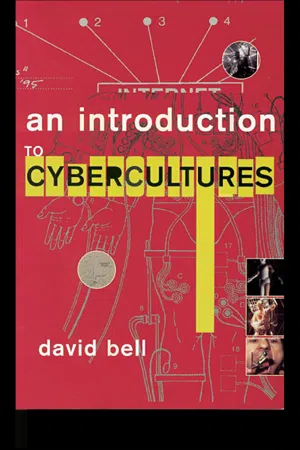
An Introduction to Cybercultures provides an accessible guide to the major forms, practices and meanings of this rapidly-growing field. From the evolution of hardware and software to the emergence of cyberpunk film and fiction, David Bell introduces readers to the key aspects of cyberculture, including email, the internet, digital imaging technologies, computer games and digital special effects. Each chapter contains `hot links' to key articles in its companion volume, The Cybercultures Reader, suggestions for further reading, and details of relevant websites. Individual chapters examine: · Cybercultures: an introduction · Storying cyberspace · Cultural Studies in cyberspace · Community and cyberculture · Identities in cyberculture · Bodies in cyberculture · Cybersubcultures · Researching cybercultures
- 256 pages
- English
- ePUB (mobile friendly)
- Available on iOS & Android
eBook - ePub
An Introduction to Cybercultures
About this book
Information
Chapter 1
CYBERCULTURES
An introduction
My personal walkabout in cyberspace has given me glimpses of a truly different world, and I wish to share them.
David Hakken
SITTING HERE, AT MY COMPUTER, pondering how to start this book, how to introduce my own ‘walkabout’ in cyberspace, I find myself struggling. Maybe it’s because I’ve just been reading and writing about hyperlinks and the web as text – as text, moreover, that is open and infinite, that has no beginning or end. But a book is still a linear thing, decidedly non-hypertexty – despite various authors’ unsuccessful attempts to simulate on paper the experience of the screen (see, for example, Taylor and Saarinen 1994; Case 1996; Bolter and Grusin 1999). So I have to abide by the logic of the book, even if it seems increasingly contradictory in the digital age to do so. The move from books to bytes, to borrow Anthony Smith’s (1993) phrase, is still far from complete – and so here I am, sitting here, the cursor blinking at me, thinking of a way to introduce you to my book.
If I was to try to define in a sentence what this book is about – some-thin g I often ask students to do with projects and dissertations – I would have to say that it is about thinking through some of the ways of under-standin g what the term ‘cybercultures’ means. It’s a series of ideas, issues and questions about what happens when we conjoin the words ‘cyber’ and ‘culture’. Think of it this way, which I borrow from Christine Hine (2000): cyberspace as culture and as cultural artefact. Let’s work that formulation through. First, what is cyberspace? It’s a slippery term, to be sure; hard to define, multiplicitous. I think of it as combining three things, as the next two chapters of this book show: it has material, symbolic and experiential dimensions. It is machines, wires, electricity, programs, screens, connections, and it is modes of information and communication: email, websites, chat rooms, MUDs. But it is also images and ideas: cyberspace exists on film, in fiction, in our imaginations as much as on our desktops or in the space between our screens. Moreover, and this is the important bit, we experience cyberspace in all its spectacular and mundane manifestations by mediating the material and the symbolic. As I attempt to track in Chapters 2 and 3, thinking about what cyberspace ‘is’ and what it ‘means’ involves its own hypertex-tuality, as we mingle and merge the hardware, software and wetware with memories and forecasts, hopes and fears, excitement and disappointment. Cyberspace is, I think, something to be understood as it is lived – while maps and stats give us one kind of insight into it, they are inadequate to the task of capturing the thoughts and feelings that come from, to take a mundane example, sending and receiving email. At one level, thinking of cyberspace as culture emphasizes this point: it is lived culture, made from people, machines and stories in everyday life. That’s why I often turn to stories of my own and others’ experiences with cyberspace. In Chapter 3 especially, I emphasize my story – not quite a tale of personal transformation from newbie to nerd, but not far off.
Thinking about cyberspace as cultural artefact means considering how we’ve got cyberspace as it currently exists; it means tracking the stories of its creation and on-going shaping, as well as the stories of on-going meaning-making that make cyberspace over. From the perspective of someone working in cultural studies, it seems relatively straightforward to see cyberspace as cultural, in that any and every thing around us is the product of culture – look at the shape of your computer, for example, and consider why it’s turned out that way. The story of how computers ended up on our desktops, and ended up connecting us to each other, is a profoundly cultural tale (Edwards 1996).
The trick is to think about cyberspace as product of and producer of culture simultaneously – another hypertext moment. Keeping both perspectives visible is important, because it avoids the all-too-easy slide into either technophilia or technophobia. And, as Jonathan Sterne (1999) points out, part of the task of cultural studies in cyberspace is to navigate a path between these two extremes, though without necessarily abandoning them totally – especially since they remain important framing discourses circulating in everyday life (from the technophilic hype around ‘dot.com’ millionaires to the technophobic imagery of Terminator).
Chapters 2 and 3 of this book are a joint attempt to work through ways of thinking about cyberspace, therefore. They can’t pretend to be comprehensive, authoritarian accounts – they are fragmentary, flickering. I hope that they are read not for grand answers, but for modestly thought-provoking moments. In the chapters that follow, by focusing in on particular aspects of cyberculture, my aim is to get a slightly better understanding of some things that ‘cyberculture’ means or might mean. To start off, I have tried to think through what cultural studies has to contribute to this, and to suggest some of the theoretical resources we can make use of. This involves establish-in g a number of different ways of thinking about science, technology, computers and cyberspace, and I hope that by taking a walkabout through some of those ways, I can trace some connections and directions that are productive. That’s the agenda for Chapter 4, which ‘detours’ through theories and theorists that we might make use of in the project understanding cybercultures.
Chapter 5 takes us into one of the most interesting and contested areas of cyberculture. The topic here is community – are new communities forming in cyberspace? Are these replacing or augmenting offline communities? Is this a good thing or a bad thing? The debate about cyber-community crystallizes many of the important issues of cyberculture, therefore. It shows the ways in which cyberspace reworks our understandings of ‘community’, and the extent to which that reworking is open to contestation. It brings to the surface the troublesome question of marking boundaries between ‘virtual life’ and ‘real life’, and asks what meanings and values we attribute to these terms. By approaching cyber-community from a range of perspectives, and letting these rub up against each other, this chapter is my attempt to indicate the implications for how we think about both cyberspace and community.
Chapter 6 shifts our attention to questions of cultural identity in cyberspace, and to do this I focus on race, class, gender and sexuality. Set in the broader context of arguments about identity in contemporary culture – what has been termed the decentring of the self – thinking through the ways in which these aspects of identity are reworked in cyberculture gives us important insights into what goes on when people enter virtual realms, cyber-communities and digital worlds. How much of our ‘real life’ identity can we jettison – and how much would we want to jettison? Does the possibility of ‘playing’ with identity in cyberspace mean something productive, or does it merely provide another arena for domination?
Closely but complexly related to questions about cybercultural identity are issues of embodiment, and Chapter 7 takes these up, introducing and exploring narratives about strange new figures on our cultural landscape: posthumans, cyborgs, digital corpses and intelligent machines. From the cyberpunk dream of ‘leaving the meat behind’ and existing in cyberspace as pure data to the intricate readings of the cyborg provided by Donna Haraway (CR), the shifting shapes and meanings of ‘the body’ in cyberculture open up a number of important questions and challenges. As we enter into evermore intimate relationships with an ever-increasing diversity of nonhuman others, we have to radically rethink what we mean by ‘body’, what we mean by ‘life’ and what we mean by ‘human’ – and consider the usefulness of retaining categories and boundaries that are becoming increasingly difficult to sustain.
Chapter 8 brings together some of the themes addressed previously, through a focus on what I’ve termed ‘cybersubcultures’. Building on cultural studies of subcultures – groups like punks, eco-warriors and football hooli- g ans – this chapter explores how different subcultural responses to and uses of cyberspace work. In some cases, pre-existing forms of subcultural activity have found a new home in cyberspace, and in this respect I look at fan cultures and ‘fringe’ political groups (such as conspiracy theorists and neo-nazis). What we see there is an adaptive relationship to new media technologies that is reshaping the practices and forms that these subcultures take. Moving on from here, I look at subcultures that signal an expressive engagement with cyberspace, focusing on MUDders, cyberpunks, hackers, and neo-Luddites. Each of these groups has its own subcultural take on cyberspace, and each reintroduces debates about identity, embodiment and community in cyberculture.
The final substantive chapter of the book explores the business of research on, in and with cyberspace and cybercultures, and is intended as a partial, critical commentary on the issues that come to the surface when the communities, identities, bodies and subcultures of and in cyberspace are investigated empirically. Two kinds of research are highlighted here: textual approaches to the web and cyberethnography. The methodological challenges and questions that arise when we attempt to do research in and on cyberspace provide us with a different way of thinking through what cyberculture means – indeed, Hine’s (2000) neat discussion of cyberspace as culture and as cultural artefact has its origins in her own online fieldwork. How we think about cyberspace shapes how we research it, and how we research cyberspace shapes how we think about it.
All of these chapters share a common architecture, and come with a common set of attachments. At the end of the chapters the following features recur: links to chapters in The Cybercultures Reader (Bell and Kennedy 2000), a handful of suggestions for further reading, and some URLs for websites on related topics. The links to the Reader are intended to point readers towards essays that illustrate, extend and contest the ideas that I introduce. This book was partly conceived as a companion to the Reader, to provide space to work through the issues raised by the essays collected there. So, in a way, that’s my own gesture towards hypertexting. While I’ve tried to make this book make sense in its own right, so these links aren’t essential, it’s always part of academic writing to stage a primitive hypertextuality by referring across to others’ work. When we assembled the Reader, our aim was to gather together what we thought to be the most useful and interesting essays on cybercultures – so it’s not surprising that I would want to make use of them in this book too.
The further reading and websites at the end of each chapter are a second kind of hypertexting, linking the reader to other places where the themes of the chapter can be explored. The sites were all up and running in January 2001, but given the ephemerality of the web, I can only apologize if any of them have vanished by the time you try to visit them. These sites aren’t the result of any kind of exhaustive or systematic survey of available sites, either. Despite Ananda Mitra and Elisia Cohen’s (1999) suggestions for ways to evaluate sites, the choice here is more personal than anything: these are sites that I think are useful ways into particular topics. Each reader can move from them in their own route, following the links that they find enticing.
At the end of the book, I have added two more resources: a glossary and another guide to further reading. These are my attempt to answer the FAQs that get asked about cybercultures. The glossary is a weird thing – compiling it calls for lots of pondering, decisions about what to include and what can be left out. Terms from cyberspace enter our everyday speech reasonably easily (Shortis 2001), and yet usage in common parlance doesn’t always equate with an ability to define any term. All I have done with the glossary is to sift through a few other glossaries provided by authors with a similar assumed audience to mine, and sifted my own text for the appearance of terms that I think could do with defining. The act of definition is itself very tricky, and another partial and contingent thing: while glossaries, like dictionaries and encyclopedias, pretend to be objective texts, we can clearly see that they are the result of somebody’s thinking. This glossary is no more than the result of mine. If I imagine my audience, I call up my own students: students doing cultural studies, who have varying amounts of prior knowledge about computers and cyberspace. In some cases, their knowledge outstrips mine, so I apologize for talking down to some readers.
The guide to further reading at the book’s end is my attempt to suggest what I think are the best handful of books for that same imagined audience. These are the books I recommend to my students, as places to begin getting to grips with cyberspace and cyberculture. I’ve added in a little commentary on the titles I’ve selected, just to help you decide which of my ‘top 20’ might be interesting or useful to you. Like the websites at each chapter’s end, this list is specific to the time and place of its compilation. Even if books don’t disappear quite as dramatically as websites sometimes do, they do have their shelf-life – and, of course, new titles appear with quite alarming frequency. Again, like the websites, this list was put together by one person (me), from one set of resources (my book shelves and teaching experience), at a particular moment (January 2001). To echo David Hakken (1999: 227) again, this book represents a ‘personal walkabout in cyberspace’ – and it’s a walkabout I think I’ll be on for a long time to come.
Chapter 2
STORYING CYBERSPACE 1
Material and symbolic stories
The experience of participating in a story, as teller or audience, is typically that of being caught up in it while it is being told. . . . Stories convey meaning about the social context and identity of the teller and audience. However, stories also have an effect on that identity and context.
John McLeod
IN THIS CHAPTER and the one that follows, I want to focus on the ways that cyberspace is talked about and written about. I shall pick out a number of ways of telling stories about cyberspace, and explore the kinds of stories that have been told. This assembling of stories is my attempt to sketch out an agenda for the rest of the book. What I want to stress is that any attempt to understand cyberspace and cyberculture must look at the stories we tell about these phenomena. Moreover, I want to suggest that we need to think about different modes of story-telling and different kinds of stories simultaneously, in order to understand how cyberspace and cyberculture are storied into being at the intersection of different knowledges and metaphors. The three strands of story-telling I identify as (1) material stories, (2) symbolic stories and (3) experiential stories. In similar moves, N. Katherine Hayles (1999b: 2) discusses ‘virtual creatures’ through what she calls three ‘modes of interro g a-tion’: what they are, what they mean and what they do, and Michael Menser and Stanley Aronowitz (1996) use the terms ontology, phenomenology and pragmatics to discuss ways of thinking about technology. I shall provide my definition of what these three kinds of stories are about, sketch some of their narrative forms and contents, and highlight the ways that they intersect as the two chapters unfold. But before that, I need to attend to two further acts of definition: to define the terms cyberspace and cyberculture themselves.
‘Cyberspace’ is a complex term to define; indeed, its definition can be refracted through our three story-telling tropes to give us different (though often overlapping) definitions. We can define cyberspace in terms of hardware, for example – as a global network of computers, linked through communications infrastructures, that facilitate forms of interaction between remote actors. Cyberspace is here the sum of all those nodes and networks (‘what it is’). Alternatively, a definition based partly on the ‘symbolic’ trope could define cyberspace as an imagined space between computers in which people might build new selves and new worlds (‘what it means’). In fact, cyberspace is all this and more; it is hardware and software, and it is images and ideas – the two are inseparable. Moreover, the ways we experience cyberspace represent a negotiation of material and symbolic elements, each given different weight depending on the kind of experience (‘what it does’). We can experience cyberspace mundanely, as where we are when we sit at a computer checking emails; or, we can experience cyberspace as an immer-sive realm where our ‘real life’ (RL) bodies and identities disappear – even if what we’re doing in those two scenarios isn’t, at one level of interro g a-tion, that different.
In The Cybercultures Reader Michael Benedikt defines cyberspace along similar axes, pointing out a number of different ways of conceptualizing what turns out to be an elusive thing. Consider just a couple of his attempts at definition:
Cyberspace: A new universe, a parallel universe created and sustained by the world’s computers and communications lines. A world in which the global traffic of knowledge, secrets, measurements, indicators, entertainments, and alter-human agency takes on form: sights, sounds, presences never seen on the surface of the earth blossoming in a vast electronic light.
Cyberspace: A common mental geography, built, in turn, by consensus and revolution, canon and experiment; a territory swarming with data and lies, with mind stuff and memories of nature, with a million voices and two million eyes in a silent, invisible concert to enquiry, deal-making, dream sharing, and simple beholding.
(Benedikt CR: 29)
After ten such attempts, Benedikt states that ‘cyberspace as just described does not exist’ (30). In fact, I would argue that it does exist – maybe not in terms of hardware and software, but certainly in terms of story-telling. Attending to cyberspace through its stories makes definition...
Table of contents
- Cover Page
- Title Page
- Copyright Page
- Acknowledgements
- Chapter 1: Cybercultures An introduction
- Chapter 2: Storying cyberspace 1 Material and symbolic stories
- Chapter 3: Storying cyberspace 2 Experiential stories
- Chapter 4: Cultural studies in cyberspace
- Chapter 5: Community and cyberculture
- Chapter 6: Identities in cyberculture
- Chapter 7: Bodies in cyberculture
- Chapter 8: Cybersubcultures
- Chapter 9: Researching cybercultures
- Chapter 10: Last words
- Further reading
- Glossary
- Bibliography
Trusted by 375,005 students
Access to over 1.5 million titles for a fair monthly price.
Study more efficiently using our study tools.
Frequently asked questions
Yes, you can cancel anytime from the Subscription tab in your account settings on the Perlego website. Your subscription will stay active until the end of your current billing period. Learn how to cancel your subscription
No, books cannot be downloaded as external files, such as PDFs, for use outside of Perlego. However, you can download books within the Perlego app for offline reading on mobile or tablet. Learn how to download books offline
We are an online textbook subscription service, where you can get access to an entire online library for less than the price of a single book per month. With over 1.5 million books across 990+ topics, we’ve got you covered! Learn about our mission
Look out for the read-aloud symbol on your next book to see if you can listen to it. The read-aloud tool reads text aloud for you, highlighting the text as it is being read. You can pause it, speed it up and slow it down. Learn more about Read Aloud
Yes! You can use the Perlego app on both iOS and Android devices to read anytime, anywhere — even offline. Perfect for commutes or when you’re on the go.
Please note we cannot support devices running on iOS 13 and Android 7 or earlier. Learn more about using the app
Please note we cannot support devices running on iOS 13 and Android 7 or earlier. Learn more about using the app
Yes, you can access An Introduction to Cybercultures by David Bell in PDF and/or ePUB format, as well as other popular books in Social Sciences & Ethnic Studies. We have over 1.5 million books available in our catalogue for you to explore.