- 296 pages
- English
- ePUB (mobile friendly)
- Available on iOS & Android
eBook - ePub
About this book
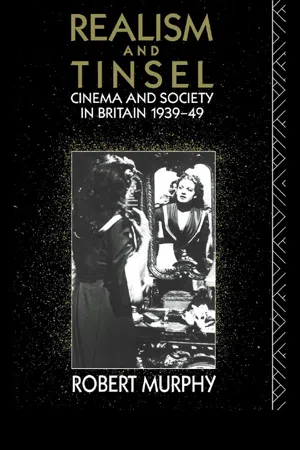
With themes ranging from passion and romance to murder and psychological disturbance, popular British film in the 1940s found little favour with the critics, but provided thrills and entertainment for millions of people during a time of austerity and danger. Realism and Tinsel looks beyond the established histories of Ealing Comedies and realist classics to excavate a rich but neglected tradition of melodrama, gangster films, morbid thrillers, and costume pictures. Discussing cinema in the context of the major social, economic, and political changes that were taking place, Robert Murphy examines the period's most popular films, including Madonna of the Seven Moons, The Way Ahead, and The Wicked Lady. The picture that emerges challenges the reassuring, cosy view of Britain presented in realist cinema, and throws new light on the British film industry of the time, and on our idea of the war era itself.
Information
1
Britain Alone
Not since the 1924–26 studio slump has the British film been confronted with the disagreeable prospect of temporary extinction, and to prophesy the state of home production a year from now would be as hazardous as any other wartime prediction. Only the optimism of craziness foresees a revival in the worth-while sense, and the task of keeping up a supply of product may necessitate a complete revolution in our methods of promotion and finance. (Kinematograph Weekly, December 1939)1
Uncertain beginnings
When war was declared on Sunday 3 September 1939 it looked as if the film industry would be the first casualty. A few weeks earlier, cinema managers had received a Home Office circular warning them that ‘during the initial stages of a war all theatres, music halls, cinemas and other places of entertainment shall be closed throughout the country’.2 A radio announcement following Chamberlain’s broadcast confirmed the order. On Monday, cinema staffs, uncertain of their future, set about spring-cleaning and carrying out black-out precautions; by the end of the week they were fearful for their jobs.
In Wardour Street, the heart of the film industry, several of the major film distributors, optimistic that the war or the closure of cinemas could not last for long, but mindful of their own safety, set out for unfamiliar green pastures: MGM to Rickmansworth, Grand National to Cheltenham, General Film Distributors to Newbury, Columbia to Wadhurst Castle, Sussex.
In the studios there was confusion. Later reports complained of studio staffs being laid off and productions abandoned. But the industry had not fully recovered from a serious slump. Shepperton had been used for very few feature films since the end of 1937, Pinewood had been closed since the end of 1938, and the big new Amalgamated studios at Elstree had been snapped up by its competitors and leased to the government as a warehouse.
When no bombs fell exhibitors and their audiences began to get restive. Britain had approximately 4,800 cinemas and the Cinema Exhibitors Association (CEA) had considerable political clout. Delegations were dispatched to Whitehall and the Kinematograph Weekly persuasively argued that:
If intoxication is becoming a public scandal, if public houses have sold out of beer by 8 p.m. just because the people will insist upon being with a crowd of their fellows and there is nowhere else to go, then the time for re-opening the kinema—and the theatres and the music halls—has become an urgent public necessity.3
The government was forced to agree. Evacuees, rushed out of the conurbations in the first few days, were drifting back to their homes; plans to disperse government ministries were suspended; the film distribution companies were returning to Wardour Street from their country retreats. Within two weeks of war being declared most cinemas were open again. They were to stay open even when the Blitz did come.
There remained the problem of what was to be shown in the re-opened cinemas. Though the technicians union, the ACT, and a few of the more articulate employers like Sidney Bernstein and Michael Balcon, argued that the production of British feature films was essential for wartime morale, all they were able to achieve was a halt to the requisitioning of studios. Government policy was dilatory and contradictory with the Board of Trade inclined to abandon film production in Britain and rely on Hollywood to supply what entertainment might be necessary, and the Treasury keen to foster production as a means of reducing the outflow of foreign exchange (Hollywood films cost at least forty million dollars a year). There was some doubt, though, whether film production could survive in Britain.4
The British film industry was never a very sturdy plant and financial sources tended to dry up at the first sign of trouble. With studios requisitioned and the future of cinema-going uncertain it was hardly surprising that independent producers who had to raise money on a film-by-film basis were forced to shut up shop, but the pessimistic climate also affected much larger companies. ABPC, a major conglomerate with a cinema circuit of over four hundred halls, was insufficiently committed to production to prevent its big Elstree studio from being requisitioned, though a second studio at Welwyn was kept open for the production of low-budget supporting features.
The American companies were required by law to handle a certain percentage of British films, which they either acquired from British producers or made themselves. Initially they reduced their activities to a bare minimum, but once British producers showed it was feasible and even profitable to make films in wartime Britain, Warner Brothers re-opened their Teddington studios (and kept them open until they suffered a direct hit by a V1 rocket in the autumn of 1944), MGM and Twentieth Century- Fox commissioned a number of films from Gainsborough (including Carol Reed’s Kipps and The Young Mr Pitt), and Columbia and RKO set up their own small production units.
Alexander Korda, the most prestigious producer working in Britain, was in the middle of a lavish re-make of The Thief of Bagdad when war broke out. Production was suspended and Korda detailed three directors (Michael Powell, Adrian Brunel, and Brian Desmond Hurst) to work on a flag-waving propaganda piece, The Lion Has Wings. The film was completed and in the cinemas before Christmas, but it had no successors, and Korda went to Hollywood to finish The Thief of Bagdad.5
In the early months of the war the only production companies to continue operating on a regular basis were those of Ealing, British National, and Gainsborough, all of whom had wealthy, patriotic backers, and Butchers, a small production/distribution company which had the unique distinction of having survived the First World War. Butchers was the first company to resume normal production: a prison comedy, Jailbirds, was made at their old Walton-on-Thames studio in October and was followed by a succession of appropriately topical subjects, such as Pack Up Your Troubles, Garrison Follies, Somewhere in England, and Sailors Don’t Care.
Michael Balcon had only recently been appointed head of production at Ealing, but he had managed to pull the company out of the doldrums and had the backing of the Courtauld family, who were the major shareholders, to go ahead with the production of The Proud Valley, an off-beat story about a black seaman—Paul Robeson—whose fine singing voice makes him welcome in a Welsh mining community. The planned ending, however, which was to have shown the miners forming a co-operative to run the mine themselves after being let down by the inefficient and short-sighted management, was changed to show miners and management working together to re-open the mine and fuel the war effort.
Gainsborough was a subsidiary of the Gaumont-British Picture Corporation, which was controlled by the Jewish financier Isidore Ostrer. Like Balcon’s Ealing it was an efficient, well-run set-up, and, with contracts to produce films for MGM and Twentieth Century-Fox, operations were moved from Gainsborough’s Islington home to larger studios at Shepherd’s Bush where work was resumed on an Arthur Askey comedy, Band Waggon.
British National had been founded by flour millionaire J.Arthur Rank and jute millionairess Lady Yule back in 1933, but had drifted into the doldrums after Rank departed for more ambitious ventures. Early in 1939 the company had been joined by John Baxter, a young director responsible for unusual low-budget films like Doss House, Song of the Plough, Say it with Flowers, Music Hall, and Hearts of Humanity. Baxter’s presence and the outbreak of war seemed to galvanize British National into action and an ambitious production programme was embarked upon. After sharing Walton-on-Thames with Butchers they were allowed to re-open Denham for Powell and Pressburger’s Contraband in December, and shortly afterwards took over the large Rock studio at Elstree which had seen little production activity since 1937.
Phoney war films
The period between September 1939 and April 1940 is often referred to as the ‘phoney war’, and there is a light-headed quality about many of the films made then. Of the fifty-one British feature films released in 1940, nearly half were comedies or comedy thrillers. They tended to be characterized by a zany euphoria which went beyond mere complacency. Let George Do It, made at Ealing in March 1940 when Chamberlain was suggesting that Hitler had ‘missed the bus’ and released in August when the Battle of Britain was raging overhead, was one of the most popular films of the year. Directed by Gainsborough’s comedy specialist Marcel Varnel, it employed the usual formula of Formby getting himself into a situation he was supremely ill-fitted to handle and with the help of his ukulele, a pretty girl, and his crazy humour, somehow coming out on top, but it skilfully exploited the possibilities for adventure opened up by the war. George, a member of the Dinky Doos concert party, loses the fellow members of his troupe in the black-out at Dover and instead of catching a train to Blackpool finds himself on a boat to Bergen, a replacement for the murdered ukulele player in a dance band. The band-leader is working for the Germans—sending musically encoded messages to U-Boats to guide their attacks on neutral shipping. George discovers the code and after several adventures finds himself re-united with the pretty British agent who has inspired his bravery, on the decks of a British destroyer.
There are some marvellous slapstick sequences and the supporting cast—Garry Marsh as the villain, Phyllis Calvert as the heroine—are excellent. But what most excited audiences was a brief dream sequence: George drifts in a balloon from England to Germany and finds himself floating over a huge Nazi rally being addressed by Hitler. ‘Hey you! Hey windbag, Adolf—put a sock in it!’ he shouts, and descending on to the platform he proceeds to give Hitler a good hiding. The stormtroopers, far from coming to the Führer’s aid, erupt into jubilant cheering. Chaos ensues and George finds himself back in his room struggling with the bedclothes.6
Gasbags, made at Gainsborough early in 1940, operated on similar lines. The Crazy Gang, given charge of a barrage balloon in Hyde Park, turn it into a well-patronized fish-and-chip stall (‘no coupons required’), and when discovered by their commanding officer, cut themselves loose and soon find themselves drifting over Europe. Inadvertently descending, they fall in line with a platoon of French soldiers and discover too late that these are prisoners being marched to a concentration camp. The film then becomes even more bizarre. The other inmates include Moore Marriott’s Jerry Harbottle, an aged eccentric who had featured in the Will Hay films of the thirties, as well as an army of Hitler look-alikes who are being punished for their refusal to undertake the dangerous work of impersonating the Führer on occasions when he is likely to be assassinated. Eventually the gang escape, employing a secret tunnelling weapon to burrow their way back to London—and their commander’s office.
Despite the fact that Norway had fallen and Britain was desperately fighting off invasion when Let George Do It and Gasbags reached the cinemas, audiences welcomed their madcap optimism. According to Tom Harrisson—whose Mass Observation network made some attempt to gauge the public mood—blatantly absurd comedy was often more acceptable than earnest exhortation and false heroics, and he pointed out that:
Part of good morale, the ability to endure in any circumstance, is the ability to switch yourself off completely. It was a very necessary quality which a great many British people were and still are very good at anyway.7
Films like Gasbags and Let George Do It ensured that the switching-off process was a pleasurable one and inaugurated a strain of fantasy in British films which was to survive and flourish during the war years. But there was also a determined attempt to deal realistically with the problems and dilemmas, situations and experiences thrown up by the war.
The Lion Has Wings, Alexander Korda’s contribution to the war effort, was released in November 1939, only six weeks after war had been declared. Initially it was well received by the Press, though critics later derided its stilted acting and portentous commentary. Ostensibly an attempt to instil confidence in Britain’s air defences, it was hampered by the unwillingness of the RAF to allow Korda’s unit shooting facilities. Though there was a reconstruction of the Kiel Canal bombing raid, producer Ian Dalrymple relied mainly on documentary and newsreel footage, filling it out with a patriotic exhortation from Queen Elizabeth (Flora Robson) cut in from an earlier Korda film, Fire Over England, and a weakly dramatized coda with Ralph Richardson and Merle Oberon.
In the circumstances the film was something of an achievement. As Dalrymple recalled: ‘At the beginning of the war we all suffered from naturally embarrassed in the construction of the film by not knowing what hush-hush, the worst-has-happened, and any-minute-now…. We were disaster might not have occurred before its exhibition.’8 Dalrymple tried to give some durability to the film by concentrating on the virtues of the English character and the achievements of democracy: ‘I opened our film with the suggestion that there was a British ideology arising from our national character; that it was valuable to the world; and that it should not be lost.’9 Though the war at sea allowed for a certain amount of action to be brought to the screen in films like Convoy and For Freedom, it was this celebration of ‘a British ideology’ which was to provide the most fertile ground for film-makers who wanted to deal seriously with the war.
The reality underlying comic discoveries of spies, fifth columnists and saboteurs was that the Second World War was not a simple conflict between nations:
If there were elements in Britain which would collaborate with Hitler, and large elements in Germany who had opposed him and (wishfully it was thought) were still...
Table of contents
- Cover Page
- Title Page
- Copyright Page
- List of Illustrations
- General Editor’s Preface
- Acknowledgements
- Introduction
- 1. Britain Alone
- 2. War Culture
- 3. Realism and Tinsel
- 4. The Rank Empire
- 5. Great Expectations
- 6. Passionate Friends?
- 7. Exotic Dreams
- 8. The Spiv Cycle
- 9. Morbid Burrowings
- 10. Nothing to Laugh At At All
- 11. Challenge to Hollywood
- Conclusion
- Chronology: Cinema and Society In the Forties
- Notes
- Bibliography
Trusted by 375,005 students
Access to over 1.5 million titles for a fair monthly price.
Study more efficiently using our study tools.
Frequently asked questions
Yes, you can cancel anytime from the Subscription tab in your account settings on the Perlego website. Your subscription will stay active until the end of your current billing period. Learn how to cancel your subscription
No, books cannot be downloaded as external files, such as PDFs, for use outside of Perlego. However, you can download books within the Perlego app for offline reading on mobile or tablet. Learn how to download books offline
We are an online textbook subscription service, where you can get access to an entire online library for less than the price of a single book per month. With over 1.5 million books across 990+ topics, we’ve got you covered! Learn about our mission
Look out for the read-aloud symbol on your next book to see if you can listen to it. The read-aloud tool reads text aloud for you, highlighting the text as it is being read. You can pause it, speed it up and slow it down. Learn more about Read Aloud
Yes! You can use the Perlego app on both iOS and Android devices to read anytime, anywhere — even offline. Perfect for commutes or when you’re on the go.
Please note we cannot support devices running on iOS 13 and Android 7 or earlier. Learn more about using the app
Please note we cannot support devices running on iOS 13 and Android 7 or earlier. Learn more about using the app
Yes, you can access Realism and Tinsel by Robert Murphy in PDF and/or ePUB format, as well as other popular books in Media & Performing Arts & Film & Video. We have over 1.5 million books available in our catalogue for you to explore.