- 464 pages
- English
- ePUB (mobile friendly)
- Available on iOS & Android
eBook - ePub
About this book
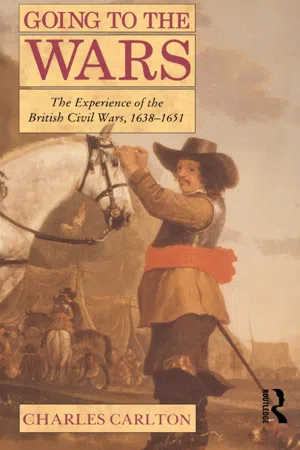
First Published in 2004. During the 1640s, tens of thousands of young British men set off for the Civil Wars full of that innocent enthusiasm with which so many before and since have welcomed the prospect of battle. Few had much idea of the reality of war. Brought up in a relatively peaceful society, they were totally unprepared for the military discipline, the physical exhaustion, the divided loyalties, the emotional strain, the loneliness, and, above all, the violence of combat. Going to the Wars studies the British Civil Wars as a military experience. It is not a traditional campaign history, a political history of the war, or an analysis of weapons, organization, supply or tactics. Rather it explains how men prepared for combat, how they campaigned, fought battles and endured sieges. Others also endured the horrors of war, and the book pays special attention to those often excluded from a military panorama: women, children and prisoners of war. Combining extensive research in primary sources with the work of the new military historians such as John Keegan and Richard Holmes, Charles Carlton provides a fresh look at the event once described by G.M. Trevelyan as the most important happening in our history.
Information
1
THE ACTUALITIES OF WAR
If I had time and anything like your ability to study war, I think I should concentrate almost entirely on ‘the actualities of war’—the effects of tiredness, hunger, fear, lack of sleep, weather…it is the actualities which make war so complicated and difficult, and are usually so neglected by historians.
Field Marshal Wavell to Basil Liddell-Hart
In the summer of 1639 Richard Lovelace had everything a young man of 20 could wish for, ‘being then accounted’, wrote the contemporary historian, Anthony Wood, ‘the most amiable and beautiful person that eye ever beheld…much adored and admired by the female sex’.1 Lovelace was the eldest son of a large, wealthy and ancient Kentish family. Both his father and grandfather had been distinguished soldiers. He had the double blessing of a Cambridge education and an Oxford MA, while his excellent connections at court obtained him an ensign’s commission in the First Bishops’ War and a captain’s in the Second. In the well-known lines Lovelace explained to his Lucasta the excitement that he—like so many other innocent young men before and since—felt about going to the wars:
Tell me not, Sweet, I am unkind
That from the nunnery
Of thy chaste breast and quiet mind,
To war and arms I flee.
That from the nunnery
Of thy chaste breast and quiet mind,
To war and arms I flee.
Over the years much has been written about the wars to which Lovelace went, because historians as distinguished as G.M.Trevelyan have argued that the cataclysm which engulfed the British Isles in the middle of the seventeenth century was the most important happening in our history. At the time Edward Hyde, the Earl of Clarendon, described it as the Great Rebellion in which a few extremists duped the mass of decent moderate men. While this view prevailed during the eighteenth century, in the first half of the nineteenth Thomas Babington Macaulay challenged it by arguing that the civil wars were essentially a Herculean struggle between liberty and despotism, which the former won, thus making possible the glories of Victorian England. Towards the end of the century S.R.Gardiner portrayed the turmoil as a Puritan Revolution, in which Godly Protestants resisted the counter reformation of pseudo-catholic royalists. In more recent times Karl Marx and his followers have interpreted the crisis of mid-seventeenth-century England as the first great Bourgeois Revolution. During this period the gentry supposedly rose—or at least the mere gentry came to the top—as the aristocracy experienced a crisis. Others have turned this thesis on its head by arguing that the aristocracy was behind the revolution all the time. Recently revisionist historians have stressed the short-term, even accidental nature of events, in which the acts of individuals played a more important role than the seemingly inevitable and impersonal forces that the reformation set in motion a century before. John Morrill, for instance, has suggested that the civil wars were essentially Wars of Religion.2
Whatever these events may have been, of two things there can be no doubt. First that the debate over the causes and nature of the crisis that engulfed the British Isles during the middle of the seventeenth century will continue, and second that they were a complex series of wars, in which men and women killed and were killed, had their bodies maimed, and had to endure some of the most traumatic experiences any human being can face. While these wars may have had different causes, may have been waged for widely varying goals, and may have employed different techniques, they share a commonality which is only just beginning to be recognized.3 The appellation ‘the Wars of the Three Kingdoms’ is rather a mouthful (which anyway ignores the Principality of Wales). Perhaps they could be better called ‘The British Civil Wars’ if only because this is more succinct, and may be used to include Ireland as part of the British Isles.4 Without doubt contemporaries recognized the conflict’s complex nature, the first use of the term ‘civil wars’ being in a pamphlet of 1643.5
There is no shortage of excellent books on the civil wars. J.R.Kenyon’s The Civil Wars of England (New York, 1988) is the best recent survey that combines military and political history. The English Civil Wars: A Military History of the Three Civil Wars, 1642–51 (1974) by P.Young and R.Holmes is an excellent introduction. Austin Woolrych’s Battles of the English Civil War (1961) and A.H.Burne’s The Battlefields of England (1951) deal with the confrontations between armies, while Brigadier Peter Young, the doyen of civil-war historians, has covered individual battles in his many books and articles.6
The supply of local studies is just as rich. County histories as those by Mary Coate on Cornwall, R.W.Ketton-Cremer on Norfolk, A.C.Wood on Nottinghamshire, David Underdown on Somerset, Anthony Fletcher on Sussex, Alan Everitt on Kent, Anne Hughes on Warwickshire, and Valerie Pearl on London, spring to mind.7 So do regional studies, such asClive Holmes’s The Eastern Association during the English Civil War (Cambridge, 1974), John Morrill’s The Revolt of the Provinces (1976), and David Stevenson’s The Scottish Revolution, 1637–44 (Newton Abbot, 1973), and Revolution and Counter Revolution in Scotland (1977). The list of biographical studies of participants in the war, ranging from major figures, such as Charles I and Cromwell, to minor players, such as Sir Richard Grenville or Ralph Josselin, is too long to mention. C.H.Firth and Godfrey Davis have written widely on the parliamentary forces.8 Mark Kishlansky has contributed a provocative interpretation in The Rise of the New Model Army (Cambridge, 1979), while the work of Ronald Hutton, Peter Newman, Ian Roy and Joyce Malcolm have done much to shed light on the royalist armed forces.9 Last, and far from least, there are numerous investigations of the wars’ political background, of which those by J.H.Hexter, Blair Worden and Brian Manning are especially noteworthy.10
This book will not try to duplicate such works. Instead it will look at the war as a war, as an experience in which violence—real or threatened— affected the lives of the inhabitants of the British Isles. Since there was little fighting at sea, the main effect of the navy, which parliament controlled, being to prevent foreign intervention, this book will examine the ‘actualities of war’ on land.
‘If I had time and anything like your ability to study war,’ wrote Field Marshal Wavell, the Second World War British Commander, to Sir Basil Liddell-Hart, another equally distinguished writer on military matters,
I think that I should concentrate almost entirely on the ‘actualities of war’—the effects of tiredness, hunger, fear, lack of sleep, weather…. The principles of strategy and tactics, and the logistics of war are really absurdly simple: it is the actualities that make war so complicated and so difficult, and are usually so neglected by historians.
Wavell was reiterating a point that Leo Tolstoy had made nearly a century before. The Russian novelist, who had seen action in the Caucasus and Crimea, admitted that he was fascinated with ‘the reality of war, the actual killing. I was more interested to know in what way and under the influence of what feeling one soldier kills another than to know how the armies were arranged at Austerlitz and Borodino.’ Professor Geoffrey Elton, the distinguished Cambridge historian, who also fought as an infantryman in the British Army in Italy, agrees that professional historians have neglected the realities of war, since ‘astonishingly few’ of them have addressed this topic.11
At one level the reasons for this neglect are simple: at another they are extraordinarily complex.
Surviving records dictate the sort of history which may be written. Ordnance, for instance, always creates large amounts of paperwork, ifonly because ‘bumpf’ is a hedge against the misappropriation of material. For much the same reason armies usually create good pay and muster rolls. Thus it is far easier to write a history of the raising of an army than on how that army fought. Again, because headquarters units are safely away from combat, it is much simpler to write on strategy, showing how divisions and regiments moved cleanly like pins on a map, than it is to show tactically how platoons, squads, individuals, scrabbled frantically on the ground.
Training manuals, military codes of conduct usually survive as records of how things should be done. Unit diaries or ships’ logs may record a version of what might have happened. Yet even logs or diaries, sometimes written during the heat of battle, usually eschew the actualities of war, for the banalities of hard facts, such as the text of orders rather than whether they were, or could have been carried out. During battle men are often too busy or too frightened to create records, and when they do so are often surprised by the banality of what they produce. For instance, the recording of RAF crew intercom conversations or the chatter of US gunship helicopter pilots in Vietnam during intense combat frequently sound like a parody of a bad war film.
The reason is simple: human beings often try to hide behind banality in order to escape the extraordinary.
Without doubt war is the most horrible, most catastrophic, and most immoral event known to man. It is, to quote Tolstoy again, ‘the vilest thing in life’. Such a conclusion contradicts the assumptions of human progress inherent in the Whig view of history. For Marxist historians war is in itself irrelevant since the long-term results are inevitable. Because all too often military history has been used to glorify war, or else to train officers to win bigger and bloodier battles, it has gained a less than savoury reputation. But as Clausewitz, the nineteenth-century Prussian who founded the modern study of war warned, ‘it is of no purpose, it is even against one’s better interests to turn away from the consideration of the real nature of the affair, because the horror of its elements excites repugnance.’12 At the individual level war threatens death or horrid wounds, noises, sights and fears that those innocent of battle cannot imagine, and those who have survived cannot forget. War is so obscene that it is pornographic.
And yet war, like pornography, exerts a profound fascination. If, as General William T.Sherman insisted, war is hell, then, as artists from Dante to Hieronymous Bosch have recognized, many people find looking at the experience of hell, as opposed to actually going there, far more interesting than heaven. ‘As long as war is regarded as wicked, it will have its fascination’, Oscar Wilde observed. Norman Davies took this point a stage further when he wrote that ‘The popularity of books and films dealing with war and violence, like that for pornography…attests to thepleasure provided by the vicarious satisfaction of frustrated drives.’ The links between male sexuality and violence are nigh universal, having been charted in some 112 different societies. They do not appear to have changed much over time, having been recognized long before Sigmund Freud delineated them. During the American Revolution, for instance, Dr Samuel Johnson noted that ‘every man thinks meanly of himself for not having been a soldier’. More recently during the Falklands campaign an officer in the Parachute Regiment observed ‘The only real test of a man is when the firing starts.’13
It is as if having experienced battle was as much a criterion for full masculinity as having had sex. Indeed the links between being a warrior and being a man have always been strong. Bulstrode Whitelocke, who took part in the civil war, recalled that in September 1643 at the First Battle of Newbury ‘both sides performed then with good manhood and animosity’.14 The ability of a soldier’s uniform to attract women has always helped persuade young men to take the Queen’s shilling. Just as US Marine Corps recruiters used to promise ‘to build men’, so Captain Abraham Stanton, a veteran of the English civil war, avowed that as a result of military training ‘Myriads of men now bear arms that bore nothing but only shapes of men before.’15 Troops innocent of battle are called virgin soldiers, waiting for the baptism of fire, which is seen as an important an event—although hopefully a far less pleasant one—in their lives, as losing their virginity.16 Thus Edward Hyde, the civil wars’ most distinguished contemporary historian, called Lord Somerset, the duke whom Charles I made a general notwithstanding his complete lack of military experience, ‘a virgin soldier’.17
Having never seen combat—although having served as a part-time soldier—I am all too aware of the problems faced in trying to write about an experience of which I am innocent. They are a little like those faced by a lifelong celibate trying to draft a sex manual. Both activities are so personal, so intense that no amount of reading other people’s experiences can fully compensate for the lack of one’s own.
On the other hand, because they are so intensely personal, one’s own experiences can cloud other people’s. One tends to see all military events in egotistical terms. Having combat experience may lock one into a view of battle from which it is very difficult to escape. For instance, a Vietnam veteran, even one who believes in God, may find it hard to credit the role religion played in combat in the English civil war: he would credit his survival to our artillery support, their bad shooting, or pure luck, rather than the direct personal intervention of the Almighty. As Sir Basil LiddellHart observed, the historian who fought during the defeat of Dunkirk might find the elation felt by the victorious cavalry at Naseby far harder to comprehend than if he had never left the secure confines of his study.18
‘We have shared the incommunicable experience of war’, wrote Oliver Wendell Holmes of his service in the Union Army. Battle is so traumatic an experience that even today survivors are loath to talk about it, particularly those who were on the losing side. When they do so they often hide in formulas or clichés, which seem to act as salve for mental wounds that may never heal. Such was even more true in the seventeenth century, for which records of close introspection about all matters (except religious salvation) were extremely rare.19 The few autobiographies or diaries from the period do not convey a very strong sense of self. When seventeenth-century men did write about their wartime experiences they invariably used the third person. Just because those veterans did not talk so openly about fear, violence, elation and despair, as men do today, it does not necessarily follow that they did not experience them as intensely. Thus whenever possible I have quoted extensively from the records so the survivors of the civil wars may speak for themselves. If the subject of my book is war and the pity of war, then the people best able to explain it are those others who have known it at first hand.
To overcome the chasm between his own experience and the experiences about which he is writing the military historian must use all the tools of his trade. While the experience of battle changes over time, as General Sir John Hackett has recently argued ‘the essential soldier remains the same. Whether he is handling a sling shot weapon on Hadrian’s Wall, or whether he is in a main battle tank today, he is essentially the same.’ As the pop singer Donovan described ‘The Universal Soldier’:20
He’s four foot two, and he’s six foot four
He fights with muscles and with spears.
He’s all of thirty one and he’s only seventeen
He’s been a soldier for a thousand years.
He fights with muscles and with spears.
He’s all of thirty one and he’s only seventeen
He’s been a soldier for a thousand years.
Perhaps historians have focused too much on change rather than continuity. We may be able to learn more about the experience of war in the British Isles three centuries ago by also examining it in more recent times, when interviews, even statistical surveys, the starkness of film, the frankness of novelists and the writers of memoirs, and the work of military sociologists have done much to shed light on its reality.
But come to think of it there is little difference between this and other historical endeavours. Few political historians have served as kings or presidents: hardly a business historian has headed a major corporation. So going to the British civil wars is in many respects much like embarking on any other historical journey. To discover the actualities of war the historian must first immerse himself in the surviving records, and then with caution and imagination combine his own experiences with those of others to make that leap into the dark that is the past.
2
THE DRUM’S DISCORDANT SOUND
I hate the Drum’s Discordant Sound,
Parading round and round and round.
To thoughtless youth it pleasure yields
And lures from cities and from fields.
John Scot of Amwell (1730–83)
In 1628 Sir Edward Cecil, Viscount Wimbledon, a veteran of the continental wars, complained that ‘This Kingdom hath been too long at peace.’ Perhaps he was trying to justify the failure of the expedition to Cadiz which he had led with a degree of incompetence noteworthy even for early seventeenth-century English generals, for he continued, ‘our old commanders, both by sea and by land are worn out, and few men are bred in their places, for the knowledge of war, and almost the thought of war is extinguished.’1
Others—at home and abroad—agreed with Cecil. In the Spanish Netherlands most people thought the English had become ‘effeminate, unable to endure the fatigations and travails of a war: delicate, well-fed, given to tobaccos, wine, strong drink, feather beds; undisciplined, unarm...
Table of contents
- Cover Page
- Title Page
- Copyright Page
- Illustrations
- Foreword
- Acknowledgments
- 1: The Actualities of War
- 2: The Drum’s Discordant Sound
- 3: A Sight—The Saddest that Eyes Can See
- 4: Naming of Parts
- 5: A Soldier’s Life is Terrible Hard
- 6: The Epitome of War
- 7: The Miserable Effects of War
- 8: Tradesmen of Killing...Managers of Violence
- 9: To Slay and to be Slain
- 10: When the Hurlyburly’s Done
- 11: More to Spoil than to Serve
- 12: I Don’t Want to Go to War
- 13: Then We Started All Over Again
- 14: Does it Matter?
- Notes
Trusted by 375,005 students
Access to over 1.5 million titles for a fair monthly price.
Study more efficiently using our study tools.
Frequently asked questions
Yes, you can cancel anytime from the Subscription tab in your account settings on the Perlego website. Your subscription will stay active until the end of your current billing period. Learn how to cancel your subscription
No, books cannot be downloaded as external files, such as PDFs, for use outside of Perlego. However, you can download books within the Perlego app for offline reading on mobile or tablet. Learn how to download books offline
Perlego offers two plans: Essential and Complete
- Essential is ideal for learners and professionals who enjoy exploring a wide range of subjects. Access the Essential Library with 800,000+ trusted titles and best-sellers across business, personal growth, and the humanities. Includes unlimited reading time and Standard Read Aloud voice.
- Complete: Perfect for advanced learners and researchers needing full, unrestricted access. Unlock 1.5M+ books across hundreds of subjects, including academic and specialized titles. The Complete Plan also includes advanced features like Premium Read Aloud and Research Assistant.
We are an online textbook subscription service, where you can get access to an entire online library for less than the price of a single book per month. With over 1.5 million books across 990+ topics, we’ve got you covered! Learn about our mission
Look out for the read-aloud symbol on your next book to see if you can listen to it. The read-aloud tool reads text aloud for you, highlighting the text as it is being read. You can pause it, speed it up and slow it down. Learn more about Read Aloud
Yes! You can use the Perlego app on both iOS and Android devices to read anytime, anywhere — even offline. Perfect for commutes or when you’re on the go.
Please note we cannot support devices running on iOS 13 and Android 7 or earlier. Learn more about using the app
Please note we cannot support devices running on iOS 13 and Android 7 or earlier. Learn more about using the app
Yes, you can access Going to the Wars by Charles Carlton in PDF and/or ePUB format, as well as other popular books in Historia & Historia británica. We have over 1.5 million books available in our catalogue for you to explore.