"Part chronicle, part analysis and part advice manual, Social Scientists Meets the Media combines the thoughts of academics and media people to produce a vivid and valuable series of accounts that will prove of service to all academics seeking a wider audience but wary of the terra incognita they face in finding one" Ellis Cashmore, Staffordshire University
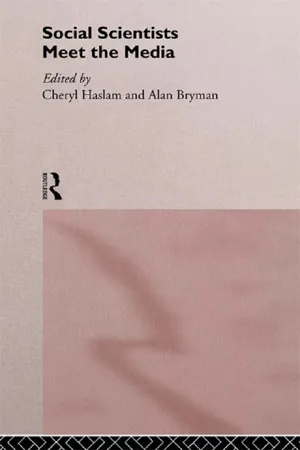
Social Scientists know they are in a dilemma: their work may fall prey to sensationalism, but at the same time they don't want to be overlooked. Social Scientists Meet the Media collects the experiences of academics who have sought to publicize their research. It contains personal accounts from social scientists with extensive media contact and representatives from radio, television and the press. Based on these often humorous and sometimes chastening accounts, the editors suggest ways to achieve a more fruitful relationship between social scientists and the media.
- 248 pages
- English
- ePUB (mobile friendly)
- Available on iOS & Android
eBook - ePub
Social Scientists Meet the Media
About this book
Information
Part I
Social scientists
Chapter 1
If you want publicity...call an estate agent?
Robert G.Burgess
When I published my first major empirical study (Burgess, 1983), I was encouraged by my publishers to think about the way in which my research could be linked to a story that would be attractive to the media. The study was of an urban co-educational Roman Catholic comprehensive school and had looked at particular aspects of school organization and also at the education of children who were defined by the school as being of ‘average’ and ‘below average’ ability. In this sense, the volume, which was an ethnographic study, provided portraits of difficult situations and disruption in a school and was expected to capture media attention.
It was decided that a press release would be prepared by the publisher and this would be sent together with a copy of the book to selected local and national newspapers, television programmes and radio shows. At this point, my hopes were high. I dreamt of being interviewed by numerous national newspapers, of appearing on breakfast television and of being contacted to appear on the Jimmy Young show on Radio 2. Indeed, my major concern was how I would inform friends and relatives that I was to be interviewed on the Jimmy Young programme if I was not given sufficient time or warning as to when I would be required. These were just dreams. The day the book was published I recall I waited close to a phone, but there were no calls. Almost a week later there had still been no follow-up, but I was told by the publisher that this always took time.
At last, after a week, the education correspondent on the Coventry Evening Telegraph telephoned me. She indicated that she had most of the details on the press release and just wanted to check out one or two things. This was my first real media interview. It seemed very routine until she got to the question ‘And can you tell me, is this a local school?’. At that point my heart quickened. I was concerned that a discovery might be made, but I gave the standard reply that I had promised not to divulge the identity of the school. To my surprise, she did not follow it up, did not ask a further question, and thanked me for the interview. This had been easy but I remained concerned. I could imagine her telephoning various schools rather in the way in which journalists had telephoned local factories in Greater Manchester when David Morgan had reported his findings to the British Association (Morgan, 1972). In this respect, I thought there was a chance that my cover would be blown and the real identity of the school would be portrayed in the press. Two nights later my fears were allayed when a very small column reported the contents of the book, and indicated I was a member of the Department of Sociology at Warwick University. There was no comment, no follow-up and really very little space devoted to it.
I report this exchange as it illustrates my naïvety in handling the press. I had no experience of dealing with the media; I had imagined that journalists would want to publish (indeed sensationalize) what I had written, and that there was a real story. I had little idea that encounters with the media needed to be developed, not only by publishers, but by researchers who need to write press releases carefully and be prepared to answer questions.
Encounters with the media and with journalists take a variety of forms. Since my first experience, I have found that I have been involved with journalists in a variety of different contexts. Firstly, in dealing with issues about the professional state and status of sociology on behalf of the British Sociological Association; secondly, reporting on my research experience and current investigations; and finally, reporting educational developments in my capacity as the Chairman of an Examination Board which was established to devise the first national examination for estate agents.
In each of these situations, my contact with the media has taken two forms: Firstly, where a journalist has contacted me to request information in order to develop a story, and secondly, where a journalist uses a press release to report something in which I have been involved, or follows up a press release through a subsequent interview. It is to these encounters that I now turn.
DEVELOPING A PROFESSIONAL IMAGE
Sociology has not had a good press. In recent years the subject has been portrayed in ways which are far from flattering, whereby journalists have claimed that unemployment is higher among sociologists (when in reality it has been no higher than among engineers). There have been claims that sociologists do very little work and old jokes have been recycled in the popular press to pander to the beliefs of the perceived readership. In addition, sociology has not been assisted by British Telecom's Beatie advertisement in which she finds that her nephew has failed all examination subjects apart from sociology. While this may appear an amusing telephone conversation, by implication it suggests that sociology is somewhat easier than other subjects.
In this respect, the British Sociological Association has attempted to counter this image by appointing a press officer and making links with the media. Indeed, it was anticipated that at the time the Association celebrated its fortieth anniversary there would be many opportunities for good press coverage on the discipline. At the time, I was President of the Association and it was suggested that I should give an interview to a journalist from The Sunday Times who wanted to do a story on the discipline and on a profile of sociology over 40 years. I was told that the journalist was interviewing a number of sociologists and that I would be interviewed as a representative of the Association. I spent over an hour talking to the journalist on the telephone. I was asked for statistical information on numbers of students taking sociology in higher education and at Advanced Level. Indeed, I recall looking up information as the journalist impressed upon me how important it was to have accurate evidence. By the end of the interview I thought I had dealt with someone who was taking some care over the material to be published. That was Friday evening.
By Sunday morning I was bitterly disappointed. The article appeared, but under the headline ‘The’ ology we all love to hate’. This was followed by a statement about sociology and its supposed development together with a series of comments from a number of people who were antagonistic to sociology. Relatively little space was devoted to sociology as a discipline, the popularity of the subject, the increase in higher education applications and so on. In this sense, I really wondered why the journalist had bothered to interview me, but I felt it was important to continue to develop relationships with the press to promote the discipline and develop its image. Interviews would need to be granted to journalists in the future, but in turn it was important to set the record straight. At one stage I had envisaged writing to The Sunday Times, but after some discussion with other executive officers we decided that this would be an empty gesture and would only draw further attention to the original article which might well have been missed by a number of readers. However, I decided that whatever opportunities came my way, I would write up the record of sociology and challenge those myths that surround the subject.
Rather than using the popular press I have used other strategies to publicize sociology. In my Presidential Address (Burgess, 1990) I decided I would talk about sociology in a way which would challenge popular stereotypes of the social sciences in general and sociology in particular. A speech by Robert Jackson (the then Secretary of State for Higher Education) had indicated that it was easy to recognize the 35-year-old taxi driver with a Master's degree in sociology ‘clinging to the urban fringe’. In my address, I demonstrated that this was a stereotypical image of sociology and reminded my audience and Robert Jackson that a very significant article had been written by Fred Davis (1959) on the basis of being a taxi driver. In addition, I have also published articles in more popular journals such as Newscheck (a magazine that goes into schools and colleges). A Newscheck article was written with Margaret Wallis, (Burgess and Wallis 1991) under the title that had been used in The Sunday Times ‘Sociology—the ‘ology we all love to hate?’, but we added the question mark and went on to demonstrate that this was not the case. Indeed we showed how sociology has increased in popularity at Advanced Level and degree level and how sociology graduates can look forward to being employed in a variety of occupations. Sociologists need to utilize popular magazines as well as academic journals to portray their subject and to counter negative images provided by journalists who wish to pander to their readers rather than base their reports on evidence.
REPORTING RESEARCH: THE ART OF THE PRESS RELEASE
Another way in which the relevance of sociology can be demonstrated to members of the public is through reports on research activities. Here, it becomes important to communicate research work and research findings in a way that will be accessible to a variety of readers. Local and national newspapers can be assisted in reporting findings by the production of press releases that are carefully designed and targeted in relation to the subject matter of the investigation. In recent years I have been engaged in a variety of topics that link together social and educational research where sociology is used as a vehicle to explore a variety of situations that occur in schools and classrooms.
One project on which I worked was ‘Energy Education and the Curriculum’. This was a short-term project commissioned by Hampshire LEA between February and May 1989. The project involved an analysis of the way in which curriculum materials were trialled and used in Hampshire schools. The materials were based around a series of curriculum packs, each of which took a zoo animal as a major vehicle for communicating the material— sun monkeys for infant and first school children, and snow cats for junior and lower secondary school pupils. As far as the project team was concerned, we were engaged in a sociological study of curriculum development which would have links with policy and practice in the Hampshire authority and in Hampshire schools (Burgess et al., 1989). Meanwhile, for the local authority it was an examination of the effectiveness of their materials, and for the schools it was an opportunity to have some feedback on the way in which the project had been handled in a variety of locations. In these circumstances, it seemed appropriate to get some material about the project published in the Hampshire press.
I approached our press officer at the university who suggested I should begin by drafting a press release. My attempt was as follows:
WARWICK RESEARCHERS EXPLORE ENERGY CONSERVATION IN HAMPSHIRE
A research team led by Professor Robert Burgess, Director of the Centre for Educational Development, Appraisal and Research at the University of Warwick, has been commissioned by Hampshire LEA to evaluate a curriculum project on Energy Conservation that is currently being trialled in sixteen schools in south west Hampshire.
The LEA have devised a cross curricular approach to energy conservation for infant/first school pupils, junior/middle school children and secondary pupils. The authority have devised packs of material that include investigations, classroom and field based activities, pictures, fact sheets and a video. The programme is a framework for enquiry based learning in the schools. The Warwick team will visit schools to see the ways in which the curriculum materials are used by teachers and pupils and the links that are made to the school curriculum and the National Curriculum.
The results of the trialling of the project will be available in May.
When I visited the press officer with my press release, he started to enquire about the focus of the project and what pupils were doing in the schools. I indicated that much of the teaching took place around animals that were in Marwell Zoo (a zoo in Hampshire which pupils could visit and see the animals for themselves). This he found more interesting than any of the social science that I had talked about and he therefore offered to rewrite the press release focusing on the use of animals in the zoo. His version of the press release was as follows:
WARWICK RESEARCHERS LOOK AT EDUCATION FOR ENERGY CONSERVATION IN HAMPSHIRE
A research team led by Professor Robert Burgess, Director of the Centre for Educational Development, Appraisal and Research at the University of Warwick, has been commissioned by Hampshire LEA to evaluate a curriculum project on Energy Education that is currently being tried out in sixteen schools in south west Hampshire. The programme is being run under the title ‘ECAMP’, which stands for Energy Conservation Awareness/ Motivation Project.
Using imaginative teaching packs based on endangered animals at Marwell Zoo, Hampshire LEA have devised a cross curricular approach to energy conservation called ‘Sun Monkeys’ for infant/ first school children and ‘Snow Cats’ for junior/middle school children. There is also a pack with a space scene for secondary pupils. The authority have devised packs of material that include investigations, classroom and field based activities, pictures, fact sheets and a video. All packs are built around exciting real life conservation issues complicated by energy needs.
The Warwick team will visit schools to see the ways in which the curriculum materials are used by teachers and pupils and the links that are made to the school curriculum and the National Curriculum.
The results of the trialling of the project will be available in May.
With the rewriting, the focus had changed. Some of the language of the project concerning cross-curricular themes was now embedded with other evidence about the animals who could be seen in Marwell Zoo, and it was claimed (by the press officer) that they were endangered species. Two weeks later a copy of an article was sent to me that had appeared in the Hampshire Chronicle. The article consisted of the whole of the press release presented as five separate paragraphs under the title ‘Marwell Zoo is inspiration for project’. It seemed a far cry from the world of sociology and social science, but it did communicate with a local readership in Hampshire, it did demonstrate that researchers were engaged in work that was beyond the ‘ivory tower’ and would have relevance for policy and practice. I had learned a major lesson, namely that press releases need to be carefully designed because they are often used in their entirety by journalists. In addition, I was made aware that topics which may be of immediate interest to social scientists are not necessarily those that are of interest to journalists and the general public. This is an important feature when preparing material for the press, as more often than not the stories are constructed on the basis of a press release rather than on any subsequent interview or investigation.
INTERVIEW OR INVENTION? THE ‘NEWS’ STORY
Some topics in social science are instantly newsworthy—at least in the eyes of reporters. In the summer of 1992, details of a project grant that I had obtained as part of the Economic and Social Research Council's ‘Nation's Diet’ initiative was included at a press launch at the British Association meetings. A Nation's Diet pack including details of the project entitled ‘Teaching and Learning about Food and Nutrition in Schools’ had been circulated to a range of reporters.
My first press contact on this project was with Dorothy Lepkowska (Education Correspondent of the Birmingham Post). The interview and the article which followed focused on the design of the project and the issues we intended to explore under the title ‘Professor in search for pupils with taste?’:
School dinners are to be scrutinised as part of a nationwide study into children's eating habits.
Prof Robert Burgess, a professor of sociology at Warwick University will spend two years visiting schools, where he will also look at the role they play in children's knowledge of nutrition.
The study is part of a £1.4 million six-year project which will be the first of its kind to look into the eating habits of children in Britain.
It is being paid for by the government's Economic and Social Research Council.
Yesterday Prof Burgess said he was entering his research with a completely open mind.
He said ‘Adults always think children eat what isn't good for them, but I will be seeking to find out whether that is the case.’
‘I will be particularly interested to look into the McDonald's culture which somehow sits alongside the healthy eating ethos schools are attempting to transmit.’
‘We will be asking children to keep diaries of what they eat throughout the day to find out how far they are influenced by what they eat at school, and at home.’
Experts will sit in on classes where food nutrition is being discussed and will attend special events, such as Food Weeks, organised by schools.
Pupils at four Midland schools—two primary and two secondary –will be investigated in depth, but Prof Burgess declined to say which ones.
They will be situated in different socio-economic areas so we get a good cross-section of population and identify how culture influences what people eat’, he said, ‘If children choose to spend their lunch money in the local chip shop instead of in the school canteen then we will follow them to find out what they buy’
A subsequent article appeared in the Birmingham Evening Mail which had made no contact with me and appeared to be little more than a recast version of the story in the Birmingham Post:
EXPERT PROBES SCHOOL DINNERS
A Midland academic is joining a nationwide study into children's eating habits by scrutinising school dinners.
Prof Robert Burgess, a professor of sociology at Warwick University, will spend two years visiting schools, to look at the role they play in children's knowledge of nutrition.
The study is part of a project funded by the government's Economic and Social Research Council, the first of its kind to look into the eating habits of children in Britain.
Prof Burgess said ‘Adults always think children eat what isn't good for them but I wil...
Table of contents
- Cover Page
- Half Title Page
- Title Page
- Copyright Page
- Contents
- Notes on contributors
- Preface
- Acknowledgements
- Introduction
- Part I Social scientists
- 1 If you want publicity…call an estate agent?
- 2 The psychologist and the media: opportunities, challenges and dangers
- 3 The sociologist as media football: reminiscences and preliminary reflections
- 4 Media vs. reality?
- 5 The research dissemination minefield
- 6 Sex and dinosaurs
- 7 Pornography's piggy in the middle: pressure groups, the media, and research
- 8 Tales of expertise and experience: sociological reasoning and popular representation
- 9 Media representations of psychology: denigration and popularization, or worthy dissemination of knowledge?
- 10 Contributing to broadcast news analysis and current affairs documentaries: challenges and pitfalls
- Part II The media
- 11 Productive partners—the view from radio
- 12 Television's dangerous liaisons
- 13 From science to journalism
- Social scientists and the media: an overview
- Bibliography
- Index
Trusted by 375,005 students
Access to over 1.5 million titles for a fair monthly price.
Study more efficiently using our study tools.
Frequently asked questions
Yes, you can cancel anytime from the Subscription tab in your account settings on the Perlego website. Your subscription will stay active until the end of your current billing period. Learn how to cancel your subscription
No, books cannot be downloaded as external files, such as PDFs, for use outside of Perlego. However, you can download books within the Perlego app for offline reading on mobile or tablet. Learn how to download books offline
Perlego offers two plans: Essential and Complete
- Essential is ideal for learners and professionals who enjoy exploring a wide range of subjects. Access the Essential Library with 800,000+ trusted titles and best-sellers across business, personal growth, and the humanities. Includes unlimited reading time and Standard Read Aloud voice.
- Complete: Perfect for advanced learners and researchers needing full, unrestricted access. Unlock 1.5M+ books across hundreds of subjects, including academic and specialized titles. The Complete Plan also includes advanced features like Premium Read Aloud and Research Assistant.
We are an online textbook subscription service, where you can get access to an entire online library for less than the price of a single book per month. With over 1.5 million books across 990+ topics, we’ve got you covered! Learn about our mission
Look out for the read-aloud symbol on your next book to see if you can listen to it. The read-aloud tool reads text aloud for you, highlighting the text as it is being read. You can pause it, speed it up and slow it down. Learn more about Read Aloud
Yes! You can use the Perlego app on both iOS and Android devices to read anytime, anywhere — even offline. Perfect for commutes or when you’re on the go.
Please note we cannot support devices running on iOS 13 and Android 7 or earlier. Learn more about using the app
Please note we cannot support devices running on iOS 13 and Android 7 or earlier. Learn more about using the app
Yes, you can access Social Scientists Meet the Media by Alan Bryman,Cheryl Haslam in PDF and/or ePUB format, as well as other popular books in Social Sciences & Media Studies. We have over 1.5 million books available in our catalogue for you to explore.