Based on an empirical examination of psychiatric care both past and present,Asylum in the Community clearly defines the concept of asylum and shows how it can be provided effectively outside the hospital. Drawing on work in the USA, Belgium, Spain, Ireland and England, contributors analyse such services from both user and provider perspectives. From these analyses the editors establish the key elements that should be considered in developing contemporary community services for the mentally ill.
Asylum in the Community provides a balanced assessment of a controversial, topical issue for managers and providers of mental health services and those teaching or training in the mental health sciences.
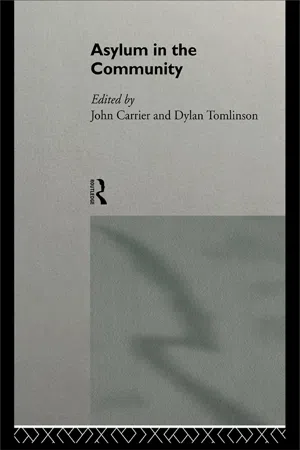
- 240 pages
- English
- ePUB (mobile friendly)
- Available on iOS & Android
eBook - ePub
Asylum in the Community
About this book
Information
Chapter 1
Asylums
Utopias and realities
Andrew Scull
INTRODUCTION
This chapter provides a series of historically informed reflections on the vicissitudes of the term ‘asylum’. The concept has, it turns out, undergone striking changes in meaning over the course of the past two centuries. Originally associated at the outset of the nineteenth-century lunacy reform movement with Utopian visions of institutions that would serve as humane and creative retreats, to which the mad would repair for rehabilitation, the concept acquired darker overtones in the Victorian age, as initial expectations met with disappointment, and what were intended as philanthropic foundations degenerated into more or less welltended cemeteries for the still breathing. In the second half of our own century, such ‘loony bins’ have come under sustained ideological assault, and the once positive associations of the term asylum have been transformed, via the writing of the sociologist Erving Goffman and others, into something with sinister overtones of the concentration camp.
Most recently of all, however, the failure of community neglect masquerading as community care has created renewed interest in the relevance of the more positive meanings that can be attached to the notion of ‘asylum’.
Most recently of all, however, the failure of community neglect masquerading as community care has created renewed interest in the relevance of the more positive meanings that can be attached to the notion of ‘asylum’.
IMAGES OF THE ASYLUM
For much of the twentieth-century, institutional psychiatrists have shied away from the term ‘asylum’. Even a hundred years ago, the concept’s associations with what Ernest Jones called the ‘Chubb lock era’ in psychiatry were an embarrassment for professionals desperate to escape their public image as little more than custodians of the degenerate and defective, and concerned to emphasise their links with the more respectable sectors of the medical profession. Hence the eagerness with which alienists sought in those years to relabel their establishments as mental hospitals and themselves as expert practitioners of psychological medicine. In the half century since the Second World War, the reluctance to make use of the older terminology has become even more pronounced. A generation of sociological studies critical of the mental hospital’s therapeutic pretensions culminated in Goffman’s (1961) denunciation of such places as fundamentally and irremediably flawed. Asylums, his book of that title, proclaimed, stigmatised, dehumanised, and systematically disabled the inmates they purported to cure. They were ‘total institutions’ that, in crucial respects, resembled nothing so much as concentration camps. With institutional care for the mentally ill rapidly falling into disfavour in political circles during the same period, as policy-makers rushed to embrace the mythical vision of a community anxious to re-embrace the mentally ill, the asylum’s fate seemed sealed on still another front. Its paymasters increasingly dismissed it as a well-meaning experiment gone wrong, an expensive irrelevance now thankfully to be relegated to the dustbin of history.
In view of its ignominious end, it is difficult to recall how differently the founders of the asylum era expected their creation to turn out. The lunacy reform movement of the early nineteenth century was driven forward, in substantial measure, by a Utopian vision of the possibilities of asylum life. So, far from being ‘a moral lazar house’ (Coombe, 1950:
376) wherein the deranged were hidden and hope and humanity abandoned, the asylum in the imagination of its proponents was transmuted into the ‘moral machinery’ through which the mind was to be strengthened and reason restored.
376) wherein the deranged were hidden and hope and humanity abandoned, the asylum in the imagination of its proponents was transmuted into the ‘moral machinery’ through which the mind was to be strengthened and reason restored.
To be sure, the moral outrage that gave energy and urgency to the reformers’ efforts was periodically refuelled by trade in lunacy. A series of parliamentary inquiries appeared to provide lurid confirmation of the public’s worst gothic nightmares about what transpired behind the high walls and barred windows of the madhouse. The reports of the Select Committees themselves, and the books and pamphlets produced by those agitating for lunacy reform, contained a compelling amalgam of sex, madness, maltreatment, and murder, mixed together in a fashion guaranteed at once to titillate and repel: patients bled and drugged into insensibility; their public display, ‘like animals in a menagerie’; unregarded deaths from botched force-feeding and the brutality of uncaring attendants; the corrupt confinement of the sane, amidst the shrieks and raving of the mad; the placing of even those madwomen who retained some semblance of ‘innate’ female purity and modesty at the disposal of the lascivious ruffians who served as madhouse attendants; and the ingenious array of ‘bolts, bars, chains, muffs, collars, and strait-jackets’ madhouse proprietors had devised to coerce a measure of order from recalcitrant raw materials.
At least as vital to the achievement of lunacy reform, however, was the construction of a positive image for the reformed asylum. Here, if its proponents were to be believed, were ‘miniature worlds, whence all the disagreeable alloys of modern life are as much as possible excluded, and the more pleasing portions carefully cultivated’ (Anon., 1836–1837:
697). Most famously realised by Tuke and Jepson at a Quaker institution, the York Retreat, this novel version of a haven for the mentally ill presented a very different scene to those with occasion to view it.
697). Most famously realised by Tuke and Jepson at a Quaker institution, the York Retreat, this novel version of a haven for the mentally ill presented a very different scene to those with occasion to view it.
The asylum was now to be a home, where the patient was to be known and treated as an individual, where his/her mind was to be constantly stimulated and encouraged to return to its natural state. Mental patients required dedicated and unremitting care, which could not be administered on a mass basis, but, rather, must be flexible and adopted to the needs and progress of each case. Such a regime demanded kindness and an unusual degree of forbearance on the part of the staff. If the ideal were to be successfully realised, the attendants would have to be taught to keep constantly in mind the idea that ‘the patient is really under the influence of a disease, which deprives him of responsibility, and frequently leads him into expressions and conduct the most opposite to his character and natural dispositions’ (Tuke, 1813:
175). Crucial, too, was the moral influence of the asylum’s governor. By paying ‘minute attention’ to all aspects of the day-to-day conduct of the institution, by always setting, through his own example, a high standard for subordinates to emulate in their dealings with the inmates, by observing the patients daily, sometimes hourly, he could foster the kind of intimate and benevolent familial environment in which acts of violence would become rare. Indeed, as the autocratic guiding spirit of the whole curative apparatus, the superior moral and intellectual character of the medical superintendent was an essential precondition for success.
175). Crucial, too, was the moral influence of the asylum’s governor. By paying ‘minute attention’ to all aspects of the day-to-day conduct of the institution, by always setting, through his own example, a high standard for subordinates to emulate in their dealings with the inmates, by observing the patients daily, sometimes hourly, he could foster the kind of intimate and benevolent familial environment in which acts of violence would become rare. Indeed, as the autocratic guiding spirit of the whole curative apparatus, the superior moral and intellectual character of the medical superintendent was an essential precondition for success.
Classification, separation, and employment, all central features of Tuke’s version of moral treatment, were to be combined with careful attention to the architecture and physical setting of the asylum. Since it was recognised that the insane were very sensitive to their surroundings, buildings ought to emphasise as little as possible the idea of imprisonment or confinement. Indeed, spacious and attractive accommodation could make its own contribution to the inmates’ ‘moral training’, and to replacing ‘their morbid feelings…[with] healthy trains of thought’ (Browne, 1837:191). Treatment could thus be individualised and adapted to the peculiarities of the particular case, and interaction managed and controlled within carefully constructed communities of the mad.
Here was an ideological vision of extraordinary resonance and surpassing attractiveness, of a social universe constituting an organic, harmonious whole wherein even the rage of madness could be reigned in without whips, chains, or corporal punishment, amidst the comforts of domesticity and the invisible yet infinitely potent fetters of ‘the desire for esteem’ (Tuke,1 837:157). Men like William Tuke, William Alexander Francis Browne, and John Conolly insisted, moreover, that theirs was a ‘description…not…of a theorist, or of an enthusiast, but of… practical [men] long accustomed to the management of lunatics’ (Conolly,1838: 74). It was, said Browne (1837:231), ‘a faithful picture of what may been seen in many institutions, and of what might be seen in all, were asylums conducted as they ought to be’. Within the controlled confines of the institution, even the irrational and the raving could be reduced to docility and cured of their madness, and by moral suasion and self-sacrifice, rather than by force. With all the fervour of a new convert, John Conolly(1847:143) delivered a panegyric to the new asylum, the place where
calmness will come; hope will revive; satisfaction will prevail.
Some unmanageable tempers, some violent or sullen patients, there must always be; but much of the violence, much of the ill-humour,almost all the disposition to meditate mischievous or fatal revenge, or self-destruction will disappear… Cleanliness and decency will be maintained or restored; and despair itself will sometimes be found to give place to cheerfulness or secure tranquillity. [The asylum is the place] where humanity, if anywhere on earth, shall reign supreme.
Some unmanageable tempers, some violent or sullen patients, there must always be; but much of the violence, much of the ill-humour,almost all the disposition to meditate mischievous or fatal revenge, or self-destruction will disappear… Cleanliness and decency will be maintained or restored; and despair itself will sometimes be found to give place to cheerfulness or secure tranquillity. [The asylum is the place] where humanity, if anywhere on earth, shall reign supreme.
VICTORIAN MUSEUMS OF MADNESS
The small, intimate institution which allowed even a remote approximation to this idyll did not survive for long. The influx of a horde of pauper lunatics brought the demise of the notion that the asylum should be a substitute household. Instead, local magistrates insisted on taking advantage of presumed economies of scale, and until well into the twentieth century, the average size of county asylums grew almost yearly. The degree of regimentation needed to administer institutions of 500, 1,000, and more ensured that such asylums would be the virtual antithesis of their supposed inspiration, the York Retreat. To Tuke, moral treatment had meant the creation of a stimulating environment where routine could be sacrificed to the needs of the individual. Here the same term disguised a monotonous reality in which the needs of the patients were necessarily subordinated to those of the institution; indeed, where a patient’s needs were unlikely even to find expression. Hence John Arlidge’s trenchant conclusion (1859:102) that ‘a gigantic asylum is a gigantic evil’.
At the margin, among those newly admitted to an asylum, turnover remained reasonably rapid, with between a quarter and two-fifths being discharged within a year or so of their arrival. Each year, however, a very substantial fraction remained behind to swell the population of chronic, long-stay patients, and as the size of county asylums grew remorselessly, annual admissions formed a smaller and smaller fraction of the whole. An over-whelming and growing proportion of the asylum population thus came to be composed of patients who lingered year after year; and it was this spectre of chronicity, this horde of the hopeless, which was to haunt the popular imagination, to constitute the public identity of the asylums, and to dominate Victorian and Edwardian psychiatric theorising and practice. Despairingly, W.A.F.Browne viewed the collapse of the vision he had once propagated of the asylum as a curative establishment under the weight of ‘a vast assemblage of incurable cases’ (Crighton Royal Asylum, 1857:
8). Their numbers ensured, he said, that
8). Their numbers ensured, he said, that
The community becomes unwieldy; the cares are beyond the capacity of the medical officers; personal intimacy is impossible; recent cases are lost, and overlooked in the mass; and patients are treated in groups and classes. An unhealthy moral atmosphere is created; a mental epidemic arises, where delusion, and debility, and extravagance are propagated from individual to individual, and the intellect is dwarfed and enfeebled by monotony, routine, and subjection.
(ibid.)
As asylums silted up with the chronically crazy, those Browne dubbed ‘the waifs and strays, the weak and wayward of our race’,1 so Victorian psychiatry moved steadily towards a grim determinism, a view of madness as the irreversible product of a process of mental degeneration and decay. The madman, as Maudsley put it, ‘is the necessary organic consequent of certain organic antecedents: and it is impossible he should escape the tyranny of his organization’ (Maudsley,1879:88). Insanity constituted nothing less than a form of phylogenetic regression —which accounted, of course, for its social location and for the lunatic’s loss of civilised standards of behaviour and regression to the status of a brute. Maudsley rhetorically asked,
Whence came the savage snarl, the destructive disposition, the obscene language, the wild howl, the offensive habits displayed by some of the sane? Why should a human being deprived of his reason ever become so brutal in character as some do, unless he has the brute nature within him?
(Maudsley,1870:53)
Employing ever harsher language which combined a physiological account of madness with ‘the look and tone of moral condemnation’, (Turner, 1988:179) psychiatric discourse now exhibited a barely disguised contempt for those ‘tainted persons’ (Straham, 1890:337) whom it sequestered on society’s behalf. And within such a world-view, given that the notion of mass sterilisation never acquired the status of a serious option in Britain, 2 the asylum was naturally accorded a wholly new significance in the battle to contain social pathology and to defend the social order.
Local authorities were always reluctant to spend ‘extravagant’ sums of money on the poor, and the funds for a predominantly custodial operation were predictably scarce, rarely more than what was needed to supply a bare minimum of care. Occasionally, indeed, the cheeseparing went too far, as in Buckinghamshire between 1916 and 1918, when the official dietary tables for St John’s Hospital suggest that a male patient’s daily food allowance provided only 40 grams of protein and 750 calories a day (which may be compared with what is now estimated to be a minimum requirement for a sedentary man of 60 grams of protein and 2, 100 calories). Female patients received even less. With a deliberate policy of semi-starvation carried to this extreme, the result (as J.L. Crammer, 1991:76–77, 113, 126–127, has noted) was a very sharp increase in asylum mortality rates, till in 1918, a third of the asylum population died in the space of twelve months, a denouement which finally shamed the authorities into action and led to limited improvements in the patients’ diet.
Recent work has shown that even in small, richly endowed private facilities—the Crichton Royal Asylum in Dumfries, the Ticehurst Asylum (the favourite resort for deranged English aristocrats), and the York Retreat itself 3—the quality of care provided by an essentially custodial operation tended to diminish steadily over time. Although, as Anne Digby(1985:199, 56) summarises in her findings for the York Retreat, ‘individuality was not crushed into helpless anonymity’ (as in the county asylums), still by the last third of the nineteenth century, control and discipline were the paramount goals of the institution, and ‘patients were no longer subjects to be t...
Table of contents
- COVER PAGE
- TITLE PAGE
- COPYRIGHT PAGE
- ILLUSTRATIONS
- CONTRIBUTORS
- ACKNOWLEDGEMENTS
- INTRODUCTION
- CHAPTER 1: ASYLUMS UTOPIAS AND REALITIES
- CHAPTER 2: THE DECLINE OF ASYLUM OR THE POVERTY OF THE CONCEPT?
- CHAPTER 3: ASYLUM AND THE COMMUNITY IN SPAIN
- CHAPTER 4: THE APPEAL TO MADNESS IN IRELAND
- CHAPTER 5: LAW AND THE SOCIAL USES OF THE ASYLUM IN NINETEENTH-CENTURY IRELAND1
- CHAPTER 6: THE REFUGE FUNCTION OF PSYCHIATRIC HOSPITALS
- CHAPTER 7: HAVEN WITHIN OR WITHOUT THE HOSPITAL GATE A REAPPRAISAL OF ASYLUM PROVISION IN THEORY AND PRACTICE
- CHAPTER 8: THE AMERICAN, FLEMISH AND BRITISH CASES OF ASYLUM IN THE COMMUNITY
- CHAPTER 9: SOME MODELS OF ASYLUM AND HELP IN TIMES OF CRISIS
- CHAPTER 10: THE SANCTUARY PROJECT 1
- CONCLUSION
Trusted by 375,005 students
Access to over 1.5 million titles for a fair monthly price.
Study more efficiently using our study tools.
Frequently asked questions
Yes, you can cancel anytime from the Subscription tab in your account settings on the Perlego website. Your subscription will stay active until the end of your current billing period. Learn how to cancel your subscription
No, books cannot be downloaded as external files, such as PDFs, for use outside of Perlego. However, you can download books within the Perlego app for offline reading on mobile or tablet. Learn how to download books offline
Perlego offers two plans: Essential and Complete
- Essential is ideal for learners and professionals who enjoy exploring a wide range of subjects. Access the Essential Library with 800,000+ trusted titles and best-sellers across business, personal growth, and the humanities. Includes unlimited reading time and Standard Read Aloud voice.
- Complete: Perfect for advanced learners and researchers needing full, unrestricted access. Unlock 1.5M+ books across hundreds of subjects, including academic and specialized titles. The Complete Plan also includes advanced features like Premium Read Aloud and Research Assistant.
We are an online textbook subscription service, where you can get access to an entire online library for less than the price of a single book per month. With over 1.5 million books across 990+ topics, we’ve got you covered! Learn about our mission
Look out for the read-aloud symbol on your next book to see if you can listen to it. The read-aloud tool reads text aloud for you, highlighting the text as it is being read. You can pause it, speed it up and slow it down. Learn more about Read Aloud
Yes! You can use the Perlego app on both iOS and Android devices to read anytime, anywhere — even offline. Perfect for commutes or when you’re on the go.
Please note we cannot support devices running on iOS 13 and Android 7 or earlier. Learn more about using the app
Please note we cannot support devices running on iOS 13 and Android 7 or earlier. Learn more about using the app
Yes, you can access Asylum in the Community by John Carrier,Dylan Tomlinson in PDF and/or ePUB format, as well as other popular books in Psychology & History & Theory in Psychology. We have over 1.5 million books available in our catalogue for you to explore.