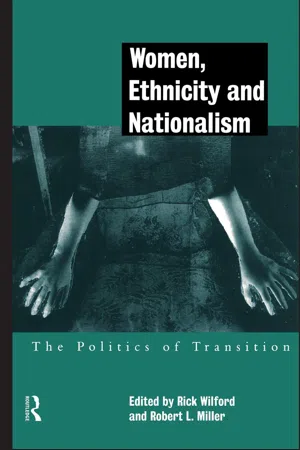
Women, Ethnicity and Nationalism asks whether societies caught in political or social transition provide new opportunities for women, or instead, create new burdens and obstacles for them. Using contemporary case-studies, each author looks at the interaction of gender ethnicity and class in a divided society. The varying experiences of women are discussed in the following countries: Northern Ireland; South Africa; the former Soviet Union and Yugoslavia; Yemen; Lebanon and Malaysia.
eBook - ePub
Women, Ethnicity and Nationalism
The Politics of Transition
- 224 pages
- English
- ePUB (mobile friendly)
- Available on iOS & Android
eBook - ePub
About this book
Information
1
Women, ethnicity and nationalism
Surveying the ground
Rick Wilford
…as a woman I have no country. As a woman I want no country. As a woman my country is the whole world.
(Virginia Woolf 1938)
INTRODUCTION
In surveying the relationship between women and nationalism it is difficult to escape the conclusion that it turns on male-crafted conceptions of nation and national identity. As Pettman (1996:49) observes, ‘In a complex play, the state is often gendered male and the nation gendered female’. Women, that is, are commonly constructed as the symbolic form of the nation whereas men are invariably represented as its chief agents and, with statehood achieved, emerge as its major beneficiaries.
The ground upon which the nexus among women and nationalism is based is, though, littered with controversy. Bystydzienski (1992:209), for instance, while not uncritical of national movements, takes a more sanguine view of nationalism than Pettman: [it has] ‘empowered millions of women…created pride in indigenous cultures, a demystification of innate superiority of foreign oppressors, and a recognition of community’. Such conflicting assessments hint at the extent of disagreement that exists. Contesting theories of nationalism, debates about the relationship between ethnicity and ‘race’, ambivalence about the celebration of ‘difference’, together with the problematization of ‘women’ as an organizing construct, all combine to lay a conceptual and political minefield. It would be misleading to claim that this book settles these controversies. At a time of rapid political transitions each of the contributors does, though, help to negotiate a course across the contested terrain guided—as this introduction is-by the proposition that All nationalisms are gendered’ (McClintock 1993:61).
The inclusion of internally divided or settler societies lends a sharp focus to this edited collection. Territorial conflict imbues the politics of such societies with a zero-sum rather than a positive-sum character. While all societies are internally differentiated those within which there is conflict over territory may become highly segmented and potentially, if not actually, violent (Horowitz 1985, 1994). Thus, while nationalism is propelled by an ‘us and them’, insider/outsider, inclusive/exclusive dynamic, this can be carried to exaggerated and dangerous extremes in divided societies: barriers—whether physical, social, material and/or psychological—are erected and inter-ethnic differences can spiral into violence as self-consciously distinctive groups take up arms in order to realize their claims to autonomy. Though such barriers or cleavages, whether structured by region, religion, ethnicity or class, may be bridged—by power-sharing and provision for segmental autonomy (consociationalism), decentralization (regional or local government), the devolution of powers (federalism) and/or an array of public policies that promote, or at least accommodate, multi-culturalism—the politics of divided societies are likely to be unstable.
MILITARISM, NATIONALISM AND FORGETTING
Where measures designed to manage conflict do fail and violence does erupt, martial values are prized and symbols of separate nationalist identities exalted. In such contexts women are invariably marginalized by a condition of ‘armed patriarchy’ (McWilliams 1995: fn 7). Enloe (1989:44) makes the broad point eloquently in discussing anti-colonial nationalism: ‘typically [it] has sprung from masculinised memory, masculinised humiliation and masculinised hope’, only rarely taking ‘women’s experiences as the starting point for an understanding of how a people becomes colonized or how it throws off the shackles of that material and psychological domination’. Enloe also declares that ‘When a nationalist movement becomes militarized…male privilege in the community usually becomes more entrenched’ (1989:56) and, with near deadening finality, states: ‘militarization puts a premium on communal unity in the name of national survival, a priority which can silence women critical of patriarchal practices and attitudes; in so doing, nationalist militarization can privilege men’ (1989:58).
Chazan (1989:5) shares this general judgement in reflecting on the consequences for Israeli women of the particular circumstances of the Arab-Israeli conflict, noting that ‘a [divided] society…in a prolonged period of conflict inevitably develops values which underestimate the role of women and [their] essential contribution to the social order’. Moreover, even where conflict is succeeded by a peace (of sorts), or at least a condition of non-war, the exclusion of women is sustained. For instance, Sharoni’s analysis (1996:121) of the gendered discourse that structured the fragile Israeli-Palestinian Accord of 1993, documents how the voices of women and feminists were silenced by the ‘masculinisation’ of the peace process: ‘This process of exclusion…is gendered. [PJeople, practices, symbols and ways of thinking coded as ‘masculine’ mark the centre of politics, while what is rendered ‘feminine’ is relegated to the margins’.
Moreover, fighting alongside men to achieve independence does not provide a guarantee of women’s inclusion as equal citizens. Jayawardena’s (1986:259) magisterial survey of feminism and ‘third world’ nationalism makes the general point: ‘Once independence had been achieved, male politicians who had consciously mobilized women in the struggle, pushed them back into their “accustomed place’”. Similarly, in postrevolutionary Algeria the ‘delegitimization of the heroine’ (Cherifati-Merabtine 1994) was symptomatic of the side-lining of women after independence was achieved. As Glavanis-Grantham (1996:175–6) observes, the Algerian experience is understood in salutary terms by Palestinian women activists, who: ‘warn of the dangers of subordinating the social struggle to the national struggle to the extent that women may have the gains of the Intifada subverted and be forced to return to the domesticity of former years’.
While others (Abdo 1994; Holt 1996) argue that the politicization of Palestinian women has created a determination to make certain, as Abdo puts it, that there will be ‘no going back’, there is a keen awareness that a tension exists ‘between women’s needs and rights and perceived national needs [which] has led some to wonder whether the national struggle is retarding the efforts for women’s equality’ (Najjar 1992:14). However, challenging a nationalist movement on the grounds that it neglects gender equality can incur high risks: women can all too easily be labelled as subversive or treacherous, or as succumbing to the blandishments of foreign and hence unwelcome ideas such as feminism. As Enloe (1989) states:
Women who have called for more genuine equality between the sexes… have been told that now is not the time, the nation is too fragile…[they] must be patient; they must wait until the nationalist goal is achieved; then relations between women and men can be addressed. ‘Not now, later’ is the advice that rings in the ears of many nationalist women.
(Enloe 1989:62)
While many women will reply ‘If not now, when?’, the broad lesson appears to be that not only do revolutions devour their children but also that nationalist movements have a disagreeable habit of swallowing their women. Pettman (1996:136–7), in cataloguing the experiences of women from a variety of revolutionary and nationalist struggles, notes the occurrence of ‘an uneven but very widespread pattern of regression in terms of women’s claims and participation after the state is won’. Men, the charge runs, suffer a collective and convenient memory loss about the contribution made by women to national liberation struggles: ‘“forgetting”…appears to be a frequent effect of reconsolidating centralised control of authority…[it] is part of the process of legitimising privilege, including gender privilege’ (ibid.: 138). Such was the case in culturally homogeneous Ireland.
Buoyed by the 1916 Proclamation’s commitment to guarantee equal rights and equal opportunities to all citizens, the women who fought and otherwise assisted in the Easter Rising were later subjected to such forgetting by the Irish Constitution of 1937. The handiwork of Eamon De Valera, the Constitution embodied his unswerving patriarchy which was foreshadowed by his singular refusal to allow women to fight alongside the men he had commanded in 1916. Together with the special status accorded to the Catholic Church, subsequently removed following a referendum in 1972, the Constitution underwrote the spirit of the Papal Encyclical, Casti Connubii, by declaring that ’In particular, the State recognises that by her life within the home, woman gives to the State a support without which the common good cannot be achieved’ (Article 41 (2) 1). Hanna Sheehy-Skeffington, a co-founder in 1908 of the Irish Women’s Franchise League, was to the fore in exposing De Valera’s ‘mawkish distrust of women’ and in criticizing the Constitution’s ‘Fascist proposals endangering [women’s] livelihood, cutting away their rights as human beings’ (Ward 1995:165). Despite a concerted and spirited campaign of opposition, this and other offending articles were implemented following the ratification of the Constitution by plebiscite.
More recent casualties of this forgetting include the 20,000 or so women who fought in the Marxist Eritrean People’s Liberation Front. Demobilized after freeing their land from Ethiopian rule in 1991, they have been decanted back into a deeply patriarchal society that has done little to reward their warrior status. As one of them commented, ‘It was better when we were in the field—we were equal with the men and we got good treatment’ (McKinley 1995).
FUNDAMENTALISM AND BARGAINING
Anti-colonial struggles have been the spur to much of the literature concerning the gendered nature of nationalism, including those within which Islamic fundamentalism (or revivalism) has been resurgent. In such regimes the wearing of hijab (modest dress) may be construed not as an act of induced submission but as a pragmatic, if not entirely voluntaristic, response among women.
On this view hijab represents a form of negotiation with patriarchy enabling women to move freely in public spaces, hidden from the ‘male gaze’ (see, for example, Afshar 1996; Mir-Hosseini 1993, 1996). One Palestinian activist, Lilly Feildy (see The Guardian, 8 February 1996), suggests another motive, viz. the adoption of propriety as a badge of commitment: There were no veiled Palestinian women before the Intifada: it became an expression of identity’. Kandiyoti (1988:283) goes further, suggesting that the donning of ‘traditional modesty markers’ by women signifies a ‘patriarchal bargain‘, indicating to their menfolk that they continue to be ‘worthy of protection’. Azari makes the same point in relation to young women in Khomeini’s Iran: ‘the restriction imposed on them by an Islamic order was…a small price that had to be paid in exchange for security, stability and presumed respect this order promised them’ (quoted in Kandiyoti 1988).
There is a certain plausibility in this latter reading of women’s motives: that at a time of political crisis or transition they seek to renew a classic patriarchal bargain as a coping strategy intended to afford some security in an uncertain present and as a hedge against an unpredictable future. Tansu Ciller, Turkey’s first woman prime minister, appears to have struck her own contract in response to the electoral advance of the pro-Islamic Welfare Party (WP). Prior to the 1996 election she committed herself to continuing the process of Westernization and to upholding the tradition of secular government bequeathed by Ataturk, explicitly ruling out a partnership between her own True Path Party and the WP. However, following the election she negotiated a coalition with the Welfare Party, acquiring the deputy premiership in the process and now often appears in public wearing hijab. Whether or not Ciller’s volte face was merited, her bargain was structured by the bounds of patriarchy: it isn’t, to borrow a cliché, only stone walls that a prison make. As Anthias and Yuval-Davis (1993:108) observe, while ‘Femininity may be seen as a coping mechanism’, it can also be interpreted to mean that ‘women can be both individually and collectively active agents in their own subordination’.
In societies based upon either a religion or a political doctrine that is consummatory in character, any attempt to oppose or subvert its tenets courts danger. Other than embracing scripturally based values and beliefs, there are few options available to women: perhaps exegesis, seeking in effect to reinterpret, and liberalize, the relevant text to their relative advantage (Afshar 1996); or, alternatively, either silence or exile. The capture of Kabul by Taliban in September 1996 demonstrates vividly the constraints that can issue from unreconstructed fundamentalism. While men have not escaped unscathed from its zealotry—they must cover their heads and grow beards, especially if employed in the public sector—Taliban’s advance led to the enforcement of an unflinchingly patriarchal interpretation of Islam. This is manifested by the imposition of the allenveloping and shroud-like burqa; the closure of schools for girls over the age of 10, and of women’s universities; and the prevention of women from undertaking paid employment, or even working for the international aid agencies upon which many rely for food, medical aid and shelter.
The extremes of Taliban, the excesses of Islamic vigilantes in Algeria who murder women adopting a secular lifestyle, the custom of so-called ‘honour-killings’ of women who are accused of adultery by their male relatives in Palestine and Iraq (see Helie-Lucas 1994), do seem to label Islam as the most patriarchal of religions. Yet, as Moghadam (1993:7) observes, the diversity of Islamic practice throughout the Middle East (and elsewhere) is such that the status of women in Muslim societies is ‘neither uniform nor unchanging nor unique’ but varies with class, ethnicity, level of educational attainment and age.
What matters here is not whether a fundamentalist interpretation of Islam, Hinduism, Judaism or, for that matter, Christianity (see Klatch 1994) is more or less oppressive of women, but the role(s) women are assigned as cultural markers of national identity and propriety. The compulsory veiling of women by nationalist movements in Sudan, Iran or Afghanistan, whether they are seeking to shore-up existing regimes or fashion new ones, is but a graphic representation of women’s subordination that elsewhere may assume more subtle forms but which are, nevertheless, integral to the processes of defining a national identity. The wider and more germane point is that the limits to self-actualization by women are, as Allen (1994) notes, culturally and historically specific.
Allen’s remark made in relation to ‘heterogeneous societies’ is perhaps even more appropriate when applied to those that are divided and within which mutually exclusive identities are accentuated: viz., ‘identity denies and suppresses differences within socially created categories and emphasizes differences between them’ (1994:96, Allen’s emphases). With the former Yugoslavia and other recent ethnic conflicts in mind, she quotes Young (1990:98) to underline the point: ‘Identity turns the merel...
Table of contents
- Cover Page
- Title Page
- Copyright Page
- Contributors
- Preface and acknowledgements
- 1: Women, ethnicity and nationalism: Surveying the ground
- 2: Gender and nation
- 3: Identity, location, plurality: Women, nationalism and Northern Ireland
- 4: Gender, nationalism and transformation: Difference and commonality in South Africa’s past and present
- 5: Women in contemporary Russia and the former Soviet Union
- 6: Back to the future: Nationalism and gender in post-socialist societies
- 7: Women’s rights and political conflict in Yemen 1990–1994
- 8: Communal violence, civil war and foreign occupation: Women in Lebanon
- 9: Islamization and modernization in Malaysia: Competing cultural reassertions and women’s identity in a changing society
- 10: Conclusion
Trusted by 375,005 students
Access to over 1.5 million titles for a fair monthly price.
Study more efficiently using our study tools.
Frequently asked questions
Yes, you can cancel anytime from the Subscription tab in your account settings on the Perlego website. Your subscription will stay active until the end of your current billing period. Learn how to cancel your subscription
No, books cannot be downloaded as external files, such as PDFs, for use outside of Perlego. However, you can download books within the Perlego app for offline reading on mobile or tablet. Learn how to download books offline
Perlego offers two plans: Essential and Complete
- Essential is ideal for learners and professionals who enjoy exploring a wide range of subjects. Access the Essential Library with 800,000+ trusted titles and best-sellers across business, personal growth, and the humanities. Includes unlimited reading time and Standard Read Aloud voice.
- Complete: Perfect for advanced learners and researchers needing full, unrestricted access. Unlock 1.5M+ books across hundreds of subjects, including academic and specialized titles. The Complete Plan also includes advanced features like Premium Read Aloud and Research Assistant.
We are an online textbook subscription service, where you can get access to an entire online library for less than the price of a single book per month. With over 1.5 million books across 990+ topics, we’ve got you covered! Learn about our mission
Look out for the read-aloud symbol on your next book to see if you can listen to it. The read-aloud tool reads text aloud for you, highlighting the text as it is being read. You can pause it, speed it up and slow it down. Learn more about Read Aloud
Yes! You can use the Perlego app on both iOS and Android devices to read anytime, anywhere — even offline. Perfect for commutes or when you’re on the go.
Please note we cannot support devices running on iOS 13 and Android 7 or earlier. Learn more about using the app
Please note we cannot support devices running on iOS 13 and Android 7 or earlier. Learn more about using the app
Yes, you can access Women, Ethnicity and Nationalism by Robert E. Miller,Rick Wilford in PDF and/or ePUB format, as well as other popular books in Social Sciences & Nationalism & Patriotism. We have over 1.5 million books available in our catalogue for you to explore.