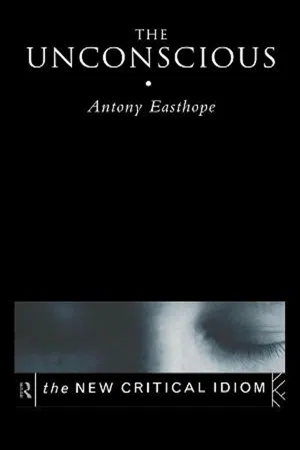
The unconscious is a term which is central to the understanding of psychoanalysis, and, indeed everyday life. In this introductory guide, Antony Easthope provides a witty and accessible overview of the subject showing the reality of the unconscious with a startling variety of examples. He takes us on a vivid guided tour of this troubling topic via jokes, rugby songs, Hamlet, Hitchcock's Psycho, and the life and death of Princess Di.
Aimed at the absolute beginner, The Unconscious is an enjoyable and easy-to-read introduction for the student and general reader.
- 208 pages
- English
- ePUB (mobile friendly)
- Available on iOS & Android
eBook - ePub
The Unconscious
About this book
Information
1
IS THERE AN
UNCONSCIOUS?
‘WOMAN FAINTS EVERY TIME SHE HEARS THE WORD SEX.’
(Headline in Daily Mirror, 15 July 1993)
This was the story of a woman who did indeed faint when she heard the word ‘sex’ and of a man who, having found out about what the paper called ‘her bizarre condition’, exploited it to molest her while she was unconscious. The case came to court but with the difficulty that every time the defence lawyer used the word ‘sex’ the woman fainted again. When another word was used— ‘nookie’—the woman did not faint.
I mention this sad and grotesque story because it seems such a clear instance of an unconscious effect. What caused this dramatic physical effect was not an event or an action but a meaning, though admittedly a highly charged one. And it’s not strictly a meaning which produced the fainting (the synonym ‘nookie’ didn’t do it) but a specific set of sounds, a single signifier: ‘sex’.
If there is an unconscious process it will be at work all the time, not just in spectacular one-off occasions like this. It will be a kind of lining on the other side of normal, waking consciousness which might not be noticed unless there was an effect over and above anything rational consciousness might expect and can explain. So it is with the following newspaper story about people campaigning against the use of animal fur. Now there is a reasonable case both for and against the use of fur: what is significant is the degree of affect, an intensity of feeling which far exceeds anything one might ordinarily predict.
Under the headline ‘Keeping their fur on’ (matched with a photograph of a beautiful woman with dark glasses wrapped in voluptuous furs), the Independent on Sunday reported a furrier, Lothar Weiss, explaining how business was going:
Really terrible. My warehouse in Manchester has been attacked twice by the animal rights people—once with smoke bombs, and then with real bombs…it’s made everyone afraid to sell or buy fur.
(14 April 1991)
The story notes that in the seventies fur was not really an issue in Britain. However, ‘a couple of decades on, thanks to Lynx and other anti-fur campaigners, it has become an act of daring to sport a splodge of beaver on your winter hat’.
Another furrier, Henri Kleiman, says about the anti-fur campaign:
These people say revolting things. They imply furs are only worn by Knightsbridge bimbos who get them in return for sexual favours.
Surely there’s an element of excess here—of aggression and excitement—which needs explaining? I would speculate as follows. For the unconscious, animal fur, especially if long and elegant, only too easily symbolises pubic hair and particularly women’s pubic hair. Imagined in this way a woman in a fur coat seems to be publicly flaunting her sexuality and transgressing Western codes about appropriate behaviour.
Two details in the story support this reading. The reference to wearing a ‘splodge of beaver’ echoes a slang word for women’s pubic hair. And the idea that women who wear fur have acquired them via prostitution recalls the vulgar judgement (better known perhaps in the north of England) in which a flashy woman is said to be, ‘all fur coat and no knickers’.
It is difficult to be sure what other explanations there could be for the surplus which oozes out of this story of the anti-fur campaigners. You could simply deny there was anything to be explained. But if an explanation is needed the idea of the unconscious can supply one. My version is consistent with details in the body of psychoanalytic writing—‘fur stands for the pubic hair’, wrote Freud (1973–86, vol 4:157) years before the anti-fur campaigners came on the scene with their bombs (both smoke and real, as Mr Weiss says). And Freud invoked the vulgar language of ‘the people’ to confirm psychoanalytic insights (I’ve drawn attention to ‘beaver’ and the phrase ‘all fur coat and no knickers’).
Freud suggests that we use symbolism with unconscious meaning all the time but conspire to ignore what we’re doing. He supposes someone asking him the exasperated question, ‘Do I really live in the thick of sexual symbols?’ and if so how would you know? ‘My reply’, Freud says, ‘is that we learn it from very different sources— from fairytales and myths, from buffoonery and jokes, from folklore (that is, from knowledge about popular manners and customs, sayings and songs) and from poetic and colloquial linguistic usage’ (1973–86; vol 1:192).
The question Freud asks himself, and his answer, points to a general principle. The concept of the unconscious bears with it the implication that people will often deny its existence so as to hold onto the (apparently) sane and ordinary world of everyday common sense.
So it should not come as a surprise if someone claimed there was no sexual connotation about ‘beaver’ and at the same time laughed at a joke which played on that double meaning (in the film parodying Basic Instinct the Sharon Stone figure parts her legs for the detectives—and reveals a large and attractively brown-eyed beaver perched there). It’s significant that the word ‘unconscious’, meaning opposite to consciousness, is not in general currency but ‘subconscious’ is. ‘Subconscious’ carries the reassuring suggestion that the unconscious is only submerged like a submarine and can be brought to the surface when you want. Freud had explicitly given up ‘subconscious’ by 1900.
In fact, the unconscious—if it exists—is not a physical object you can put into a tube and test with chemicals. Its nature is inferred from an analysis of features in human behaviour—and particularly linguistic behaviour—which cannot be understood except on the hypothesis that there is an unconscious. The process is only apparent to us indirectly.
INNER SPEECH AND THE UNCONSCIOUS
A Russian linguist, L.S.Vygotsky, proposed a distinction between outer speech and inner speech—between articulated, external discourse and that ‘voice’ which goes on inside my head when I’m not talking to anyone. Vygotsky doesn’t believe that inner speech is simply external speech which has been internalised—rather, inner speech has ‘its own laws’ (1962:131). Generalising from the egocentric speech observed in children, Vygotsky supposed that inner speech had a certain specific style (peculiar syntax, repeated terms, discontinuity, etc.). Perhaps. But surely we can’t fail to spot a serious epistemological problem hanging over his whole enterprise? We can only know about the inner speech of others from what they tell us, in outer speech. And that’s not inner speech at all.
The question of unconscious thought has the same problematic status as inner speech—but with an added twist. In one respect it is harder to know about the unconscious than inner speech precisely because it is consciously repressed, actively unconscious (German: unbewusst). But for the same reason it’s not harder to know about, because it is subject to the principle of psychoanalysis that ‘the repressed returns’. Unlike inner speech, the unconscious ‘speaks’, willy-nilly, in all kinds of symptoms, traces, gaps, discontinuities and excesses that appear in ordinary conscious discourse. That phrase, ‘splodge of beaver’, articulates a repressed relationship between animal fur and female pubic hair, although the writer may not have been conscious of this relationship.
INSTINCT AND DRIVE
Today we have an exaggerated respect for the supposedly selfconscious rational individual, an idea we preserve by treating anything that is not part of consciousness as physical, an effect of the body. In Freud’s carefully articulated explanation the unconscious is not part of the body but has a close relationship to it.
Freud was hugely influenced by Darwin’s theory of evolution with its materialist and secular explanation of how life developed (see Sulloway 1980). Darwin argued that in order to succeed a species must develop not only instincts for survival (the theme of The Origin of Species, 1859) but also instincts for reproduction (which he wrote up in The Descent of Man and Selection in Relation to Sex, 1871). Freud suggested that the human species experiences not just instinct but drive, particularly in two forms—narcissism corresponding to the instinct for survival, and sexual desire corresponding to reproduction.
Drive (German: Trieb) is related to but profoundly different from instinct (German: Instinkt). Drive is instinct insofar as it has become represented. Freud says:
an ‘instinct’ [Trieb] appears to us as a concept on the frontier between the mental and the somatic, as the psychical representative [Repräsentant] of the stimuli originating from within the organism and reaching the mind, as a measure of the demand made upon the mind for work in consequence of its connection with the body.
(‘Instincts and their Vicissitudes’, 1973–86, vol 11:118)
So, the human infant shares with other mammals an instinct which compels it to seek nourishment at the nipple. This instinct is very strong and very direct. Drive originates when there is a degree of separation between body and mind. An idea of or image of the nipple (along with associations of fulfilment) becomes remembered, a signifier which can become pleasurable in its own right—the symbol of the breast.
The situation is complicated by the fact that the standard English translation of Freud, trying to make psychoanalysis look more scientific, consistently translates Trieb as ‘instinct’. The distinction should be quite clear, for as Freud explains:
An instinct [Trieb] can never become an object of consciousness—only the idea [Vorstellung] that represents the instinct can. Even in the unconscious, moreover, an instinct cannot be represented otherwise than by an idea. If the instinct did not attach itself to an idea or manifest itself as an affective state, we would know nothing about it.
(1973–86, vol 11:179)
His point is that we don’t ‘know’ about our irises contracting in bright light but we do ‘know’ about the image of the breast, for example. In psychoanalysis there is a continuing controversy about how far the body determines the forms of drive it initiates as well as the question of how far Freud is using the body as a metaphor for psychical processes. I shall stress that the unconscious is concerned above all with meanings, with symbols, a view which is quite unmistakable when Freud refers to ‘the mother’s penis’ (1973–86, vol 7:352), something unknown to physiology though it may be an object of fantasy for the unconscious.
The main evidence for the necessity of the concept of the unconscious occurs in certain specific forms of human behaviour, particularly:
- hypnosis;
- dreams;
- jokes;
- slips and everyday life;
- art;
- psychoanalytic case histories.
I shall say something about each of these, in part because set out in order like that they rather neatly recapitulate the development of Freud’s ideas from around 1890 to 1910. At this stage I think we can go along with just the hypothesis that the unconscious seeks pleasure wherever it can, without being at all fussy about how it gets it, though it has the problem of finding a way round the surveillance of the conscious mind.
HYPNOSIS
Poets and artists have known for a long time that there is a powerful unconscious component in human experience. In 1821 in ‘A Defence of Poetry’ Shelley affirms that poetry ‘acts in a divine and unapprehended manner, beyond and above consciousness’ (1966:423). But the unconscious in the psychoanalytic sense had to be discovered, to be analysed and evidenced in ways that might claim to be scientific. This began effectively when Freud, having qualified as a doctor, pursued his interest in neurology, by going to Paris in 1885, to the hospital of Salpêtrière where he studied with J.-M.Charcot. Charcot was using hypnosis to work on hysteria.
The existence of hypnosis is very well attested, a state in which an individual’s consciousness is ‘put to sleep’ though they continue to respond to questions and commands. The idea of hysteria comes from the Greek for womb (hysteron) and names a malady supposed to give women hysterical symptoms. These were reinterpreted by Freud in a diagnosis he applied to men as well as women.
In a general sense hysteria refers to a psychosomatic symptom, a physical effect without a physical cause. A patient treated by Freud’s colleague, Joseph Breuer, and written up as ‘Anna O.’ suffered from: a squint, feelings that the walls of the room were falling over, headaches, paralysis in the muscles of the neck which stopped her moving her head, loss of feeling and some loss of movement in the right arm (1973–86, vol 3:75). Yet there was nothing physically wrong with her. And apparently all the symptoms were cured.
Breuer and Freud put forward the hypothesis that hysteria was caused by a traumatic experience which had become ‘repressed’ by passing into ‘the unconscious’ (both terms were introduced for the first time in this context, see, ibid: 61, 100). If they could get the patient to confront the terrible memory the symptoms disappeared—in Anna O.’s case a dream she had had while nursing her father that a black snake came out of the wall and tried to bite the sick man. The problem was to get them to remember ideas which were locked away from consciousness, and for this they turned to hypnosis. Later, Freud found it just as effective to ask the patient to associate ideas freely while he himself sat out of sight and took a neutral position. Anna O. christene...
Table of contents
- COVER PAGE
- TITLE PAGE
- COPYRIGHT PAGE
- SERIES EDITOR’S PREFACE
- PREFACE
- 1. IS THERE AN UNCONSCIOUS?
- 2. THE UNCONSCIOUS IN FREUD AND LACAN
- 3. THE UNCONSCIOUS AND THE ‘I’
- 4. THE UNCONSCIOUS AND SEXUALITY
- 5. THE UNCONSCIOUS AND THE TEXT
- 6. THE UNCONSCIOUS AND HISTORY
- 7. CONCLUSION: GIVING IT ALL AWAY
- BIBLIOGRAPHY
Trusted by 375,005 students
Access to over 1.5 million titles for a fair monthly price.
Study more efficiently using our study tools.
Frequently asked questions
Yes, you can cancel anytime from the Subscription tab in your account settings on the Perlego website. Your subscription will stay active until the end of your current billing period. Learn how to cancel your subscription
No, books cannot be downloaded as external files, such as PDFs, for use outside of Perlego. However, you can download books within the Perlego app for offline reading on mobile or tablet. Learn how to download books offline
Perlego offers two plans: Essential and Complete
- Essential is ideal for learners and professionals who enjoy exploring a wide range of subjects. Access the Essential Library with 800,000+ trusted titles and best-sellers across business, personal growth, and the humanities. Includes unlimited reading time and Standard Read Aloud voice.
- Complete: Perfect for advanced learners and researchers needing full, unrestricted access. Unlock 1.5M+ books across hundreds of subjects, including academic and specialized titles. The Complete Plan also includes advanced features like Premium Read Aloud and Research Assistant.
We are an online textbook subscription service, where you can get access to an entire online library for less than the price of a single book per month. With over 1.5 million books across 990+ topics, we’ve got you covered! Learn about our mission
Look out for the read-aloud symbol on your next book to see if you can listen to it. The read-aloud tool reads text aloud for you, highlighting the text as it is being read. You can pause it, speed it up and slow it down. Learn more about Read Aloud
Yes! You can use the Perlego app on both iOS and Android devices to read anytime, anywhere — even offline. Perfect for commutes or when you’re on the go.
Please note we cannot support devices running on iOS 13 and Android 7 or earlier. Learn more about using the app
Please note we cannot support devices running on iOS 13 and Android 7 or earlier. Learn more about using the app
Yes, you can access The Unconscious by Anthony Easthope in PDF and/or ePUB format, as well as other popular books in Psychology & Literary Criticism. We have over 1.5 million books available in our catalogue for you to explore.