Managing the consumption and conservation of energy in buildings must now become the concern of both building managers and occupants. The provision of lighting, hot water supply, communications, cooking, space heating and cooling accounts for 45 per cent of UK energy consumption.
Energy Management and Operating Costs in Buildings introduces the reader to the principles of managing and conserving energy consumpton in buildings people use for work or leisure. Energy consumption is considered for the provision of space heating, hot water, supply ventilation and air conditioning. The author introduces the use of standard performance indicators and energy consumption yardsticks, and discusses the use and application of degree days.
- 196 pages
- English
- ePUB (mobile friendly)
- Available on iOS & Android
eBook - ePub
Energy Management and Operating Costs in Buildings
About this book
1
The economics of space heating plants
Nomenclature
| A | area (m2) |
| AEC | annual energy consumption (J, etc., kWh) |
| d | temperature rise due to indoor heat gains (K) |
| DD | Degree Day(s) |
| dt | design temperature difference (K) |
| e | exponent, e=2.7183 |
| F1, F2 | temperature ratios |
| fr | thermal response factor |
| HWS | Hot water supply |
| k | constant |
| MDD | maximum Degree Days |
| N | number of air changes/hour |
| Qg | indoor heat gains (kW) |
| Qp | plant energy output (kW) |
| S | number of days in the period under review |
| SDD | Standard Degree Day(s) |
| tai | indoor air temperature |
| t | ao outdoor air temperature |
| tb, | B base temperature in °C |
| tc | dry resultant temperature |
| tm | mean outdoor air temperature |
| tn | minimum daily outdoor temperature |
| tx | maximum daily outdoor temperature |
| U | thermal transmittance coefficient (W/m2 K) |
| V | volume of space (m3) |
| Y | thermal admittance (W/m2 K) |
1.1 Introduction
The use of primary fuels in industrialized countries has been the subject of national interest only since the oil crisis of the early 1970s. Much work has been done in the UK and elsewhere to reduce the consumption of energy derived from fossil fuels since that time, particularly in the manufacturing industries. Energy used in building services is estimated at 45 % of national primary energy consumption in the UK, of which space heating, hot water supply and auxiliary power is estimated at 32%.
The building services industry therefore has a mandate here to design systems which conserve energy, to provide accurate forecasts of energy consumption, to promote energy conservation, to undertake energy audits and to monitor and target the consumption and future use of energy in buildings.
Clearly the building services engineer may only be responsible for one or two of these tasks but he or she should be able to contribute to all of them in a professional manner if called upon to do so. Energy managers on the other hand have a responsibility for all of these tasks.
Technical innovation and breakthrough in recent years has meant that boiler plant and associated equipment is more efficient, bringing the benefits of lower consumption of primary energy and less harmful releases of the products of combustion into the atmosphere.
It is likely that as this trend continues, with the increasing public awareness of issues which have a direct bearing on the well-being of our Earth, more emphasis will need to be placed upon the design of space heating plants in the world’s temperate climates and hence upon costs in use. This is due also to the release of harmful products into the atmosphere during manufacturing processes as well as during the activities of building construction and as a result of living and working in the buildings we create for ourselves. It does now appear that controlling the release of carbon dioxide and pollutants may have a more significant impact on the building services industry than that resulting from the diminishing reserves of fossil fuel.
1.2 The economics
The economics of space heating plant should therefore be more relevant now than ever before. The economic evaluation of building engineering systems includes:
• capital costs;
• costs in use;
• life cycle costs;
• investment appraisal.
Investment appraisal is considered in Chapter 8.
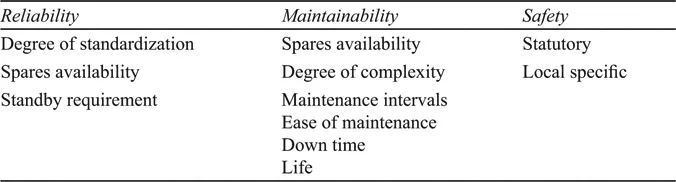
Life cycle costs relate to the estimated life of plant and systems and to the following factors: reliability, maintainability and safety. The features given in Table 1.1 will influence the life cycle costs.
Table 1.1 Factors affecting life cycle costs
Investment for the replacement or refurbishment of plant and equipment may form part of the life cycle costs.
The life of the plant and equipment may be less than the life of the distribution pipework and radiators, for example. It may therefore be prudent to consider plant and equipment separately from distribution when accounting for replacement and refurbishment. See also Chapter 8.
Capital costs include:
• design fees;
• fees for supervising the installation of the services;
• material and labour costs of the installation;
• commissioning costs;
• costs for supplying the utilities of gas, water and electricity;
• builder’s work and attendance costs.
Costs in use (operational costs) include:
• fuel;
• auxiliary power for boilers, pumps, fans, temperature controls etc.;
• preventive maintenance;
• corrective maintenance;
• insurance.
On large sites the client may consider buying in the supervision, operation and maintenance of the entire space heating plant or plants together with the management of its operational costs under an outsourcing agreement referred to as Contract Energy Management. Purchase of new plant can also form part of an outsourcing agreement.
FUEL CONSUMPTION
The estimation for fuel consumption for space heating depends upon:
• plant energy output;
• seasonal efficiency of boiler plant and systems;
• duration of occupied period;
• mode of plant operation;
• thermal inertia of the building;
• internal heat sources;
• Degree Days appropriate to the season and the locality.
PLANT ENERGY OUTPUT QP.
This is calculated from the design heat loss for the building and is determined from the following formulae. (It is important to note here that in the calculation of weekly, monthly or annual fuel consumption, design heat loss is used. This is equivalent to plant energy output Qp regardless of whether the plant in question operates continuously or intermittently.)
Thus:
Thus:

where F1 and F2 are temperature ratios involving the indoor design comfort temperature tc, the indoor environmental temperature tei and indoor air temperature tai.
The temperature ratios are dependent upon the proportions of radiant to convective heat emanating from the space heating appliances. They can be determined from data in the CIBSE Guide [1] or from formulae in another publication in the series [2]. Clearly the heat flow path resulting from a system of natural draught convectors will start at the indoor air point and proceed to the dry resultant, environmental and finally mean radiant point. In the case of a system of high temperature radiant strip or tube the resulting heat flow path commences at the mean radiant point. Thus the temperature ratios are affected by the type of heating system proposed for the building and in turn the building design heat loss is also affected. This matter is discussed at length in another publication in the series [2].
If, however, the building is thermally insulated to current standards and has low infiltration rates, which is to say that it is well sealed from ingress of outdoor air, design heat loss can be determined in the traditional manner from:

with only limited loss in accuracy.
SEASONAL EFFICIENCY OF BOILER PLANT AND SYSTEMS
Boiler manufacturers’ quote efficiencies of their products under test conditions at full load. The efficiency of modern boil...
Table of contents
- Cover
- Halftitle
- Title
- Copyright
- Contents
- Preface
- Acknowledgements
- Introduction
- 1. The economics of space heating plants
- 2. Estimating energy consumption—space heating
- 3. Intermittent space heating
- 4. Estimating the annual cost for the provision of hot water supply
- 5. Energy consumption for cooling loads
- 6. Performance indicators
- 7. Energy conservation strategies
- 8. Cost benefit analysis
- 9. Energy audits
- 10. Monitoring and targeting
- Appendix 1. Standard heating Degree Day data
- Appendix 2. Energy conservation measures
- Appendix 3. Preventive maintenance measures
- Appendix 4. Energy Efficiency Office’s series of booklets on Introduction to Energy Efficiency
- Appendix 5. Monitoring equipment
- Appendix 6. Cost benefit tables
- Appendix 7. Standard service illuminance for various activities/interiors
- Appendix 8. Source organizations and addresses
- Appendix 9. Source journals
- Appendix 10. Some current energy saving schemes
- Bibliography
- Index
Trusted by 375,005 students
Access to over 1.5 million titles for a fair monthly price.
Study more efficiently using our study tools.
Frequently asked questions
Yes, you can cancel anytime from the Subscription tab in your account settings on the Perlego website. Your subscription will stay active until the end of your current billing period. Learn how to cancel your subscription
No, books cannot be downloaded as external files, such as PDFs, for use outside of Perlego. However, you can download books within the Perlego app for offline reading on mobile or tablet. Learn how to download books offline
Perlego offers two plans: Essential and Complete
- Essential is ideal for learners and professionals who enjoy exploring a wide range of subjects. Access the Essential Library with 800,000+ trusted titles and best-sellers across business, personal growth, and the humanities. Includes unlimited reading time and Standard Read Aloud voice.
- Complete: Perfect for advanced learners and researchers needing full, unrestricted access. Unlock 1.5M+ books across hundreds of subjects, including academic and specialized titles. The Complete Plan also includes advanced features like Premium Read Aloud and Research Assistant.
We are an online textbook subscription service, where you can get access to an entire online library for less than the price of a single book per month. With over 1.5 million books across 990+ topics, we’ve got you covered! Learn about our mission
Look out for the read-aloud symbol on your next book to see if you can listen to it. The read-aloud tool reads text aloud for you, highlighting the text as it is being read. You can pause it, speed it up and slow it down. Learn more about Read Aloud
Yes! You can use the Perlego app on both iOS and Android devices to read anytime, anywhere — even offline. Perfect for commutes or when you’re on the go.
Please note we cannot support devices running on iOS 13 and Android 7 or earlier. Learn more about using the app
Please note we cannot support devices running on iOS 13 and Android 7 or earlier. Learn more about using the app
Yes, you can access Energy Management and Operating Costs in Buildings by Keith Moss in PDF and/or ePUB format, as well as other popular books in Business & Architecture Methods & Materials. We have over 1.5 million books available in our catalogue for you to explore.