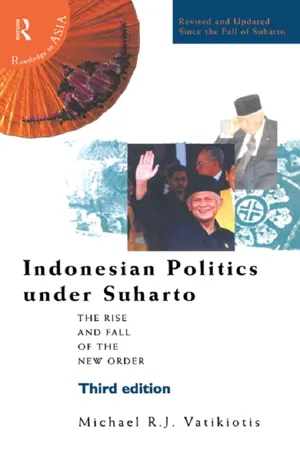
This revised third edition provides an analysis of Suharto's New Order from its inception to the emergence of B.J. Habibie as President. The author reassesses the New Order's origins and its military roots and evaluates the considerable economic changes that have taken place since the 1960s. He examines Suharto's politics and, in a new chapter, the reasons behind the crisis and Suharto's fall.
eBook - ePub
Indonesian Politics Under Suharto
The Rise and Fall of the New Order
- 272 pages
- English
- ePUB (mobile friendly)
- Available on iOS & Android
eBook - ePub
About this book
Information
1
SUHARTO
I conjured up in my imagination the kings and bupatis of Java, mad with their lust for power, making people bow down and crawl before them, giving obeisance to them, do their pleasure. And no guarantee that they would be better educated than those they ordered about.
(Pramoedya Ananta Toer)1
Indonesia emerged from the political turbulence of the immediate post-colonial era more battered than most countries in South-east Asia. The trauma of wrenching independence from the Dutch had only just been put behind them in 1949, when Indonesians were plunged into a political mayhem generated by competing power groups. The situation worsened as Sukarno, the country’s founding constitutional president, exploited factional and regional divisions to assume executive authority. In July 1959, Sukarno replaced parliamentary with ‘Guided Democracy’, wrapping himself in the trappings of power. By the mid-1960s, he was on the verge of allowing Indonesia’s Communist Party, with over three million members, to arm themselves and neutralize the conservative army. Not surprisingly, cold war warriors in the West saw this as Indonesia’s first step towards membership of a then ascending Communist bloc.
While the country struggled under the burden of triple-digit inflation, Sukarno talked about revolution with politics as the commander. Finally, goaded into action by a still unexplained coup attempt on 30 September 1965, the army moved in, effectively deposing Sukarno in March 1966 and ushering in a conservative military-backed regime steered by a relatively unknown general called Suharto.
The move left a trail of tragedy and a host of unanswered questions in its wake, questions which continue to be posed after Suharto’s resignation. Yet the events of 1965 proved the exception to generalized views about the inherent instability of coup-born governments. For more than thirty years the unitary basis of the state, with a powerful executive at its head, remained more or less intact. While coup and counter-coup plagued Thailand, and deep political and racial animosities periodically afflicted Malaysia, Indonesia for thirty-two years experienced comparative political tranquillity and steady economic growth. Over the same period, Indonesians knew only Suharto as president.
The extraordinary grip this man managed to maintain over such a large and diverse country amazed even his own countrymen, who at the very least consider him something of a political wizard—whom no one seemed capable of outwitting. Any study of contemporary Indonesia must focus on this poorly educated, but determined farmer’s son from Central Java, who became a general of the army and soon afterwards leader of South-east Asia’s largest and most populous nation.
Suharto came to power in the confused and hitherto not fully explained aftermath of an abortive coup. Whether the events of 30 September/1 October 1965 were mounted by dissident soldiers against President Sukarno, or with the President’s connivance against the army leadership remains to this day unresolved. The official explanation has always been that it was a Communist-inspired coup which failed. Every year to mark the anniversary the government shows a long feature film re-enactment of the events of those two days. In it Indonesians see men of the presidential guard round up six generals, who are later murdered by Communist Party members. The message is simple: Communists are barbarous and bad, the army is virtuous and good.
Objective assessments of the affair have yet to dislodge the primacy of the government’s explantion that it was ‘an attempted communist coup’. Still further suppressed—perhaps more instinctively than by design—is the fact that the events of that year and into the next, eventually cost the lives of possibly a million Indonesians, innocent of politics, and mostly in forgotten rural villages on the country’s main island of Java.
Somehow, out of this chaos, the little-known General Suharto emerged on top. To this day contemporary observers insist that nobody knew very much about the man at the time. Yet he was formally confirmed as President in March 1968, and re-elected by unanimous consensus of the people he appointed to the one thousand-member Majelis Permusyawaratan Rakyat (People’s Consultative Assembly or MPR.) six times since then—the last time in March 1998, just two months before he resigned as president.
Indonesia in the mid-1960s was ripe for political change. But it would be incorrect to assume that the country’s founding President, Sukarno, was unpopular. As proclaimer of independence and great world leader in the eyes of his people, he commanded profound respect. The Javanese, who dominate Indonesia’s tapestry of cultures, greatly respect authority and are hard pushed to question those who demonstrate a firm grip on power. Sukarno was, however, increasingly resented in ruling circles, and specifically by the military. Foremost among their grievances was Sukarno’s apparent headlong tilt towards the Communist fold. The Indonesian Communist Party, which claimed some three million members, could count on some support from within the military—perhaps more than the army will ever be prepared to admit. By the 1960s, however, the bulk of officers were being trained by those under the influence of the US and its cold war warriors.
Sukarno’s taste for wasteful displays of international diplomacy irked an inward-looking officer corps. Frustration was building up and, aided by development of a notion of the army’s dual political and military role, many officers began to feel it was as much their duty to run the state as to guard it. Aid pouring in from the Soviet Union and China annoyed many in the intellectual elite and the army who saw their interests better served by the economically nascent West. Sukarno spoke of the need to continue the revolution that brought independence, mesmerizing the people with mass rallies and oratory laden with compelling rhetoric but little else. Meanwhile, what the people needed was stability, and to be fed. Yet despite the factors loaded against Sukarno, there is no convincing proof that there were a mess of plots against him. Sukarno commanded loyalty and respect. He was, after all, the man who declared independence; the country’s paramount leader with a talent for demagoguery second to none.
Members of the Indonesian elite—many of them in the military—began to resent Suharto in similarly ambiguous fashion for almost the same reasons, but against a markedly different background. There is no easy comparison with the Sukarno period. Sukarno’s Indonesia was bankrupt and starving when he was overthrown. Suharto’s Indonesia in the 1990s was growing better off by the year on the back of seemingly sensible economic policies. Similarities between the two periods do exist, however. They provide compelling evidence of a political culture with one foot in the past; of a society resistant to change. One facet of this political culture is of crucial importance to understanding why Sukarno commanded popularity while people starved, why Suharto survived mounting pressure for more open government and criticism of his family’s hydra-like business interests for so long: that is the inordinate respect Indonesians have for firm, established leadership.
Like Sukarno at the end of his rule, Suharto was completely confident that he had the support of the people—apparently to the very end. Sukarno used to describe himself as penyambung lidah rakyat—literally the ‘extension of the people’s tongue’. Suharto pinned his legitimacy on a unanimous mandate from the people—a point he frequently made in the course of his long and rather dull public speeches. Increasingly, Suharto was aware of his international standing. Sukarno before him took pride in hosting gatherings of developing world leaders, basked in the regional controversy he stirred up, and took Indonesia out of the United Nations. Suharto was less brash and far more circumspect when it came to the outside world. But recent years have brought him awards and honours for achieving self-sufficiency in rice, and implementing effective birth control in the world’s fourth most populous nation. The economic policies he has presided over have won plaudits overseas, and Indonesia is a model debtor country. Sukarno manipulated his overseas image in a showy and destructive fashion. Suharto showed signs of wanting to use it to reinforce his mandate.
Suharto always said he was willing to be replaced at any time, if—and given Suharto’s tight rein over formal political groups, this was a big if—anybody else could secure a unanimous mandate. To guarantee this unlikelihood, he rejected the notion that alternative candidates be allowed to campaign openly ahead of the presidential elections. Officially, one-tenth of the thousand-member MPR which elected him is directly selected by the president. But half the assembly is composed of members of the bureaucracy, armed forces and other social organizations. All its members undergo a rigorous screening procedure. In effect, less than 50 per cent of the MPR is actually composed of elected representatives.
By 1991 it seemed clear that Suharto, now in his seventieth year, was making no apparent preparations for a graceful exit. Rather, he appeared to be quietly and efficiently mobilizing support for his acclamation to another five-year term. While his colleague in Singapore, Prime Minister Lee Kuan Yew, seemed to have tackled the succession problem by settling for a step back (by assuming the post of ‘Senior Minister’) in November 1990, Suharto was talking about the need for his own generation to continue serving the nation and a ‘New National Awakening’ in 1993, which few doubted he wished to lead. Five years after his re-election in 1993, Suharto was once again seeking re-election. Although now close to 80 years old and suffering from prostate problems which may or may not have contributed to a mild stroke in November 1997, Suharto showed no outward signs of wishing to retire.
Like Sukarno, Suharto presented a paternal image to his people. Before the current crisis hit, poverty was drastically reduced, the country was almost self-sufficient in basic foodstuffs, and basic health and education facilities were available at every level of society. Quantitatively, Suharto lent substance to that handiest of catchwords in the lexicon of third world politics: development. Development was Suharto’s leitmotiv.
By the time he was elected to his fifth term of office in March 1988, a generation had come of age who knew no other president than Suharto. Yet muted criticism of his rule was being heard from young and old alike in educated circles. After almost a decade of inactivity on the nation’s campuses, students in late 1988 began, in small numbers, to call for a change of leadership. By the middle of 1989, student protests—still in limited numbers and seemingly guided by the armed forces—were regularly reported in the press. In the course of 1989, the size and frequency of these protests increased, and some arrests were made to keep it all under control. The focus of demonstrations in the mid- and late 1970s had been on corruption. Now the ‘corruptors’ were singled out.
From the older generation came calls for renewal as well. They stemmed largely from a group of retired army officers, some of whom had been involved in previous moves against Suharto in the mid-1970s. But there was some evidence that these disgruntled men—characteristically of Suharto, more or less freely allowed to pursue their business interests—were being encouraged by the active military leadership. Their concern focused on the significant decline in the military’s political power and their inability as a result to exert influence over the executive. Suharto’s judicious use of divide-and-rule tactics over the previous decade has weakened and divided the ranks of the military. Though the cliché of military rule was still widely employed outside Indonesia, inside the country it was clear that only Suharto ruled.
In liberal intellectual circles, there was talk of the need to open up the system, give younger people a chance to take initiatives, and for the institutions of government to be more democratic. Some of these were old tunes, though now struck up with new vigour in harmony with the global wave of democratic and human rights awareness sweeping the new post-cold war world. Suharto became a target in this respect because of the role he played in the New Order’s resistance to political change.
From the business community came grumbles about the president’s wealth—an accusation never seriously hurled at Sukarno, who was more interested in what money could buy rather than the accumulation of riches. The youngest of his three sons and three daughters were still in their twenties, yet they had assembled fast-growing business empires and sizeable fortunes. Suharto insisted they were engaged in business for social and welfare-orientated ends. His eldest daughter, Siti Hardiyanti Hastuti Rukmana, even suggested that her father’s position was a hindrance to her business activities. In reality, aided by a phalanx of sycophantic followers, the Suharto family was acquiring control over the fastest growing and most lucrative areas of the economy.
The web of profitable enterprises woven around his family and their mainly Chinese business associates was one source of Suharto’s political strength. With an estimated $US2–3 billion tied up in ostensibly charitable foundations in his name, Suharto could draw on virtually unlimited funds for political purposes. There is no legislation governing these foundations save for their exemption from tax and auditing. By the late 1980s the scale of Suharto’s family enterprise was so great that scarcely any large project could proceed without the involvement of one or another of the family’s business groups. Government ministers came under pressure to channel tenders and projects their way.
For the most part, the family avoided any significant capital outlay on their own account, but received a hefty commission for the facilities they extended to enable the project to proceed. The principal facility employed was the use of the Suharto family name and the unequalled influence this brought to bear on the bureaucracy. Rather than sophisticated corporate strategies, what the family engaged in were essentially tollgate operations; a means of earning revenue Siti Rukmana applied literally by building several inner- and inter-city toll-roads on Java.
The behaviour of the young sycophantic entrepeneurs who were the children’s business partners was criticized for the way in which they gambled with sizeable sums of other people’s money for their own gain. Their business acumen was frequently none too good; their greed was seemingly unlimited. A newspaper editorial in September 1990 went so far as to ask if the near failure of a major private bank controlled by Suharto’s foundations meant that the New Order ‘was suffering from systematic fatigue by effected moral carelessness’.2
The issues are somewhat different, but the sense of creeping resentment disguised by apparently unwavering support and respect is reminiscent of the culturally driven sycophancy which gave Sukarno the illusion of power to the very end. Just as some of the fiercest criticism of Sukarno came from within bodies he set up, using the ideological parlance he insisted on; so with Suharto the banner of development is waved in his face. Members of the 1966 generation of students which helped bring Suharto to power, are today criticizing the New Order’s failure to renew itself:
There is need to further cultivate responsible openness which is the key to political dynamism in society. Legal order based on Pancasila must prevail in the effort to create an image of the state based on the rule of law.3
In 1966 the New Order promised the rule of law. A quarter of a century later, many Indonesians felt that promise had yet to be fulfilled.
However useful comparisons with the Sukarno era may be with regard to the slow erosion of Suharto’s popularity in the 1980s, the two leaders are about as far apart as possible in origin and background. Sukarno came from the upper classes of Javanese society and, like so many Indonesian nationalists, spent the first years of his life aspiring to acceptance by the Dutch civil service; acquiring a quasi-western education provided for the lucky few with the ability and the resources to obtain it.
Suharto’s rural origins and military background set him firmly apart from Sukarno. Suharto typified what Harold Crouch so aptly described as the ‘small town Java’ types,4 who dominated the new generation of Indonesians which inherited the mantle of power from the generation of Dutcheducated pioneer nationalists. Both Suharto’s origins and early career are, if not shrouded in myth, subject to speculation. One thing is clear: the man who held sway over the world’s fourth largest nation for almost thirty-three years was, until he became president in 1966, no extraordinary person.
Suharto was born on 8 June 1921 in Kemusuk, a small ham...
Table of contents
- Cover
- Title
- Copyright
- Contents
- Preface
- Foreword to the Third Edition
- Acknowledgements
- Introduction
- 1. Suharto
- 2. Order and Development
- 3. Two Functions, One Purpose: The Indonesian Army in Politics
- 4. New Order Society
- 5. Towards an Islamic Identity
- 6. Succession Stalks Suharto
- 7. Dragon Apparent or Rogue Tiger?
- 8. Democracy on Hold
- 9. The Fragile State
- 10. Endgame
- Notes
- Index
Trusted by 375,005 students
Access to over 1.5 million titles for a fair monthly price.
Study more efficiently using our study tools.
Frequently asked questions
Yes, you can cancel anytime from the Subscription tab in your account settings on the Perlego website. Your subscription will stay active until the end of your current billing period. Learn how to cancel your subscription
No, books cannot be downloaded as external files, such as PDFs, for use outside of Perlego. However, you can download books within the Perlego app for offline reading on mobile or tablet. Learn how to download books offline
Perlego offers two plans: Essential and Complete
- Essential is ideal for learners and professionals who enjoy exploring a wide range of subjects. Access the Essential Library with 800,000+ trusted titles and best-sellers across business, personal growth, and the humanities. Includes unlimited reading time and Standard Read Aloud voice.
- Complete: Perfect for advanced learners and researchers needing full, unrestricted access. Unlock 1.5M+ books across hundreds of subjects, including academic and specialized titles. The Complete Plan also includes advanced features like Premium Read Aloud and Research Assistant.
We are an online textbook subscription service, where you can get access to an entire online library for less than the price of a single book per month. With over 1.5 million books across 990+ topics, we’ve got you covered! Learn about our mission
Look out for the read-aloud symbol on your next book to see if you can listen to it. The read-aloud tool reads text aloud for you, highlighting the text as it is being read. You can pause it, speed it up and slow it down. Learn more about Read Aloud
Yes! You can use the Perlego app on both iOS and Android devices to read anytime, anywhere — even offline. Perfect for commutes or when you’re on the go.
Please note we cannot support devices running on iOS 13 and Android 7 or earlier. Learn more about using the app
Please note we cannot support devices running on iOS 13 and Android 7 or earlier. Learn more about using the app
Yes, you can access Indonesian Politics Under Suharto by Michael R J Vatikiotis in PDF and/or ePUB format, as well as other popular books in Politics & International Relations & Economic Policy. We have over 1.5 million books available in our catalogue for you to explore.