In stark contrast to undergraduates, new PhD students often find no framework for study, few deadlines and little peer support.
Working for a Doctorate:
* Addresses the problems of the research process, such as finance and time-management
* Offers practical guidance and specialist advice to both students and their supervisors
* Is written by a team of experts who have had a long and successful experience of tutoring PhD students
* Contains case studies of current and ex-PhD students
* Explores issues such as gender, culture and the fundamental nature of the PhD.
The book will be a vital guide and companion to anyone studying, supervising or contemplating a doctoral degree in the humanities or social sciences.
eBook - ePub
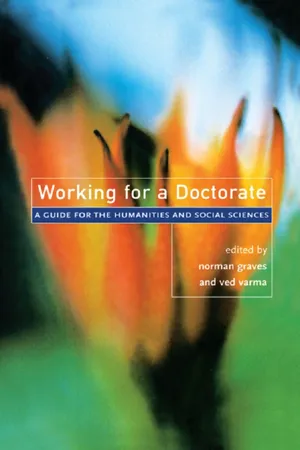
Working for a Doctorate
A Guide for the Humanities and Social Sciences
- 216 pages
- English
- ePUB (mobile friendly)
- Available on iOS & Android
eBook - ePub
Working for a Doctorate
A Guide for the Humanities and Social Sciences
About this book
Information
Chapter 1
How to succeed in postgraduate study
Denis Lawton
INTRODUCTION
Studying for a PhD is likely to be very different from what you have probably experienced as an undergraduate or even as a student on a taught masters course. This idea will probably not be entirely surprising to you because each level of education is different in some ways from that which preceded it: GCE Advanced level students are often shocked by the fact that the demands of A level subjects are different from those at GCSE; university undergraduates are usually expected to be even more responsible for organizing their own learning; masters students usually have a dissertation to write with only limited direct supervision. All of this is good preparation, but a PhD thesis is so different that some students never really adjust to what is required.
Writing a thesis should be an enjoyable, creative experience – and it often is. But there are many pitfalls which this book may be able to help you to avoid. Failing to complete a thesis is very common – far more common than it should be. In recent years universities and other institutes of higher education have made many improvements to the conditions offered to PhD students but the situation is still far from satisfactory. Perhaps a first step is for you to decide whether you really want to do a PhD. If you do then you should make up your mind that you will complete and not be one of the too large proportion who never finish what they start. The fact that you are reading this book perhaps means that you have already made up your mind. If so there are still a number of questions you should ask yourself.
I will return to those questions shortly, but first you might want to know on what basis I am offering advice. I completed my own PhD nearly thirty years ago, and for the last twenty-five years I have been supervising the work of others who want to do a research degree. To begin with I was not very good at it; now I think I am, and the completion rates support that view. At first I was not sure what was expected of me in the supervisory role and I am sure I made mistakes. After so many years experience, I now have very clear views on what the relation between a supervisor and a research student ought to be, but even so there is often room for misunderstanding. The possible relationships are countless: generalizations are limited, but there are a few important principles which nearly always apply.
One reason for the existence of difficulties and misunderstandings is that supervisors will often try to adopt a friendly, collegial stance, and it may not be easy for a research student to recognize the difference between a suggestion and a requirement. There is a good deal of interesting evidence from the field of industrial management that in many structured, hierarchical situations subordinates may often interpret a statement by their ‘line manager’ as a suggestion when it was intended as a command. In the much less hierarchical situation of supervisor and research student that kind of ambiguity can be even more common – sometimes with serious results. A supervisor might, for example, say that a questionnaire could be improved by a second draft being piloted before being used in the main sample; the research student in this case will need to clarify whether this is a suggestion or a requirement. The social skills required in the relationship are not all on the side of the supervisor, although an experienced tutor will be careful to try to avoid such ambiguities. Even so the research student will often need to be sure about what is meant during the supervision interview – even at the risk of temporarily changing the relationship. Clarity will be better in the long run. Few supervisors want to be put into a situation where they have to say ‘I insist that you …’. A sensitive student will learn to avoid the necessity for such commands. For a full treatment of the problems of supervision see Chapter 5.
So the requirements of doing research successfully include not only subject knowledge and research training – many interpersonal skills will be needed too. Most researchers will experience embarrassment or even pain at some time during the course of their PhD. Most will have moments when they wished they had never started. The first suggestion is that you should be very sure that you really want to do a PhD before you go too far.
WHY STUDENTS WANT A PhD
It would be a good idea to start by examining your aspirations, motives and long-term goals. It is usually a mistake to embark on a research degree because you have nothing else in mind. To get a PhD will involve years of hard work and all kinds of difficulties. So why do you want a PhD?
Have you a particular interest in research as a process or activity? Are you so interested in a particular subject that you want to continue working within it? Is there a problem you have identified that you think you could solve (or at least throw some light on)? Or are you interested in a job where a PhD will improve your chances of appointment or promotion? Are there other relevant motives?
The more of the above that you can honestly say ‘Yes’ to the better. Most people have a mixture of motives for starting anything as serious as a research degree. But even so, affirmative answers may not be enough. If your dominant interest in life is, for example, romanesque architecture, it does not necessarily follow that you should start a PhD on it. You might be better advised to write a book on the subject. I have often given that advice to potential students – sometimes mature students – who want to write a PhD thesis on a subject which they find interesting. A PhD might be a good idea, but there are alternatives – writing a good book or producing a first class catalogue might be better. A PhD thesis may impose too many constraints on a potential writer who may only want to learn more about a topic or to create something interesting. A research thesis has to be written in a certain style, obeying academic conventions about referencing and constructing bibliographies which some find extremely irksome. If so, why do it if you do not have to? It may be a good discipline or it may provide good training for some kinds of research activity. But it may not. It is essential to work out your reasons as well as the alternative options early on.
You should also try to develop a clear notion of what a PhD ought to be. In my experience, there are two kinds of PhD thesis (in the humanities/social sciences/education field). One view is that a PhD must be a piece of scholarly enquiry, deliberately limited in scope, but perfectly executed – a ‘masterpiece’ in the tradition of craftsmen who demonstrate their competence at the end of an apprenticeship by producing an example of work without any blemishes. The other view of a PhD is that it is a worthwhile learning experience. An external examiner who inclines to that view may well ask, towards the end of the oral examination, ‘If you were starting this research all over again, what would you do differently?’
These two views might be better regarded as two extremes of a continuum, and that in reality a PhD will often exhibit characteristics of both models. But some topics may lend themselves more to the second model rather than the first, whilst some supervisors (and external examiners) may have the first model firmly in mind. There are certainly some aspects of a thesis where imperfections should not be tolerated – for example, there is no real excuse for having uncorrected errors in a bibliography, or even having a bibliography which is inconsistently presented. (There are several conventions possible but you have to stick to one of them.) In either case a PhD is seen as a training programme which is designed to demonstrate competence as a researcher within a limited field.
In some respects the Humanities and Social Sciences do not lend themselves to ‘perfection’. Nevertheless, it is important to have a good match between topic and supervisor. To achieve a good match the research student must know why she wants to write the thesis. And in addition the research student must have a strong desire to finish the PhD. Many fall by the wayside, and although they will probably have benefited in some ways, failure to complete is nearly always a very negative and frustrating experience.
THE HIGHER EDUCATION INSTITUTION
Once you have decided that you really do want to start a PhD you should think carefully about where you should do it. There is usually a choice, and you should make the best choice possible. You should also be aware of the fact that universities and higher education institutes want research students – especially good students – who will not only complete their degrees but also make a positive contribution to the life and work of the university. There will be a selection process of some kind, but before discussing that, it may be useful to see the whole issue from the point of view of the university or the university department.
Why do universities want PhD students?
Research is an important part of university work. In recent years universities have been encouraged to write ‘mission statements’, which without exception mention research as one important aspect of their work – often the most important one. Universities also get funded to do research and to have a number of research students – if they do not meet their target numbers they lose income. Research students also pay fees. But some universities are better than others, and some departments are better than others – better both at doing research and looking after research students (and the correlation between the two may not be very high!).
Research students should find out all they can about a department long before applying for a place. Specialist journals such as the Times Higher publish annual ‘league tables’ of research ratings. They are important, but it is even more important to know how well a department trains its research students, and this is only indirectly reflected in the published ratings. Evaluations of research are more concerned with the quantity and quality of research publications than with the quality of research supervision, although in recent years the ‘completion rates’ for each department have been scrutinized. But a more revealing indication will be to discover how satisfied the research students are with the conditions in their department. They can be asked how satisfied they are with the kind of training they have received, the kind of computer facilities that exist, the accommodation available for research students, the adequacy of the library, and above all, the formal and informal arrangements for monitoring the progress and well-being of the research students. If you are contemplating doing your research degree in a university unfamiliar to you, it is well worthwhile spending a few days on the new campus to make the necessary enquiries. This may seem an extravagance, but it is really a good investment. Do not forget that the PhD will take from two to four years of your life: you are risking a great deal. In comparison with the risk, a few days may be very well spent.
University departments should only take students who they think will do well and complete their theses, but some departments, and some individual supervisors, have poor reputations for making adequate arrangements for their research students. Apart from making formal enquiries, it is worth asking at the Students’ Union or, if you know students at the university, ask them. You should also collect the names of university teachers who are available for research supervision in your subject and discretely ask lecturers at your own (first degree) university. Such information can be available at great distances – if you ask the right people. It is by no means uncommon in my institution for Australian students to ask for a specific supervisor.
Some university teachers enjoy teaching research students; others regard them as a waste of valuable research time. It is important to find out who belongs in each category. It is easier to express a preference for a specific tutor at this stage than to ask for a change of supervisor later on. (It is not impossible, and it may be necessary, but if you can avoid the embarrassment by getting the right supervisor from the beginning, so much the better.)
I have occasionally given advice to university teachers that if they do not actually enjoy supervising research students, they should not do it. I am sure this is good advice, but it is often not taken, for a variety of reasons. A university teacher may ‘need’ a few research students to justify his existence in terms of teaching load (increasingly university teachers have a target teaching load; taking on research students who never complete is a very unsatisfactory short-term solution to the problem of reaching a ‘norm’, but it does happen).
Another problem may be that the best supervisors of research students may not have any vacancies. Different universities or departments have different conventions, but in most there is a notional maximum or even a compulsory maximum number of research students per teacher. This is sensible because supervising research adequately involves such a close relationship and so much time (if done properly) that most teachers prefer not to have more than about ten research students: above that it is very difficult for teachers, even those with superb memories, to carry enough detail to be an effective research supervisor. (The best supervisors will keep very good records of each student’s problems and progress, but even so, there are limits.)
The selection process
You will almost certainly be invited to attend the department for an interview before being accepted as a research student. This is likely to be an interview with the departmental research degrees admissions tutor rather than with a potential supervisor. That will come later. At this preliminary interview the admissions tutor will try to satisfy her/himself (and her/his colleagues in the department) that an applicant has the right kind of academic background, as well as the personality requirements for completing a degree which I described briefly above. At this stage the applicant will be expected to have a reasonably clear idea of a research topic – a proposal, preferably in writing. This need not be a fully worked out outline of research but it should reflect sufficient thought about the question or problem to satisfy the admissions tutor that you are both qualified to undertake the research and capable of seeing it through. If all goes well at this stage, you may be invited to write further details of your proposal and then to discuss it with a research supervisor. It is at this stage, or perhaps even earlier, that you need to make a decision about the supervisor who has been suggested. The better prepared you are at this stage the more likely it is that you will get what you want. Too many prospective research students attend for interview having only the vaguest idea about what they want to do, what research techniques will be involved, and not even being familiar with the existing literature on the subject of their research topic. In order for you to get what you want out of a department, you should be aware of what their priorities are, and – to some extent – prepare yourself for the interviews accordingly. Knowledgable students can turn what is intended to be a selection process into a two-way negotiation.
WHY SOME STUDENTS FAIL
Kinds of ‘failure’
First we should define failure in the context of research degrees. Comparatively few students complete their theses and still fail; but a high percentage of students never complete (the figures vary considerably from subject to subject, department to department, supervisor to supervisor – you have been warned!). If a student has a reasonably good supervisor and submits a thesis for examination with the approval and support of the supervisor, that student is statistically very likely to pass.
There are, in most universities, two other possibilities. The examiners may decide that there is some merit in the thesis but that further work is necessary either to repair an omission or possibly to re-write a few chapters. A frequent requirement is for the final chapter to be re-written in order to provide a more comprehensive summary and conclusion. The examiners will specify a time limit to complete this referral (this requirement is not a failure – a thesis declared to be a failure means that no repair work will make it good enough). The time allowed for a referral will be within a maximum specified by university regulations – often eighteen months. A final possibility, within the regulations ordained by most universities, is that the examiners can pass the thesis subject to their being satisfied about minor corrections to be completed usually within a month (anything taking longer than a month being regarded as needing referral rather than minor corrections). The minor corrections may range from something as simple as a few spelling mistakes (even good students are sometimes surprisingly careless about authors’ names), or completing a bibliography, or even re-writing a few pages of the text.
Causes of failure or non-completion
So far I have been discussing ‘how’ students fail rather than ‘why’. That is a more difficult question. I know some very clever individuals who have failed, and others who were originally regarded as less gifted academically who succeeded. Why? One reason is that point I started the chapter with: PhD work is qualitatively different from the kind of studying that probably preceded it. Possessing three A grades at GCE A level and a first class honours degree in the chosen subject are useful predictors of success but are certainly not guarantees of success. Other qualities turn out to be much more important.
Apart from developing desirable work habits and attitudes of mind, to which I shall return, there are certain other prerequisites to successful thesis writing. The first is choosing a suitable topic. I mentioned above that there are two views of the PhD: a perfect small-scale piece of research study, or a worthwhile learning experience. There is a third view which students often begin with and have to be talked out of: it is a topic or a problem so complex and enormous that it would take a lifetime’s work to complete. I call that view the magnum opus type of PhD, which if persisted with will probably never be completed.
A key word to bear in mind when choosing a research topic is manageability. Whilst being sufficiently interesting to keep you going for two or three years (preferably not much more), it must not be so complex that it does not...
Table of contents
- Cover
- Halftitle
- Title
- Copyright
- Contents
- List of figures and boxes
- List of contributors
- Introduction
- 1 How to succeed in postgraduate study
- 2 The research process
- 3 Financing a doctorate
- 4 Planning time
- 5 Problems of supervision
- 6 Writing the thesis
- 7 Student experiences
- 8 Intercultural issues and doctoral studies
- 9 Gender issues in doctoral studies
- 10 Comparative perspectives on the British PhD
- Index
Trusted by 375,005 students
Access to over 1.5 million titles for a fair monthly price.
Study more efficiently using our study tools.
Frequently asked questions
Yes, you can cancel anytime from the Subscription tab in your account settings on the Perlego website. Your subscription will stay active until the end of your current billing period. Learn how to cancel your subscription
No, books cannot be downloaded as external files, such as PDFs, for use outside of Perlego. However, you can download books within the Perlego app for offline reading on mobile or tablet. Learn how to download books offline
We are an online textbook subscription service, where you can get access to an entire online library for less than the price of a single book per month. With over 1.5 million books across 990+ topics, we’ve got you covered! Learn about our mission
Look out for the read-aloud symbol on your next book to see if you can listen to it. The read-aloud tool reads text aloud for you, highlighting the text as it is being read. You can pause it, speed it up and slow it down. Learn more about Read Aloud
Yes! You can use the Perlego app on both iOS and Android devices to read anytime, anywhere — even offline. Perfect for commutes or when you’re on the go.
Please note we cannot support devices running on iOS 13 and Android 7 or earlier. Learn more about using the app
Please note we cannot support devices running on iOS 13 and Android 7 or earlier. Learn more about using the app
Yes, you can access Working for a Doctorate by Norman Graves,Ved P Varma,Ved Varma in PDF and/or ePUB format, as well as other popular books in Education & Education Theory & Practice. We have over 1.5 million books available in our catalogue for you to explore.