eBook - ePub
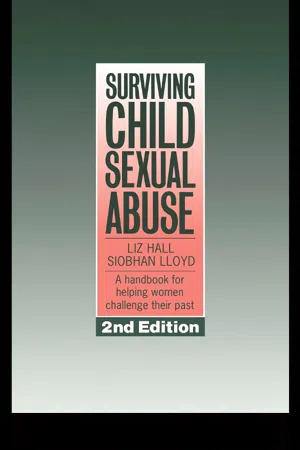
Surviving Child Sexual Abuse
A Handbook For Helping Women Challenge Their Past
- 416 pages
- English
- ePUB (mobile friendly)
- Available on iOS & Android
eBook - ePub
Surviving Child Sexual Abuse
A Handbook For Helping Women Challenge Their Past
About this book
Surviving Child Sexual Abuse" is a handbook for survivors and their helpers. It examines what sexual abuse entails for a child and why it happens. Personal and professional issues for helpers are addressed and the long term effects of sexual abuse are examined. The strengths of survivors are acknowledged together with the supportive alliances they have formed with partners, helpers and friends. The theme of disclosure is examined in depth and the main themes in therapeutic work with survivors are discussed and methods are described which can be used in such therapeutic work. This highly successful book ends with an evaluation of the issues involved in training helpers for working with survivors.; The book is aimed at therapists including social workers, counsellros in public organizations and private practice, clinical psychologists, psychiatrists, nurses, health visitors, general practitioners, police and psychotherapists.
Information
Chapter 1
Introduction
One consequence of the public interest in the issue of sexual abuse has been a dramatic rise in the number of women seeking help because of their childhood experiences. Statutory services and voluntary organizations have had to respond to this increased demand on their resources. People working with survivors have also been forced to examine their own attitudes and working practices, so that women can be offered the help most appropriate to their needs. Wider issues have also been debated; the legal framework for crimes of sexual violence has been examined and prevailing theories about the nature and extent of child sexual abuse have been challenged. Most importantly our understanding of child sexual abuse has been heightened by the testimony of survivors themselves. This chapter covers three main areas:
a definition of some of the key terms used in the book;
a summary of the main theoretical perspectives that have been used to understand and explain child sexual abuse;
a description of sexual abuse.
Definition of Terms
Child Sexual Abuse
Attempts at defining child sexual abuse abound in the literature. Definitions vary according to the abuse activities included, the relationship of the child to the abuser and the age difference between the child and the abuser. Some of the difficulties in the search for an acceptable definition can best be illustrated by examining different but overlapping approaches. One of the most widely used definitions is as follows:
The involvement of developmentally immature children and adolescents in sexual actions which they cannot fully comprehend, to which they cannot give informed consent, and which violate the taboos of social roles. (Kempe and Kempe, 1984)
This definition has been criticized on two counts by MacLeod and Saraga (1988):
It takes no account of the possibility or threat of force being used by the abuser.
It suggests that some acts are abusive only because they are not socially acceptable.
The definition does not acknowledge that young adults can also be sexually abused, even though they may be over the age of informed consent. It also ignores the fact that most children are abused by adults known to them. Survivors themselves have agreed a definition which has also been adopted by campaigning groups. Their definition is:
The sexual molestation of a child by an older person perceived as a figure of trust or authority—parents, relatives (whether natural or adoptive), family friends, youth leaders and teachers, etc. (Incest Survivors Campaign, quoted in Nelson, 1987)
It is vital that survivors of child sexual abuse have a right to define sexual abuse as they choose. However, by including abuse by babysitters or family friends, it becomes easy for critics who still doubt the prevalence of sexual abuse to discount new statistics. The allegation can be made that the figures are misleading because they include these wider extrafamilial relationships (Nelson, 1987). Nelson also argues that 'nothing should be allowed to obscure the fact that the majority of (incest) survivors suffered at the hands of a father-figure or brother.'
A third, more restricted definition is used by Forward and Buck (1981):
Any overtly sexual contact between people who are closely related or perceive themselves to be…if that special trust which exists between a child and parent figure or sibling is violated by a sexual act, that act becomes incestuous.
This definition is restricted to family relationships, even though it is recognized that the abuse of trust within the family has particularly devastating effects lasting into adulthood. Nelson (1987) concludes that
Traditionally, professionals have ignored or played down such abuse because it takes place within the family…there is no good place for sexual abuse…the family is the most destructive place of all.
Sgroi (1982) uses a definition which has fewer problems:
Child sexual abuse is a sexual act imposed on a child who lacks emotional, maturational and cognitive development. The ability to lure a child into a sexual relationship is based on the all-powerful and dominant position of the adult or older perpetrator which is in sharp contrast to the child’s age, dependence or subordinate position. Authority and power enable the perpetrator, implicitly or directly, to coerce the child into sexual compliance.
However, its emphasis on the ‘sexual act’ does not cover the range of sexual activities which children find threatening or unpleasant, for example, being watched in a ‘sexual’ way whilst undressing or bathing. It also fails to mention the range of other types of abuse which all too frequently accompany sexual abuse.
The search for the perfect definition of child sexual abuse will doubtless continue. Whatever the outcome it should include the following elements:
the betrayal of trust and responsibility;
the abuse of power;
an indication of the wide range of sexual activity involved in the abuse;
the use of force and/or threats by the abuser;
the child’s perception of a threat even if the abuse is non-coercive, non-threatening or non-violent.
In this way, it will acknowledge that child sexual abuse not only crosses the physical boundaries between adult and child, but it also constitutes a fundamental abuse and betrayal of the power that an adult has in relation to a child. In this book we examine issues relating to child sexual abuse which is perpetrated by an adult who is known to and trusted by the child. We emphasize abuse which is perpetrated by family members.
Characteristics of Sexual Abuse
Child sexual abuse has a number of features which make it particularly difficult for the child and which cause problems for the adult survivor:
Duration of the abuse A child may be abused by a trusted adult on one occasion only, but more frequently the sexual abuse goes on for months or years (Lukianowitz, 1972; Maisch, 1973).
Frequency of the abuse The abuse may occur once only or several times a week over a number of years. Often, however, a child experiences sexual abuse on a daily or more frequent basis.
The identity of the abuser Most sexual abuse is perpetrated by fathers or father-figures. Forward and Buck (1981) suggest that 75 per cent of reported abuse cases involve fathers and daughters, and that 10 per cent involve grandfathers. Brothers, uncles and cousins, or adult men who are in a position of trust with the child, for example, youth leaders, babysitters, teachers and doctors have also been identified as perpetrators (Patton, 1991). It is also estimated that approximately 5 per cent of the abusers of girls are female (Russell, 1986; Finkelhor, 1986).
The age of the child For most abused children the abuse starts well before puberty. Kempe and Kempe (1984) found the median age was between nine and ten years old. Herman and Hirschman’s (1977) study found that between six and nine was a common age for the abuse to start. There have been many individual cases reported where the child was under the age of six and even as young as a few months old.
Age of the abuser Evidence on the age of abusers comes from figures on convicted offenders and the accounts of survivors themselves. In most cases, the abuser is at least ten years older than the child. In relation to abuse by brothers and cousins, the age difference may be less, but the abuser is usually at or past puberty when the abuse starts. (O’Brien, 1991).
Multiple abusers Some children are abused by several adults, including a number of family members and other adults known to the family.
Sexual Abuse and Incest
Incest is defined by the New Collins Concise English Dictionary as ‘sexual intercourse between two people who are too closely related to marry’. This definition reflects the legal parameters of the crime of incest, and it confirms that children who have suffered long-term sexual abuse without full sexual intercourse have no recourse in law. We have deliberately avoided the use of the word ‘incest’ in the book to describe sexual abuse. We consider ‘incest’ to be a difficult, emotive and confusing word for the following reasons:
it does not take into account the range of sexual activity which constitutes sexual abuse;
it omits the fact that one of the ‘persons’ is a child and is in no position legally, emotionally or socially to consent;
it is a word which survivors themselves believe implies consent;
it is too narrow and legalistic a definition.
For all these reasons, we prefer to use the term ‘sexual abuse’.
Survivor
Throughout the book we have use the term ‘survivor’ to describe a woman who has experienced sexual abuse. The term was identified by women themselves in the 1980s as an alternative to the word ‘victim’ which had been in common use until that time. To describe a woman as a survivor suggests that:
it confirms that she has survived traumatic experiences;
she is no longer powerless in relation to the abuse;
she has identified the cause of her problems and is, hopefully, going to seek help;
she can identify with other survivors, sharing elements of a common past, a common language and a common wish for change;
it emphasizes the inner personal resources and strengths which she has used to survive
the abuse.
Helper
Throughout the book we use the term ‘helper’ to describe the person who works with a survivor to help her to deal with the effects of her childhood experiences. The term is not wholly satisfactory, as the helping role may take a variety of forms and can occur in different settings. For example, the helper might be:
a member of the survivor’s family, a partner or friend;
a volunteer working in an organization such as Women’s Aid or Rape Crisis;
a trained ...
Table of contents
- Cover Page
- Dedication
- Title Page
- Copyright Page
- List of Tables
- List of Figures
- Acknowledgments
- Preface to the Second Edition
- Chapter 1: Introduction
- Chapter 2: Issues for the Helper
- Chapter 3: Problems in Adulthood
- Chapter 4: Strengths of Survivors
- Chapter 5: Seeking Help
- Chapter 6: Stages of Recovery
- Chapter 7: Disclosure
- Chapter 8: Themes In Therapeutic Work
- Chapter 9: Sexuality
- Chapter 10: Survivors’ Groups
- Chapter 11: Therapeutic Techniques
- Chapter 12: Training for Working With Survivors
- Chapter 13: Conclusions
- Appendix: 1
- Appendix: 2 Hidden Memories
- Appendix: 3
- Bibliography
Trusted by 375,005 students
Access to over 1.5 million titles for a fair monthly price.
Study more efficiently using our study tools.
Frequently asked questions
Yes, you can cancel anytime from the Subscription tab in your account settings on the Perlego website. Your subscription will stay active until the end of your current billing period. Learn how to cancel your subscription
No, books cannot be downloaded as external files, such as PDFs, for use outside of Perlego. However, you can download books within the Perlego app for offline reading on mobile or tablet. Learn how to download books offline
Perlego offers two plans: Essential and Complete
- Essential is ideal for learners and professionals who enjoy exploring a wide range of subjects. Access the Essential Library with 800,000+ trusted titles and best-sellers across business, personal growth, and the humanities. Includes unlimited reading time and Standard Read Aloud voice.
- Complete: Perfect for advanced learners and researchers needing full, unrestricted access. Unlock 1.5M+ books across hundreds of subjects, including academic and specialized titles. The Complete Plan also includes advanced features like Premium Read Aloud and Research Assistant.
We are an online textbook subscription service, where you can get access to an entire online library for less than the price of a single book per month. With over 1.5 million books across 990+ topics, we’ve got you covered! Learn about our mission
Look out for the read-aloud symbol on your next book to see if you can listen to it. The read-aloud tool reads text aloud for you, highlighting the text as it is being read. You can pause it, speed it up and slow it down. Learn more about Read Aloud
Yes! You can use the Perlego app on both iOS and Android devices to read anytime, anywhere — even offline. Perfect for commutes or when you’re on the go.
Please note we cannot support devices running on iOS 13 and Android 7 or earlier. Learn more about using the app
Please note we cannot support devices running on iOS 13 and Android 7 or earlier. Learn more about using the app
Yes, you can access Surviving Child Sexual Abuse by Liz Hall,Siobhan Lloyd in PDF and/or ePUB format, as well as other popular books in Education & Education General. We have over 1.5 million books available in our catalogue for you to explore.