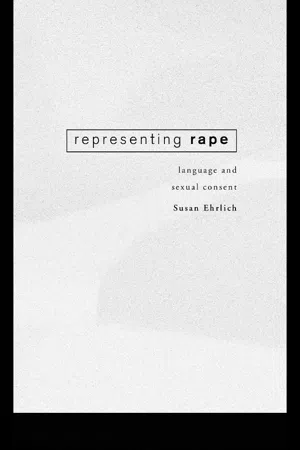
Representing Rape is the first feminist analysis of the language of sexual assault trials from the perspective of linguists. Susan Ehrlich argues that language is central to all legal settings - specifically sexual harassment and acquaintance rape hearings where linguistic descriptions of the events are often the only type of evidence available. Language does not simply reflect but helps to construct the character of the people and events under investigation.
The book is based around a case study of the trial of a male student accused of two instances of sexual assault in two different settings: a university tribunal and a criminal trial. This case is situated within international studies on rape trials and is relevant to the legal systems of the US, Canada, Britain, Australia, and New Zealand. She shows how culturally-dominant notions about rape percolate through the talk of sexual assault cases in a variety of settings and ultimately shape their outcome. Ehrlich hopes that to understand rape trials in this way is to recognize their capacity for change. By highlighting the underlying preconceptions and prejudices in the language of courtrooms today, this important book paves the way towards a fairer judicial system for the future.
- 184 pages
- English
- ePUB (mobile friendly)
- Available on iOS & Android
eBook - ePub
About this book
Information
1 The institutional coerciveness
of legal discourse1
Introduction
Central to an investigation of language as it is embodied within institutional settings is both an understanding of the relationship between linguistic practices and speakers’ social identities and an exploration of the institutional and cultural backdrop against which speakers adopt such practices. Building on scholarship in feminist linguistics, sociolinguistics and feminist legal studies, I develop in this chapter an approach to the language of sexual assault adjudication processes that brings together what has traditionally been two separate (but related) strands of research within feminist language studies: (1) the study of language use: how individuals draw upon linguistic resources to produce themselves as gendered and (2) the study of linguistic representations: how culturally-dominant notions of gender are encoded (and potentially contested) in linguistic representations. Because, as Conley and O’Barr (1998: 3) note, ‘the details of everyday legal practices consist almost entirely of language’, language is the primary vehicle through which cultural and institutional ideologies are transmitted in legal settings. Thus, to the extent that such ideologies are expressed linguistically in legal settings, the (gendered) linguistic practices of participants may be influenced by other kinds of linguistic practices. Put another way, my approach elucidates how the ‘talk’ of participants, specifically witnesses, is filtered through cultural and institutional ideologies which themselves are manifest in ‘talk’.2 Specifically, by investigating the linguistic details of a sexual assault trial and tribunal, not only do I provide a concrete demonstration of how dominant ideas about male and female sexuality and violence against women are reproduced and recirculated in the ‘talk’ of these institutional contexts, but also how such discursive formations shape and/or constrain the kinds of gendered identities that are produced. In developing my theoretical approach, I first draw upon the feminist linguistics literature, arguing that investigations of gendered ‘talk’ must be attentive to the way that institutions – specifically legal institutions – constrain and shape ‘gendered’ performances. I then turn to the specific ways that legal discourse can be shown to make possible or thwart certain performances of gender.
Enacting gender though ‘talk’
Debates over the nature of gender identity and its social construction, originating in feminist work of the 1990s, have in recent years informed research in sociolinguistics generally and feminist linguistics more specifically. In particular, conceptions of gender as categorical, fixed and static have increasingly been abandoned in favour of more constructivist and dynamic ones. Cameron (1990: 86), for example, makes the point (paraphrasing Harold Garfinkel) that ‘social actors are not sociolinguistic ‘‘dopes’’ ’, mindlessly and passively producing linguistic forms that are definitively determined by social class membership, ethnicity or gender. Rather, Cameron argues for an understanding of gender that reverses the relationship between linguistic practices and social identities traditionally posited within the quantitative sociolinguistics or variationist paradigm. Work in this tradition has typically focused on establishing correlations between linguistic variables and social factors such as age, race, ethnicity and sex, implicitly assuming that these aspects of social identity exist prior to and are determinate of linguistic behaviour (and other social behaviour). Indeed, early research in language and gender (in the 1970s and 1980s) was largely conducted within this research paradigm, focusing specifically on the correlation of linguistic variables with the independent variable of sex. By contrast, more recent formulations of the relationship between language and gender, following Butler (1990), emphasize the performative aspect of gender: linguistic practices, among other kinds of practices, continually bring into being individuals’ social identities. Under this account, language is one important means by which gender – an ongoing social process – is enacted or constituted; gender is something individuals do – in part through linguistic choices – as opposed to something individuals are or have (West and Zimmerman 1987). Cameron’s comments are illustrative:
Whereas sociolinguistics would say that the way I use language reflects or marks my identity as a particular kind of social subject – I talk like a white middle-class woman because I am (already) a white middle-class woman – the critical account suggests language is one of the things that constitutes my identity as a particular kind of subject. Sociolinguistics says that how you act depends on who you are; critical theory says that who you are (and are taken to be) depends on how you act. (emphasis in original)
(Cameron 1995: 15–16)
The idea that an individual’s linguistic behaviour does not simply arise from a set of permanent and invariant social attributes is also suggestive of the contextually-variable nature of social identities. If identities are not fixed and static, then their ‘performance’ can vary across social, situational, and interactional contexts. It is in this regard that Schiffrin (1996) is critical of variationist studies within sociolinguistics, in particular, the practice of coding aspects of social identity as categorical and invariant across contexts. Schiffrin argues for a different view, one in which social identities are locally situated and constructed: ‘we may act more or less middle-class, more or less female, and so on, depending on what we are doing and with whom. This view forces us to attend to speech activities, and to the interactions in which they are situated’ (Schiffrin 1996: 199). Likewise, Goodwin in an ethnographic study of urban African-American children in Philadelphia suggests that stereotypes about women’s speech collapse when talk in a whole range of activities is examined:
In order to construct social personae appropriate to the events of the moment, the same individuals articulate talk and gender differently as they move from one activity to another. The relevant unit for the analysis of cultural phenomena, including gender, is thus not the group as a whole, or the individual, but rather situated activities. (emphasis mine)
(Goodwin 1990: 9)
Goodwin’s comments not only argue for a dynamic and variable conception of gender identity, they also point to the variable linguistic resources drawn upon in performances of gender from one activity to another.
While much language and gender research in the 1970s and 1980s took ‘difference’ between men and women’s linguistic behaviour as axiomatic and as the starting point for empirical investigations, scholarly work in the 1990s (such as Goodwin’s), attentive to the way that the linguistic production of gendered identities varies according to contextual factors, has questioned such assumptions on both empirical and political grounds. Henley and Kramarae (1991) argue, for example, that focusing on differences rather than similarities between women and men functions to exaggerate and reinforce gender polarities (arguably, a focus that does not serve the interests of feminism) and abstracts gender away from the specificities of its social context. Indeed, many of the claims about gender-differentiated language that emerged from studies in the 1970s and 1980s (the most notable being that women’s speech styles are cooperative, while men’s are competitive) were based on studies that did just this: they were based on limited populations – white, North American and middle class – engaged in cross-sex conversations where, as Freeman and McElhinny (1996) note, gender is probably maximally contrastive, yet their results were overgeneralized to all women and men. Newer conceptions of the relationship between language and gender, then, not only question the fixed and static quality of gender within individuals but also across individuals and social groups. Like feminist scholarship, more generally, work in feminist linguistics has attempted to challenge universalizing and essentialist descriptions of women, men and language – descriptions that are more accurately characterized as contextually, historically, or culturally specific.
One influential attempt to theorize the relationship between gender and language in terms of local communities and social practices is the ‘communities of practice’ framework developed by Eckert and McConnell-Ginet (1992a, 1992b, 1999). Advocating a shift away from overarching generalizations about women, men and ‘gendered’ speech styles, Eckert and McConnell- Ginet (1992a: 462) emphasize the need to ‘think practically and look locally’. They recommend that the interaction between language and gender be examined in the everyday social practices of particular local communities (what they term ‘communities of practice’) because they claim that (1) gender is not always easily separated from other aspects of social identity and relations, (2) gender will not always have the same meaning across communities, and (3) the linguistic manifestations of gender will also vary across communities. In Eckert and McConnell-Ginet’s (1992b: 95) words: ‘gender is produced (and often reproduced) in differential membership in communities of practice’. For Eckert and McConnell-Ginet, then, it is not gender per se that interacts with linguistic practices, but rather the complex set of communities of practices in which individuals participate. That is, just as women’s and men’s involvements in ‘gendered’ communities of practice will vary, so women’s and men’s relations to normative constructions of gender (including linguistic ones) will vary. Although gender undoubtedly influences the kinds of communities of practice to which individuals have access and/or in which they participate, the mediating variable of ‘practice’ in Eckert and McConnell-Ginet’s framework leaves open the possibility of linguistic practices being variable within an individual speaker as well as across individual speakers of the same sex/gender (Cameron 1996, 1997).
In a discussion of an experimental setting (Freed and Greenwood 1996) that produced similar linguistic behaviour in both female and male subjects, Freed (1996: 67) provides a more concrete description of the way in which gender is produced through involvement in certain social practices or activities. Freed and Greenwood found that women and men involved in same-sex dyadic conversations with friends, displayed strikingly similar linguistic behaviour – behaviour typically associated with the so-called cooperative speech style of women.
First, participating in the same practice produced in the women and men the same kind of talk; second, outside of this experimental setting, it is possible that women and men would be less likely to find themselves in such similar settings, given the sex- and gender-differentiated society in which we live . . . Thus language and gender studies conducted in natural settings may often find differences not similarities in women’s and men’s speech simply because women and men are frequently engaged in different activities (see M. Goodwin 1990) and not because of any differences in women and men themselves. Since it is increasingly clear that speech patterns are products of the activities that people are engaged in and not inherent to the participants, we can conclude that communicative styles are customs related to actions, activities and behaviors differentially encouraged for women and men.
(Freed 1996: 67)
That linguistic forms are not inherent to the gender of speakers is a point also made by Ochs (1992: 340) when she argues that ‘few features of language directly and exclusively index gender’. A direct indexical relationship between linguistic forms and gender is evident in personal pronouns that denote the gender of an interlocutor. To say that most linguistic features indirectly index gender, then, is to say, like Freed and Eckert and McConnell-Ginet, that the connection is mediated by the social stances, acts and activities that women and men perform linguistically (e.g., displaying uncertainty, showing force). In turn, these stances, acts and activities index or become conventionally associated with normative constructions of gendered behaviour in a particular community or culture. Tag questions, for example, may display or index a stance of uncertainty (among other kinds of stances) and, in turn, a stance of uncertainty may in some communities become associated with feminine identities (Duranti and Goodwin 1992: 335). Given the multifunctionality of linguistic forms, Ochs’ account allows for the possibility that different hearers may assign different (gendered) meanings to utterances. If, for example, a particular hearer does not associate a stance of uncertainty with femininity, then that hearer may assign a different function to a woman’s use of tag questions, for example, that of facilitating conversation. What is challenged, then, under Ochs’ account of gender indexing is the proposition that a particular linguistic style or linguistic form directly and exclusively marks gender, for both speakers and hearers. And what is left open is the possibility of individuals performing social stances, practices or activities that transgress or transform normative constructions of gendered behaviour (see Hirsch 1998). Indeed, dynamic and constructivist approaches to gender more generally allow for the possibility of individuals actively reproducing and/or resisting linguistic practices implicated in hegemonic notions of masculinity and femininity.
Institutional coerciveness
While the theorizing of gender as ‘performative’ has succeeded in problematizing mechanistic and essentialist notions of gender that underlie much variationist work in sociolinguistics, for some feminist linguists (e.g., Wodak 1997; Kotthoff and Wodak 1998) Butler’s formulation ignores the power relations that impregnate most situations in which gender is ‘performed’ and hence affords subjects unbounded agency. For Cameron (1997), Butler’s (1990) discussion of performativity does, arguably, acknowledge these power relations, that is, by alluding to the ‘rigid regulatory frame’ within which gendered identities are produced. Yet, as Cameron (1997: 31) also points out, often philosophical treatments of this ‘frame’ remain very abstract: ‘for social researchers interested in applying the performativity thesis to concrete instances of behaviour, the specifics of this ‘‘frame’’ and its operation in a particular context will be far more significant considerations than they seem to be in many philosophical discussions.’ The routine enactment of gender is often, perhaps always, subject to what Cameron calls the ‘institutional cooerciveness’ of social situations; in other words, dominant gender ideologies often mold and/or inhibit the kinds of gendered identities that women (and men) produce.
Addressing the tensions between local and more universal accounts of language and gender, Bergvall (1999) emphasizes the need to analyse dominant gender ideologies that pre-exist and structure local (linguistic) enactments of gender. That is, while more local and contextual accounts of language and gender (e.g., Eckert and McConnell-Ginet 1992a, 1992b, 1999) move us away from overarching and excessive generalizations about women, men and ‘gendered’ talk, Bergvall (1999: 282) suggests that we also consider the force of socially ascribed gender norms – ‘the assumptions and expectations of (often binary) ascribed social roles against which any performance of gender is constructed, accommodated to, or resisted.’ Likewise, Woolard and Schieffelin (1994: 72) argue that we must connect the ‘micro-culture of communicative action’ to what they call ‘macrosocial constraints on language and behavior’. Certainly, the examination of language and gender within institutions elucidates some of the macro-constraints that pre-exist local performances of gender. Indeed, Gal (1991) suggests that because women and men interact primarily in institutions such as workplaces, families, schools and political forums, the investigation of language and gender in informal conversations, outside of these institutions, has severe limitations. It ‘creates the illusion that gendered talk is mainly a personal characteristic’ (p. 185), whereas, as much feminist research has revealed, gender is also a structuring principle of institutions.
Sexual assault adjudication processes are a rich and fertile site for the investigation of gendered ideologies that pre-exist and ‘coerce’ many performances of gender. Embedded within legal structures, feminist legal theorists (e.g., MacKinnon 1987, 1989, Bartlett and Kennedy 1991, Lacey 1998) have argued, are androcentric and sexist assumptions that typically masquerade as ‘objective’ truths. The crime of rape, in particular, has received attention from feminists critical of the law, because in Smart’s (1989: 50) words ‘the legal treatment of rape epitomizes the core of the problem of law for feminism.’ Not only are dominant notions about male and female sexuality and violence against women implicated in legal statutes and judicial decisions surrounding sexual assault, I argue they also penetrate the discursive arena of the trial. Moreover, the material force with which the law legitimates a certain vision of the social order, through, for example, fines, imprisonment or execution, means that the discursive imposition of ideologies in legal settings will have a particular potency. Hence, by locating my analysis of gendered linguistic practices in the context of sexual assault adjudication processes, I propose to explore the ‘institutional cooerciveness’ of these particular institutional settings or, put differently, the way that these settings shape and constrain performances of gender. While acknowledging the dynamic and performative nature of gendered identities, I demonstrate in what follows how particular institutions make available or thwart certain definitions of masculinity or femininity, thereby homogenizing what in other contexts might be realized as variable and heterogeneous performances of masculinity or feminit...
Table of contents
- Cover Page
- Title Page
- Copyright Page
- Acknowledgements
- Notes On Transcription
- Introduction
- 1. The Institutional Coerciveness of Legal Discourse
- 2. ‘My Shirt Came Off . . . I Gather That I Took It Off’: The Accused’s Grammar of Non-Agency
- 3. ‘I See an Option . . . I Simply Want to Explore That Option With You’: Questions and Ideological Work
- 4. ‘I Didn’t Yell . . . I Didn’t Scream’: Complainants’ Ineffectual Agency or Strategic Agency?
- 5. ‘The Signals . . . Between Men and Women Are Not Being Read Correctly’: Miscommunication and Acquaintance Rape
- Conclusion
- Notes
- Bibliography
Trusted by 375,005 students
Access to over 1.5 million titles for a fair monthly price.
Study more efficiently using our study tools.
Frequently asked questions
Yes, you can cancel anytime from the Subscription tab in your account settings on the Perlego website. Your subscription will stay active until the end of your current billing period. Learn how to cancel your subscription
No, books cannot be downloaded as external files, such as PDFs, for use outside of Perlego. However, you can download books within the Perlego app for offline reading on mobile or tablet. Learn how to download books offline
Perlego offers two plans: Essential and Complete
- Essential is ideal for learners and professionals who enjoy exploring a wide range of subjects. Access the Essential Library with 800,000+ trusted titles and best-sellers across business, personal growth, and the humanities. Includes unlimited reading time and Standard Read Aloud voice.
- Complete: Perfect for advanced learners and researchers needing full, unrestricted access. Unlock 1.5M+ books across hundreds of subjects, including academic and specialized titles. The Complete Plan also includes advanced features like Premium Read Aloud and Research Assistant.
We are an online textbook subscription service, where you can get access to an entire online library for less than the price of a single book per month. With over 1.5 million books across 990+ topics, we’ve got you covered! Learn about our mission
Look out for the read-aloud symbol on your next book to see if you can listen to it. The read-aloud tool reads text aloud for you, highlighting the text as it is being read. You can pause it, speed it up and slow it down. Learn more about Read Aloud
Yes! You can use the Perlego app on both iOS and Android devices to read anytime, anywhere — even offline. Perfect for commutes or when you’re on the go.
Please note we cannot support devices running on iOS 13 and Android 7 or earlier. Learn more about using the app
Please note we cannot support devices running on iOS 13 and Android 7 or earlier. Learn more about using the app
Yes, you can access Representing Rape by Susan Ehrlich in PDF and/or ePUB format, as well as other popular books in Languages & Linguistics & Linguistics. We have over 1.5 million books available in our catalogue for you to explore.