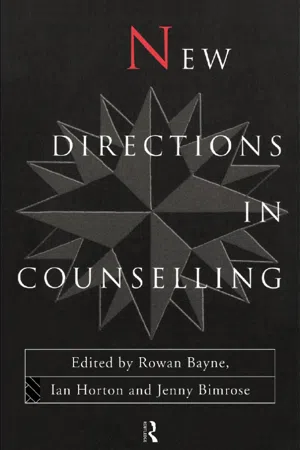
New Directions in Counselling responds to major changes currently affecting counselling. A team of well-known contributors identify the pressures forcing change, taking into account national and European legislation and the drive from within counselling towards greater professionalism and accountability.
Part one considers the impact of accredation, National Vocational Qualifications (NVQs), developing Codes of Ethics and evaluating effectiveness. Part two looks at new interventions for common problems, such as smoking, depression, stress and abuse; new settings for counselling, including the workplace and medical practice; and new techniques, such as using narratives. The final part discusses issues in training, raising questions about the place of a feminist perspective and whether there are still myths about counselling which need to be challenged.
New Directions in Counselling makes a timely response to questions affecting all counsellors, whether in training or practice.
eBook - ePub
New Directions in Counselling
- 336 pages
- English
- ePUB (mobile friendly)
- Available on iOS & Android
eBook - ePub
New Directions in Counselling
About this book
Information
Part I
Counselling as a profession
Chapter 1
Who will count as a counsellor?
Gleanings and tea-leaves
Marcus Lefébure
INTRODUCTION
This chapter’s title may well seem obscure, but, when duly interpreted, it is meant to sum up the series of convictions out of which the chapter is written: that the emerging profession of counselling and psychotherapy is undergoing rapid and profound developments of both substantive and organisational orders; that even the organisational changes will affect each one of us, to the extent, at the worst, of depriving us of the right to exercise our profession legally; that we can no longer afford to be ostriches; that we therefore need to inform ourselves better of these developments; that the relevant information is not readily available; that the most important elements can nevertheless be gleaned—hence the first part of the chapter’s subtitle—from two of our main professional journals, Counselling and the British Journal of Psychotherapy; but that even after such a diligent search the shape of the future can still at this stage be only guestimated, by a process rather dismayingly but fascinatingly like that of interpreting tealeaves— hence the second term of the subtitle; that we have no option but to hazard such a guestimate, but that any such guestimate will be reliable in proportion to its being informed.
This chapter is, therefore, in two main parts: selectively gathering and presenting the main elements of information available to the best of my ability, and then, on that basis, hazarding a few guesses about the future and its corresponding impact on counsellors.
GLEANINGS OF INFORMATION
Since I write as a counselling therapist, the total field of psychological care seems to me to be dominated by my chief representative body, the British Association for Counselling (BAC), which is, however, flanked, on the one hand, by the United Kingdom Council for Psychotherapy (UKCP, as the UK Standing Conference on Psychotherapy became at the beginning of 1993, after years of difficult struggle and debate), but also, on the other, by the Association for Counselling at Work (a division of BAC), the British Psychological Society (BPS) and, as from 1 April 1993, counselling in the context of the government’s reforms of community care (see Robertson and Tudor 1993).
I draw particular attention to the BPS and the news that it has established a Diploma in Counselling Psychology and a Division of Counselling Psychology, in so far as this marks the bringing to bear of the more than one hundred years of the scientific tradition and credibility of the BPS on counselling and therefore the entry of another very powerful player onto the field. And I put the last three groupings together because they do not, I think, generally figure large in the consciousness of the average counselling therapist, which is all the more of a defect of vision for these groups being, in my opinion, destined to be ever more important players on the therapeutic scene as a whole. Reddy (1993), for example, states that ‘The centre of gravity of the counselling universe is moving inexorably to the workplace.’ As for the UKCP, I shall say no more for the present beyond noting that, without any government intervention or legislation, it has already set up a national register of psychotherapists, which will therefore surely have an ever-increasing moral and de facto authority only just short of full legal authority—and that this register does not include counsellors (Deurzen Smith 1993).
Granted, however, that this suffices as a first approximation to a view of the whole scene, and that the BAC thus occupies a mid-position, this middle ground is far from being an undisturbed island. On the contrary, BAC seems in the early 1990s to have become more and more jostled and challenged from within and without. And I go on therefore to suggest the nature of this disturbance, in terms of what I see as the four main factors: (1) European pressure and opportunity; (2) the development of National Vocational Qualifications (NVQs); (3) the move towards a National Register of Counselling; and (4) the issue of a single body for counselling and psychotherapy.
The single European market: pressure, politics and opportunity
For practical purposes, the story begins in 1991, shortly before the coming into force of the single European market in 1993. The Management Committee of BAC set up a small working party to consider the Association’s response to the single European market and in particular to European Economic Community (EEC) regulations which might affect the practice of counselling in Britain and the other member states. After widespread consultation, BAC decided to work towards taking a lead role in establishing a European network for those concerned with counselling and psychotherapy (Counselling 1991, 2 (4) 123).Even prior to this, however, there had been what seems to have been a powerful stimulus to this initiative in the shape of the keynote address given at the 1991 training conference (Deurzen Smith 1991). This really put the subject on the map and indicated its main contours. Speaking with the inside feel of her Dutch and French background, with the authority of many years’ involvement with the subject in the UKSCP, and with the overview of an ‘applied philosopher’ (existentialist), Emmy van Deurzen Smith began by referring to the would-be reassuring statement of the then general manager of BAC, Elizabeth Davies, that ‘there are no European directives that mention either counselling or psychotherapy’, but went on to say that by dint of ‘reading between the lines’ of the emerging directives and policies, much could be descried. She then went on to point out that there were already two relevant ‘directives’ from Brussels.
First, the 1st Diploma Directive (89/48/EEC), already in force, and being implemented through the Department of Trade and Industry, governs all professions for which at least three years’ full-time education and training at university or the equivalent level are required—as is the case for most psychotherapy training courses—and ‘protects the rights of a person qualified in a particular profession in one EEC country to practise that profession in another EEC country without having to retrain’. But the monitoring of the equivalence of forms of training requires the existence of a so-called ‘designated authority’ in each country, which is in turn easily established where there is already a ‘competent authority’ for that profession, that is, a national body that sets standards and controls the awards of diplomas for the profession in question. And this is precisely what the UKCP has expressed its intention to become for the field of psychotherapy. In other words, in the UK the pressure for a national ‘competent authority’ for psychotherapy has come in the first place from within the country and not from Europe, but this would-be competent authority has thus been ready to fit into the European legislation when it comes into being.
The process is the reverse in the case of diplomas that do not require graduate entry, such as those in some areas of counselling, because there is nothing like a ‘competent authority’ for the whole range of counselling bodies. Moreover, the relevant directive here is not yet in force. But the grand political reasons for working towards intra-European mobility and the mutual recognition of qualifications across member states obtain at least as much for counselling as for psychotherapy. And there is in fact a second directive in draft (being actively processed by another government department, the Department of Employment)—the 2nd Diploma General Directive (COM(90)389 Final). Therefore there is pressure in the field of counselling too towards inter-state equivalence of training and so towards a national ‘competent authority’ for counselling (see too Counselling 1992, 3 (4): 3 of the ‘Stop Press’ section). It is just that here there is, as it were, European legislation in search of a due competent authority,
whereas in the case of psychotherapy it was a case of a competent authority in search of due legislative recognition (and see Counselling 1992, 3 (2) 64).
In the same article, Deurzen Smith (1991) made a powerful plea for an overall, umbrella body to represent both psychotherapy and counselling. This idea of a single authority for the whole gamut of therapy was one that was to have an independent future, as we shall have occasion to see later in this chapter.
Lest the idea of a single authority seems to be rather academic, let me point out that the kind of representation there is to be is a political matter. This is because the experience of counselling is very variable within the Western countries, strong in the Anglo-American tradition, weak to the point of non-existence in countries like Italy. This, however, carries the corollary that there is a risk that the non-Anglo-American countries will require any counselling that does emerge to be in their own national image and so to be restricted to medically trained people—unless the countries with wider traditions of counselling can make their counter-influence felt: the process that was later elegantly named ‘power-broking’ (see Counselling 1992, 3 (4) 3 of ‘Stop Press’, and 1993, 4 (2) 72), power politics by any other name. That this is not chimeric is shown by the fact that there have already been two attempts to launch a European association for psychotherapy, restricting membership to medically or psychoanalytically trained people (see Counselling 1991, 2 (4) 134, and 1993, 4 (2) 72). And this, of course, is but the pan-European equivalent of a group of so-called ‘conservative’ or strict training institutes in Great Britain restricting psychotherapy to their kind (see Counselling 1991, 2 (4) 134 and 1993, 4 (2) 72; British Journal of Psychotherapy 1993, 9 (4) 514, 515–16).
It also happens that part of this involvement truly ‘at the heart of Europe’ is cross-fertilisation with the work towards the so-called National Vocational Qualifications:
National Standards development and European Development for BAC has [sic] a sibling-like relationship, their growth appears to be developing hand in hand. It is not possible to analyse one in isolation from another. It is vital that a strong cohesive national voice is presented in order to have any influence in the development of counselling and psychotherapy within the single European market.
(Counselling 1992, 3 (2) 64)
This is, therefore, a suitable point at which to turn to my second factor: NVQs.
National Vocational Qualifications (NVQs)
The concept of NVQs has been born of a government initiative that seems to constellate a number of aims: to develop a flexible vocational training system for a skilled workforce in the 1990s and beyond; to respond to the EC idea of mobility of labour and therefore of mutually recognised quali-fications; to give a new place to work experience as distinct from traditional education in the acquisition of qualifications, therefore to bring providers and users of education and training into closer collaboration; and so to institute the notion of progression in qualifications and thus to the concept of national (and Scottish) vocational qualifications (NVQs and SVQs) organised into levels (of which there are so far four, with a fifth—professional—level well under way).From the beginning it was envisaged that this new structure should apply to all areas of employment. It was therefore to include whatever could be considered to be counselling. But at first there were no NVQs in that field. The government, therefore, acting through the Department of Employment, soon turned to BAC to fill this gap. And BAC responded to such effect that it was first asked to manage the initial project to differentiate between advice, befriending, guidance, counselling skills and counselling, and so to inform the appropriate ‘lead body’ (the Lead Body on Advice, Guidance and Counselling), and finally secured a sizeable representation on this lead body. This was formally launched on 8 October 1992. The task of the lead body seemed to be threefold: to differentiate between advice, befriending, guidance, counselling skills and counselling; to identify the different standards of competence required by each activity; to match competencies with appropriate qualifications.
The result of BAC’s involvement in the development of the National Council for Vocational Qualifications seems to be double-edged. On the one hand, by being so effectively recognised to be the, or at least a, leading representative of counselling, BAC has extended its influence deep into the world of ordinary skilled work. On the other hand, it may thereby have contributed to digging its own grave. For by lending its authority to the differentiation of advice, befriending, guidance and ‘counselling skills’ prior to what might be called core or therapeutic counselling, and to the articulation of four levels, it has inevitably raised the idea of integrating such counselling ‘proper’ into the whole emerging structure of progressive competencies as the fifth level. But this has already provoked a strong reaction from those who see such a development of counselling as a threat to the emergent ‘separate and identifiable professional activity having parity with other professional qualifications’ (Counselling 1991, 2 (4) 1 and 4 of ‘Stop Press’).
However, apart from the fact that those reacting in the way indicated beg the question whether their justifiable concern for professional counselling status could not be met within the very context of the NVQs, the idea of such a grand integration is organisationally and politically very appealing and potent. And in fact Counselling reported in May 1993 that ‘Included in the action plan [of the Lead Body on Advice, Guidance and Counselling] to develop standards and establish NVQs and SVQs will be further work on the production of a function map to encompass psychotherapy’ (4 (2) 71, italics added). And this in turn raises the question of an even grander, overall structure of some integration of the whole field from the lowest mooted level of advice, through counselling ‘proper’, to psychoanalysis, what Deurzen Smith (1991:134) called ‘the national and European stratification of the profession of counselling with that of other professions that cover a similar terrain’.
However, it also takes us into the dimension of what I called at the beginning ‘guestimation’, whereas we are at this point still fact-finding. I should, therefore, like to suspend further discussions of this issue until this fact-finding is complete. Suffice it to say that BAC has here put its future on the line. Nor is this the only way in which it has done so. It has put itself on the line in the very way in which it has come to participate in the project of a so-called ‘National Register’. We come therefore to my third factor.
A National Register
The first mention of a National Register came in BAC’s Annual Report for 1992/93:A verbal report at last year’s conference indicated that BAC alongside the Westminster Pastoral Foundation (WPF), Relate and the Confederation of Scottish Counselling Agencies (COSCA) had begun to explore the possibility of setting up a single National Register. During the year we have identified, through means of a questionnaire, which of our member organisations might already fulfil most of the criteria for a Register and by the time of the Annual Conference this year will have met this larger group for the first time. This is where the discussion will really begin. It will be important, as this work develops, that BAC is open in its negotiations as to the form the Register might take. At the same time we must maintain standards we have already set and make sure the Register is professional in all senses.
(BAC Annual Report 1992/93:2; and see Counselling 1992, 3 (4) 3 of ‘Stop Press’; 1993, 4 (2) 70, and 1993, 4 (3) 154)
This statement is charged with explosive implications:
- The very fact that there is no mention of the psychotherapeutic organisation of the UKCP and its register (see above) and that it takes it for granted that the newly projected register is about a ‘single, national, government recognised system of professional self-regulation for counselling which might eventually lead to some form of legal recognition’ (Counselling 1993, 4 (3) 154, italics added) leaves open the questions of the de facto division of the therapeutic profession as a whole into two main groupings (psychotherapy and counselling), of their mutual relationship, and of a possible umbrella organisation.
- The fact that, even within the field of counselling alone, BAC recognises such well-established and powerful players as the national networks of the WPF and Relate, puts itself forward as only an ‘equal partner’, and declares itself ‘open’ to the processes of negotiation—all this expresses BAC’s relative and possibly transitional position.
- Then, as regards what is a sub-topic within counselling, but a critical one—that of accreditation—the final two sentences indicate a tension between the existing emphasis given by BAC to ‘standards’ (in fact interpreted rather quantitatively) and the progressive notion of ‘competence’, taken over from the system of NVQs and SVQs by the still young but independent-minded and so potentially challenging COSCA.
This leaves the last of the four factors.
A single umbrella organisation for the whole of psychological care
In her keynote speech at the BAC Annual Conference in 1991, Emmy van Deurzen Smith made a powerful plea for a single, over-arching organisation to reassure the public, strengthen the profession within the country, and speak for Britain and the Anglo-American tradition of psychological care in Europe:
Isn’t it true that to provide a full service to clients, ranging from counselling skills and different levels of counselling through counselling psychology and a variety of therapeutic approaches to specialist psychotherapy or psychoanalysis, we do need to simplify and rationalise levels of training and practice?
(1991:134)
INTERPRETING THE TEA-LEAVES
The motto here must surely be:
If you can look into the seeds of time,
And say which grain will grow and which will not,
Speak then to me.
And say which grain will grow and which will not,
Speak then to me.
(Macbeth, I, iii: 58–9)
As to how this is likely to come about, most of the work in the field of psychotherapy strictly so called has been done by the UKCP. It also seems to me that, as a matter of another hard political fact, it is highly unlikely that the UKCP will admit any counselling organisation into any process of renegotiation at this to them late stage, since this would be to risk letting ten years of hard work unravel. No, the logic of events is surely towards the development of a separate branch of psychological care comprising counselling as distinct from psychotherapy in the strict sense—at most a sister (younger?) organisation.
This, then, leaves the question of how the equivalent de...
Table of contents
- Cover Page
- Title Page
- Copyright Page
- Illustrations
- Contributors
- Acknowledgements
- Introduction
- Part I: Counselling as a Profession
- Part II: Counselling Practice
- Part III: Counsellor Education and Training
Trusted by 375,005 students
Access to over 1.5 million titles for a fair monthly price.
Study more efficiently using our study tools.
Frequently asked questions
Yes, you can cancel anytime from the Subscription tab in your account settings on the Perlego website. Your subscription will stay active until the end of your current billing period. Learn how to cancel your subscription
No, books cannot be downloaded as external files, such as PDFs, for use outside of Perlego. However, you can download books within the Perlego app for offline reading on mobile or tablet. Learn how to download books offline
Perlego offers two plans: Essential and Complete
- Essential is ideal for learners and professionals who enjoy exploring a wide range of subjects. Access the Essential Library with 800,000+ trusted titles and best-sellers across business, personal growth, and the humanities. Includes unlimited reading time and Standard Read Aloud voice.
- Complete: Perfect for advanced learners and researchers needing full, unrestricted access. Unlock 1.5M+ books across hundreds of subjects, including academic and specialized titles. The Complete Plan also includes advanced features like Premium Read Aloud and Research Assistant.
We are an online textbook subscription service, where you can get access to an entire online library for less than the price of a single book per month. With over 1.5 million books across 990+ topics, we’ve got you covered! Learn about our mission
Look out for the read-aloud symbol on your next book to see if you can listen to it. The read-aloud tool reads text aloud for you, highlighting the text as it is being read. You can pause it, speed it up and slow it down. Learn more about Read Aloud
Yes! You can use the Perlego app on both iOS and Android devices to read anytime, anywhere — even offline. Perfect for commutes or when you’re on the go.
Please note we cannot support devices running on iOS 13 and Android 7 or earlier. Learn more about using the app
Please note we cannot support devices running on iOS 13 and Android 7 or earlier. Learn more about using the app
Yes, you can access New Directions in Counselling by Rowan Bayne, Jenny Bimrose, Ian Horton, Rowan Bayne,Jenny Bimrose,Ian Horton in PDF and/or ePUB format, as well as other popular books in Psychology & Education in Psychology. We have over 1.5 million books available in our catalogue for you to explore.