eBook - ePub
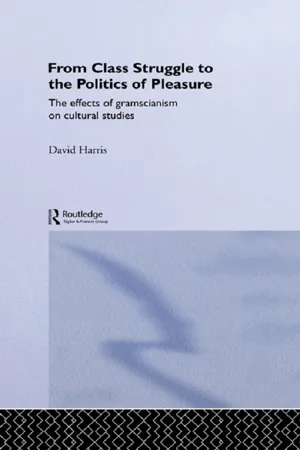
From Class Struggle to the Politics of Pleasure
The Effects of Gramscianism on Cultural Studies
- 240 pages
- English
- ePUB (mobile friendly)
- Available on iOS & Android
eBook - ePub
From Class Struggle to the Politics of Pleasure
The Effects of Gramscianism on Cultural Studies
About this book
This book examines the rise of cultural studies and evaluates its strengths and weaknesses. The author raises searching questions about the originality of cultural studies and its political motivation. Written with zest and a judicious sense of purpose it is a landmark work in cultural studies media and the sociology of culture.
Information
1
THE CONTEXT: BREAKING INTO MARXISM
INTRODUCTION
The history of the development of gramscianism can be conceived as a series of debates with a number of rival disciplines and perspectives. There are other determinants too, as we shall see, but the formal and polite way of locating what I have called gramscianism, the way it often represents itself in public, is in terms of running debates with a number of ‘bourgeois’ social sciences, including various sociologies and sub-sociologies; community studies; certain philosophies, ‘humanities’ and histories; and a number of marxisms, including different readings of Gramsci and Althusser, as well as rather vaguer ‘mass culture theorists’ and ‘orthodox marxists’. Later, the debates concerned some traditions in linguistics, structuralist and post-structuralist, ‘discourse theorists’ and Russian formalists; and postmodernism. This chapter considers some of the earlier debates, and Chapter 2 discusses some of the later ones.
Hall has given his own account (Hall et al. 1980) of some of these debates and the different ‘problematics’ which have coloured the work of the Birmingham Centre for Contemporary Cultural Studies (hereinafter known as CCCS), and there is some common ground between my account and his. However, Hall argues that the debates show an ongoing heterodoxy and openness in CCCS publications, but I want to suggest that beneath this pluralism lies a deeper conformity to a continuing project—the development and defence of gramscianism. I shall also argue later that although Hall’s account mentions a number of contextual micropolitical factors in the development of the Centre’s work, he has not theorised their effects adequately. The same arguments occur in discussing certain of the Open University courses which exhibit gramscianism, especially popular culture, or U203, as it is known to enthusiasts (Open University 1982).
My point about continuity is shown intially by the astonishing tendency for the figure of Gramsci to keep coming to the fore, as a leading theoristand guide, as a source of specific pieces or concepts which guide analysis, or less specifically as a kind of model of good practice, able always to ‘teach a lesson’, keep the faith, and see off the rivals. For me, this tendency is linked to the academic context of the production of these works: briefly, it is conventional in academic writing to conduct a debate with rivals before allowing the chosen theorist to emerge as the person most likely to synthesise the offerings, make sense of the debates, or offer some suitably pleasurable resolution and closure. This underlying narrative structure, which might be called ‘academic realism’, not an innocent pluralism or heterogeneity, is what lies behind the accounts of the specific twists and turns of the debates which are summarised below.
The ways of dealing with rivals have varied, from attempting critiques of, or ‘breaks’ with them, to admitting their force then laughing at (or possibly off) the consequences. As well as what might be called formal academic responses, there have been a number of other responses to the challenge offered by these rivals, like the partial admission of some of the points made, sometimes ‘genuinely’, sometimes in a spirit of ‘inoculation’, ‘gesture’ or ‘apology’, or the deployment of a number of rhetorical arguments, including appeals to authority, to political or emotional loyalties, to privileged inside knowledge, to common-sense, or to shared beliefs. Again, these are recognisable techniques, well-developed in the common room or seminar.
Discussion of these less formal manoeuvres is left to the substantive chapters that follow, and to the final chapter. It should suffice for now to say that the discussion of these ploys in gramscianism in no way involves comparing the texts against some ‘pure’ model of academic discourse, ‘correct’ reading, or ‘science’: all science involves rhetoric, and all academic argument uses ploys like these. ‘Pure’ science is a snark that no one is hunting any more.
There are signs of that snark hunt in the earlier and central pieces of the gramscian tradition, though, largely thanks to the influence of Althusser and his attempt to read marxism as a break from ‘ideology’ into ‘science’. Other ‘founding fathers’ of sociology may well have considered their work in this way too (see Crook 1991), but marxism was seen as offering a particularly attractive version of a radical ‘epistemological’ break designed to found a new science, and to open up a hitherto dark and unexplored continent. The model of a radical social theory, guiding revolutionary practice from the findings of a science, reaches its best development here too. Thus the first way of conceiving of the novelty and the promise of gramscian work was as a break from bourgeois social scientific or literary appropriations of culture into marxist ones.
THE BREAK WITH ‘BOURGEOIS’ DISCIPLINES
I have used the term ‘discipline’ to cover not just a range of ‘subjects’, but to highlight a claim that gramscianism is not just another ‘discipline’ but a new interdisciplinary study, or rather a ‘metadiscipline’, a discipline that focuses on some sort of ‘totality’. Thus behind the disputes with particular academic subjects in individual fields, like education or youth studies, lies a common claim that some context has been suppressed, some set of determinants omitted.
This claim is made clearly in intentions to ‘break with or to reform a number of separations…between “past” and “present”, between “history” and “sociology”, between the empirical and the theoretical, between the study of the cultural and the study of the not-cultural-at-all’ (Clarke et al. 1979:9). More specifically, Critcher critiques the tradition of ‘community studies’ for its attempt to ‘appropriate working class culture in terms of a discrete sociological variable: in this case the family’ (ibid: 14), and, later, when praising work which shows the connection of ‘community’ with ‘broader, national, sets of apparatuses or ideological fields’ (ibid: 23). The sociological material, on working-class affluence and embourgeoisment, fails to explicate ‘the relation between…changes in material life and the forms of working class consciousness and culture’ (ibid: 15). The literary tradition, including the seminal material by Hoggart, is criticised in terms of its method, and in terms of its neglect of the material factors that shaped that ‘[apparently] eternal working class Weltanschauung’ (ibid: 20).
Johnson, in the same volume, illustrates the limits of ‘labour history’ in a similar way, pointing to unduly narrow focuses on the economic factors, leaders, or Parliamentary politics in the various approaches in the tradition (including those developed by ‘Leninists’), and arguing for a ‘break’ in radical history too (ibid: 66). He goes on to flesh this out in terms of some compromise between ‘culturalist’ and ‘structuralist’ approaches (a continuing theme, as we shall see).
All the gramscian work reviewed throughout this book makes similar claims, as individual chapters will show. The ‘new sociology of education’ exhibits an early form of a break with the old sociology of education (seen as largely ‘functionalist’), bringing to bear a rather loose coalition of symbolic interactionist, ‘social phenomenological’ and marxist approaches, and offering a good deal of work to establish the role of any kind of critical sociology at all in areas that were seen as the proper preserve of philosophy. The ‘sociology of knowledge’ was the route to restoring a social context omitted in the rather odd ‘formal philosophy’ of the curriculum, and the first step was to argue for the ‘social construction of knowledge’ by a variety of agents, from abstract individuals to rather amorphous ‘powerful groups’. Again, this would break the monopoly of philosophy, but also open the possibility for a powerful new synthesisbetween the fields of sociology of education and sociology of knowledge, and, via Berger and Luckmann (1966), connect together the founding fathers, all of whom could be seen as offering a proto-sociology of knowledge. The struggles within this ‘new’ approach which led to the eventual emergence of gramscianism eased the passage of later ‘breaks’, and was copied in other fields.
The CCCS work on cultural studies shows an intent to perform a similar break, this time with a definite tactical ‘inflection’: cultural studies had to steer ‘between…two entrenched—but in their different ways, philistine and anti-intellectual—positions [sociology and humanities]’ (Hall et al. 1980:22), leading to a tactic of the ‘appropriation of Sociology from within’ (ibid: 23). This tactic involved searching out and using all the alternative sociological traditions, in the same initially messy mixture of Weber, Becker and Schutz that characterised the new sociology of education.
Luckily, the New Left project to translate and publish the major works of ‘western marxism’ was underway, and the Centre were soon able to develop their own ‘complex marxism’. As a result, the first major collection, Resistance Through Rituals (Hall and Jefferson 1976), is awash with confident marxist terminology, still used rather eclectically, and locates itself firmly within this ‘western marxist’ ‘alienation problematic’.
The new marxist approach would restore the hidden relations between youth subcultures, parent culture and dominant cultures that the old work had omitted. The shift to the level of ‘real’ as opposed to ‘phenomenal’ forms would lose none of the specificity of the old analysis, however: each of the phenomenal forms could be seen as valid variants of the underlying real ones as in the (not specifically mentioned) notion of critical transcendence in marxism. Devices like the ‘double articulation’, the conception of style as an ‘imaginary solution’ to structural problems, or the concept of ‘homology’ were tried out as means to perform this non-reductive connection.
Although echoes of the old eclectic radical sociology crept back in with Critcher’s piece on ‘structures, cultures and biographies’, marxism was firmly distinguished from its old radical allies (like symbolic interactionism), even if in a rather strange way (see the fuller discussion of the work on youth in Chapters 4 and 5). For the first time, ideas of ‘the crisis’, and the ‘levels’ model of the social formation were used in applying modern marxist analysis to this particular project in an attempt to demonstrate the self-sufficiency of marxism.
Here too, the emerging claims of women and black people to be included in any adequate analysis were made: bourgeois social science (and some marxisms) had omitted them, and rendered them ‘invisible’ or permanently outside the scope of analysis. Bringing back these groups, and recognising the structuring effects of race and gender, in conjunction with class, became an important subsequent task, and this spawned whole collections of CCCS work, and whole Open University (OU) courses of their own.
SEXISM AND RACISM IN THE OLD DISCIPLINES
Women had been judged by male and bourgeois standards in sociology and other social sciences, and factors specific to their lives had been neglected, or grasped in male terms (one of the best examples arises in the field of leisure—see Chapter 8). Women had also been neglected in ‘orthodox marxist’ work too, in Marx himself, and even in the work of prominent modern marxist theoreticians like Hindess and Hirst (Women’s Study Group 1978, especially Chapter 3). To restore the dimensions specific to women’s oppression required a synthesis of marxist economics and anthropology, and Freudian theory. This new synthesis would focus primarily on the site of oppression most commonly foregrounded in women’s experience—the family and its economic, political and ideological determinants and functions.
Hall suggests that this work was decisive and affected all subsequent analysis (Hall et al. 1980). No longer could the Centre see class as the final determinant of culture, and most of the subsequent published collections contained chapters on women and black people. Specific work developed by former members of the Women’s Study Group at CCCS was to reinstate largely female forms of leisure and resistance, in shopping, in watching television, and in fantasy. These activities were not only not trivial, but were proto-politics of a highly suitable kind in the new postmodernist age. In the latest work, this argument has swept all before it, and the women’s movement has become the very model of ‘new times’ politics.
Black people had been studied already in ethnocentric ways, often largely as pathological (e.g. in terms of how their family lives compared to the bourgeois ideal), so the gramscians had a familiar task to accomplish. The same sorts of devices were employed to expose the limits of these traditional conceptions and explain them as ‘phenomenal’, unable to grasp the structuring influences of economic, political and ideological determinants on the surface characteristics of the black working class, both in the UK and in the countries of origin (for Hall et al. 1978). Later work (CCCS 1982) pursued the same argument via analysis of the structuring effects of the blatant racist discrimination of the police, and the effects of the education system in Britain in the 1980s.
The misunderstandings in bourgeois social science extended to failed attempts to grasp ‘work-refusal’, patois, black family life, the social position and non-passivity of Asian women, the political significance of Rastafarianism (as opposed to its phenomenal religious or consolatory forms—see Gilroy in CCCS 1982), and, above all, the real connections between race, crime, sexuality and the inner city. Here, bourgeois sociology in particular (and popular journalism) offer an ideological ‘environmentalism’, or a straightforwardly racist ‘moral pollution’ argument respectively (Hall et al. 1978).
In a famous (actually fairly insignificant) section in Policing the Crisis (Hall et al. 1978), and in a lengthier account in The Empire Strikes Back (CCCS 1982), labelling theory and ethnography (respectively) are blamed specifically for some of these inadequacies. These approaches ignore issues of power, including the power of the police to decide when ‘standing on a street corner becomes the criminal act of “attempting to steal”’ (CCCS 1982:151), and they display a rather dangerous convergence between their concepts and ‘Home Office [or police] thinking’, especially in terms of the enthusiasm for ‘community’, and the slide towards ‘community policing’ (see CCCS 1982:164–73).
Once more, we need an account of ideology to fully understand how race came to be central to the ‘mugging phenomenon’ (later the riot phenomenon), and a (gramscian) theory of crisis to show how this in turn reveals the State’s ‘tilt towards coercion’ (Hall et al. 1978:216).
Butters, writing in anticipation of the completion of ‘the mugging project’, is one of the most enthusiastic supporters of the new approach in this field. He sees it offering a whole new methodology, breaking with the old dilemmas of inductivism found in ethnography, or tautologous deductivism in marxist theories of the State (in Hall and Jefferson 1976). Chapter 5 explores his argument in more detail.
BREAK OR INVERSION?
The distinctiveness of the break was not to be simply a matter of adding new elements in a broader context. The relation between those elements was to be reconsidered: old simple unities (generalisations or convergencies) were to be ‘deconstructed’, and new complex unities put in their place, preserving complexities among the different levels (‘relative autonomy’ was to be the key term here, or later ‘moving equilibrium’ or ‘organic unity’). Empiricism was to be abandoned, including its ethnographic variants, and empirical phenomena were to be ‘read’, interrogated for their political, symbolic or cultural significance, a move which was to become distinctively shaped by the ‘linguistic turn’ discussed below.
The old sociological and orthodox marxist connections with social democratic, Labourist, or orthodox Communist Party politics were to be abandoned, too, in favour of a new activism. This emerged steadily but unevenly as the work progressed, and ranged from support for the campaign against the sentences on the Handsworth muggers, to activist organisation of black people on the ‘front line’, or to a commitment to the Women’s Liberation Movement with its various struggles (including women-only consciousness-raising), or to work with radical community or occupational groups, or to a more diffuse activism in whatever site one found oneself—see Bennett’s Unit 3 of Mass Communication and Society (DE353) (Open University 1977). The early work also displayed, notoriously, a refusal to condemn, and a tendency to ‘talk up’, deviant, sometimes criminal, activities from street fighting to shoplifting.
Of course, the notion of a break reflects the influence of Althusser’s work, which we will consider below. Briefly, Althusser had proposed that marxism be read as offering a complete ‘epistemological break’ with earlier knowledges, with its own characteristic concepts and ‘objects’, and a whole Althusserian literature grew up attempting to refine these notions, and spot where the break had actually occurred in Marx’s work. This whole exercise required a ‘symptomatic’ reading of Marx, which eventually led to Althusser’s own problems and difficulties (see Hirst 1979).
By Althusser’s criteria, though, it is in fact doubtful if the new gramscian work does reveal much in the way of a break with the old disciplines. At the level of appearances at least, Cohen has noticed that the old methods and the old sorts of data have appeared in the new work too, for example (Cohen 1987). He singles out for attention Hebdige (1979), but one can find survey data as well as ethnographic data largely untransformed in a number of gramscian pieces including the ones cited above. Some of the old themes are there too, not far beneath the surface, especially in the rediscovery in the work on youth cultures of anomie theory or other variants of ‘strain’ theory (Downes and Rock 1988:260f). It is not at all clear that many of the new concepts came from a break with conventional methodology either: even the famous notion of style as a ‘magical solution’ is not confined to gramscian work, for example.
Of course, these earlier theories are suitably radicalised, but radicalising a theory is not the same as breaking with it. Young’s comments on his own early attempts to found a critical criminology make this clear, and he uses a familiar marxist figure to perform an auto-critique—he says the early work offered only an inversion of conventional work (in Fine et al. 1979). In inversion, the categories of conventional work are preserved, but one inverts the conclusions to be drawn fro...
Table of contents
- Cover
- Title
- Copyright
- Contents
- Author’s Note
- Acknowledgements
- Introduction
- 1. The Context: Breaking into Marxism
- 2. Floating Signifiers
- 3. Struggle and Education
- 4. Youth and symbolic Politics
- 5. The Crisis and its Consequences
- 6. The Mass Media: Politics and Popularity
- 7. Positioning, Pleasure, and the Media Audience
- 8. Leisure, Pleasure, Sport and Tourism
- 9. Gramscian Politics
- 10. Conclusion
- Bibliography
- Name Index
- Subject Index
Trusted by 375,005 students
Access to over 1.5 million titles for a fair monthly price.
Study more efficiently using our study tools.
Frequently asked questions
Yes, you can cancel anytime from the Subscription tab in your account settings on the Perlego website. Your subscription will stay active until the end of your current billing period. Learn how to cancel your subscription
No, books cannot be downloaded as external files, such as PDFs, for use outside of Perlego. However, you can download books within the Perlego app for offline reading on mobile or tablet. Learn how to download books offline
Perlego offers two plans: Essential and Complete
- Essential is ideal for learners and professionals who enjoy exploring a wide range of subjects. Access the Essential Library with 800,000+ trusted titles and best-sellers across business, personal growth, and the humanities. Includes unlimited reading time and Standard Read Aloud voice.
- Complete: Perfect for advanced learners and researchers needing full, unrestricted access. Unlock 1.5M+ books across hundreds of subjects, including academic and specialized titles. The Complete Plan also includes advanced features like Premium Read Aloud and Research Assistant.
We are an online textbook subscription service, where you can get access to an entire online library for less than the price of a single book per month. With over 1.5 million books across 990+ topics, we’ve got you covered! Learn about our mission
Look out for the read-aloud symbol on your next book to see if you can listen to it. The read-aloud tool reads text aloud for you, highlighting the text as it is being read. You can pause it, speed it up and slow it down. Learn more about Read Aloud
Yes! You can use the Perlego app on both iOS and Android devices to read anytime, anywhere — even offline. Perfect for commutes or when you’re on the go.
Please note we cannot support devices running on iOS 13 and Android 7 or earlier. Learn more about using the app
Please note we cannot support devices running on iOS 13 and Android 7 or earlier. Learn more about using the app
Yes, you can access From Class Struggle to the Politics of Pleasure by David Harris in PDF and/or ePUB format, as well as other popular books in Social Sciences & Ethnic Studies. We have over 1.5 million books available in our catalogue for you to explore.