- 258 pages
- English
- ePUB (mobile friendly)
- Available on iOS & Android
eBook - ePub
About this book
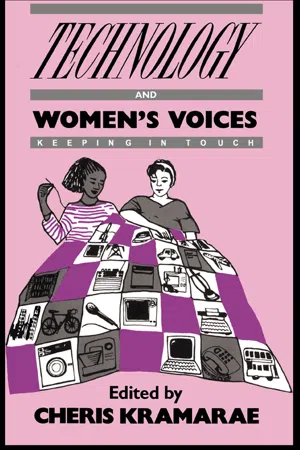
Avoiding jargon and using well-chosen illustrations, Technology and Women's Voices assesses technological changes in terms of their impact on women's social lives. The contributors investigate women's talk as part of the technological environment in which it occurs, and argue that technology has made a lasting impact on women's communications. The articles trace the operations of several specific innovations - including electricity, the telephone, washing machine, car, sewing machine and computer.
Information
ANNE McKAY
SPEAKING UP: VOICE AMPLIFICATION AND WOMEN’S STRUGGLE FOR PUBLIC EXPRESSION
‘If a woman knows her business when she tries to speak before the microphone she can create a most favorable impression.’
(Jennie Irene Mix 1924)
Devices for artificial voice amplification were developed in the last quarter of the nineteenth century. They were brought into practical application during World War I, and began to be used for public address and for radio during the 1920s. These devices—the microphone, amplifier and speaker—accomplished for the ear what the microscope and telescope did for the eye. Sounds fainter than the footstep of a fly or the voice of a woman could now be amplified and distributed to unlimited numbers of listeners.
Walter Ong (1967; 1974) has suggested that the technology of voice amplification is significant for women’s advancement because it helped to open the world of public participation previously closed to them by natural vocal deficiency and reinforced by custom and lack of training. I have tested Ong’s assumption by examining evidence surrounding some related questions.
- Are women’s voices in fact less powerful than men’s? What is the cultural and sociobiological evidence? What is the evidence left by observers of women’s public speaking in the era before artificial amplification?
- How did women make use of amplification devices when they first appeared, and what was the response to them?
My findings, drawn largely from reports and commentary in newspapers and popular journals, suggest a familiar thesis—that when women used the new technology in support of the goals and activities of established institutions, they were applauded at best or ignored at worst. When they attempted to use it in ways that would lead to change in the traditional order and in women’s customary roles, their right to use it at all was challenged.
ARE WOMEN’S VOICES NATURALLY LESS POWERFUL THAN MEN’S?
It has long been assumed that most women’s voices without artificial amplification are unequal to the demands of big-time public speaking. Ong (1974) states that, ‘the typical male voice can articulate words at a far greater volume than can the typical female voice’ (8). Only postpubertal males, and only exceptional ones among them, are said to have had the vocal power needed to address great open air crowds assembled on battlefields, on town squares, and inside vast churches and other public buildings.
An important consequence is that the style and form of public address and later of formal education were developed with little participation by women, and in many ways most compatible to the needs of men. Education, like public speaking, developed as an aggressive, combative, all-male activity centered on attack and defense. Both remained so in-the West from the time of the Greeks until the beginnings of this century.
The roots of this style and form lie deep in the intellectual economy of pre-literate cultures—in procedures for managing knowledge, that is, for remembering hard-won information essential for continuity and survival. These procedures are ‘formulaic in design and, particularly in public life, tend to be agonistic in operation’ (Ong 1974, 2). The exclusion of girls from formal education meant that few had the chance to develop the required intellectual tools of public discourse, even if some had possessed the necessary vocal power.
In the nineteenth century many factors converged to provide more ladders on to public speaking platforms for women, including:
- Changing roles and aspirations of women in church settings in America, partly in response to republican ideals and frontier conditions. These prepared women for active, vocal participation in the great nineteenth- and twentieth-century reform movements—temperance, abolition and suffrage (Griffith 1984).
- Growth of public gatherings outside the church context, including the lyceum and Chautauqua movements. These provided new arenas for women’s public speaking, even though frequently limited to traditionally women’s subjects and roles (Bode 1956; Gould 1961; Harrison and Detzer 1958; Morrison 1974).
- Rapid industrialization and the resultant growth of cities, promoting large-scale social movements, led and followed by women.
Direct witnesses to the public speaking of nineteenth- and twentieth-century women in response to these forces, prior to artificial amplification, provide cause to question the absolute primacy of vocal debility in accounting for women’s long silence in public:1
Her voice was deep toned and heavy, and well suited to a public speaker. She sometimes spoke in large houses, and even in the open air; and was distinctly heard by large audiences…. In the pulpit her appearance was bold and commanding. She used but few gestures, but her manner was such as to gain the attention of those who heard. (Said of Salome Lincoln, a female preacher; in Davis 1843, 22.)
I remember being one of five thousand who listened to her in Hyde Park, and I shared the general delight in her musical voice and the force of her logic. (Said of Eleanor Marx; in Rosebury 1973, 45.)
[Her] voice is of small compass, but before an audience it is so excellently ‘pitched’ and is used with such clarion-like effect that every word, as it comes in soft, measured cadence, can be heard. (Said of Mrs. Russell Cooke; in Dolman 1897, 677.)
The full complement of enabling and disabling factors for premicrophone women speakers is summed up in the following description of a talented nineteenth-century orator, Lady Henry Somerset:
As was to be expected, questions of the heart rather than the intellect, questions of moral and spiritual well-being, have been the most effective in leading women to undertake the work of the platform. But for the temperance movement, it is exceedingly doubtful whether Lady Henry Somerset, for example, would have become one of the most widely known public speakers of her time. Her ladyship first discovered that she possessed the gift of eloquence at temperance meetings held in the neighborhood of her Herefordshire estate, and it was through the British Women’s Temperance Association that she soon had opportunities of addressing gatherings that numbered several thousand…. Whether she is addressing five hundred or five thousand, Lady Somerset is always audible to everyone of her audience…. Endowed by nature with a voice clear and musical, but not at all strong, her Ladyship acquired, by two or three years of constant practice, the art of making herself heard without strain or apparent effort. She would take her maid to a meeting, post her at its farthest point, and by signals learn whether or not she was succeeding in filling the hall with her voice. This is the secret of Lady Somerset’s great success on the platform, coupled with a rare faculty for seizing hold of the strongest points in her case and presenting them invivid and graphic speech. (Dolman 1897, 679-80)
Many of these women were identified with powerful, influential men. The few who were not were unusually endowed with intellectual and educational resources and with personal dynamism rare in either gender, which helped them overcome the problem which may be more critical than vocal or oratorical ability—legitimation of their right to speak publicly at all.
The anti-slavery platform perhaps provides the best evidence of the importance of such legitimation. In 1898, a professor of public speaking reminisced about his first ‘teachers’ on the abolition circuit:
[I] cannot remember a really poor speaker; as Emerson said, ‘eloquence was dog-cheap’ there. The cause was too real, too vital, too immediately pressing upon heart and conscience, for the speaking to be otherwise than alive…. [M]y own teachers were the slave women who came shyly before the audience… women who, having once escaped, had, like Harriet Tubman, gone back again and again into the land of bondage to bring away their kindred and friends. (Higginson 1898, 188)
There, all questions of vocal and oratorical ability and of propriety were put aside by the public’s intense interest in what slave women had to say.
The testimony of women who themselves became skilled in oratory is also instructive. A Mrs. Phillips was described in 1894 as one of England’s brightest and most successful political speakers. At first, she says, she had a great prejudice against women on the platform. ‘Now I am more than reconciled, and I fully appreciate the value of public speech. I consider that it is the revival of one of the noblest of all arts, and should take a place in education, and in recreation as well, alongside with writing books and reading them.’
Asked her advice for women who wished to follow her example, she said,
Take trouble. I often say to women who feel it their duty to speak, but find it so difficult: ‘Do you take as much trouble in trying to make a speech as you would in learning French verbs or cooking an omelette? Why should you expect to make a speech without taking the trouble and going through the drudgery which would be absolutely essential to excellence in a very much easier department of work?’ (Woman as…, Review of Reviews, June 1894, 709)
Mrs. Phillips was herself trained in elocution but recommended study of voice production rather than elocution.2
Temperance leader Frances Willard (1839–1898) summed up the situation as she saw it in 1888:
Formerly the voices of women were held to render them incapable of public speech, but it has been discovered that what these voices lack in sonorosity they supply in clearness, and when women singers outrank all others, and women lecturers are speaking daily to assemblies numbering from one to ten thousand, this objection vanishes. It is probably no more ‘natural’ to women to have feeble voices than it is for them to have long hair. (Willard 1888, 53)
SOME SOCIOBIOLOGICAL EVIDENCE ABOUT THE POWER OF FEMALE VOICES
Evidence gathered over the past fifty years on sexual dimorphism indicates that gender alone is often a poor predictor of general physical ability. The difficulty of abstracting gender expectations and so-cial norms from ‘scientific’ evidence can be seen in a study of men’s and women’s voices made at Bell Laboratories in the mid-1920s.
The conclusion drawn from a series of experiments comparing voices was that women’s were equal to men’s in loudness, but significantly less intelligible:
The experiments which revealed this information were designed to measure the relative difficulty with which the fundamental sounds were perceived when uttered by male and female speakers. Each speaker uttered a hundred simple English words; and observers recorded the words in the usual manner of an articulation test…. The percentage of the various vowel and consonant sounds which were correctly perceived was thus ascertained for each of forty speakers.
At the same time the loudness with which the various sounds were spoken was automatically recorded…. [M] easurements …showed that on the average a woman’s voice is as loud as that of a man although individuals differ widely…. In the case of the women the enunciation, or articulation, of the vowels was on the average a few per cent less than for less. (Steinberg 1927, 153)
The author attributes the greater difficulty in understanding female speech to two factors.
- Women’s higher fundamental tone (250 cycles per second at the lowest end of the speaking range, on the average) produces only one-half as many audible overtones as a man’s voice (125 cycles at the lower end of its range).
- ‘Auditory masking,’ whereby if women’s speech (or any high-pitched tone) is loud, the higher frequencies are obliterated by the ear itself. (It is not mentioned that a similar masking occurs with low frequencies when they are loud.) The author concludes that ‘It thus appears that nature has so designed woman’s speech that it is always most effective when it is of soft and well modulated tone.’ (Steinberg 1927, 154)
More recent studies suggest that physique may be far less important than acculturation in producing gender-specific variations in speech. In their study of the factors enabling identification of a speaker as male or female, Sachs et al. (1973) made some observa-tions that are relevant here:
There are…some rather puzzling aspects to the actual acoustic disparities that exist between adult male and female speakers…. [Reanalysis of previous studies suggests that] acoustic differences are greater than one would expect if the sole determining factor were simply the average anatomical difference that exists between adult men and women. It is possible that adult men and women modify their articulation of the same phonetic elements to produce acoustic signals that correspond to the male-female archetypes. In other words, men tend to talk as though they were bigger, and women as though they were smaller, than they actually may be. (Sachs etal. 1973, 75)
In tests with preadolescent girls and boys, matched by size, listenerswere almost always able to correctly identify the speakers by gen...
Table of contents
- COVER PAGE
- TITLE PAGE
- COPYRIGHT PAGE
- TECHNOLOGY AND WOMEN’S VOICES
- ILLUSTRATIONS
- PREFACE
- GOTTA GO MYRTLE, TECHNOLOGY’S AT THE DOOR
- WOMEN’S VOICES/MEN’S VOICES: TECHNOLOGY AS LANGUAGE
- WOMEN CLERICAL WORKERS AND THE TYPEWRITER: THE WRITING MACHINE
- COMPUTATIONAL RETICENCE WHY WOMEN FEAR THE INTIMATE MACHINE
- ‘WHO NEEDS A PERSONALITY TO TALK TO A MACHINE?’: COMMUNICATION IN THE AUTOMATED OFFICE1
- CHATTING ON A FEMINIST COMPUTER NETWORK
- GENDER AND TYPOGRAPHIC CULTURE: BEGINNING TO UNRAVEL THE 500-YEAR MYSTERY
- WOMEN ON THE MOVE: HOW PUBLIC IS PUBLIC TRANSPORT?
- PUTTING WHEELS ON WOMEN’S SPHERE
- TALK OF SEWING CIRCLES AND SWEATSHOPS
- ‘WASHING, SEEMS IT’S ALL WE DO’: WASHING TECHNOLOGY AND WOMEN’S COMMUNICATION
- ORAL TRADITIONS AND THE ADVENT OF ELECTRIC POWER
- SPEAKING UP: VOICE AMPLIFICATION AND WOMEN’S STRUGGLE FOR PUBLIC EXPRESSION
- WOMEN AND THE TELEPHONE THE GENDERING OF A COMMUNICATIONS TECHNOLOGY
- NOTES ON CONTRIBUTORS
Trusted by 375,005 students
Access to over 1.5 million titles for a fair monthly price.
Study more efficiently using our study tools.
Frequently asked questions
Yes, you can cancel anytime from the Subscription tab in your account settings on the Perlego website. Your subscription will stay active until the end of your current billing period. Learn how to cancel your subscription
No, books cannot be downloaded as external files, such as PDFs, for use outside of Perlego. However, you can download books within the Perlego app for offline reading on mobile or tablet. Learn how to download books offline
Perlego offers two plans: Essential and Complete
- Essential is ideal for learners and professionals who enjoy exploring a wide range of subjects. Access the Essential Library with 800,000+ trusted titles and best-sellers across business, personal growth, and the humanities. Includes unlimited reading time and Standard Read Aloud voice.
- Complete: Perfect for advanced learners and researchers needing full, unrestricted access. Unlock 1.5M+ books across hundreds of subjects, including academic and specialized titles. The Complete Plan also includes advanced features like Premium Read Aloud and Research Assistant.
We are an online textbook subscription service, where you can get access to an entire online library for less than the price of a single book per month. With over 1.5 million books across 990+ topics, we’ve got you covered! Learn about our mission
Look out for the read-aloud symbol on your next book to see if you can listen to it. The read-aloud tool reads text aloud for you, highlighting the text as it is being read. You can pause it, speed it up and slow it down. Learn more about Read Aloud
Yes! You can use the Perlego app on both iOS and Android devices to read anytime, anywhere — even offline. Perfect for commutes or when you’re on the go.
Please note we cannot support devices running on iOS 13 and Android 7 or earlier. Learn more about using the app
Please note we cannot support devices running on iOS 13 and Android 7 or earlier. Learn more about using the app
Yes, you can access Technology and Women's Voices by Cheris Kramarae in PDF and/or ePUB format, as well as other popular books in Social Sciences & Gender Studies. We have over 1.5 million books available in our catalogue for you to explore.