eBook - ePub
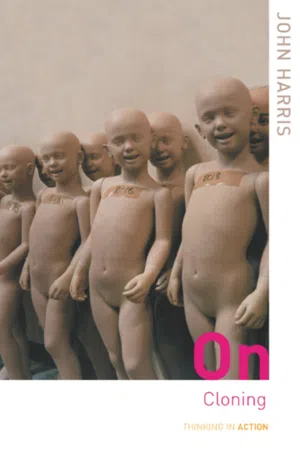
On Cloning
About this book
Cloning - few words have as much potential to grip our imagination or grab the headlines. No longer the stuff of science fiction or Star Wars - it is happening now. Yet human cloning is currently banned throughout the world, and therapeutic cloning banned in many countries.
In this highly controversial book, John Harris does a lot more than ask why we are so afraid of cloning. He presents a deft and informed defence of human cloning, carefully exposing the rhetorical and highly dubious arguments against it. He begins with an introduction to what a human clone is, before tackling some of the most common and frequently bizarre criticisms of cloning: Is it really wicked? Can we regulate it? What about the welfare of cloned children? Does it turn human beings into commodities?
Dismissing one by one some of the myths about human cloning, in particular that it is degrading and unsafe, he astutely argues that some of our most cherished values, such as the freedom to start a family and the freedom from state control, actually support the case for human cloning.
Offering a brave and lucid insight into this ethical minefield, John Harris at last shows that far from ending the diversity of human life or creating a race of super-clones, cloning has the power to improve and heal human life.
Information
Notes
PREFACE
1 See my ‘In vitro fertilisation: the ethical issues’ in The Philosophical Quarterly Vol. 33, No. 132, July 1983.
ONE ON CLONING: AN INTRODUCTION
1 In this section I draw on John Harris and Simona Giordano ‘On Cloning’, The Routledge Encyclopedia of Philosophy, Edward Craig (ed.) Online Edition 2003. I am very much indebted to my colleague Simona Giordano for her important and major contributions to this chapter.
2 Triplets probably occur when the egg splits twice but one of the resulting ‘clones’ dies. See for example Gary Steinman ‘Spontaneous monozygotic quadruplet pregnancy: An obstetric rarity’ in Obstetrics & Gynecology 1988, p. 866.
3 For the problematic nature of attributing moral significance to early embryos see my The Value of Life, Routledge 1985, and ‘Stem cells, sex and procreation’, Cambridge Quarterly of Healthcare Ethics, Vol. 12, No. 4, Fall 2003, pp. 353–372.
4 Since writing this I have been alerted to this possibility by Julian Savulescu – another example of synchronicity in bioethics?
5 Unless of course the nucleus donor is also the egg donor.
6 See http://www.dnapolicy.org/genetics/chronology.jhtml
7 Although Aldous Huxley may have been rather better informed about the science than most through his brother Julian, a leading scientist of the day.
8 Ibid.
9 See Anne McClaren ‘The decade of the sheep’, Nature Vol. 403, 2000, pp. 479–480.
10 In this section and the next I again draw on John Harris and Simona Giordano ‘On Cloning’, The Routledge Encyclopedia of Philosophy, Edward Craig (ed.) Online Edition 2003.
11 DOH (2000) – Department of Health: Stem Cell Research: Medical Progress with Responsibility. A report from the Chief Medical Officer’s Expert Group reviewing the potential of developments in stem cell research and cell nuclear replacement to benefit human health, Department of Health, June 2000. (This document provides clear guidelines through the technical and ethical issues surrounding stem cell research in general and contains sections on CNR.)
12 Ibid., p. 26.
13 House of Lords (2002) Stem Cell Research, Report from the Select Committee, London: Stationery Office. (Technical, ethical, social and legal issues surrounding stem cell research are analysed in this comprehensive document. Sections on cloning are included.)
14 DOH 2000, p. 26. Note 11 above.
15 Ibid., p. 26.
16 John Harris and Søren Holm ‘Extended lifespan and the paradox of precaution’ in The Journal of Medicine and Philosophy, 2002.
17 N. Ashford et al. Wingspread Statement on the Precautionary Principle, 1998, http://www.gdrc.org/u-gov/precaution-3.html.
18 I must acknowledge that this ‘reductio’ of the precautionary principle is the invention of Søren Holm.
19 J.A. Thomson et al. Science Vol. 282, 6 Nov. 1998. Roger Pedersen, Scientific American, April 1999.
20 David J. Mooney and Antonios G. Mikos ‘Growing new organs’, Scientific American, April 1999, pp. 38–43.
21 David K.C. Cooper and Robert P. Lanza, Xeno: The Promise of Transplanting Animal Organs into Humans, Oxford University Press, Oxford 2000. Chapters 1 and 2.
22 M.C. De Rijk et al. ‘Prevalence of Parkinson’s disease in Europe’, Neurology 54 (11 Suppl 5), pp. S21–23, 2000.
23 A. Schrag et al. ‘Cross sectional prevalence survey of idiopathic Parkinson’s disease and Parkinsonism in London’, British Medical Journal Vol. 321 (7252) 1 July 2000, pp. 21–22.
24 http://www.parkinsons.org.uk/docs/
25 Source ‘Parkinson’s Disease Foundation, Inc. http://www.pdf.org/aboutdisease/overview/imdex.html
26 Ian Wilmut et al. ‘Viable offspring derived from fetal and adult mammalian cells’, Nature, 27 February 1997.
27 See Cloning Human Beings: Report and Recommendations of the National Bioethics Advisory Commission, Rockville, MD, June 1997.
28 From President Clinton’s weekly radio broadcast reported in Bioworld Today Vol. 9. No. 7 Tuesday 13 January 1998. Interestingly the National Bioethics Advisory Commission stated that it was unethical because unsafe. Either Clinton misread his advisers’ report or decided to add ‘morally unacceptable’ on top of the fact that it was untested and unsafe rather than simply because it was untested and unsafe.
29 George W. Bush Remarks by the President on Stem Cell Research, The White House, 9 August 2001. http://www.whitehouse.gov/news/releases/2001/08/20010809–2.html
30 Reported in BioCentury, The Bernstein Report on BioBusiness, 19 January 1998.
31 The European Parliament, Resolution on Cloning, Motion dated 11 March 1997. Passed 13 March 1997.
32 Government Response to the Recommendations Made in the Chief Medical Officer’s Expert Group Report, August 2000, The Stationery Office Cm 4833.
33 The most reliable recently published article on the subject is S. Macintyre and A. Sooman, Lancet 1991, Vol. 338, p. 1151, and ensuing correspondence.
34 Source http://news.bbc.co.uk/1/hi/health/2570503.stm
35 For more on this particular fascination, see my ‘Intimations of immortality’ in Science Vol. 288, No. 5463 p. 59, 7 April 2000. ‘Intimations of immortality – the ethics and justice of life extending therapies’ in Michael Freeman (ed.) Current Legal Problems, Oxford University Press 2002, pp. 65–95.
36 Despite some powerful dissent from Aristotle.
37 I owe this example to Julian Savulescu.
38 See note 10 above.
39 Histocompatible simply means ‘compatible tissue’. The key point is that organs be sufficiently similar to avoid dangers of rejection when implanted in a host.
40 See J.M.W. Slack et al. ‘The role of fibroblast growth factors in early Xenopus development’, in Biochem. Soc. Symp. Vol. 62, pp. 1–12.
TWO HUMAN DIGNITY AND REPRODUCTIVE AUTONOMY
1 See, for example, Gary Steinman ‘Spontaneous monozygotic quadruplet pregnancy: An obstetric rarity’ in Obstetrics & Gynecology 1998, p. 866.
2 I am told (personal communication from Julian Savulescu) that the rate can be as low as one in every 40 births. In the literature I have so far found reference only to a rate of 1:80 births. See Sills et al. ‘Human zona pellucida micromanipulation and monozygotic twinning frequency after IVF’ in Human Reproduction, April 2000, Vol. 15, No. 4, pp. 890–895.
3 Katrien Devolder pointed this out to me. S.N. IVF baby marks 25th anniversary. BBC News, 26 July 2003 (http://news.bbc.co.uk/1/hi/health/3098437.stm). According to the American Society of Reproductive Medicine, 114,000 babies have been born in the United States alone (http://www.cnn.com/2003/HEALTH/parenting/07/25/ivf.anniversary/index.html.).
4 Axel Kahn ‘Clone mammals . . . clone man’, Nature, Vol. 386, 13 March 1997, p. 119.
5 See my ‘Is cloning an attack on human dignity’, Nature, Vol. 387, 19 June 1997, p. 754.
6 Opinion of the Group of Advisers on the Ethical Implications of Biotechnology to the European Commission No. 9. 28 May 1997. Rapporteur Dr Anne McClaren.
7 Axel Kahn, Nature, Vol. 388, 24 July 1997, p. 320.
8 See Hilary Putnam in Justine Burley ed. The Genetic Revolution and Human Rights, Oxford: Oxford University Press, 1999, pp. 1–14. Richard Lewontin ‘Confusion about cloning’ The New York Review of Books, 23 October 1997, pp. 18–23.
9 For Putnam’s quotation see his essay note 8 above, pp. 10–11. For mine see my ‘Rights and human reproduction’ in John Harris and Søren Holm (eds). The Future of Human Reproduction: Choice and Regulation, Oxford: Oxford University Press, 1998.
10 Ibid.
11 I realise Putnam says nothing about punishment. But by saying that Nazism might easily follow were cloning permitted, Putnam is certainly giving support to those who would outlaw human cloning.
12 Ibid.
13 My added emphasis.
14 Leaving aside, for the sake of the moral image, the interests of the child.
15 And, for good measure, perhaps we should use legislation to prevent any family having an established religion.
16 Another argument for the surprise factor in cloning!
17 Federico Mayor ‘Devaluing the human factor’ in The Times Higher, 6 February 1998.
18 Robert Winston, British Medical Journal Vol. 314 1997, pp. 913–914.
19 See Hilary Putnam note 8 above.
20 It is unlikely that ‘artificial’ cloning would ever approach such a rate on a global scale and we could, of course, use regulative mechanisms to prevent this without banning the process entirely. I take this figure of the rate of natural twinning from Keith L. Moore and T.V.N. Persaud The Developing Human (5th edn), W.B. Saunders, Philadelphia, 1993. The rate mentioned is one per 270 pregnancies.
21 Mitochondrial DNA individualises the genotype even of clo...
Table of contents
- Cover Page
- Title Page
- Copyright Page
- Preface
- Acknowledgements
- One
- Two
- Three
- Four
- Five
- Conclusion
- Notes
- Bibliography
Trusted by 375,005 students
Access to over 1.5 million titles for a fair monthly price.
Study more efficiently using our study tools.
Frequently asked questions
Yes, you can cancel anytime from the Subscription tab in your account settings on the Perlego website. Your subscription will stay active until the end of your current billing period. Learn how to cancel your subscription
No, books cannot be downloaded as external files, such as PDFs, for use outside of Perlego. However, you can download books within the Perlego app for offline reading on mobile or tablet. Learn how to download books offline
Perlego offers two plans: Essential and Complete
- Essential is ideal for learners and professionals who enjoy exploring a wide range of subjects. Access the Essential Library with 800,000+ trusted titles and best-sellers across business, personal growth, and the humanities. Includes unlimited reading time and Standard Read Aloud voice.
- Complete: Perfect for advanced learners and researchers needing full, unrestricted access. Unlock 1.5M+ books across hundreds of subjects, including academic and specialized titles. The Complete Plan also includes advanced features like Premium Read Aloud and Research Assistant.
We are an online textbook subscription service, where you can get access to an entire online library for less than the price of a single book per month. With over 1.5 million books across 990+ topics, we’ve got you covered! Learn about our mission
Look out for the read-aloud symbol on your next book to see if you can listen to it. The read-aloud tool reads text aloud for you, highlighting the text as it is being read. You can pause it, speed it up and slow it down. Learn more about Read Aloud
Yes! You can use the Perlego app on both iOS and Android devices to read anytime, anywhere — even offline. Perfect for commutes or when you’re on the go.
Please note we cannot support devices running on iOS 13 and Android 7 or earlier. Learn more about using the app
Please note we cannot support devices running on iOS 13 and Android 7 or earlier. Learn more about using the app
Yes, you can access On Cloning by John Harris in PDF and/or ePUB format, as well as other popular books in Philosophy & Gynecology, Obstetrics & Midwifery. We have over 1.5 million books available in our catalogue for you to explore.