Introduction
The idea for this textbook originated with a need to provide undergraduate students studying the broad discipline of marine and coastal resource management at the University of Aberdeen in Scotland, UK, with a framework of reference and support for their studies over the duration of their three-to-four-year degree programme. In many ways, marine and coastal resource management is very similar to the discipline of geography. It is an integrating discipline and one that draws upon the expertise, tools and techniques from many other disciplines. In addition, it is also a vocational degree that ultimately provides a basis for students to pursue a broad-based career that falls under the terms coastal or marine management. The coast involves aspects of the landward side of the coastline, including the hydrological catchment, and the marine or offshore environment.
For some students undertaking a three- or four-year degree programme, it can be difficult at the start to grasp just how the many degree programme subjects are interconnected to provide them with the knowledge and understanding they need to enter a career and be well prepared for a competitive job market. This is particularly so in the first couple of years. Feedback from students in the university degree programme mentioned above revealed that many students – despite attempts by academics to link modules (e.g. in course outlines and handbooks) within a semester or year and from year to year – did not really put two and two together to comprehend how their curriculum evolved over the duration of the degree programme. In part, this is because time constraints may require that an entire discipline get covered in one module at the start of the programme. This may be followed with an advanced module on the subject, but, if not, the coverage may be present only as part of another module, one for which the student is expected to recall the earlier content sometimes years later. Not all students make comprehensive notes as part of their degree module, relying instead on online materials delivered through software such as Blackboard. In addition, they may not retain recommended course texts or keep notes beyond the end of a module.
These challenges are compounded by the fact that the titles coastal manager and marine manager are not commonly found in job adverts. What is a coastal manager? It is a name given to someone who is responsible for managing the coast. What does it entail? For some, given that much of the management of a coast is often perceived to be carried out by the coastal engineer – a coastal manager is a coastal engineer. Will degree graduates find a job advert with the name coastal manager in the title? Probably not! In reality, they will more often find aspects of their expertise and a broad knowledge of marine and coastal subjects and issues of value in jobs that relate to aspects of management being the expectations of a position. This means that they may not have a very clear picture in their mind of what a coastal or marine manager actually does, or until they gain employment, the actual breadth and practice of coastal or marine management. Ultimately, they will likely find that they need to know a little about a lot of things and will not necessarily specialise in one particular aspect. For example, coastal or marine management requires a knowledge of the law but does not necessitate you being a lawyer. What it does mean, however, is that there will be occasions when you need to know the legal aspects, and that you should have a basic working knowledge of what those aspects mean, who to contact for more information if needed and how the law applies to different facets of the coast or oceans. The same also applies to planning, engineering, social sciences and geomorphology, amongst many other identifiable areas.
Whilst there are already many textbooks on integrated coastal (zone) management (ICM/ICZM), ICM is often only one part of coastal and marine resource management and it does not include all the aspects of the broader subject. There are many textbooks on the different subjects that make up coastal and marine management, but these tend to treat the subject from a single perspective. This limits appreciation of the more holistic, integrated viewpoint. This book is intended to address this issue by pulling together the fundamental underpinnings of coastal and marine resource management into a single volume.
For many students, the attraction to such a degree programme is the vocational versus academic nature and practical application. In today’s world, this is increasingly perceived to be a pathway to a job and a career. Possessing knowledge and understanding that can be applied and practiced has many benefits for the employer who is looking for a student with the practical and transferable skills needed for employment. In a world increasingly looking for degrees that are applied, marine and coastal resource management is a perfect fit, provided that the student understands why a general knowledge of a wide range of subjects, tools, and techniques is necessary.
Aside from this, students are often attracted to the keywords – marine, coastal and resources, but perhaps more importantly, management – that make up the name of the programme. The word management tends to suggest a future career combining a range of academic subjects in the natural, physical and social sciences with tools and skills that allow the student to apply their knowledge and understanding in a job that has an element of management, managerial, and both immediate and forward-looking decision-making responsibilities.
This textbook comprises seventeen chapters. These are organised into five elements: the Introduction; Fundamentals; Mapping, Monitoring and Modelling; Current and Emerging Sectors and Issues and an Epilogue. These sections provide a structure intended to focus the student on some of the key areas of marine and coastal management that form a foundation for knowledge and understanding as well as on specialist areas that are developing and evolving quickly. The final section serves to provide some insights into key areas and issues that are beginning to shape the future management of our coasts, estuaries and seas.
Each chapter contains both broad and specific coverage of subjects related to marine and coastal studies. In addition, small case studies are included to extend coverage of many interesting topics. Case studies and example applications serve to provide links between the different chapters and the subjects discussed therein. This volume will serve to provide a useful introduction and, in the longer term, a reference for the multiple subject areas that form the basis of coastal and marine management.
Chapter 1 is a contextual setting for the book, what it covers and an outline of the structure. In Part 1, Chapter 2 by Ballinger sets out to provide the student with a broad global introduction to ICM/ICZM, including an historical evolution of coastal management and some of the key definitions. Chapter 3 by Mead examines a more localised approach to coastal management at the scale of the beach, considering the development and application of strategies to protect, preserve and enhance the beach, particularly in areas where erosion dominates or where there is a drop in sediment supply to continue to nourish the beach. Chapter 4 by Macdonald covers another key area of knowledge that every student should know: marine law. Critical in practice, this chapter offers the student a ‘potted’ coverage of some of the main marine and coastal designations, with examples drawn from Europe and North America, with the intention of providing a basic understanding of marine law, boundaries and designation as an element of marine and coastal management, e.g. marine protected areas. Chapter 5, on marine spatial planning (MSP), by Slater and Reid leads on quite logically from Chapters 2 and 3 to provide insight into how marine and coastal management will increasingly be delivered and negotiated in practice and in decision making. The final chapter in Part I, Chapter 6 by Pontee provides a broad overview of the role of the coastal engineer in coastal and marine management, touching upon coastal defences, hard, soft and hybrid engineering approaches, coastal modelling and a link to shoreline management plans.
Part II of the book is designed to offer students an insight into the importance of geospatial data and information in coastal management. Chapter 7 by Green and Hagon sets out to introduce students to the data-into-information pathway, specifically looking at the rapidly evolving geospatial techniques and technologies that now provide the basis for the collection of increasingly high-resolution spatial and temporal data about marine and coastal environments, their processing, analysis, visualisation and communication. Geographic information system (GIS)-based data sets are, for example, crucial for undertaking MSP. Chapter 8 by Niedzielski covers the role of modelling in coastal and marine environments and reveals the importance and complexity of mathematical modelling and prediction. This chapter also touches upon aspects of GIS and remote sensing data as well as programming, illustrated with some marine and coastal examples. Chapter 9 by Green examines the needs and methods for access to marine and coastal data and information in the form of digital online GIS-based web atlases, with examples specifically drawn from the International Coastal Atlas Network. A modern day equivalent of paper-based atlases, electronic storage and representation of marine and coastal data has revolutionised the ease with which people and organisations can now share and publically access this information. The chapter also includes an historical overview of the evolution of the modern-day web-based atlas. Finally, Chapter 10 by Abbot examines the basics of hydrography from charting to navigation and a brief coverage of underwater surveying using an array of technologies from sonar to multibeam.
Part III of the book – Current and Emerging Sectors and Issues – which in a marine and coastal management degree would often be offered as specialist options – focuses on a number of distinct topics. In Chapter 11, Doody brings together the complexity of coastal ecology, coastal conservation, sustainability and coastal management. Chapter 12 by Herbert and Saunders considers marine and coastal biology, marine fisheries and aquaculture, and extends the student’s appreciation of the marine environment in the context of managing coastal ecosystems. Chapter 13 by Nursey-Bray et al. examines a very timely and topical area of research on the need for adaptation to climate change and its impacts on coastal communities and environments. Another very important area of research relating to climate change concerns the challenges with moving towards a more sustainable energy future powered by renewables versus our current global dependence on carbon-emitting fossil fuels. In Chapter 14, Smith and Thrupp examine the growing interest worldwide in marine and coastal renewables, and the potential for conflicts of interest in the nearshore environment. Chapter 15 by Cater and Richardson examines coastal and marine tourism, the popularity of which has grown considerably in recent years with social affluence and mobility, necessitating greater knowledge and understanding in order to determine and mitigate potential impacts. The final chapter in this section of the book, Chapter 16 by Mead and Borrero introduces the concept of surf science and examines some of the science behind the development of multi-purpose reefs, including artificial reefs.
As an Epilogue, the final section of the book – Chapter 17 by Green and Payne – seeks to highlight some of the future issues facing marine and coastal environments worldwide as attention is once again focused on the many and often competing uses of the marine and coastal environment. This includes concerns such as the need for and impact of giant seawalls as coastal protection from storm surges and tsunami to the uncertainty now facing the Arctic with the rapid melting of sea ice, the cruise liner industry worldwide, marine debris and related implications for commercial shipping and energy and mineral exploitation, amongst others.
It is impossible to cover every aspect of coastal and marine management in any single volume or even to begin to predict what will become the issues of the future. However, this book sets out to provide the basic background knowledge required for coastal and marine management, together with some of the tools and techniques in use, key optional subjects of relevance and finally some of the emerging issues and subjects of interest.
Introduction
For millennia, coasts have provided locational advantages for human settlement. As a focus for trade and with ready access to rich coastal resources, the attraction of these areas has resulted in the ‘littoralisation’ of human society. However, the very attractiveness of the coast has been the agent of its decline. The extensive depletion and degradation of highly productive ecosystems, including mangroves and coral reefs, over the last century is well documented (Agardy et al., 2005; Kay and Alder, 2005). This has resulted in marked reduction of many of the benefits provided by coasts, including their natural defence capacity. Half of the world’s wetlands disappeared over the previous century due to human interference (Creel, 2005). Pollution impacts and overexploitation of coastal resources, particularly fisheries, also pose pressures on coastal systems and threaten the well-being of coastal populations.
Academics and others began to question approaches to coastal governance, particularly institutional arrangements for coastal areas, towards the end of the twentieth century, as they became increasingly aware of the ineffectiveness of traditional sectoral management practices in stemming the decline in coastal environmental quality (for example, Sorensen and McCreary, 1990). Sectoral approaches were deemed incapable of addressing ‘wicked’ coastal problems: those resulting from the complexity and interconnectivity of coastal systems, including both human and physical subsystems and associated cascading impacts. Much debate focused around the inadequacies of fragmented institutional arrangements, which, in many countries, had arisen through the piecemeal and reactive evolution of legislation (Sorensen and McCreary, 1990). It was suggested that the resultant disjointed, sectoral and function-based organisational structures perpetuated silo-like professional mindsets, leading to narrow windows of decision making. This, it was contended, could induce significant incompatibilities and potential conflicts between stakeholder groups, especially in the context of the limited space and associated power struggles typical of many congested coastal areas.
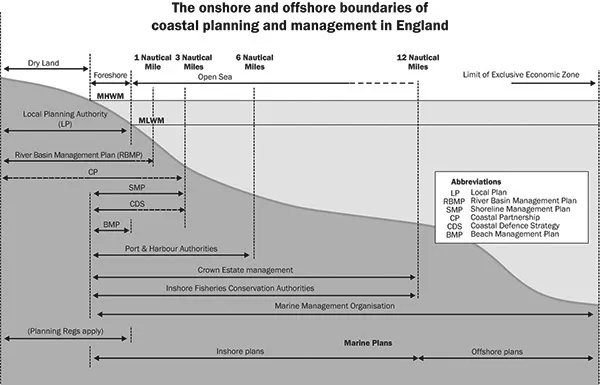
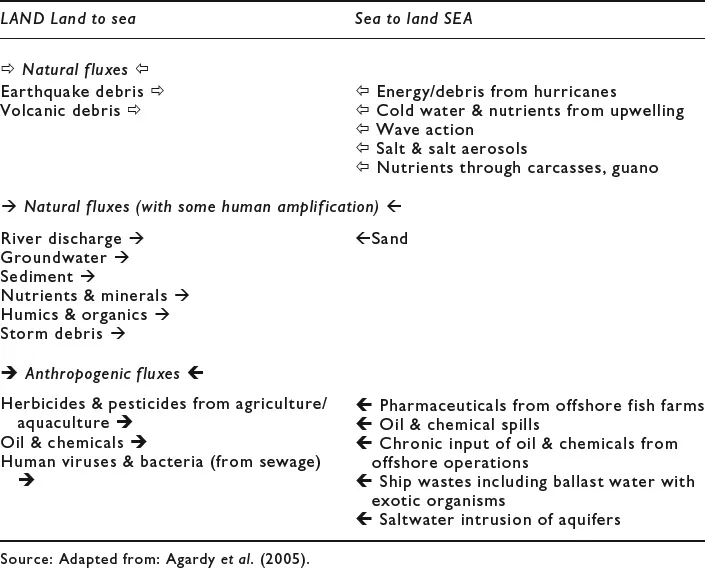
The inappropriate division of responsibilities across the land-sea interface was deemed to lie at the root of many coastal problems. National bodies with long time horizons and strategic concerns generally have dominated offshore. In contrast, onshore, locally-focused bodies, with more community-based and shorter-time priorities, steer onshore decision making and planning, often compromising environmental health for expediency and shorter-term gain. Figure 2.1 demonstrates the jurisdictional complexity associated with the land-sea interface for the English coast and Table 2.1 highlights the range of fluxes which are common across the littoral. Given the human amplification and derivation of many of these fluxes, it is vital to ensure that this jurisdictional ‘jungle’ does not hinder the system-based approach required to manage such processes (Agardy et al., 2005). As Cicin-Sain et al. (2002) also point out, such fluxes are not insignificant: 77 per cent of land-based pollutants influence coastal ecosystems and 44 per cent of these arise from inadequately treated wastes and catchment runoff.
Table 2.1 Main fluxes between land and sea
This chapter provides an overview of integrated coastal zone management (ICZM), which evolved as a mechanism to address these problems, particularly the inadequacies of existing coastal governance, planning and management. The chapter commences with a brief outline of the evolution of ICZM before providing an explanation of the key characteristics of ICZM and an evaluat...