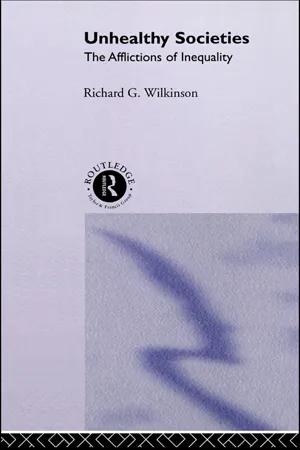
Among the developed countries it is not the richest societies which have the best health, but those which have the smallest income differences between rich and poor. Inequality and relative poverty have absolute effects: they increase death rates. But why? How can smaller income differences raise average life expectancy?
Using examples from the USA, Britain, Japan and Eastern Europe, and bringing together evidence from the social and medical sciences, Unhealthy Socities provides the explanation. Healthy, egalitarian societies are more socially cohesive. They have a stronger community life and suffer fewer of the corrosive effects of inequality. As well as inequality weakening the social fabric, damaging health and increasing crime rates, Unhealthy Societies shows that social cohesion is crucial to the quality of life.
The contrast between the material success and social failure of modern societies marks an imbalance which needs attention. The relationship between health and equality suggests that important social needs will go unmet without a larger measure of social and distributive justice. This path-breaking book is essential reading for health psychologists, sociologists, welfare economists, social policy analysts and all those concerned with the future of developed societies.
- 272 pages
- English
- ePUB (mobile friendly)
- Available on iOS & Android
eBook - ePub
About this book
Information
Table of contents
- Cover Page
- Title Page
- Copyright Page
- Illustrations
- Preface
- Chapter 1: Introduction: The social economy of health
- Part I: The health of societies
- Part II: Health inequalities within societies
- Part III: Social cohesion and social conflict
- Part IV: How society kills
- Part V: Redistribution, economic growth and the quality of life
- Bibliography
Trusted by 375,005 students
Access to over 1.5 million titles for a fair monthly price.
Study more efficiently using our study tools.
Frequently asked questions
Yes, you can cancel anytime from the Subscription tab in your account settings on the Perlego website. Your subscription will stay active until the end of your current billing period. Learn how to cancel your subscription
No, books cannot be downloaded as external files, such as PDFs, for use outside of Perlego. However, you can download books within the Perlego app for offline reading on mobile or tablet. Learn how to download books offline
Perlego offers two plans: Essential and Complete
- Essential is ideal for learners and professionals who enjoy exploring a wide range of subjects. Access the Essential Library with 800,000+ trusted titles and best-sellers across business, personal growth, and the humanities. Includes unlimited reading time and Standard Read Aloud voice.
- Complete: Perfect for advanced learners and researchers needing full, unrestricted access. Unlock 1.5M+ books across hundreds of subjects, including academic and specialized titles. The Complete Plan also includes advanced features like Premium Read Aloud and Research Assistant.
We are an online textbook subscription service, where you can get access to an entire online library for less than the price of a single book per month. With over 1.5 million books across 990+ topics, we’ve got you covered! Learn about our mission
Look out for the read-aloud symbol on your next book to see if you can listen to it. The read-aloud tool reads text aloud for you, highlighting the text as it is being read. You can pause it, speed it up and slow it down. Learn more about Read Aloud
Yes! You can use the Perlego app on both iOS and Android devices to read anytime, anywhere — even offline. Perfect for commutes or when you’re on the go.
Please note we cannot support devices running on iOS 13 and Android 7 or earlier. Learn more about using the app
Please note we cannot support devices running on iOS 13 and Android 7 or earlier. Learn more about using the app
Yes, you can access Unhealthy Societies by Richard G. Wilkinson in PDF and/or ePUB format, as well as other popular books in Medicine & Health Care Delivery. We have over 1.5 million books available in our catalogue for you to explore.