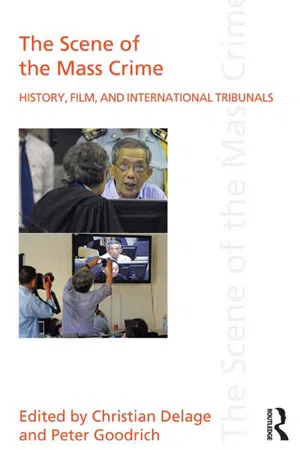
The Scene of the Mass Crime takes up the unwritten history of the peculiar yet highly visible form of war crimes trials. These trials are the first and continuing site of the interface of law, history and film. From Nuremberg to the contemporary trials in Cambodia, film, in particular, has been crucial both as evidence of atrocity and as the means of publicizing the proceedings. But what does film bring to justice? Can law successfully address war crimes, atrocities, genocide? What do the trials actually show? What form of justice is done, and how does it relate to ordinary courts and proceedings? What lessons can be drawn from this history for the very topical political issue of filming civil and criminal trials? This book takes up the diversity and complexity of these idiosyncratic and, in strict terms, generally extra-legal medial situations. Drawing on a fascinating diversity of public trials and filmic responses, from the Trial of the Gang of Four to the Gacaca local courts of Rwanda to the filmic symbolism of 9-11, from Soviet era show trials to Nazi People's Courts leading international scholars address the theatrical, political, filmic and symbolic importance of show trials in making history, legitimating regimes and, most surprising of all, in attempting to heal trauma through law and through film. These essays will be of considerable interest to those working on international criminal law, transitional justice, genocide studies, and the relationship between law and film.
eBook - ePub
The Scene of the Mass Crime
History, Film, and International Tribunals
- 248 pages
- English
- ePUB (mobile friendly)
- Available on iOS & Android
eBook - ePub
The Scene of the Mass Crime
History, Film, and International Tribunals
PART | 1 |
History, trauma, war crimes
CHAPTER | 1 |
‘Historical trials’: getting the past right – or the future?
The organisation of ‘historical trials’, especially in the realm of international justice, is often justified by at least four debatable claims. First, these trials are supposed to help victims overcome their trauma, alleviate their suffering; quench their legitimate thirst for justice. Second, they are expected to reconcile war-torn societies, promote the transition to democracy, restore law, order and human rights. Third, they would prevent repetition, create legal precedent, build a better future. Fourth and last, they purportedly establish historical truth, constitute a record for posterity and thus combat oblivion. Who could oppose an intervention that can promise such an array of eminently desirable results, with, after all, a limited mobilisation of resources – compared at least to almost any alternative mode of intervention in post-conflict societies? But, by raising expectations of this kind, can trials ever deliver anything but crude disappointment?
In this chapter, we will limit ourselves to the last claim. To start, it might be important from the outset to distinguish between ‘making history in the courtroom’ and ‘writing history in the courtroom’. The Iraqi court was most certainly making history by sentencing Saddam Hussein to death, but was it also writing history, creating a useful record of decades of Ba'ath party rule? 1 Historians are addicted to judicial records. They are dependent upon them, not just as raw material, but also as an interpretation and a narrative. Yet, all historians agree that historical truth is superior to judicial truth and that judicial sources are ridden with traps and biases, loopholes and blind spots. In this contribution I will argue that a court case is most often not very good at establishing the truth and, more often still, not really interested in establishing what historians hold to be the truth.2 As an introduction, I will briefly present two probably rather unexpected examples.
The first example is Emmanuel Le Roy Ladurie's Montaillou, a monument of the French nouvelle histoire and absolute historical bestseller of the 1970s, with over two million copies sold (including translations – for comparison, Braudel's La Méditerranée sous le règne de Philippe II sold eight thousand).3 Le Roy Ladurie's book is based on one sole source: the registry of the Inquisition of Jacques Fournier, compiled during his judicial campaign in the course of the year 1317.4 In his introduction, Le Roy Ladurie makes the unlikely claim that Fournier, in his registry, revealed himself to be both a professional policeman and an ethnographer. He would moreover have been a man of great moderation (since he abstained from torturing his suspects) and remarkable intelligence, with a sharp sense of observation and intuition. For Le Roy Ladurie, Fournier's registry offers a fascinating window into the depths of the minds and souls of fourteenth-century peasants and shepherds, thus allowing the historian to probe into the immutable times of rural societies unspoiled by modernity, industrialisation and democracy. Since all pre-modern mountain villages share essentially the same way of life, Le Roy Ladurie suggests, through his matching of primary and secondary sources, that his judicial source gives him equal access to his object of study as that which Pierre Bourdieu obtained through participating observation in Le Village Kabyle and that their conclusions can be compared.
Le Roy Ladurie is what the French call a monstre sacré and he used to be an academic baron. His work was thus not criticised in France until fairly recently by the iconoclastic medievalist Patrick Boucheron in a sanguine, and for French academic traditions unusually refreshing exchange.5 Fournier was an exceptionally ambitious young cleric, who built his career on his short stint as an Inquisitioner when Bishop of Pamiers. In the course of just one year, he triumphantly scored several unprecedented, crucial points. First, the regular clergy is perfectly apt to conduct the Inquisition, much better actually than the Dominican and Franciscan orders, which claimed its monopoly. Second, the Inquisition is a superb tool to assert the power of the Church over society. Even though Catharism had long been subdued, Fournier extended the reach of the Inquisition into unexplored realms of heresy, such as superstition, political and fiscal disobedience and sexual mores. All of which was to the delight of Le Roy Ladurie and Fournier's superiors since, third, he went on to be promoted, having proven to be an exceptionally gifted administrator of the Church, ending his career as Pope Benedict XII. All through his steeply ascending career, he carried a leather-bound luxury copy of his Inquisition registry with him, to the papal seat in Avignon, from which it was later transferred to the library of the Vatican. His registry stood witness to his glorious feats of arms in battling heresy, but as such it also became a judicial source and a doctrinal treaty of sorts.
Le Roy Ladurie was very much oblivious of this context. What his source registered was the brutal irruption and unprecedented intrusion of the Inquisition into a village society. What it revealed was trauma and survival strategies when facing persecution, not the longue durée of the peasant mentality.6 Like so many social scientists working on transcripts of the International Criminal Tribunal for Yugoslavia or Rwanda, he also totally evacuated the issue of translation, from patois into church Latin and onwards into contemporary French. From the point of view of the historian, Fournier, for his part, proved to be a fourteenth-century Carla Del Ponte, Baltazar Garzón, Antonio di Pietro or Eva Joly: a relentless militant of the extension of the jurisdiction of his court; a great innovator of its mandate and of the legal categories at its disposal; an explorer of new realms for the application of criminal law; a public prosecutor with professional ambitions beyond what the judicial career had to offer. In short, Montaillou is methodologically a very poor production. Historians, beware of the Le Roy Ladurie syndrome.
A second example is chosen from a very different context, starting from a rather straightforward question of historical truth: are the Anne Frank Diaries a fraud, or do they constitute an authentic document?7 A series of judicial proceedings tried to tackle this question, but all remained inconclusive. A first court case, started in 1956, opposed Meyer Levin to Otto Frank, Anne's father and only heir.8 This was a civil law case, involving intellectual and property rights. With Otto Frank's agreement, Meyer Levin had authored a first theatre adaptation of the diaries, but he failed to find a theatre willing to produce his scenario on stage. Frank then entrusted the same task to Frances Goodrich and Albert Hackett, who went on to produce an absolute blockbuster on Broadway and later achieved worldwide success. Levin felt betrayed, claimed financial compensation for his fruitless work and also, in a McCarthyist mindset, very much resented the ‘ideological orientation’ of the successful and ‘leftist’ version. The case went on to the Supreme Court, but was finally settled out of court in 1959, with Frank agreeing to pay Levin the sum of $25,000. That same year, a second court case pitched Otto Frank and the editor of the German translation of the diaries against Lothar Stielau, a Lübeck high school teacher.9 Stielau had written in an article in the student periodical of his school that the diaries were a fake and Frank and his editor sued him for libel and defamation in another civil tort law case. The case was again closed by an out of court settlement in October 1961, the plaintiff accepting the pretium doloris proposed by the defendant. Stielau did face a further disciplinary procedure brought against him by his ministry of education. Further libel cases brought against Heinz Roth, Ernst Römer and Edgar Geiss, authors and distributors of rather more straightforward pamphlets on the ‘Anne Frank Lie’ in 1976, were ultimately inconclusive, dragging on through appeal procedures, statutes of limitation and the trespassing of the defendants.10 There were also two stalled criminal proceedings: first the investigation into the betrayal of the Frank family's shelter, dropped for dearth of evidence in 1946; and second, in 1963, the case against Karl Silberbauer, the SS agent responsible for their arrest, identified by Simon Wiesenthal while still on active service in the Vienna police corps, but dropped on the request of Otto Frank.11
The long series of diverse civil and criminal proceedings before American, German and Dutch legal authorities not only failed to reach a final verdict or state the truth. They also substantially nourished the controversy by new suspicions, undecided issues and rumours. It was obviously and quite legitimately the role and duty of defence attorneys to produce arguments that made the doubts expressed by their clients appear less outlandish or inspired by anti-Semitism and neo-Nazi sympathies only; arguments that did find their way into the public discourse. And court cases did offer a stage for the paranoid interpretations of Robert Faurisson (in the Roth case) and David Irving (in the Geiss case). After all, so ran the rumour, why would Otto Frank agree to pay Meyer Levin $25,000 if really it was his daughter who had written the diaries? Facing this growing controversy, in 1980 the Dutch government commissioned a critical edition of the diaries from a committee of historians. Published in 1986, the critical edition effectively halted the controversy, by establishing through the methods of historical source analysis the firm and simple truth that the diaries are an authentic, and, besides, quite exceptional document.12
As far as the capacity of the court to state the truth is concerned, we can draw a few conclusions from this introduction. First of all, only a minority of cases lead to a trial (only in a handful of the 100,000 cases of Dutch Jews deported and killed was a trial investigating the circumstances of their arrest ever organised). Second, most civil law cases never reach a verdict, because a settlement is reached out of court. In these cases, the court helps individuals to reach an agreement, but it does not pronounce any judicial truth. Third, the court as an institution and the judge as an individual pursue a whole set of goals which have overwhelming priority over 'saying the truth’. They want to set legal precedent, affirm or extend the jurisdiction of the court, promote a personal career. These goals do not just interfere with historical truth; they will inform the judicial narrative, select the events under the attention of the court, their legal definition, the witnesses summoned to the court and the stories they will be allowed to tell.
Historians of the Second World War all suffer to some extent from the Le Roy Ladurie syndrome. They are heavily dependent upon judicial sources, which inform their historical narrative in crucial ways, and they are most often not aware of it. In the final analysis, it is the task the judiciary sets itself that dictates the judicial narrative, and the underestimation or ignorance of this agenda by historians has far-reaching consequences. I will try to illustrate this observation through the example of Belgium, but the Belgian case is only a case in kind, which could easily be extended to most occupied territories. Post-war justice in Belgium followed two very different and separate tracks, one concerning Belgian nationals and one concerning Germans.
Belgian nationals were brought to trial on charges of collaboration and treason. The task the judiciary set itself – or at least, the task the political authorities conferred on it – was to purge the national electorate of fascist elements, and to do it quickly and on a large scale. Some 400,000 cases were opened, in a population of eight million inhabitants, which means one out of every 20 citizens of all ages and sexes. As a result 60,000 trials were organised and 40,000 individuals convicted, which is 0.5 per cent of the total population. Compared even to Soviet statistics of the Stalinist purge of occupied territories, this is quite impressive.13 How did the Belgian judiciary treat this massive volume of cases? The judgement of wartime collaboration, including civilians, was deferred to military tribunals, which were created almost ex nihilo, involving the recruitment of 400 judges, freshly graduated from the country's law schools.14 The tribunals deployed a peculiar legal arsenal, defining crimes such as ‘intelligence with the enemy’ and ‘undermining of national institutions’. Elements of proof included simple membership of criminal organisations, including most collaborationist organisations and parties, defining the crime as essentially a political offence. This made it relatively easy to establish guilt, since collaboration movements had been careful to keep membership lists, which the judiciary only had to compile. It was especially incomparably easier to check membership of criminal organisations than to establish individual responsibility for criminal acts. This in turn had a long-lasting impact on historiography and public memory, where collaboration came to figure as a...
Table of contents
- Front Cover
- The Scene of the Mass Crime
- Title Page
- Copyright
- Contents
- List of illustrations
- Notes on contributors
- Introduction
- PART 1 History, trauma, war crimes
- PART 2 Show trials
- PART 3 Khmer Rouge on trial
- PART 4 Visual memory
- Index
Trusted by 375,005 students
Access to over 1.5 million titles for a fair monthly price.
Study more efficiently using our study tools.
Frequently asked questions
Yes, you can cancel anytime from the Subscription tab in your account settings on the Perlego website. Your subscription will stay active until the end of your current billing period. Learn how to cancel your subscription
No, books cannot be downloaded as external files, such as PDFs, for use outside of Perlego. However, you can download books within the Perlego app for offline reading on mobile or tablet. Learn how to download books offline
We are an online textbook subscription service, where you can get access to an entire online library for less than the price of a single book per month. With over 1.5 million books across 990+ topics, we’ve got you covered! Learn about our mission
Look out for the read-aloud symbol on your next book to see if you can listen to it. The read-aloud tool reads text aloud for you, highlighting the text as it is being read. You can pause it, speed it up and slow it down. Learn more about Read Aloud
Yes! You can use the Perlego app on both iOS and Android devices to read anytime, anywhere — even offline. Perfect for commutes or when you’re on the go.
Please note we cannot support devices running on iOS 13 and Android 7 or earlier. Learn more about using the app
Please note we cannot support devices running on iOS 13 and Android 7 or earlier. Learn more about using the app
Yes, you can access The Scene of the Mass Crime by Christian Delage,Peter Goodrich in PDF and/or ePUB format, as well as other popular books in Law & Holocaust History. We have over 1.5 million books available in our catalogue for you to explore.