Chapter 1
Your role in assessment
COMMON CONCERNS IN ASSESSMENT
Listed below are questions asked by beginning teachers in Higher Education at a recent training workshop about their role and practices in assessment:
- How much detail should I give in written feedback to students?
- I’d like to know how to mark quickly, how do you do it?
- I want to know how to achieve objectivity and consistency when some aspects are excellent and others are lacking within a piece of work, i.e., how do I deal with a half model answer?
- How do I balance ‘being critical’ with not being too discouraging and undermining the student’s confidence?
- I’d like to know about the need for marking schemes and model answers. How much should the student know?
- How do I know where to pitch the assessment and marking for Master’s level work?
- How do you know whether the mark you have given is the ‘right one’?
What are your key questions right now? This book aims to provide practical answers to questions like the ones above. This chapter aims to help you to clarify what your role and attitudes to assessment are right now, in order to gain the most from the relevant sections of the book.We begin with how you have been assessed.
ASSESSMENT:YOUR EXPERIENCE AND ATTITUDES
Of course, we are affected by our experiences. It is worth asking yourself a few questions about your own experience of assessment, and considering what this might mean for your style in the role of assessor.
You are, by definition, a successful product of the assessment system – or you wouldn’t be invited to assess people today. It is likely that most students that you will be required to assess will have a worse assessment record than yours, have experienced less academic success and may need a different approach to encourage them to achieve their best.
Some experiences of assessment: formative and summative
I remember being told at primary school not to be so stupid as to ask questions and to get on with my work. I felt this was unfair.
As soon as she said I was not very good at maths, I was determined to prove her wrong!
I was told, ‘You can’t do computing, you’re a girl who likes English.’ I did computing.
And these are just a few examples of my responses to some assessment experiences. The importance of this is that you understand your own tendencies when under pressure, and consider that the preferences and needs of others are very likely to be different.
Assessment can affect our progress
Those of us within the UK system will have passed through some common stages of assessment that have shaped our current choices. Some of these stages had direct results on what choices we had open to us. Table 1.1 shows the progression through an assessment history.
█TABLE 1.1 An assessment history sho
HOW ASSESSMENT CAN AFFECT OUR EMOTIONS AND PERFORMANCE
The best assessment experiences can motivate and encourage us to further learning and achievement and build on our strengths.The worst assessment experiences, perhaps, disappointing exam results, a failed driving test, getting lower grades than expected, can limit our life choices or discourage us from future efforts, or give us information about our limitations with respect to others.
You may have evolved preferences about the ways you like to be encouraged to work harder in your current situation; perhaps by being paid more, praised for your efforts, seeing positive results in your research. How do you want to be criticised? Throughout our working and learning lives the opinions of others about the things we are not yet doing as well as we could are of immense value. In our research work, for example, we are accustomed to seeking opinions from our colleagues, peers, supervisor, and experts in our discipline, and so on. Assessment can provide some of these opportunities for students.
Opinions on the purpose of assessment vary between the disciplines
Even the core purpose of study in your discipline can vary enormously from those of your peers in other disciplines, but tend to be consistent within disciplines. For example, which of the following, conflicting statements might be true for your discipline?
- There is no right answer.
- There is independent, scientifically reproducible truth.
- The students are here to learn to be (geographers/ historians/physicists, etc.).
- The students are here to gain a general, useful training to enable them to get a good job in the field.
- The course should provide as many real-world examples as possible.
- The course should provide a purely theoretical training in ideas for its own sake.
- The best students should all go on to study the subject at a higher level.
- The best students show daring and originality.
- Students should be here for the pure love of the subject.
- Whatever we teach them will be soon out of date, their approach to learning is of the most value.
- The best students are the most patient, accurate and disciplined; originality is inappropriate at this level of study.
Are you tough or tender?
Do you tend to assess like a hawk or a dove? Hawks like to pounce on their prey and hold mistakes up to attention and give large penalties; doves tend to be gentler and more likely to see the positives and reward them, and give higher grades to encourage a better response next time. These tendencies do not change. In other words, hawks are always hawks and doves are always doves.Within a system of assessment it is hoped that these tendencies will cancel each other out in arriving at a fair assessment, which is one reason why many assessors are needed.
HOW DO YOU SUPPORT AND CHALLENGE YOUR STUDENTS?
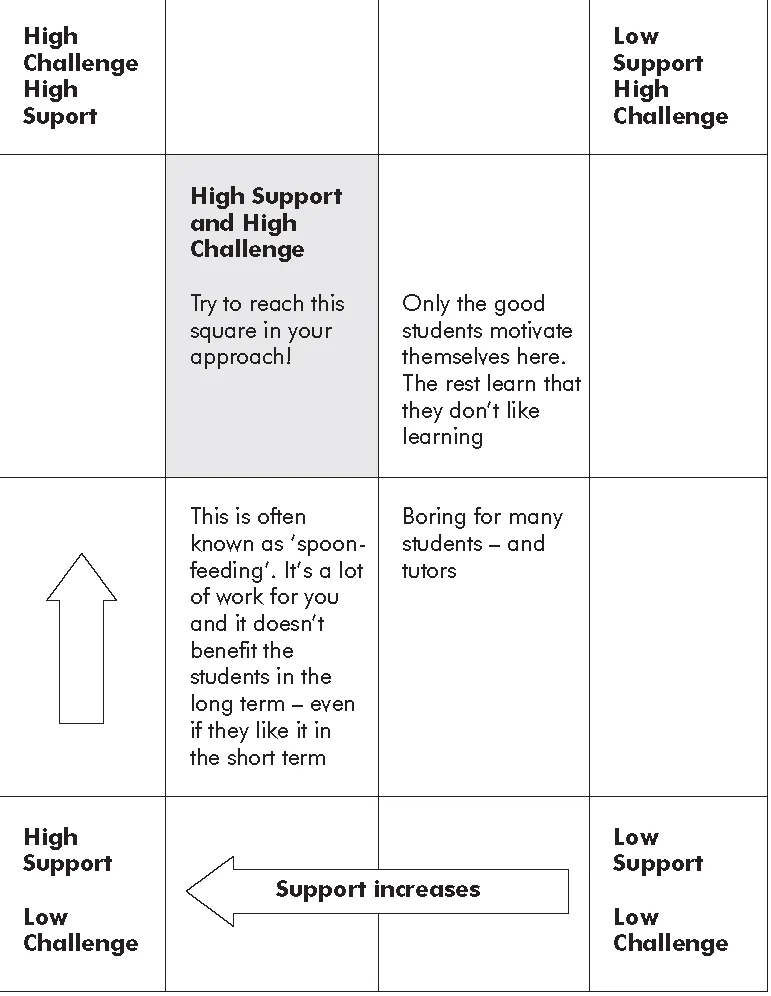
One of the key ideas about balancing your tendency to correct and grade people is to consider your philosophy. One suggestion is to balance the amount of support and challenge you use to assess students. If we imagine a matrix, shown in Figure 1.1, where support and challenge can be high or low, we get four quadrants with different implications for you and for your students.
Examples of supportive behaviour in assessment might be:
- Directing students to appropriate support in college, e.g. study skills and language support, tutor.
- Correcting a section of an essay for grammar, spelling and logic to show the standard you are expecting.
- Repeating information, reading, conceptual explanations, helping students review and revise material you know is difficult for them.
Examples of challenging behaviour in assessment might be:
- Making clear what the highest levels of achievement are.
- Clearly pointing out where a student is falling short of the highest standards.
- Ensuring that all students get a taste of high aspirations.
FIGURE 1.1Support and challenge in learning
SUMMARY: GOOD PRACTICE CHECK-LIST FOR ASSESSING WRITTEN WORK
- Am I clear about my role in this assessment? (Chapter 1)
- Do I have a clear plan for how to feedback to students in a timely and specific manner? (Chapter 2)
- Am I clear about the definitions which apply to this assessment?
(Chapter 3) - Am I clear about the functions of this assessment, its strengths and weaknesses and role in the course? (Chapter 3)
- Am I clear about how I plan to use my time assessing, have I prepared an assessment sheet? (Chapter 4)
- Do I have a clear policy on language issues? (Chapter 5)
- Do I have a clear idea of what model answers would look like for relevant work? (Chapters 6, 7, 8, 9, 10)
- Have I reviewed my performance and formulated ways to improve for next time?
IN THE DISCIPLINES Your role in assessment
All the seminar plans and essay questions for the year are mapped out. I just have to select them from the departmental office and work out how to keep myself and the students interested in them. That can be hard for me when I have to repeat the same seminar three times in two days. I only see each student three times in the semester and so don’t really get a chance to know them before assessing their course work.
(Tutor in Law)
I have written the whole module which is based on my area of research.
I am very wrapped up in preparing for my PhD viva and find it hard to work at an appropriate level for the second years who have chosen my subject. I expect too much from them and have to take care to assess them according to the standard they are at.
(Tutor in History)
I just assess lab reports every week after demonstrating in the lab. The students are not really sure why they have to do it and don’t take much notice of my comments. They only want to get the grade.
(Demonstrator in Chemistry)
I am a new sort of teaching assistant in engineering. As well as doing my PhD, I am helping to run PBL (problem-based learning) classes in
the first year undergraduate module. This is only the second year of running these sorts of sessions and we are still working out the best ways to assess the students.
(Teaching assistant in Engineering)
I am one of the most experienced practitioners in our department (Occupational Therapy) and still maintain my clinical experience. I am very new to assessing written work though and need all the help I can get from my colleagues if I am to be fair to the students.
(Part-time tutor in Occupational Therapy)
PROBLEM SCENARIOS
You know you will be doing some assessment next year for the first year undergraduates. You think it will be essays which have all been taught before.You are part-way through preparing your class time. What could you do to prepare for ...