Trafficking of women and girls for purposes of sexual exploitation across the globe is widely acknowledged as a leading criminal activity. Women of poor countries are particularly vulnerable to sex trafficking. This book identifies the patterns, causes and consequences of female sex trafficking in Nepal, Cambodia and the Philippines. Using empirical evidence this book illustrates the commonalities and the differences among the different countries and recommends that serious attention should be paid to location-specific dimensions of sex trafficking in designing anti-sex trafficking strategies.
eBook - ePub
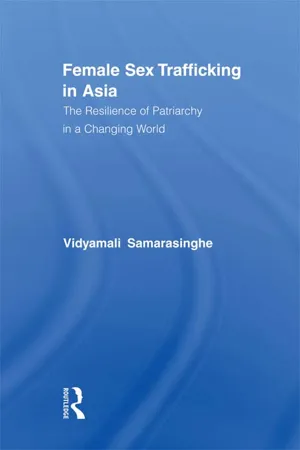
Female Sex Trafficking in Asia
The Resilience of Patriarchy in a Changing World
- 256 pages
- English
- ePUB (mobile friendly)
- Available on iOS & Android
eBook - ePub
Female Sex Trafficking in Asia
The Resilience of Patriarchy in a Changing World
1 Evolving Discourse and Expanding Global Reach of Female Sex Trafficking
INTRODUCTION
Human trafficking in the form of slavery has being a part of history as evidenced in the ancient empires of Egypt, Babylon, Greece and Rome. Later, the transatlantic slave trade that spanned nearly four and a half centuries captured and transported thousands of able-bodied men, women and children from the African continent across the Atlantic to the Americas. Even after the abolition of slavery in 1838, the use of ‘indentured’ labor, transported from the Asian continent by the colonial powers to work in plantations in South America and Asia, had broad similarities to slavery (Tinker, 1974). All or most of the characteristics associated with slavery are also played out in the contemporary human trafficking. Modern forms of trafficking are a flourishing international business involving a chain of people, which includes the victims, local recruiters, corrupt officials, business interests, governments and global syndicates of organized crime.
Trafficking in human cargo, whether the victims are females or males, adults or children, involves the movement of people internally or internationally for some form of work, which may be legal or illegal, and under highly exploitative working conditions. Today, women, men and children are trafficked across borders and domestically for farm work, factory work, domestic servitude, camel jockeys, begging, forced marriage, mail-order-brides and forced prostitution and also for harvesting human organs. A fundamental issue in the discourse of trafficking is that while the trafficker is well aware of all the ramifications, the trafficked victims have at best partial information, and at worst none at all. Trafficking basically caters to a demand, created by a scarcity often stemming from the illegal nature of the work and the social stigmatization of the type of work demanded. However, trafficking is also triggered by the need to use cheap labor in order to maximize profits from a range of certain goods and services produced for the market. In all cases, profiteering from the use of bodies, labor and the time of the victims motivates the traffickers.
DEVELOPING THE DISCOURSE ON FEMALE SEX TRAFFICKING
Female sexual exploitation accounts for a significant proportion of the current global flows of trafficking. Female prostitution, separated for the most part from the morally accepted norm of female chastity has been a global phenomenon since the time of recorded history. Lerner's scholarship on the Creation of Patriarchy illustrates that while commercial prostitution was seen as a social necessity for meeting the sexual needs of men, it was also used as a distinguishing marker between chaste women and immoral prostitutes. For example she notes that the Assyrian legal code established that while all chaste women who go out in the streets should veil themselves,… ”[H]arlot must not veil: her head must be uncovered.” (Lerner, 1987:137). The moral structures of any society are shaped by different socio-behavioral elements, which are perceived to be appropriate or inappropriate by that particular society. Madonnas and whores are thus created to uphold the binary opposites, i.e., respectability and decency of the Madonnas in contrast to the immorality and indecency of the whores. Hence, female sexuality has to be controlled in order to maintain the sanctity of marriage, the legitimacy of children and, by extension, the stability of society. At the same time prostitution is implicitly accepted since the controlled female sexuality within marriage and other stable forms of co-habitation inhibits males, whose sexual demands are expected to go beyond the restricted spaces dictated by stable forms of cohabitation. As Emma Goldman stated in 1917 “… [S]ociety considers the sex experience of a man as attributes of his general development, while similar experiences in the life of a woman are looked upon as a terrible calamity. A loss of honor and all that is good and noble in a human being. The double standard of morality has played no little part in the creation and perpetuation of prostitution.” (Goldman, 1917/1970:25). What is embedded as a constant throughout human history is that prostitution is perceived to be immoral and that those who engage in prostitution should be shunned by decent society. Yet it continues to be sought out by a section of the male population creating a space for a thriving clandestine activity. In modern society, where laws are encoded to uphold moral strictures, prostitution is illegal or restricted to specific locations in an overwhelming majority of countries, but the demand for prostitutes seems to be increasing. Thus, given the immorality and illegality of prostitution and social acceptance of the male need for sex outside stable co-habiting relationships, trafficking of women and girls becomes the modus operandum of obtaining the supply to meet the demand.
The contemporary discourse on trafficking in women may be traced to the latter part of the nineteenth century when Europe was caught up in the intermingled discourses on prostitution and ‘white slavery’. The Contagious Diseases Acts (CDA) enacted in England between 1864 and 1869 was an attempt to subject prostitutes to a set of regulations, including mandatory medical examinations for sexually transmitted diseases and to impose restrictions on prostitutes’ freedom to move. The ‘Abolitionist’ movement spearheaded by Josephine Butler waged a successful campaign to abolish the Act on the premise that regulating prostitution gave it legitimacy and exposed the “official recognition of the ‘double standard’ of sexual behavior of men and women.” (Doezema, 2000:30). Abolitionists noted that when the state regulates or legalizes prostitution, it leads to its acceptance as a social institution and as a legitimate form of work. In that context of the state would not have to concern itself with whether or not women are trafficked or coerced (Barry, 1995:237). Early abolitionists equated prostitution of women to their victim-hood as exploited human beings.
In the last decade of the nineteenth century, the International Society for the Suppression of the White Slave Trade was formed and covered conferences periodically from 1899–1913. Member countries signed agreements to maintain surveillance at ports, repatriate women and criminalize the acts of abduction and trafficking (Tambe, 1998). The term ‘white slavery’ was formally used at the 1902 Paris Conference where representatives of several governments met to draft an international instrument for the suppression of white slave traffic. While initially the term was meant to distinguish the practice from the nineteenth century black slavery, it immediately assumed a racial, gendered image of innocent ‘white women’ outraging the sensibilities of white racist segments of society (Barry, 1979). This social outrage over ‘white slavery’ was greatly influenced by the social purist movement and supported by the abolitionists, although some of the abolitionists challenged the often repressive aspects of the social purists (Walkowitz, 1980). The anti-trafficking ‘white slavery’ campaign had an explicit racial overtone. Grittner explains ‘white slavery’ “as the enslavement of white women or girls by means of coercion, tricks or drugs by non-white or non-Anglo-Saxon men.” (Grittner, 1990:5). The emphasis was on the purported transportation of innocent white females for purposes of sexual exploitation by non-whites, and not on prostitution in general. The anti-white slavery campaign whithered away in the early twentieth century.
The International Conference of 1921 recommended that the term ‘white slavery’ be dropped and replaced with “traffic in women and children” (Lazarsfeld, 1938: 437). This new term was also adopted by The League of Nations, which began focusing on trafficking in women after 1921. Prostitution remained the cornerstone of Conventions on trafficking proposed by the League of Nations. Its 1921 Convention raised the age of consent of women from 20 to 21 years, and the convention of 1933 made all trafficking, even of adult women, a criminal activity (Tambe, 2001). The U.N Convention of 1949 on the Suppression of Traffic in Persons and the Exploitation for the Prostitution of Others in effect had adopted as its foundation the abolitionists’ perspectives on anti-prostitution. The preamble to the 1949 Convention declares1 that prostitution and trafficking in persons are incompatible with the dignity and worth of human persons and endanger the welfare of the individual, the family and the community. It called upon nations to close brothels and punish those who procure for and promote prostitution (Barry, 1995:120). However, although the U.N. Convention of 1949 uses the word ‘trafficking’ in its title, it did not specifically define the concept of trafficking.
The issue of trafficking is specifically addressed in the 1979 U.N. Convention on the Elimination of All forms of Discrimination Against Women (CEDAW).2 Article 6 of the Convention directs state parties to take all appropriate measures, including legislation to suppress all forms of traffic in women and exploitation of women for the purpose of prostitution. Children's rights were addressed by the 1989 Convention on the Rights of the Child3, in which Article 35 directs the states to take appropriate national, bilateral and multilateral measures to prevent the abduction and sale of or traffic in children for any purpose or in any form. A new urgency for a comprehensive and a stronger commitment to combat slavery-like practices and transnational criminal activity has resulted in a series of new and expanded protocols to address the issue of global human trafficking. The complete set of commitments made by member states regarding human trafficking are embedded in the U.N. Convention Against Transnational Crime; The Protocol to Prevent, Suppress and Punish Trafficking in Persons, Especially Women and Children, which supplements the U.N. Convention and Interpretive Notes on the Trafficking Protocol.4 Taken together (hereafter referred to as the U.N. Trafficking Protocol), these three documents comprise a set of international obligations, which specifically address the issue of human trafficking. (Jordan, 2002). The 1990 International Convention on the Protection of the Rights of All Migrant Workers and Members and Their Families, in force only since July 2003 also addresses the issue of trafficking.
The main thrust on human trafficking during the past century and half has been primarily focused on female prostitution. Spurred on by the powerful campaigns of the abolitionists and the social purists the emphasis was on ‘rescuing’ the female from immoral sexual behavior. Female prostitution was considered as an involuntary activity and women who became prostitutes were thus by definition deemed to be ‘trafficked’. As discussed in Chapter 2, this assertion of necessary victim-hood of female prostitutes has since been challenged by different anti-trafficking advocates who argue that some women may choose to become prostitutes and hence cannot be categorized as trafficked. The main thrust of the current trafficking discourse is still focused primarily on the issue of prostitution, which continues to be perceived, by and large, as an exercise based on sexual exploitation of women and girls.
While the supply of trafficked women that outraged Europeans and led to the anti-trafficking campaigns at the turn of the twentieth century came mainly from white Anglo-Saxon societies, the current global female sex trafficking pattern illustrates a shift of the supply lines to developing countries of Asia, Africa and Latin America and the former socialist countries of Eastern Europe and the Soviet Republic. Furthermore, while Anglo-Saxon women no longer play a significant part in the supply side of female sex trafficking, there is a blurring of ‘skin colors’ of trafficked women since all major racial categories are caught in the web of female sex trafficking flows. Both internationally and intra-nationally, relatively richer and more developed areas demand the supply of trafficked women and a higher premium is placed on lighter skinned women and young virgins. The supply and demand structure of female sex trafficking clearly illustrates the nature of commodification of the trafficked female.
THE NUMBERS GAME
A serious concern of policy makers, donor agencies, NGOs, advocates and scholars who are involved in analyzing the trafficking situations and formulating and implementing empirically grounded anti-trafficking initiatives is the serious lack of accurate statistics on sex trafficking. U.S Government estimates on trafficking of human beings, as reported in the U.S State Department annual Trafficking in Persons Reports (TIP), demonstrate the underlying problems in getting accurate data on trafficking in human beings. All numbers quoted by the U.S. Government are estimates and furthermore, there has been a gradual reduction of global human trafficking estimates over the past four years. In 2002 the estimate was 700,000 to 4 million people, reduced to 800,000 to 900,000 people in 2003, and 600,000 to 800,000 in 2004. The 2005 estimate of trafficked persons globally is the same as for 2004 (U.S State Department, 2002, 2003, 2004, 2005). Among them eighty percent of the cases of trafficking concerned sexual exploitation. Of the cases where women were reported to be victims of trafficking, eighty-five percent were said to be trafficked for sexual exploitation, two percent for other types of forced labor and thirteen percent for both types of exploitation (Kanganspunta, 2003).
The United Nations Office of Drug Control and Crime Prevention (UNODC), whose databases on monitoring global trends, routes and volumes of trafficking in persons and the smuggling of migrants are used extensively by organizations engaged in anti-trafficking initiatives derives its statistics of traffic flows mostly from estimates. Unfortunately, once published the initial estimate often cited by other publications become credible numbers. Lin Lean Lim notes that since the estimates range so widely they should be treated with caution. For instance, she points out that the figure of 800,000 Thai child prostitutes has been seriously questioned by other sources familiar with the situation in Thailand. The estimate was based on a sample of just one brothel and extrapolated to the 60,000 brothels found in Thailand (Lim, 1998:9). Similarly, Sanghera and Kapur (2000) observe that the common belief that 5,000–7,000 Nepali girls are trafficked across borders to India each year, and that currently 150,000–200,000 women and girls are in various Indian cities, were disseminated in an article published in 1986 and has remained unaltered over the past 18 years.5 While this is not to say that all estimates are gross exaggerations, fabrications or dated, my own field visits to countries of Asia have shown that trafficking numbers are indeed significant and in some instances, numbers quoted appear to be underestimates. The problem seems to be in the flawed methodology used, especially the difficulty of tracing the estimate back to the methods (Steinfatt, Baker and Beesey, 2002).
While accurate numbers of trafficking could be obtained best from good field-based methods, several inter-related factors inhibit this process. The most significant road block is the illegality of trafficking, hence its clandestine nature and the intimate, private activity of sexual relationships, compounded by the stigma attached to prostitution. The serious lack of anti-trafficking legislation and law enforcement mechanisms makes the already vulnerable women and girls who become victims reluctant to report trafficking incidents to the authorities. In fact, until very recently, indifference or apathy on the part of the policy makers to the issue of trafficking in women and girls was the rule rather then the exception. Victims of sex trafficking mostly belong to the poorer segments of society who are usually ignored by decision-making political groups in society.
As Tyldum and Brunovskis have shown, two main issues inhibit accurate counting of trafficking victims. First is the problem of a common ‘conceptual identification’ of a trafficked victim. The second is the ‘practical identification’ of trafficked victim of “being able to say this is a victim of trafficking” (Tyldum and Brunovskis, 2005:20). As will be discussed in more detail in Chapter 3, while new international anti-trafficking instruments have constructed more expanded definitions of trafficking, continuing lack of clarity in defining female sex trafficking leads to confusion, both at the theoretical as well as at practical levels (Gallagher, 2001, GPAT, 2003). Indeed, in practice identification of trafficked victims becomes a difficult task since they are enclosed within a ‘hidden population’ (Heckathorn, 1997), one that refuses to cooperate or gives unreliable responses to questions in order to protect itself since her/his activities are socially stigmatized and/or illegal. Blurred boundaries between smuggling/immigration/trafficking also not only demonstrate problems in conceptual clarity, they pose practical problems in clearly identifying a trafficked victim.
Most governments do not give priority to research and data collection on trafficking numbers or patterns. One gets the impression that any new efforts in this direction, particularly among developing countries, is at the behest of donor agencies which are increasingly pushing anti-trafficking initiatives as a segment of development aid. A significant feature of the U.S. Trafficking in Persons Act of 2000 is that the U.S. Government reserves the right to impose mandatory non-emergency sanctions on those governments, which according to the annual survey conducted by the U.S. State Department does not make a significant effort to combat trafficking (US Department of State, 2001). Such policies by major aid donor countries compel developing countries to undertake statistical surveys in order to formulate anti-trafficking strategies.
Apart from structural and systemic problems faced in obtaining accurate numbers of female sex trafficking, the trafficking discourse itself carries with it certain practical problems in identifying a clearly distinct category of trafficking. Firstly, the ideological debate on prostitution between the anti-legalization/abolitionists and pro-legalization advocates would give different numbers of trafficking victims (see Chapter 2 for a discussion of the different approaches to trafficking by these groups). While the anti-prostitution abolitionists would consider all prostitutes as trafficking victims, the pro-prostitution would want to separate those adult women who enter prostitution voluntarily from women who are forced into commercial sex sector and all child sex workers. Second, there is a more practical difficulty of separating trafficking statistics from migration statistics, and especially in terms of migrant smuggling. ‘Smuggling’ and ‘trafficking’, which are often used interchangeably, confuse the issue of separating the numbers between the two categories of human flows. Third, there is also confusion in pinpointing the difference between legitimate migration and trafficking. For instance, women who migrate to Japan for work from the Philippines or Thailand may have official travel papers and employment/fiancée contracts. However, once they reach their destination some of them are forced into sexual exploitation. In such cases, while their mobility as a primary dimension of trafficking is legal; would they be deemed to be trafficked victims since the final outcome of their migration is sexual exploitation? Fourth, there is an element of danger in gathering trafficking data for two reasons. First, some of the female sex trafficking is known to occur in conflict zones, where any type of data gathering on sex trafficking becomes difficult. Second, the increasing control exercised by criminal groups on the sex industry in general makes the efforts of data gathering dangerous for a researcher. Finally, trafficking is generally not incorporated into the national agendas in most countries. Consequently, there are very few state coordinated mechanisms to research or gather trafficking data. Citing a successful anti-trafficking initiative started in 2003 by the Government of Norway, Tyldum and Brunovskis (2005) state that law enforcement bodies were given more resources and were instructed to give higher priority to trafficking for sexual exploitation. The number of cases identified had increased dramatically, although the overall numbers still remained rather low. The question was whether the low numbers were the tip of the iceberg or an accurate number of all cases of trafficking. The researchers also bring up the issue...
Table of contents
- Front Cover
- Half Title
- Routledge International Studies of Women and Place
- Title Page
- Copyright
- Contents
- Dedication
- Maps
- Graphs
- Preface
- Abbreviations
- Introduction
- 1 Evolving Discourse and Expanding Global Reach of Female Sex Trafficking
- 2 Definitions and Analytical Approaches
- 3 Feminization Of Global Human Exchange
- 4 Nepal: Young, Female and Vulnerable
- 5 Cambodia: Conflict, Poverty and Cultural Values on Female Sex Trafficking
- 6 The Philippines: Looking for Greener Pastures
- 7 Faceless and Anonymous: An Overview of Demand
- 8 Conclusions
- Notes
- Bibliography
- Index
Trusted by 375,005 students
Access to over 1.5 million titles for a fair monthly price.
Study more efficiently using our study tools.
Frequently asked questions
Yes, you can cancel anytime from the Subscription tab in your account settings on the Perlego website. Your subscription will stay active until the end of your current billing period. Learn how to cancel your subscription
No, books cannot be downloaded as external files, such as PDFs, for use outside of Perlego. However, you can download books within the Perlego app for offline reading on mobile or tablet. Learn how to download books offline
Perlego offers two plans: Essential and Complete
- Essential is ideal for learners and professionals who enjoy exploring a wide range of subjects. Access the Essential Library with 800,000+ trusted titles and best-sellers across business, personal growth, and the humanities. Includes unlimited reading time and Standard Read Aloud voice.
- Complete: Perfect for advanced learners and researchers needing full, unrestricted access. Unlock 1.5M+ books across hundreds of subjects, including academic and specialized titles. The Complete Plan also includes advanced features like Premium Read Aloud and Research Assistant.
We are an online textbook subscription service, where you can get access to an entire online library for less than the price of a single book per month. With over 1.5 million books across 990+ topics, we’ve got you covered! Learn about our mission
Look out for the read-aloud symbol on your next book to see if you can listen to it. The read-aloud tool reads text aloud for you, highlighting the text as it is being read. You can pause it, speed it up and slow it down. Learn more about Read Aloud
Yes! You can use the Perlego app on both iOS and Android devices to read anytime, anywhere — even offline. Perfect for commutes or when you’re on the go.
Please note we cannot support devices running on iOS 13 and Android 7 or earlier. Learn more about using the app
Please note we cannot support devices running on iOS 13 and Android 7 or earlier. Learn more about using the app
Yes, you can access Female Sex Trafficking in Asia by Vidyamali Samarasinghe in PDF and/or ePUB format, as well as other popular books in Social Sciences & Geography. We have over 1.5 million books available in our catalogue for you to explore.