This book is about children with speech and language impairments and what teachers and other professionals can do to promote their learning and their social inclusion in a mainstream setting. A brief introduction to SLI is followed by a chapter on the main issues for the classroom; how teachers can support the preferred learning style of the children and literacy and numeracy strategies are each given a separate section.
Inclusion involves more than the learning experience and so the social, emotional and behavioral agenda, including successful transition and working with parents, is given equal emphasis.
eBook - ePub
Inclusion For Children with Speech and Language Impairments
Accessing the Curriculum and Promoting Personal and Social Development
- 128 pages
- English
- ePUB (mobile friendly)
- Available on iOS & Android
eBook - ePub
Inclusion For Children with Speech and Language Impairments
Accessing the Curriculum and Promoting Personal and Social Development
About this book
Information
Chapter 1
The language system and how it develops
Introduction
Man is a social animal. Social interaction and social communication are fundamental to normal development. The skills which are used for interaction and communication are complex, sophisticated and take many years to reach an adult level of competence.
To be an effective communicator the individual needs to develop an ability to understand what others say, receptive language, and a command of spoken language, expressive skills. Receptive and expressive language skills depend upon developing a knowledge of the sounds of a language (phonology), how meaning is attached to the specific sound patterns which we know as words (semantics) and the rules for how words are combined to make units of meaning (grammar). These language skills must then be used in a socially aware, flexible way which has regard for the needs of the partner in any exchange (pragmatics). All the elements of language are to some extent interdependent so that difficulties in any one area would be expected to have repercussions throughout the language system. The language system was represented graphically by Bloom and Lahey (1978) and this model is very useful when considering how language develops and understanding the needs of children who experience a specific language impairment (see Figure 1.1).
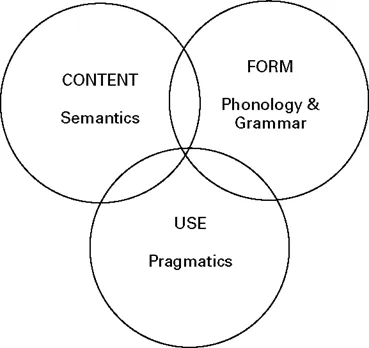
Figure 1.1
In the model, the phonology (sound system) and grammar of the language are described as the form of language, while the semantics, the meaning element, is described as the content of language and the pragmatic aspects of language are described as language in use. For children with a specific language impairment, development of the form and/or the content of language may be delayed or disordered so that understanding, receptive skills, and/or expressive skills may be affected.
Difficulties with form and content can and do affect how language is used, because what a child is able to understand or say will affect how they attempt to communicate with other people. It may take careful investigation to identify whether the apparent pragmatic problems are linked to difficulties with form and content, or to other factors.
To become an effective communicator it is also necessary to have an awareness of the interests, motives and possible intentions of other people. This ability to look at events and ideas from the perspective of another person has been called ‘Theory of Mind’ (Frith 1989) and it is this aspect of language which is a core problem for many people on the autistic spectrum. The form of their language (phonology and grammar) and even the content of their language may appear to be intact but they experience problems with using language in order to communicate effectively.
Examples
The impact of difficulties with Form and Content on language use
• An inability to make oneself understood may influence what one attempts to say and with whom one chooses to communicate. Thus, a child with an articulation problem may continue to use two-word phrases to everyone except close family who are able to understand his/her speech. Alternatively, frustrations about being unable to communicate effectively may precipitate behaviour problems.
• A failure to understand fully what is said, may result in some unexpected responses to questions. For example:
| Q: ‘Where is your brother?’ | R: ‘Phillip.’ |
| or | |
| Q: ‘How are you?’ | R: ‘Me five.’ |
Alternatively, there may be a reluctance to try to engage in an interaction or a determination to steer the conversation to a safe known subject.
Language development
Newly born babies are able to demonstrate an amazing range of social interaction and communication skills so that in normally developing infants:
- a preference for faces over objects is evident at a few hours old;
- two-way interactions can be observed at two hours old (Snow 1972); These mark the beginning of coordinated turn-taking in what are known as proto-conversations;
- by eight weeks babies will respond differently to the sound of their own language and by four months they are able to distinguish their language from others which are quite similar, e.g. Spanish and Catalan: Just as bees learn fast to distinguish flowers from, say balloons or bus stops, so human children are preset by nature to pick out natural language sounds: they don't get distracted by barking dogs or quacking ducks' (Professor Jean Aitchison 1996 Reith Lecture, ‘The Language Web’);
- by six months babies will babble using language-like sounds and will produce single words by one year;
- in the first six months infants will react differently according to voice tone and facial expression;
- by six months there is evidence of ‘theory of mind’ when they look to a familiar adult for cues if they are uncertain about how to react to a new object or experience; this demonstrates that they anticipate that the other person will have a response to the situation which is independent of their own experience.
During their second year children show an explosion of naming words and start putting words together in a way which suggests some pre-programming of grammar. By the age of five most children will have mastered the basic aspects of the form of language and have an ability to understand language which is embedded in a real-life context. Early language develops most successfully, in a social context with parents or carers interacting in a dynamic way with their infants, so that they adapt the form and content of the language they use to match the developmental level of the child. The television or the video is no substitute for this process. For most children Basic Interpersonal Communication Skills (BICS) will be well established by the time a child enters school. However, as children progress through the education system the language demands become more complex and decontextualised so that children need to develop Cognitive Academic Language Proficiency (CALP) in order to access the language used in the classroom. Children with speech and language impairment usually need extra support in order to progress to this stage of language development.
Social skills and the social use of language are an even more complex set of skills and will continue to develop into adult life. Each new social situation which a person encounters requires new skills to be learned or established skills to be adapted. In turn, the ability to communicate affects the social experiences to which an individual is exposed and the success of their social interactions. These will have consequences for the development of the self-concept, positive self-esteem and behaviour patterns.
A successful communicator will gradually develop a range of skills which are summarised below:
- an awareness of the sound system of the language and the ability to use that system efficiently;
- an understanding and an ability to use the rules of grammar, including the function of different forms of utterance, e.g. question forms;
- a knowledge of the meaning of a wide range of words and the ability to choose the appropriate words to express what they want to communicate;
- an awareness that language is a tool with which to communicate with others and the motivation to initiate and respond to communication;
- an ability to manage the process of communication which requires the cooperation of the participants, e.g. to time turn-taking, to explore shared reference and to respond to the messages which are implied in, for example, tone, stress or intonation patterns;
- an awareness of the subtleties of communication so that the style of the utterance matches the context in which it takes place, e.g. not shouting a ‘secret’ across the room or greeting a teacher using the same style as to a close friend.
When children come into school they will be in the process of developing many of these skills but most children will show a range of language expertise by the age of five.
Language levels expected at 5 years
Speech
Intelligible under most conditions.
Immaturities may persist:
— ‘r’, ‘th’
— consonant blends, particularly clusters e.g. ‘str’ insecure or reduced, e.g.

Attention control
The child is at the integrated stage so that he/she is able to continue with an activity and listen to simple instructions. This may break down if the activity (e.g. tying a shoelace) or the instruction, is complex for that child.
Comprehension
Able to understand classroom instructions, particularly in context:
— to answer questions about past and future events
— to understand some abstract concepts
— to show some metacognitive features, e.g. jokes which play on words.
Expression
Able to:
— use complete sentences without omitting functions words
— join simple sentences using conjunctions, e.g. ‘because’
— explain a sequence of events from his/her own experience.
Immaturities of syntax, e.g. irregular past tenses and plurals are still quite common.
Pragmatics
Able to:
— take turns in conversations
— adapt to the listener's needs in conversation.
Children should also be able to use language for a range of purposes:
- expression of feelings, needs and wants
- commenting and directing
- social greetings
- use of language in play
- response to and maintenance of conversation
- use of questioning
- use of descriptive language
- reporting previous experience
- reasoning
- prediction of events.
These early language goals are towards the development of Basic Interpersonal Communication Skills (BICS). Children in school need to develop Cognitive Academic Language Proficiency (CALP):
- the rules for exchanges are different
- words take on precise meanings
- language becomes more abstract
- language becomes less embedded in context.
Language impa...
Table of contents
- Cover
- Full Title
- Copyright
- Contents
- Acknowledgements
- Introduction
- 1. The language system and how it develops
- 2. Multidisciplinary assessment
- 3. Reading and the literacy hour
- 4. The Numeracy Strategy
- 5. Sample subjects through the key stages
- 6. Strategies to support learning
- 7. Language and behaviour
- 8. Social groups
- 9. Inclusion and working with parents
- Appendix 1: Terminology
- Appendix 2: Brief notes on assessments often used by speech and language therapists with school aged children
- Appendix 3: Interview schedule
- References
- Index
Trusted by 375,005 students
Access to over 1.5 million titles for a fair monthly price.
Study more efficiently using our study tools.
Frequently asked questions
Yes, you can cancel anytime from the Subscription tab in your account settings on the Perlego website. Your subscription will stay active until the end of your current billing period. Learn how to cancel your subscription
No, books cannot be downloaded as external files, such as PDFs, for use outside of Perlego. However, you can download books within the Perlego app for offline reading on mobile or tablet. Learn how to download books offline
Perlego offers two plans: Essential and Complete
- Essential is ideal for learners and professionals who enjoy exploring a wide range of subjects. Access the Essential Library with 800,000+ trusted titles and best-sellers across business, personal growth, and the humanities. Includes unlimited reading time and Standard Read Aloud voice.
- Complete: Perfect for advanced learners and researchers needing full, unrestricted access. Unlock 1.5M+ books across hundreds of subjects, including academic and specialized titles. The Complete Plan also includes advanced features like Premium Read Aloud and Research Assistant.
We are an online textbook subscription service, where you can get access to an entire online library for less than the price of a single book per month. With over 1.5 million books across 990+ topics, we’ve got you covered! Learn about our mission
Look out for the read-aloud symbol on your next book to see if you can listen to it. The read-aloud tool reads text aloud for you, highlighting the text as it is being read. You can pause it, speed it up and slow it down. Learn more about Read Aloud
Yes! You can use the Perlego app on both iOS and Android devices to read anytime, anywhere — even offline. Perfect for commutes or when you’re on the go.
Please note we cannot support devices running on iOS 13 and Android 7 or earlier. Learn more about using the app
Please note we cannot support devices running on iOS 13 and Android 7 or earlier. Learn more about using the app
Yes, you can access Inclusion For Children with Speech and Language Impairments by Kate Ripley,Jenny Barrett,Pam Fleming in PDF and/or ePUB format, as well as other popular books in Education & Education General. We have over 1.5 million books available in our catalogue for you to explore.