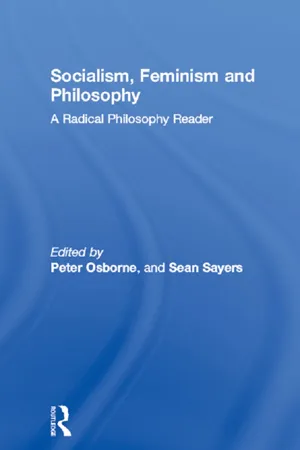
Since 1972, the journal Radical Philosophy has provided a forum for the discussion of radical and critical ideas in philosophy. It is the liveliest and probably the most widely read philosophical journal in Britain. This anthology reprints some of the best articles to have appeared in the journal during the past five years. It covers topics in social and moral philosophy which are central to current controversies on the left, focusing on theoretical issues raised by the socialist, feminist and environmental movements.
Topics covered include feminist perspectives on a range of traditional philosophical issues and contemporary problems; theoretical questions involved in the rethinking of socialism and Marxism; and questions about the relation between humanity and nature raised by environmental debates. The pieces included engage with contemporary issues in critical terms, and represent the best of recent philosophical work on the left. The book is essential reading for anyone interested in the current state of radical thought.
- 256 pages
- English
- ePUB (mobile friendly)
- Available on iOS & Android
eBook - ePub
About this book
Information
Part I
FEMINISM AND PHILOSOPHY
1
MARY WOLLSTONECRAFT AND THE TENSIONS IN FEMINIST PHILOSOPHY
Jean Grimshaw
The history of the reception and interpretation of Mary Woll-stonecraft's Vindication of the Rights of Woman is a complex and fascinating one.1 It was praised by many of her radical contemporaries, including Tom Paine and Mary's husband, the radical anarchist philosopher and social theorist, William Godwin. It was condemned, sometimes vitriolically, by other contemporaries, including, notoriously, Horace Walpole, who called Mary a ‘hyena in petticoats’ and refused to have her book in his library. The Historical Magazine declared, in 1799, that her work should be read ‘with disgust by any female who has any pretensions to delicacy; with detestation by everyone attached to the interests of religion and morality’. It was not only men who condemned it. Many women disliked it intensely, including Hannah More, who felt justified in condemning it without even having read it.
The fate of the Vindication cannot be separated from views of Mary's personal life, nor from the fate of radical political ideas in the wave of repression and political reaction that dominated English politics in the years after the 1790s. Mary's name and her work were tarred with the brush of French-style liberty, free thought, free love, irreligion, the undermining of family life, and all those things that were anathema both to conservative political orientations and to nineteenth-century evangelicalism. Apart from the memoir published after her death by her husband William Godwin,2 obituaries were mostly ambivalent or condemnatory, and no biography was published until 1884, nearly 100 years after her death. One gets the impression that few people in the nineteenth century can actually have read the Vindication, and that Wollstonecraft's reputation was an embarrassment to the bourgeois, evangelical and philanthropic modes in which much Victorian feminism was cast. Some contemporary judgements are hardly less damning. Lundberg and Farnham, in their book Modern Woman: The Lost Sex (1959) wrote:
Mary Wollstonecraft was an extreme neurotic of a compulsive type. Out of her illness arose the ideology of feminism, which was to express the feelings of so many women in years to come. Unconsciously…Mary and the feminists…wanted to turn on men and injure them. …Underneath her aggressive writings, Mary was a masochist…as indeed all the leading feminist theorists were in fact. By behaving as she did Mary indicated… that she was unconsciously seeking to deprive the male of his power, to castrate him.3
In the Pelican History of England, the historian J.H.Plumb writes about what he calls the ‘self-conscious intellectual bohemianism’ which deliberately set out to live in defiance of accepted moral codes.
Men and women had lived in sin frequently enough in the eighteenth century, but they had felt no compulsion to justify their acts on the highest ethical principles. The intellectual bohemians, Godwin, Shelley, Mary Wollstonecraft and their circle, sinned for the sake of revolt rather than for enjoyment and then justified themselves by the principles of liberal philosophy. Squalid as their lives were, they had important consequences for English literary tradition.4
This is perhaps one of the most egregiously ignorant and prejudiced judgements on Wollstonecraft that I have come across.
Most nineteenth-century critics, then, and some twentieth-century ones, seem scarcely to have read the Vindication, and thus failed to notice that not even on the most casual reading could one find in it an apology or justification for loose living or sexual libertinism. It was Wollstonecraft's life and reputation which largely determined how she was perceived. Ironically, however, if Wollstonecraft was often perceived by earlier critics as a radical and libertine, contemporary perceptions of her, often by feminist writers, have been very different. One of the most recent essays on Wollstonecraft is by Cora Kaplan.5 Kaplan's critique concentrates on the text of the Vindication, and from its pages emerges a very different Wollstonecraft. Kaplan argues that a central theme of the book is a deep ambivalence about sexuality, even a violent antagonism to the sexual; an exaggeration of the role of the sensual in the lives of women which recapitulates that of Rousseau, and a fear of the disruptive power of female sensuality. In the Vindication, Wollstonecraft turned against feeling and sensibility, and they are seen as reactionary and regressive. As Kaplan puts it:
Sexuality and pleasure are narcotic inducements to a life of lubricious slavery. Reason is the only human attribute appropriate to the revolutionary character, and women are impeded by their early and corrupt initiation into the sensual from using theirs.6
Wollstonecraft's programme for women, far from being that of ‘free love’ or sexual libertinism, is that of a strenuous programme of renouncing the sensual; her ideal is that of a life in which Reason is triumphant, but at the cost of the death of female pleasure and sexuality.
Rather similarly, Diana Coole's7 discussion of the Vindication stresses the way in which the book seems at times to require of women an almost ascetic dedication to duty, and a rejection of passion or self-indulgence. Both Kaplan and Coole and other commentators suggest that Wollstonecraft's feminism could really only apply to middle-class women; the Vindication is, in essence, a liberal or bourgeois feminist tract which, while indeed calling attention forcefully to many aspects of sexual injustice and inequality, failed to address the lives of working-class women or even to challenge in any fundamental way the norms of bourgeois marriage and family life. Coole suggests that Wollstonecraft basically shared much of Rousseau's idealised vision of the patriarchal bourgeois family, away from the corruption and ‘false manners’ of the city. And Kaplan writes that in Wollstonecraft's text, with its stress on the potential virtues of those in the ‘middle’ class and on the importance of Reason, idealised humanity appears as a rational, plain-speaking bourgeois man.
In one sense, I do not think that these judgements are wrong; they represent the ‘Wollstonecraft’ who appears in the pages of the Vindication far more adequately than those judgements which have seen Wollstonecraft as a libertine. But if many earlier critiques of Wollstonecraft failed to pay any attention to the text of the Vindication at all, I think that some contemporary discussion, in focusing so closely and sometimes exclusively on the text of the book, has failed fully to see the ways in which Wollstonecraft's work resists easy classification.
The Vindication has often been criticised for being rushed, hasty and repetitive. There is some substance in these criticisms; it was written in six weeks, in the heat of a political situation. But it is not just that the text itself sometimes appears rushed; it should, I think, be read as provisional. In other words the ‘Wollstonecraft’ of the Vindication does not adequately represent, all by itself, Mary Wollstonecraft's thinking about the situation of women and the response she thought that they should make. Virginia Woolf wrote of Wollstonecraft: ‘Every day…something was born in her that thrust aside her theories and forced her to model them afresh’.8
The Vindication needs understanding not only in the context of Wollstonecraft's life, but in the context of her other writings and the ways in which these wrestled with the dilemmas thrown up by eighteenth-century politics, both radical and reactionary, and by contemporary views on literature and philosophy and on the nature of femininity. These dilemmas were of course cast in an eighteenth-century form, but they are ones which, in altered shape, feminism still continues to encounter. Wollstonecraft never had an answer to any of these dilemmas that could satisfy her for long; and it is perhaps the restless and provisional quality of her work that often makes it speak most strongly to those who, nearly 200 years later, often encounter similar dilemmas.
Her struggle was formed around a number of features of eighteenth-century thought and politics. Central, of course, were the radical political ideas of her time. Mary herself became part of the circle of radical London intelligentsia, including Tom Paine, Thomas Holcroft, her publisher Joseph Johnson and her husband William Godwin, who believed passionately in the cluster of political ideas which centred around the critique of autocratic government and hereditary privilege, belief in the natural right of individuals to self-determination, and belief in the perfectibility of human nature and institutions if only corruption and privilege could be swept away.
Mary was also heir to a steady stream of writing in the eighteenth century about the nature and situation of women. She had almost certainly read feminist writers such as Catherine Macaulay; but there were men too, such as some radical teachers in Dissenting Academies, who had written about the social oppression of women. As Barbara Taylor points out, in her history of Owenite socialist feminism, it was not too hard to see an analogy between a critique of aristocratic government and a critique of the despotic power of men in families.9 Wollstonecraft herself drew such analogies frequently; she also compared the idle and corrupt state of the aristocracy to the state of degradation into which she thought women had fallen. Not all of the radical circle to which she belonged were by any means fully committed to feminist analysis or goals, but lip service at least was paid to questions about the oppression of women.
The eighteenth century saw, in fact, a growing interest in questions about femininity and female consciousness. This was importantly related to changes in the social situation of women. The precise nature of changes in eighteenth-century family patterns remains a matter of historical dispute, but what is at least clear is that, increasingly, for middle-class women, the home was no longer also the workplace, and married women were not generally seen as independent economic actors or helpmates. The home of the nouveau-riche bourgeois was becoming a display case for affluence, and his wife's role was being reduced to that of a decorative accessory in this display. The only route to security (of a sort) for a woman was a marriage in which she was wholly dependent, and for the woman who was not married, the prospects were bleak indeed: the often humiliating and penurious ‘careers’ of governess or lady's companion (both of which Wollstonecraft experienced), or a dependence on the charity of some male relative.
This total dependence of women on and within marriage was a central target of nearly all feminist critique in the period. But the eighteenth century also saw the beginnings of an idealisation of family life and the married state that remained influential throughout the nineteenth century. The eighteenth century moved away from the cynical and overtly sexually exploitative views of women which had tended to characterise the Restoration period; but moved away, also, from those religious views which had seen women simply as Eve the temptress, the occasion of man's sin. Women became, as Janet Todd puts it, ‘the fair sex’, the Protestant virgin.10 And there are two related aspects of eighteenth-century thought about women which are central to understanding Wollstonecraft: the idea that virtue is gendered, that it is different for women and for men, and that it is female ‘sensibilities’, women's particular psychological characteristics, which fit women for a specifically female type of virtue (but also disqualify them from that type thought appropriate to the male, and render them weaker and potentially easily corruptible). The overt disparagement of women displayed, for example, by Lord Chesterfield in his letters to his son, was displaced by the musings of writers such as Addison and Steele, in new journals such as the Tatler and the Spectator, on the virtues of the ‘fair sex’; a sentimental vision of the gentle, feeling, but subordinate wife and mother.
But it is above all the philosophy and other writings of Rousseau which form a backdrop to Wollstonecraft's work, and central to this is Rousseau's account, in Emile, of female nature, his prescriptions for female upbringing and female virtue. Emile is Rousseau's account of the sort of upbringing that would help to form the model citizen and enable him to develop the qualities of autonomy and self-determination; and the book portrays, too, Rousseau's vision of the rural family and simplicity of life which alone would enable the citizen to remain uncorrupted by the evil manners of the city. Emile's virtues are to be those of self-sufficiency, hardiness and independence of mind. Above all, he is to learn to make his own judgements based on his own experience, and to be beholden to no-one else for his opinions; Rousseau even suggests that Emile should not learn to read whilst still a boy.
But when we turn to the education of the girl Sophie, who is to be Emile's companion, it is a different story. Just as Emile is to be truly a man, so Sophie is to be truly a woman. ‘But for her sex,’ Rousseau writes, ‘a woman is a man.’
Yet where sex is concerned man and woman are unlike; each is the complement of the other; the difficulty in comparing them lies in our inability to decide, in either case, what is a matter of sex, and what is not.11
Rousseau's o...
Table of contents
- Cover Page
- Half Title Page
- Title Page
- Copyright Page
- Contents
- Notes on Contributors
- Introduction
- Part I Feminism And Philosophy
- 1 Mary Wollstonecraft And The Tensions In Feminist Philosophy
- 2 Hegel As Lord And Master
- 3 Morality, Masculinity And The Market
- 4 Feminism And The Logic Of Morality A consideration of alternatives
- 5 From Virginia Woolf To The Post-Moderns Developments in a feminist aesthetic
- Part II Socialism And Philosophy
- 6 Proletarian Philosophy: A Version Of Pastoral?
- 7 Marxism And The Dialectical Method A critique of G.A.Cohen
- 8 Analytical Marxism: A New Paradigm?
- 9 Socialism And Democracy Beyond state and civil society
- Part III Nature And Human Nature
- 10 Women, Humanity And Nature
- 11 Humanism=Speciesism? Marx on humans and animals
- 12 The Human Body In Social Theory Reich, Foucault and the repressive hypothesis
- Index
Trusted by 375,005 students
Access to over 1.5 million titles for a fair monthly price.
Study more efficiently using our study tools.
Frequently asked questions
Yes, you can cancel anytime from the Subscription tab in your account settings on the Perlego website. Your subscription will stay active until the end of your current billing period. Learn how to cancel your subscription
No, books cannot be downloaded as external files, such as PDFs, for use outside of Perlego. However, you can download books within the Perlego app for offline reading on mobile or tablet. Learn how to download books offline
Perlego offers two plans: Essential and Complete
- Essential is ideal for learners and professionals who enjoy exploring a wide range of subjects. Access the Essential Library with 800,000+ trusted titles and best-sellers across business, personal growth, and the humanities. Includes unlimited reading time and Standard Read Aloud voice.
- Complete: Perfect for advanced learners and researchers needing full, unrestricted access. Unlock 1.5M+ books across hundreds of subjects, including academic and specialized titles. The Complete Plan also includes advanced features like Premium Read Aloud and Research Assistant.
We are an online textbook subscription service, where you can get access to an entire online library for less than the price of a single book per month. With over 1.5 million books across 990+ topics, we’ve got you covered! Learn about our mission
Look out for the read-aloud symbol on your next book to see if you can listen to it. The read-aloud tool reads text aloud for you, highlighting the text as it is being read. You can pause it, speed it up and slow it down. Learn more about Read Aloud
Yes! You can use the Perlego app on both iOS and Android devices to read anytime, anywhere — even offline. Perfect for commutes or when you’re on the go.
Please note we cannot support devices running on iOS 13 and Android 7 or earlier. Learn more about using the app
Please note we cannot support devices running on iOS 13 and Android 7 or earlier. Learn more about using the app
Yes, you can access Socialism, Feminism and Philosophy by Peter Osborne,Sean Sayers in PDF and/or ePUB format, as well as other popular books in Philosophy & Ethics & Moral Philosophy. We have over 1.5 million books available in our catalogue for you to explore.