Defenders of the Union is a concise and readable overview of the history and contentious politics of Unionism and the affect it has had on Anglo-Irish relations over the last two hundred years. It is an essential guide to this confusing topic and covers key areas such as:
* definition of unionism
* establishment of the union
* Unionist literature
* loyalists since 1972.
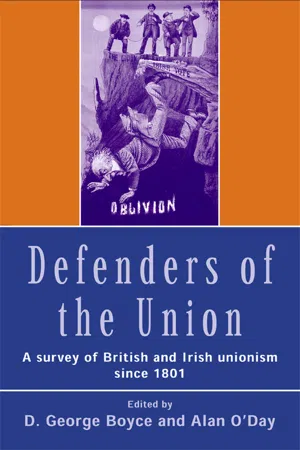
eBook - ePub
Defenders of the Union
A Survey of British and Irish Unionism Since 1801
- 352 pages
- English
- ePUB (mobile friendly)
- Available on iOS & Android
eBook - ePub
About this book
Information
1 The Union
Introduction
DOI: 10.4324/9780203183267-1
The Act of Union has been the aim of so much random invective that its good fruits (for it has borne good no less than evil fruits) are in danger of being forgotten.1
Thomas Hobbes reminds us that mankind’s basic desire is to find security against each other; Irish history and Anglo-Irish relations bear out the truth of his proposition. In the wake of the United Irishmen’s rebellion of 1798 the Act of Union was passed to ensure that there would be no similar challenge to the supremacy of Great Britain. For the Protestant Irishmen who agreed to the Union, the principal attraction was the security it offered against a Catholic majority which bared its sectarian teeth in the rising of 1798. The difference between British and Irish purposes remained at the heart of misunderstanding and mistrust between the two countries down to the present, a point made by Arthur Aughey and Paul Bew in chapters in this book. But what emerged when the Union came into effect on 1 January 1801 was something much more than a mutual security pact; it gave birth to a new state, the United Kingdom of Great Britain and Ireland, though this spelt no change of political regime, no seismic shift in the social order. Yet, if the transition appeared modest, it portended the integration of Ireland into a unified if not necessarily unitary community. Dicey made the point that ‘the Union . . . whilst it increases the power of the whole United Kingdom, provides the means of carrying out, and of carrying out with due regard to justice, any reform, innovation, or if you please revolution, required for the prosperity of the Irish people’.2 On the one hand the Union seemed the last step in the political consolidation of the English state, on the other it represented a brave attempt to absorb a people, the majority different in religion. Ultimately, incorporating all Ireland proved too testing.
As Dicey observed, the Union has not enjoyed an enviable repute. Oliver MacDonagh writes that ‘the Act of Union forms the matrix of modern Irish history’.3 In his estimation, ‘it was the pure principle, the very idea, of the Act of Union, and not its substantial clauses, which was at stake’. F.S.L. Lyons states:
In the unending struggle between those who upheld the Union and those who opposed it, the initiative had habitually rested with the latter. The business of a conservative, after all, is to conserve, and to Irish and British Conservatives alike a stern, unyielding resistance to change had seemed for most of the nineteenth century the only course open for those who wished to maintain intact the connection between the two countries.4
A bit less harshly, R.F. Foster suggests, ‘the unionist side tended to brutal truths, and to borrowing the Whig line by depreciating the colonial and elitist nature of the College Green assembly as no great loss: logic demanded a Union as the only alternative to separation. The argument relied on the concept of constitutional union as an integrative force, which experience would disprove’.5 Alan Ward contends:
The Act of Union should have simplified the constitutional relationship between Britain and Ireland because the two countries were now governed under a single Crown by a single Parliament. The reality is that the Union failed abysmally as a constitutional device because it was approached in a strange way that did little to eradicate the sense that Ireland was a separate political community.6
This apparently near-universal judgement has only recently been balanced by the recognition that protagonists of the Union have usually, thought not always, felt obliged to defend the status quo, the totality of the Union as it actually operated. This is not a logical necessity. To uphold the general framework of the Union does not imply support for every administrative detail or legal aspect of its operation. The chapters in this volume explore aspects of the Union and of Union culture for the past two and a half centuries. The chapters are arranged chronologically around three broad themes - the purposes, establishment and definition of the Union; its modification; and the after-effects and entrenchment.
This was not an amalgamation of equals to be sure, for Great Britain was the dominant partner, but it was something more than neo-colonialism because Ireland received a fair bargain by the norms of the day, and within a relatively short time its people and commerce enjoyed full rights in the new state. Still, during its existence the Union remained unloved by a significant section of the Irish people and misunderstood by many in Great Britain who continued to see it largely in terms of security for themselves. From an early date the Union was challenged by spokesmen for the Catholic majority. This is ironic because the main resistance to the passage of the legislation came at the hands of Protestants in Dublin. The contest spurred an intermittent debate on the nature of the Union itself. Was it a federal compact between equal partners for their common good? Was it merely a pragmatic legislative union or a union of hearts? Was it primarily a defensive arrangement for the protection of the British state and Irish Protestants? There were ad hoc responses to such inquiries from time to time when alterations to the Union were either discussed or implemented but until 1921 these were no more than tentative in vital respects and the questions raised by the Union remain open up to the present.
In 1921 the Union was modified by the creation of three jurisdictions - an Irish Free State, Northern Ireland and the remainder of the United Kingdom, something scarcely visualised a generation earlier by any side. The chapters in this volume explore the dialogue about the Union and the changing relationships within it, both relatively neglected topics. While this is relevant to Ireland, it has broader importance for the future of a United Kingdom. Is it a Union state or a unitary state with certain local variations? The creation of assemblies in Scotland and Wales reflects a pragmatic solution to a perceived demand but largely sidesteps the problem of the sort of state that should emerge in the twenty-first century.
In Ireland the question of the Union hinged on deep divisions in society springing from distinctions which are not derived from religion alone, but from what it implies - power and the loss of power. This was a long-running battle. The quest for social and political ascendancy, even the establishment of a ‘superior’ religion and the way of life this exemplified, dates from the arrival of the ‘New English’ in the sixteenth century, and of the Scots Presbyterians and English who settled in Ulster and elsewhere in the early seventeenth century. Though often divided internally, these immigrants identified themselves with the Protestant or English cause in Ireland. But they never did so unswervingly. George Boyce outlines their conditions and reservations. Central to these was that in the wars of religion of the seventeenth century they had defended themselves by their own swords. In the great crisis of 1912 to 1914 Ulster Protestants showed that this spirit was alive and that reluctantly in the final resort they would brandish their swords again. Irish Protestants’ attitude to Great Britain therefore was equivocal and remains so in Ulster, yet they could not but acknowledge that the British connexion was crucial to their survival and victory. This facilitated belief on the part of late eighteenth-century ‘patriots’ that Ireland under Protestant leadership could stand alone, though within the wider confines of the British Empire. To stand alone, if need be, was articulated once more with the formation in the early 1970s of William Craig’s Vanguard. Unease among Protestants about their position and the ultimate intentions of the British state with regard to Ireland have been parts of the Protestant mentality for two and a half centuries. Aughey explains how the mix of self-confidence and sense of betrayal boiled over among northern Protestants in the controversy about the Anglo-Irish Agreement, a treaty arranged over their heads by the governments in London and Dublin.
Most of Ireland was not ready for the benefits of French revolutionary ideology - the ending of confessional and political inequalities, the overthrow even of religions, institutions and superstition, specifically embodied in Catholicism. The rebellion of 1798, commemorated in later popular national mythology, seemed to confirm fears that suspicions and hatred were not easily discarded. The sectarian war in Wexford, in particular, fuelled both Protestant and Catholic views of the past. Yet, even in this feverish atmosphere, the Irish Parliament of the late eighteenth century, with all of its limitations and narrowness, assumed a halo for opponents of the Union or conversely was seen as the cause of Irish problems by those who upheld it. ‘History5 could never be an abstract value-free rendering of the past for it necessarily belonged to and legitimised the stance of each side.7
The Union was made between 22 January 1799 and 1 August 1800, coming into effect at the beginning of January 1801. Having put enormous effort into securing passage of the Act of Union, Westminster governments seemed less concerned with its actual workings. This would be a recurrent criticism not only from Irish nationalists but by supporters of the Union. Alan O’Day highlights some Conservatives’ concurrence in 1869 that not enough had been done, while Carla King considers Sir Horace Plunkett’s critique of the Union and his ideas for improvements. Whatever the objections about the record under the Union, it was a remarkable settlement, with Great Britain making unusual efforts to conciliate the lesser partner. The Act had eight articles, four settling the political basis and the remainder dealing with the unification of the Irish and English Churches, commerce, finance and the law (see Appendix at the end of this book). Ireland was granted 100 representatives in the Westminster House of Commons and 32 representative peers (28 temporal and 4 spiritual) in the House of Lords, thus guaranteeing the country a prominent role in the new state. Unification of the Churches was ‘deemed and taken to be an essential and fundamental part of the Union’, though one which by the 1840s came under attack and then was modified in 1869. After a period of twenty years the financial and commercial regulations of the two countries were to be harmonised. Contributions to the expenditure of the United Kingdom were set at 15:2, a proportion to be reconsidered after twenty years. The laws in both countries remained in force, subject to such changes as might be made by the United Kingdom Parliament. Unlike the Scottish Union of 1707, these terms were not worked out by the respective parliaments but by the British government and Irish executive, the latter appointed by Westminster. Paradoxically, the Irish Protestant opposition to the Union was too strong to allow equal negotiations. On 2 August 1800 the Irish Parliament met for the final time.8
Several aspects of the transaction merit notice. The principal opposition to the Union came from a Protestant Parliament that, throughout its existence, spoke for the Protestant people. This reflected the Protestant concern that the loss of their parliament deprived them of their constitutional protection, the defence both of their own and in their view Ireland’s interest, a perspective that characterised northern unionists’ demands from 1972 for the restoration of their parliament. That most came to see the Union as essential for their survival and Ireland’s welfare reveals not a change in their desires and ambitions but, as Boyce points out, a new perception of how best those desires and ambitions could be secured. But the process of conversion was halting and there remained a residual Protestant tradition that looked back to the Irish parliament with regret, and hoped for its return.9 Isaac Butt was one notable member of that tradition and his outlook is assessed by Joseph Spence, while Charles Stewart Parnell is another and more famous case, one inspired by familial traditions of resistance to the Act of Union. There were others, too: Thomas Davis, William Smith O’Brien, the members of the Protestant Rule Association are ready illustrations. This residual view among the ‘minority’ was important as a continuum between the eighteenth century and the present; William Gladstone in 1886 repeatedly propagated the view that, but for British interference, the Protestant patriots of the eighteenth century and Catholic nationalists of his own time would resolve their differences jointly rather than each appealing to London. Such appeals, he believed, had corrupted Irish politics, dividing its people into factions. The home rule measure in 1886 was structured to provide a forum for his own interpretation of the co-operation that previously had been present among Irishmen. This helps explain why he made no special arrangements for the minority and even more so his unwillingness to treat Ulster as a different case. Boyce, Spence, King and the several chapters on Ulster unionism address the conditional nature of the Union in the eyes of many Protestants. This sense of ‘differentness’ was aggravated by a union conceived for strategic rather than social reasons and British preoccupation with other, usually more important, problems. There was also the lingering sense that the Irish and Ireland were akin to the ‘near abroad’.
If Protestants expected the Union to be a bulwark against an aggressive political Catholicism, they were quickly disabused.10 Admittedly, they retained a grip on the legal apparatus, local and municipal government and land ownership, but each of these in turn came under increasing pressure from Catholic spokesmen who demanded access to and then a ‘fair’ share of the spoils. Implicitly, the Union promised to be ‘fair’ but in Ireland the term itself was elusive. ‘Fair’ could imply rewards linked to merit and loyalty, to equality in the distribution of plums between Protestants and Catholics, or to share bounty in relation to the relative numbers. It required time before Catholics routinely reached the summit and even in 1921 they remained under-represented in some areas of endeavour. During the last decades before 1921 Catholics unquestionably made great headway. Ironically, the settlements of 1921 did not achieve ‘fairness’ but entrenched Catholic ascendancy in the south and a Protestant one in the north. This vitiated the precept of the Union. Ulster Protestant concern that it would be victimised under home rule was turned on its head; Patrick Buckland casts a wary eye on the extension of Protestant hegemony in the years after 1921, which he attributes to three prime causes - the inexperience of the new leadership of Northern Ireland; grass-roots Protestant sentiment that had to be satisfied by unionist politicians; and a British state that largely ceased to act as a referee between contending factions.
Another irony was that a union designed to give security to Irish Protestants afforded instead a United Kingdom platform for Catholic grievances and a means to moderate the supposed guarantees to Protestants. The Catholic ‘offensive’ was not long in gestation. William Pitt wanted to take the step of allowing Catholics to sit in Parliament but this was blocked by King George III who insisted that to give his assent to such a measure would violate his coronation oath to defend the Protestant faith and church establishment. The sovereign was not the only one who held such opinions. But this opposition immediately raised a cry among middle-class Catholics for ‘emancipation’, that is political rights, setting the agenda for a fierce public and parliamentary campaign lasting almost three decades. As Brian Jenkins shows, though, British officials did not meet Irish demands by unrelenting resistance: William Wellesley-Pole, Robert Peel and Henry Goulburn between 1809 and 1827 utilised the powers at their disposal and helped shape enduring policies aimed at sustaining the Union, in part, by appeasing Catholic feeling. Anti-Catholicism was behind the refusal of ‘emancipation5 but there was a principle at stake as well - the formal role of religion in the state. Repeal of the Test and Corporation acts in 1828 and more certainly Catholic emancipation the following year drove a wedge into the foundations of the confessional state.11 Benjamin Disraeli attempted a last-minute resuscitation of the confessional ideal, basing opposition to disestablishing the Irish Church in 1869 on the necessity of religion in the life of the community. In the event he lost to a new concept - state impartiality. The Union had ensured the status of the Church of Ireland, uniting it with the English Church, but this was declared void because it stood between the British state and conciliation of Ireland’s Catholics.
Disestablishment had implications for the Union. Was this to be a union based on separate laws and institutions to accord with local conditions (‘Irish ideas’), which became Gladstone’s position by 1886, on the basis that recognition of distinctions would be a source of national strength, or should the state continue on the path to harmonisation of institutions, rights and duties? Because the position of the Church was part of the constitution, religious questions initiated debate on the constitution. Not surprisingly, these disputes revealed differing concepts of the constitution. As discourse about the Union was often a metaphor for the constitution, the debate could never be wholly or perhaps even primarily about Ireland. Because the entire matter concerned principles, tally sheets of benefits and deficits about the Union were inappropriate measures of its utility for either Great Britain or Ireland, though, of course, this did not stop the contestants attempting to establish such a ledger.
British Conservatives held that the Union should be maintained, if not without alteration, at least in major essentials. Though they had opposed legislation for disestablishment, its enactment eased their dilemma. They were no longer in a position of defending the privilege of a small minority but now seized command of the high road, upholding the political Union. Their position received an additional fillip when a succession of land acts mainly sponsored by Conservatives gradually turned a largely Catholic peasantry into owner-occupiers. Just as the case for the Union had ceased being about religious privilege, it also was detached incre...
Table of contents
- Cover Page
- Half-Title Page
- Title Page
- Copyright Page
- Table of Contents
- List of contributors
- 1 The Union: introduction
- Part I Purposes, establishment and definition of the Union
- Part II Modification of the Union
- Part III After-effects and entrenchment of the Union
- Appendix: the Act of Union
- Index
Trusted by 375,005 students
Access to over 1.5 million titles for a fair monthly price.
Study more efficiently using our study tools.
Frequently asked questions
Yes, you can cancel anytime from the Subscription tab in your account settings on the Perlego website. Your subscription will stay active until the end of your current billing period. Learn how to cancel your subscription
No, books cannot be downloaded as external files, such as PDFs, for use outside of Perlego. However, you can download books within the Perlego app for offline reading on mobile or tablet. Learn how to download books offline
Perlego offers two plans: Essential and Complete
- Essential is ideal for learners and professionals who enjoy exploring a wide range of subjects. Access the Essential Library with 800,000+ trusted titles and best-sellers across business, personal growth, and the humanities. Includes unlimited reading time and Standard Read Aloud voice.
- Complete: Perfect for advanced learners and researchers needing full, unrestricted access. Unlock 1.5M+ books across hundreds of subjects, including academic and specialized titles. The Complete Plan also includes advanced features like Premium Read Aloud and Research Assistant.
We are an online textbook subscription service, where you can get access to an entire online library for less than the price of a single book per month. With over 1.5 million books across 990+ topics, we’ve got you covered! Learn about our mission
Look out for the read-aloud symbol on your next book to see if you can listen to it. The read-aloud tool reads text aloud for you, highlighting the text as it is being read. You can pause it, speed it up and slow it down. Learn more about Read Aloud
Yes! You can use the Perlego app on both iOS and Android devices to read anytime, anywhere — even offline. Perfect for commutes or when you’re on the go.
Please note we cannot support devices running on iOS 13 and Android 7 or earlier. Learn more about using the app
Please note we cannot support devices running on iOS 13 and Android 7 or earlier. Learn more about using the app
Yes, you can access Defenders of the Union by D.George Boyce,Alan O'Day in PDF and/or ePUB format, as well as other popular books in Storia & Storia britannica. We have over 1.5 million books available in our catalogue for you to explore.