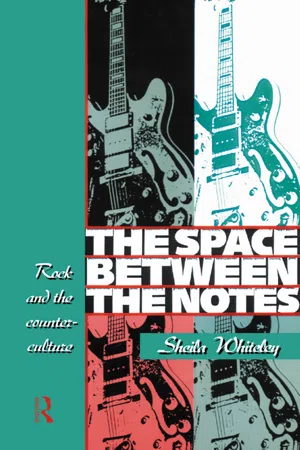
The Space Between the Notes examines a series of relationships central to sixties counter-culture: psychedelic coding and rock music, the Rolling Stones and Charles Manson, the Beatles and the `Summers of love', Jimi Hendrix and hallucinogenics, Pink Floyd and space rock. Sheila Whiteley combines musicology and socio-cultural analysis to illuminate this terrain, illustrating her argument with key recordings of the time: Cream's She Walks Like a Bearded Rainbow, Hendrix's Hey Joe, Pink Floyd's Set the Controls For the Heat of the Sun, The Move's I Can Hear the Grass Grow, among others.
The appropriation of progressive rock by young urban dance bands in the 1990s make this study of sixties and seventies counter-culture a timely intervention. It will inform students of popular music and culture, and spark off recognition and interest from those that lived through the period as well as a new generation that draw inspiration from its iconography and sensibilities today.
- 152 pages
- English
- ePUB (mobile friendly)
- Available on iOS & Android
eBook - ePub
About this book
Information
1
Introduction
Rock’s superiority over previous popular musical forms is simply the result of its existence in a period of expanded and heightened social, political and psychological awareness, a period which made possible and necessary a hip and relevant popular music.
Progressive rock and the counter-culture are often perceived as inseparable. Recognised as a social force, music was thought to say things of cultural and political significance, to have a message. Orientated towards a collective experience, rock appeared to provide the means whereby young people could explore the politics of consciousness, ‘love, loneliness, depersonalisation, the search for the truth of the person and the attempt to set up an alternative life style’2. The question that arises is why there should have been this emphasis on a ‘hip and relevant popular music’.
Was it, as Richard Neville wrote at the time, just symptomatic of an ‘intense, spontaneous internationalism’?3 ‘From Berlin to Berkeley, from Zurich to Notting Hill, Movement members exchange a gut solidarity, sharing common aspirations, inspirations, strategy, style, mood and vocabulary. Long hair is their declaration of independence, pop music their esperanto and they puff pot in their peace pipe.’4
Roszak also draws attention to the international dimensions of the movement. Throughout the West (as well as in Japan and parts of Latin America), it is the young (qualified as perhaps only a minority of the university campus population) who find themselves cast as the only effective radical opposition within their societies.’5
Both Neville and Roszak, in common with most counter-cultural theorists, also discuss the divisions within the counter-cultural movement, the New Left, hippies and yippies. At the same time, Roszak points to the similarity of sensibility which united student and graduate activists and the drop-out hippies,
the continuum of thought and experience among the young which links together the new left sociology of Mills, the Freudian Marxism of Herbert Marcuse, the Gestalt-therapy anarchism of Paul Goodman, the apocalyptic body mysticism of Norman Brown, the Zen-based psychotherapy of Alan Watts and finally Timothy Leary’s impenetrably occult narcissism, wherein the world and its woes may shrink at last to the size of a mote in one’s private psychedelic void.6
What is especially interesting is that contemporary analysts should draw attention both to the divisions within the movement and to the broad consistency in their antagonistic position towards the dominant culture. As Roszak points out, ‘What makes the youthful disaffiliation of our time a cultural phenomenon rather than a political movement, is that it strikes beyond ideology to the level of consciousness, seeking to transform our deepest sense of the self, the environment.’7
It is, perhaps, this involvement with the self that has been particularly relevant to the progressive rock musician in that it shifted the emphasis away from the external constraints of the easily accessible, defined here as known styles associated with particular bands, towards a more personalised expression of musical exploration. With the recognition of musicians as significant both to and within the counter-culture, who could not only voice its concerns but also provoke reaction through their own musical and personal confrontation with the mainstream culture, there was both a support system and space to innovate. Their Satanic Majesties Request may have appeared to move in a somewhat unlikely direction for a hard core r&b band like the Rolling Stones, it may have been dubbed cynically a quick and overall badly thought through response to the Beatles’ Sgt. Pepper album, but it reflected, nevertheless, the general trend towards a changed state of musical consciousness. Musicians did not have to abandon a particular rock style, but instead could add to it, select elements that continued to express their own personal styles and incorporate techniques or spatial dimensions which resonated with the new vocabulary of psychedelic rock8 that had come over from the West Coast of America.
Clearly this was not a new phenomenon; rock music is eclectic by nature. What was new, however, was the emphasis on meaning in music which was not simply tied to the lyrics, but spilled over into the sound itself. As Neville wrote at the time: ‘All the relevant sounds seemed somehow associated with acid and universal love. The Beatles, Donovan, Cream, Jefferson Airplane, Quicksilver Messenger Service, The Grateful Dead, The Doors, Country Joe and the Fish all celebrated the acid experience and revived our faith in each other.’9
This lumping together of so many diverse groups and the association of acid and universal love with sounds in the music suggests that there was a homology between musical and cultural characteristics. Progressive rock was acknowledged as the major communicative organ of the counter-culture. Its experimental nature mirrored concern for an alternative society. Stylistic complexity, the elements of surprise, contradiction and uncertainty suggested alternative meanings which supported the hippies’ emphasis on timeless mysticism. It appeared that the counter-culture and musical innovation were inseparable.
With progressive rock standing in a contradictory position to mainstream pop conventions, the question that arises is how it can be read as oppositional. How does progressive rock, from within its musical structures, articulate the socially mediated subjective experiences of the different groups within the counterculture? Is it a simple contestation of existing musical frameworks, and how can a musical language express an alternative ‘progressive’ viewpoint? To what extent does this rely on personalised intuitional breaks, inflections and the breakdown of structure?
My initial analysis addresses the problem of the music itself—how it is arranged, instrumentation, style, and so on—but the question remains of how it provides social and cultural meanings. At one level it could be argued that music refers symbolically to such notions as physical space and movement. Musical shape and articulation are often accompanied by vocal and physical gestures. Pitch and timbre correlate with a sense of physical space and colour. Basic body rhythms (heartbeat, breathing) relate in turn to musical rhythms, while the tension/release patterning in melodic and rhythmic structures have associations with the pulse and breathing. Yet it is difficult to correlate these general connections with specific cultural contexts.
Progressive rock was located where particular sociological, cultural and musical developments crossed. It could therefore be argued that as the music was actually created in concrete cultural situations these orientated its received meaning in particular ways.10 In reality, however, progressive rock was a particularly heterogeneous genre and while the variety of musical styles may have reflected the variety of radical movements and concerns within the counterculture, the area of signification presents problems. In particular, the level of denotation seems lacking or, at best, unclear. Apart from some very clear references to the outside world (such as animal noises in the Beatles’ Good Morning; clocks and alarms in Pink Floyd’s Dark Sideof the Moon), there is no system of objective reference to concepts and perceptions. On the other hand, it is possible to discuss connotations, since music was recognised as a symbolic act of self-liberation and self-realisation in which reality and musical experience were fused: the sound-shape, together with the socio-cultural element superimposed upon it, consolidate to form a distinct form of communication. At this point the diversity of musical styles within the genre of progressive rock becomes significant in establishing particular codes of behaviour through common musical codes.
For example, the counter-culture was largely concerned with alternative modes of living which involved, to a great extent, the use of drugs as a means of exploring the imagination and self-expression. Focused by a reading of Joel Fort’s The Pleasure Seekers: The Drug Crisis, Youth andSociety,11 my analysis explores the way in which the different styles of progressive rock have common codes which convey a musical equivalent of hallucinogenic experience. These include the manipulation of timbres (blurred, bright, overlapping), upward movement (and its comparison with psychedelic flight), harmonies (lurching, oscillating), rhythms (regular, irregular), relationships (foreground, background) and collages which provide a point of comparison with more conventionalised, i.e. normal treatment.
Yet it is recognised that such associations quickly become conventionalised. As Middleton and Muncie point out,
psychedelic elements in musical style are typically interpreted as such by reference to a sub-culture of drug usage; in other words, they are defined in this way primarily because hippies said they should be. A whole group of connotations, arising from our knowledge of the drug culture, then settles on the music. But this culture has already been defined in this way partially because of the existence in it of this particular kind of music. The meaning of drug usage is affected by the meaning of the associated music… The system is perfectly structured internally…but has no necessary purchase on it from without.12
While my consideration of the music has been influenced to some extent by this awareness of intra-cultural interpretations, I have tried to establish the meaning of psychedelic elements through an examination of the musical codes involved and, more important, their interrelationship. This has also made possible an identification of whether or not a group has simply ‘lifted’ the more general psychedelic musical codes (e.g. blurred overlapping timbres, bright tinkly sounds) in an attempt to capitalise on the popularity of acid rock.
Although the initial analysis at first focuses on the music of Cream, Jimi Hendrix and Pink Floyd, who were considered by contemporary commentators to be influential progressive rock musicians and of interest to the counter-culture, it is apparent that the counter-culture was by no means their total audience. Similarly, while the Beatles’ Sgt. Pepper album was considered especially influential in setting the agenda for the counter-culture in Britain, and in particular in focusing attention on hallucinogenics, its general popularity points to the conclusion that even in the presence of a sharply delineated relationship between progressive rock and the counter-culture, musical styles are rarely the exclusive property of one specific group. This point was borne out in my analysis of 1967 chart singles which dealt with psychedelic experience, and Pink Floyd’s Dark Side of the Moon, which topped the LP charts for three years from 1972 to 1974. Conversely, while the Rolling Stones’ role as anti-establishment musicians reverberated with the counter-culture’s stand against mainstream society, there is little to suggest that the group specifically identified with counter-cultural ideology. This is equally true of Hendrix, whose refusal to be associated with the Black Panther party is well documented.
So there is little to suggest that progressive rock was the exclusive property of the counter-culture. Rather, it seems that there were correspondences between musical practices and social relationships and the way in which these were lived out at the level of cultural symbols. Progressive rock, like all music, relied on communication and positive identification. As such, it had an intrinsically collective character which suggested that it was capable of transmitting the affective identities, attitudes and behavioural patterns of the group(s) identifying with it.
Finally, while it is recognised that progressive rock (in common with other popular forms of music) is primarily an aural experience, that it is performed, stored and distributed in a non-written form and that musical notation is not, therefore, the only key to analysis, I have nevertheless found it helpful to use manuscript as a graphic way of leading the reader through selected areas of the text. In particular, my analysis of psychedelic coding in Jimi Hendrix relates musical notation to haliucinogenic experience and as such should be read in context. Clearly, it could not be assumed that the use of a particular chord sequence, for example, always carries with it the same connotations.
2
Cream, Hendrix and Pink Floyd
Commentaries on ‘progressive rock’ are generally framed in terms of becoming. ‘Rock became progressive’,1 ‘Underground music’ became ‘progressive music’.2 The mid-sixties letters page of Melody Maker highlights the ‘emergence’ of rock in which progress is measured in terms of musical ideas and techniques: ‘Hendrix: Progressive and beautiful in his ideas’; ‘Clapton: Progressing with ideas and techniques’.3 Musicians such as Cream, Pink Floyd, Hendrix and the Beatles are credited with liberating rock from pop4 in terms of qualities of ‘art’ and ‘genius’. Equally there is a focus on ‘relevant sounds’ which, in the summer of 1967, were tied to the psychedelic,5 thus raising the question of whether rock, acid rock and progressive rock are interchangeable terms.
Middleton and Muncie’s observation that ‘progressive rock (which we can take roughly as the music of the counter-culture) is a particularly heterogenous genre’6 also points to the problem of categorisation, of whether it is possible to arrive at a definition which can satisfactorily describe its range of musical styles. Definition is further problematised by the importance attributed to rock by the counter-culture itself: ‘it was thought to say things of cultural and political significance, to have a message’.7 This would suggest that there is a relationship between the musical form and its cultural use with the implication that the meaning of progressive rock cannot fully be understood without a consideration of extra-musical factors.
During the late sixties, three groups considered to be of particular significance in the development of British progressive rock were Cream, the Jimi Hendrix Experience and Pink Floyd, all formed in 1965–66. As they were just as influential in the development of psychedelic rock their music will also be analysed for psychedelic coding to determine the extent to which acid rock and progressive rock are comparable terms.
Cream was formed by Eric Clapton (guitar), Ginger Baker (drums) and Jack Bruce (bass and most of the vocals). Baker and Bruce were originally in the Graham Bond Organisation, a group whose virtuoso jazz and blues format was inherited by Cream when they recruited Eric Clapton from John Mayall’s Bluesbreakers, a group famous for their accurate recreation of the sound and style of such contemporary Chicago blues players as Buddy Guy, Otis Rush and Magic Sam.8 According to Clapton, Cream was originally planned as a blues trio which ‘aimed to extend the expressive potential and aesthetic quality of blues-based rock music’,9 through an emphasis on improvisational technique based on individual virtuosity.
Cream’s pedigree was impeccable and any doubts about the three musicians’ ability to play as a group were initially dispelled after their début appearance at th...
Table of contents
- Cover Page
- Title Page
- Copyright Page
- Dedication
- Examples
- Acknowledgements
- 1. Introduction
- 2. Cream, Hendrix and Pink Floyd
- 3. The Beatles
- 4. 1967 and Psychedelic Rock
- 5. The Rolling Stones
- 6. Pink Floyd: Dark Side of the Moon
- Notes
Trusted by 375,005 students
Access to over 1.5 million titles for a fair monthly price.
Study more efficiently using our study tools.
Frequently asked questions
Yes, you can cancel anytime from the Subscription tab in your account settings on the Perlego website. Your subscription will stay active until the end of your current billing period. Learn how to cancel your subscription
No, books cannot be downloaded as external files, such as PDFs, for use outside of Perlego. However, you can download books within the Perlego app for offline reading on mobile or tablet. Learn how to download books offline
Perlego offers two plans: Essential and Complete
- Essential is ideal for learners and professionals who enjoy exploring a wide range of subjects. Access the Essential Library with 800,000+ trusted titles and best-sellers across business, personal growth, and the humanities. Includes unlimited reading time and Standard Read Aloud voice.
- Complete: Perfect for advanced learners and researchers needing full, unrestricted access. Unlock 1.5M+ books across hundreds of subjects, including academic and specialized titles. The Complete Plan also includes advanced features like Premium Read Aloud and Research Assistant.
We are an online textbook subscription service, where you can get access to an entire online library for less than the price of a single book per month. With over 1.5 million books across 990+ topics, we’ve got you covered! Learn about our mission
Look out for the read-aloud symbol on your next book to see if you can listen to it. The read-aloud tool reads text aloud for you, highlighting the text as it is being read. You can pause it, speed it up and slow it down. Learn more about Read Aloud
Yes! You can use the Perlego app on both iOS and Android devices to read anytime, anywhere — even offline. Perfect for commutes or when you’re on the go.
Please note we cannot support devices running on iOS 13 and Android 7 or earlier. Learn more about using the app
Please note we cannot support devices running on iOS 13 and Android 7 or earlier. Learn more about using the app
Yes, you can access The Space Between the Notes by Sheila Whiteley in PDF and/or ePUB format, as well as other popular books in Media & Performing Arts & Communication Studies. We have over 1.5 million books available in our catalogue for you to explore.