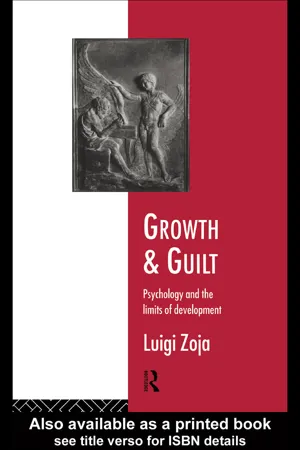
- 248 pages
- English
- ePUB (mobile friendly)
- Available on iOS & Android
eBook - ePub
About this book
The relentless exploitation of the earth's resources and technologys boundless growth are a matter of urgent concern. When did this race towards the limitless begin?
The Greeks, who shaped the basis of Western thinking, lived in mortal fear of humanity's hidden hunger for the infinite and referred to it as hubris, the one true sin in their moral code. Whoever desired or possessed too much was implacably punished by nemesis, yet the Greeks themselves were to pioneer an unprecedented level of ambition that began to reverse that tabu.
If it is true that no culture can truly repudiate its origins, and that gods who are no longer potent can vanish but still leave behind a body of myth which coninues to live and assert itself in modernized garb, then our concern with the limits of growth reflects something more than an awareness of new technological problems - it also brings to light a psychic wound a a feeling of guilt which are infinitely more ancient.
Information
Part I
THE PROBLEM
1
THE MYTH OF GROWTH, THE MYTH OF LIMITS
Europe has conquered the world, and on a scale more vast than any of its wars. The Euro-American way of life has spread across the whole of the globe, assuming the status of the first planetary culture in human history. Yet this enormous achievement seems to strike no chord in our emotions. Like the technology on which it rests, it seems to have no soul. The victory of the west—or of its technological civilization, flanked by market economy, representative democracy, and the morals of consumerism—has created no epic in its own celebration.
Such a grandiose scale of hegemony has never before been witnessed. The non-European civilizations that have not already succumbed are currently doing their best to enter the world of technology; they are likewise in the throes of converting themselves to the ideologies and ways of life that accompany technology. All attempts to curb such tendencies have proved entirely fruitless, and by now this process of development is also fully underway in the countries that once pursued the experiment of Marxism. Yet the fact that the western way of life has defeated or converted all others produces no sense of excitement; it does not inspire us to assume victorious attitudes. Western triumph over the peoples of Asia Minor once found celebration in the Iliad; the routing of Islam was immortalized in the Chanson de Roland; the Nibelungensage is the epic of Europe's repulsion of enemy hordes that arrived from the east. But today, at the time of the achievement of its total and global supremacy, the west remains silent. One can only wonder why.
To reply that epic poetry has ceased to exist as a viable genre would be simply to beg the point. The limits of epic poetry were already clear to Herodotus, and to narrate the story of the Persian Wars—which he saw as a sequel to the Trojan Wars—he invented new forms of expression that consisted of a mixture of myth and chronicle. Cinema, today, might take on the task of re-inventing an epic tradition. Or does it make more sense to imagine that the west relinquishes self-celebration because its victory has not been the fruit of the adventures of individual heroes or exemplary protagonists, such as the Captains of ancient Greece or the Paladins of medieval France? Such a reply seems even more suspicious. Our world knows no heroes since all of us have played an active part in the expansion of the technological west; we all share equal status in the story of its victory. “Today, there are no longer any protagonists; there is only a chorus.”1 But we do not recognize ourselves in this victory; instead, we are ever more fascinated by the rural and primitive worlds that are now on the verge of disappearing.
A modern-day epic could again take the form of a mixture of history and myth, which is not, however, to imply that fact would give way to fantasy. Fact itself can have the presence of myth, since epic simply recasts facts into forms that allow for a style of majestic narration, and they come to be charged with transcendental overtones. The original meaning of “myth” had nothing to do with declaring a story to be fictional rather than true. “Myth” was synonymous with “language,” or with narrative in its broadest, most general, and most authoritative form, charged with emotion and the power to persuade. Myth speaks with a voice that seems to arise from the very events it narrates, and it typically possesses the power to mold human beings into a semblance of the forms that it uses to capture their attention. Myth is the repository of a destiny, even perhaps while omitting to describe it.
Myth is the part of history that refers to no previous explanations. No ulterior origins lie farther to its rear. It is the part of history that deflects the movements of its personages into confirmations of ancestral expectations and it routs all personal intentions on the part of its narrator. Myth constrains the narrator to follow a rhythm inherent in the myth itself. Myth is that “past” which even in the past was never a present, but which claims none the less to be a part of every present. Myth is autonomous, or independent of everything other than itself; but it constitutes and imposes a bond that events are forced to respect. While distant, it is also everpresent.2
But to offer a simple description of myth is still to offer too little. Myth possesses a peculiar relationship with the person who recounts it and also with the listener, since in addition to being a narrative form, it is also an interior space. Myth is the site of our most peremptory mental images. This fact is very clear to the politicians who govern us, and they are often prone to abandon rational arguments—which very few are likely to want to hear—and to replace them by myths; myths function even without being heard, since they seem to speak truths that we have always known. Myth is society's first medication, arresting time and restoring us by sending us back to the roots of things. One can know a myth by heart and yet tirelessly return to hearing it told, year after year, always the same.
Human beings need narratives in order to identify with figures or models of human behavior. Things are not sufficient, since they offer no respite from solitude. But technological civilization ignores the need for the production of mythic event and instead is committed to the manufacture of objects of use, which are alien to the functions and purposes of narrative. These objects are the victors. Technological civilization thus stands at a special distance from the passions of myth: Weber describes our civilization as disenchanted, or entzaubert. In the realm of the victory of things, the sources of action no longer reside in the states of mind of individuals: action is objective, and the course of action can programmed. It is in much the same way that the victory of things banishes emotion and makes itself an impossible theme for narrative or for epic celebration. The achievements of technology are immediately distributed, but difficult to mythologize. Progress today is so swift that we constantly exploit its most recent innovations without having been able to establish any profound connection with the culture from which it derives. Technology has beneficiaries, but no fathers. Its victory has its chroniclers and archivists, but no narrators.
Here we can add a second consideration. The problem of the lack of an epic form of expression for the praise of the victory of technological civilization also coalesces with a moral problem. Technological civilization forswears the celebration of its triumph not only because of its loss of access to the elevated planes of mythic language, but also because it harbors doubts and feelings of guilt about the meaning of its achievements. The achievements of western mankind are ever less experienced as a victory over the men of other civilizations; they seem instead to represent the general defeat of men by things. Some of us sometimes wonder why the west directs its pacifism against itself and not against its adversaries, and one has to respond that the source of western pacifism is embedded in the west's sense of guilt. It represents a need to make peace with all of those parts of ourselves that the modern world has bruised and mangled. Our universal victory bears the burden of a guilt that derives from technology's original sin.
If we seek out the mark of that sin, we will soon discover that the absence of a canon of mythic description in the ways in which we depict our world is really no more than apparent.
Unlike all preceding civilizations, whether European or otherwise, the world of technology exposes its belly primarily by taking recourse to the modes of critical thinking, ever further exploring the heritage and increasing the scope of what we refer to as Kulturpessimismus. The intellectuals of the western world have the impression of now for the very first time living out the story of a form of life that does not love itself. Suicide among such people is now more frequent than ever before. The future is an eddying maelstrom that first engulfs our gaze and then sucks us down to its depths. Technological civilization has compiled something more than a body of critical descriptions of itself: such self-descriptions amount in fact to a cycle of negative epics, or of epics in reverse. They graft history onto a myth that narrates destruction rather than creation. As though returning to an ancient Greek idea, such visions describe the succession of the generations as a linked series of degenerations. The Greek version of the tale sees mankind as already having fallen from a former and indeterminate golden age to the age of iron; the modern myth, on the other hand, sites the lowest point of human life not in the present, but in an ominous future.
At a time when medical progress had begun quite effectively to beat back illness as a cause of death, Malthus predicted demographic disaster. Marx belonged to the era in which the industrial revolution was beginning to reveal its scope, but saw it as the harbinger of social catastrophe. The critical spirit of the twentieth century has grown even more intense—especially since the period of the two world wars—pushing ever further forward in an ever greater number of fields, from sociology to history, anthropology and ecology. By now it directs its attention to the state of the whole of the globe. The world ever increasingly presents itself as a single thing, or as an integrated whole in the sway of technological and territorial interdependencies, and one foresees an interlocking series of collapses and disasters that will show their effects, with no respect for geography, on all the various sectors of civilized life. Frightened and regressive modes of thought dwell on the possible death of western civilization and of everything that the west produces, and all precisely at the very same time in which the tenets of western civilization seem once and for all to have widened their sphere of dominion to include the whole of the globe. In rational terms, western civilization conceives of itself as a positive force; but the narrative terms of its self-styled myth present it as something negative. This makes for a highly dangerous state of self-conflict. The west remains unconscious of the myth with which it describes itself, and unconscious psychic functions are always prone to turn against us.
Studies of the limits of the globe thus function on two different levels, shifting constantly back and forth between them. At the upper level we find immediate, articulate and historically responsible observation, no less technological than the world it attempts to describe. What we find at the lower level is much more pessimistic—prophetic, secretly inspired and a-historical. It is here that we find the seat of the narrative's “moral” element, which is of course the force that determines its shape and that structures the meaning of the negative epic. It formulates something more than any superficial lament on the loss of earlier and simpler times—a theme to be found in every age—and in fact it lends a voice to a much more vast and radical impulse that functions in much more thorough and sophisticated ways. One notes quite clearly that the various authors who deal with the subject of the limits of the globe start out from a number of highly contrasting points of view, and yet all of them reach conclusions that are charged with the same kind of pessimism; what they hold in common seems to derive less from the conscious elaboration of scientific data than rather from the activation of a single unconscious mythic idea.
The culture that lies at the basis of western civilization (if we accept a distinction between these often synonymous terms)3 makes a remarkable departure from the cultures of nearly all other civilizations: the basic tenets that it consciously holds include an idea of productive technology as an agent of positive expansion. This culture, in short, is consciously committed to that “myth of growth” that in many ways accounts for the nature of the modern world. But this culture is also characterized by an accompanying unconscious fantasy in which it continues to nourish taboos and fears of punishment that in the past were associated with arrogance and excessive fortune. It therefore continues to live in fear of catastrophe, the forgotten denoument of its myth.
Unlimited growth is tantamount to the theft and unwarranted exercise of activities that belong to the gods. Anything that knows no limits is a part of their own and peculiarly divine prerogative.
One notes as well that the Latin words for “grow” (cresco) and “create” (creo) are intransitive and transitive valences of one and the same root, which is to say that growth and creation are the self-same act. We forget this fact because it manifests our sin of pride. Both are a question—growth internally, and creation externally—of causing the existence of a quantity that had no previous substance.
We are to see, moreover, that faith in the growth of human society, in the continuity of human development, and, more unconsciously, in a limitless course of history and an endless collective immortality (the vessels that respectively host them in the course of time) constitute expectations that do not date back to the origins of western culture. They are one of the products of western culture and they have slipped, like others, beyond its control. At the beginnings of western culture, things stood in fact quite differently. The myth of growth found its genesis in the disruption of the principles of moderation that originally flourished in ancient Greece.
The central part of our essay will therefore address the ancient culture of this country that cultivated the notion of limits and that likewise counts as the starting point of the history of our civilization. Our culture, after all, and rightly so, has been referred to as Hellenocentric.4 Yet the decision to tread this path—like the exercise of any other option—none the less exhibits a certain one-sidedness. The later role of Christianity, which most certainly contributed to our notions of limits, will receive no more than indirect consideration. And the treatment of Greece itself will not be truly equable since the variety of its culture, its various epochs and its various states will remain unstressed so as better to savor its most essential traits. We know as well that the gods of Olympus do not date back to the origins of Hellenic culture and that the ways in which they were characterized were never truly stable or univocal. The religion that centered on Olympus had to conquer spaces that were occupied by the chthonian cults, by the mystery religions,5 and also by the strange and overwhelming gods that came from the Orient.6 Still, however, the gods of Olympus will serve as our general point of reference since they represent the forms of religion that were most widely practiced and their figures had the presence of already well-codified metaphors. And while recognizing the significance of Sparta, Ionia, Thebes, Corinth and Hellenized Macedonia, we will concentrate on Athens, seeing it as the most important of the city-states and as a crucible of unrivaled creativity. Our references, moreover, to the various historical phases of Greek civilization will primarily aim to relate them to the fifth century; this was the age in which the decisive developments that hold our interest can be seen to have crystalized as Athens affirmed and asserted its superiority. Our need, finally, to retrieve a sense of the essence of a Greek spirit—no matter if historical or intuitively reconstructed—will lead us to select our sources according to criteria that were dominant in ancient Greece itself. No matter how perfect they may have been, the figurative arts in ancient Greece were only accessory ornament, whereas the site of true creation was the word. Poetry derives from poiéo, the verb “do.”7 Our study will be based primarily on written documents.
The need for a paradigmatic vision of antiquity is mainly a modern need. When Greece and Hellenic culture were rediscovered, they came to be seen as an absolute ideal. Burckhardt and Nietzsche turned the Greeks into a metaphor of the very goals of education, and as such they initially enlivened the cultural life of nineteenth-century Germany and later contributed—here is the paradox—to the formation of modern thought.8 This strong and highly concentrated image of Hellenic man is one of the tools that our recent culture has habitually employed for the stimulation of cultural growth—or of what the Greeks themselves referred to as paideía, which was a great deal more profound than any process of simple learning. Rather than in the documents that reach us from the past, the meaning of such an image is actually more to be found in the ways we currently use it. It is of less importance as a model that allows us to delve into the nature of antiquity than as a model for presentday life. Depth psychology goes about its tasks through the use of similar constructs. The unconscious is its principal working hypothesis, and that hypothesis is not verifiable. But the very notion of the unconscious has exercised significant influence, whether good or bad, on the shaping of modern culture.
This essay will attempt to explore the genealogy9 of the Greek myth that set limits for desire. The task of following the myth's subsequent developments i...
Table of contents
- Cover Page
- Half Title Page
- Frontmatter
- Title Page
- Copyright Page
- Dedication
- Contents
- Part 1 The Problem
- Part 2 The Hellenic Past
- Part 3 From the Greeks to the Present
- Part 4 Nemesis Returns
- Notes
- Primary sources and bibliographical note
- Reference
- Index
Trusted by 375,005 students
Access to over 1.5 million titles for a fair monthly price.
Study more efficiently using our study tools.
Frequently asked questions
Yes, you can cancel anytime from the Subscription tab in your account settings on the Perlego website. Your subscription will stay active until the end of your current billing period. Learn how to cancel your subscription
No, books cannot be downloaded as external files, such as PDFs, for use outside of Perlego. However, you can download books within the Perlego app for offline reading on mobile or tablet. Learn how to download books offline
Perlego offers two plans: Essential and Complete
- Essential is ideal for learners and professionals who enjoy exploring a wide range of subjects. Access the Essential Library with 800,000+ trusted titles and best-sellers across business, personal growth, and the humanities. Includes unlimited reading time and Standard Read Aloud voice.
- Complete: Perfect for advanced learners and researchers needing full, unrestricted access. Unlock 1.5M+ books across hundreds of subjects, including academic and specialized titles. The Complete Plan also includes advanced features like Premium Read Aloud and Research Assistant.
We are an online textbook subscription service, where you can get access to an entire online library for less than the price of a single book per month. With over 1.5 million books across 990+ topics, we’ve got you covered! Learn about our mission
Look out for the read-aloud symbol on your next book to see if you can listen to it. The read-aloud tool reads text aloud for you, highlighting the text as it is being read. You can pause it, speed it up and slow it down. Learn more about Read Aloud
Yes! You can use the Perlego app on both iOS and Android devices to read anytime, anywhere — even offline. Perfect for commutes or when you’re on the go.
Please note we cannot support devices running on iOS 13 and Android 7 or earlier. Learn more about using the app
Please note we cannot support devices running on iOS 13 and Android 7 or earlier. Learn more about using the app
Yes, you can access Growth and Guilt by Luigi Zoja in PDF and/or ePUB format, as well as other popular books in Psychology & Ethnopsychology. We have over 1.5 million books available in our catalogue for you to explore.