![]()
BEYOND ENDANGERMENT
Indigenous Youth and Multilingualism
Leisy T. Wyman, Teresa L. McCarty, and Sheilah E. Nicholas
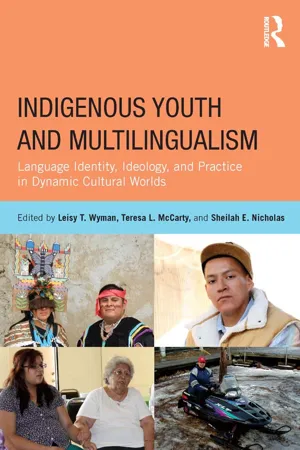
Throughout the world Indigenous communities are vigorously engaged in efforts to reclaim and revitalize their languages. Many revitalization efforts are being carried out in schools—highly charged environments, as schools have been primary sites for Indigenous linguistic and cultural repression. Equally, however, language reclamation takes place in the context of families and communities. While the circumstances and approaches to these language reclamation efforts differ, all share the goal of ensuring that present and future generations have access to language practices that have transported distinct knowledge systems and connections to place and peoplehood through time. Youth are prime stakeholders in these efforts, and it is to Indigenous youth in endangered-language settings that this volume is devoted.
Our geographic focus is North America, where a shift to dominant colonial languages has in some cases occurred within the space of only 5 to 10 years. Within this dynamic sociolinguistic landscape, we forefront the work of Indigenous and non-Indigenous scholars with longstanding ties to language planning efforts in diverse Indigenous communities, including Navajo, Hopi, O'odham, Yup'ik, and Arikara communities in the United States, circumpolar Inuit communities in the Far North, and Mexicano (Nahuatl) communities in Mexico. Together, the chapters highlight the complex positioning of Native American youth in communities experiencing rapid cultural and sociolinguistic change. The chapters also bring into high relief youth agency and sociolinguistic innovation. Commentaries by scholars who work with Indigenous language revitalization movements and Latino/a bilingual education further illuminate how youth negotiate crosscutting themes of language ideologies, intergenerational dynamics, and linguistic human rights.
Our goals in the book are threefold. First, we chart new ground in Indigenous language research by critically examining youth language ideologies, practices, and agency. The introductory chapter title—“Beyond Endangerment”— hints at this new ground, as we go beyond commonplace rhetorics of endangerment that tend to invisibilize youth perspectives, concerns, and practices within language reclamation efforts. Historically, most Indigenous-language research has overlooked youth altogether or made passing observations of youth culture. Youth's purported disinterest in traditionally rooted cultural forms and practices, and adult and youth's related feelings of alienation in rapidly changing societies have also been seen as major causal factors in emerging dynamics of language endangerment.
More recently, however, Indigenous youth language scholars in the fields of linguistic and educational anthropology, applied linguistics, and Indigenous studies have shown the complex ways that young people participate in a dynamic, interconnected world, crisscrossing multiple symbolic, discursive, and physical borders and transforming local and global communities of practice. This growing body of work bridges the divide between research focused on young people's emic perspectives and youth linguistic creativity, and research oriented toward adult-determined developmental and educational goals (cf. Rymes, 2011). This research also brings a much-needed youth perspective to the field of language planning and policy (LPP).
Second, the volume exemplifies new work in the ethnography of language policy (Hornberger & Johnson, 2011; Johnson, 2009; McCarty, 2011a). From this perspective, policy is viewed not as a “disembodied thing, but rather [as] a situated sociocultural process: the complex of practices, ideologies, attitudes, and formal and informal mechanisms that influence people's language choices in profound and pervasive everyday ways” (McCarty, 2011b, p. xii). Within this framework language policy is examined as de facto and de jure, implicit and explicit, bottom-up and top-down (McCarty, 2011c, p. 2; see also Hornberger & McCarty, 2012; Shohamy, 2006). In the chapters that follow, carefully situated, critical ethnographic research offers insights into the ways that implicit and explicit language policies reflect and refract language identities and ideologies, generational and cultural learning opportunities, as well as conflict and linguistic human rights. By taking a close, nuanced look at Indigenous youth bi/multilingualism across diverse cultural and linguistic settings, the authors here go beyond endangerment in another sense, illuminating youth language hybridities, heteroglossia, and innovation in diverse sociolinguistic contexts, and arguing for these as resources rather than liabilities in heritage-language reclamation.
Finally, we position this work as explicitly humanizing, counter-hegemonic, and praxis-driven. As Paris (2011) writes, humanizing youth research entails “a certain stance and methodology, working with [youth] in contexts of oppression and marginalization” (p. 137; see also Paris & Winn, 2014). All chapter authors have long histories of experience with the communities with which they work. Some identify as cultural insiders, and all embrace an ethic of respect, responsibility, relationality, and reciprocity—qualities that characterize what Brayboy, Gough, Leonard, Roehl, and Solyom (2012) call a “critical Indigenous research methodology,” and what Smith (2012) and others describe as decolonizing research (see also Kovach, 2009; Matua & Swadener, 2004). From this perspective we go beyond endangerment in yet another way, outlining the praxis potential of youth-centered LPP research to support communitydriven language reclamation and youth empowerment.
In the remainder of this chapter, we review relevant research on Indigenous youth language, connecting the contributions of the present volume to current youth studies and bi/multilingualism research, laying out key considerations and identifying crosscutting themes. We then discuss the humanizing, decolonizing, and praxis-oriented stance the chapters and the book exemplify.
Research on Native American Youth Language Practices and Ideologies
Situating Indigenous Youth Language Research
In many Native American communities, elders are viewed as knowledge keepers with crucial roles in sharing historically rooted Indigenous knowledge systems. Indigenous youth, in comparison, have historically been studied from the perspectives of Western socialization models in pre-existing community ways of speaking, and movement along adult-organized developmental trajectories with predictable transitions and rites of passage. In efforts to conceptualize tensions around language and cultural difference, contact and conflict in Indigenous communities, early researchers typically positioned youth as passive, troubled victims of these tensions, or romanticized youth as modern agents wishing to be free of the “backward” cultural beliefs and constraints espoused by older community members.
From a language planning perspective, youth have often been viewed as problems to be fixed en route to school achievement, or as the last line of defense in Indigenous-language maintenance. Passing comments about Indigenous young people's connections to new media, in particular, assumed Indigenous young people's engagement with circulating forms of youth culture straightforwardly indicated their disconnection from their elders, families, and communities. Leading scholars described youth as gullible imbibers of “cultural nerve gas” (i.e., electronic media [Krauss, 1980]), or as “cultural beings in need of reprogramming” (discussed in Reynolds, 2009, p. 234).
Recent language and youth culture research has moved toward a serious engagement with youth as interpreters and shapers of society, with an emphasis on youth agency and identity (Bucholtz, 2002; Bucholtz & Hall, 2005), stylistic performance (Eckert, 1989, 2000; Mendoza-Denton, 2008), language crossing and sharing (Paris, 2011; Rampton, 1995, 2006), global circulation and ongoing localization of popular cultural forms such as hip hop (Alim, Pennycook, & Ibrahim, 2009; Deyhle, 1998; Morgan, 2009), ethnography of communication (Alim, 2007; Heath, 1998), media learning, use, and production (Horst, Antin, & Finn, 2010; Hull, 2003; Ito, Knobel, & Lankshear, 2011; Lam, 2006; Soep & Chavez, 2010), and language rights and activism (Paris & Winn, 2014; Scott, Straker, & Katz, 2009).
Current youth language researchers highlight the role of larger social, economic, and political systems in structuring inequities, focusing on youth culture to illuminate “the production of cultural centers or margins” and which bodies and discourses “are privileged, condemned, or overlooked” (Maira & Soep, 2005, p. xix). This research explicitly recognizes that, like adults, youth “act as agents, resignifying and articulating the different and conflicting messages” they receive (Szulc, 2009, p. 144). Like adults, youth “make sense of inequality and difference in their local situations,” interpreting them across a range of gender, social class, regional, and generational relationships (Rampton, 2006, p. 19). Studying young people's emic views, language ideologies, and identities can provide insights into how social and political processes are lived and constructed through language use.
As we see in this volume, many youth researchers also see the potential for engaging youth in addressing educational and social inequities. At the same time, the field continues to wrestle with the tensions between analyzing youth as agentive actors offering critical insights and positive innovations in the face of untenable situations (Bucholtz, 2002), and analyzing how youth are deeply impacted and constrained by the inequities that lead to such situations (Roth-Gordon & Woronov, 2009).
Indigenous youth language scholars similarly show how young people contest and grapple with racialized societal inequities, and how youth responses to these inequities are shaped by their experiences, relationships, and subjectivities in particular times and locales. Importantly, Indigenous youth language scholars are also deeply engaged in understanding the ways in which access to particular relationships, learning opportunities, and linguistic resources lay the groundwork from which young people negotiate a range of challenges that include the looming specter of language endangerment, education inequities, and a wider range of threats to community, family, and personal well-being.
Engaging with complex system theories, scholars have documented how the sociolinguistic settings in which many Indigenous and immigrant youth are growing up are far more complex than the word “bilingual” or even “multilingual” implies (Hornberger, 2002; Makoni, Brutt-Griffler, & Mashir, 2007; McCarty, Romero-Little, Warhol, & Zepeda 2009). In recent years, scholars have also noted how the communicative repertoires of heritage language learners1 vary dramatically within communities, peer groups, and families, depending on the ways that youth move along individualized and shared language learning trajectories (Kagan, 2005; King, 2013; McCarty et al., 2009, 2013; Nicholas, 2011; Valdes, 2005; Wyman, 2012). Scholars have additionally recorded how young people's everyday interactions in multileveled, multidirectional language socialization processes shape possibilities for language learning and expression, as well as larger dynamics of language shift and bi/ multilingualism (Garrett & Baquedano-Lopez, 2002; Wyman, 2012; Zentella, 1997).
As we see in this volume, contemporary Indigenous youth commonly contend with lack of access to key language learning resources and learning environments. Their accumulating language learning opportunities, or lack thereof, also shape their communicative repertoires and language ideologies in complex ways. At the same time, youth show tremendous agency, innovation, and adaptation as they use their communicative repertoires, and “language” and “translanguage” (Garcia, 2009, this volume; Shohamy, 2006), performing identities and positioning themselves in emerging interactional moments in classrooms, family homes, and other out-of-school spaces (Jørgensen, 1998; McKay & Wong, 1996; Mendoza-Denton, 2008; Wyman, 2012; Zentella, 1997).
In this regard the experiences of youth from Indigenous and immigrant communities in North America share certain similarities. Increasing numbers of Indigenous youth from Latin America are migrating north with their families; many Indigenous groups in North America have migrated in the history of their peoples, and many contemporary Indigenous youth are flowing with their families among urban and rural spaces, so the very categories of “immigrant” and “Indigenous” contain important areas of overlap (Collins, 2012; Fox & Rivera-Salgado, 2004; King & Haboud, 2011; McCarty et al., this volume). Both Indigenous and immigrant youth language research shows how youth cloak or uncloak language competencies as they engage with, contest, and co-construct language ideologies, language learning opportunities, and the fluid interactional dynamics around them (Mendoza-Denton, 2008). Indigenous communities, like immigrant communities, commonly negotiate tensions related to heritage language loss, given hopes for maintaining unique funds of knowledge and fostering strong intergenerational relationships of trust in and out of school (Gonzalez, Moll, & Amanti, 2005; Wong-Fillmore, 1991). Even in Indigenous settings that are seemingly homogenous and remote, the dynamics of language shift, schooling, migration, and peer cultures can mirror those found within immigrant social networks in diverse urban areas in important ways (Wyman, 2012, 2013).
When discussing Indigenous youth language, however, scholars often are at least indirectly referencing young people's relationships to endangered languages. As such, approaches to the study of Indigenous youth language demand additional consideration and sensitivity, as families, communities, and youth struggle with the realization that their languages may disappear from the earth altogether with the death of elders, the keepers of these linguistic systems and related accumulated oral bodies of Indigenous knowledge. If Turkish youth in Denmark, or Spanish or Chinese heritage language speakers in California gain only minimal skills in their heritage languages, those languages exist elsewhere. The same is not true for speakers of endangered Indigenous languages.
Youth language research is documenting how, in contrast to early erroneous assumptions, many youth share adult allegiances to and interest in maintaining Indigenous languages as part of Indigenous knowledge systems and ways of being, and express deep concerns about language endangerment and desires to change the reverberating effects of oppressive ...