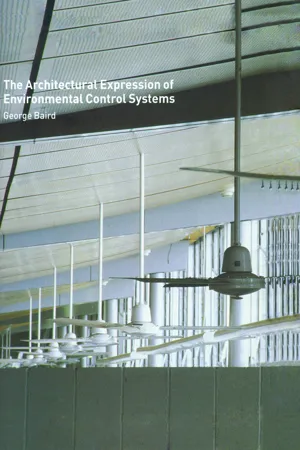
The Architectural Expression of Environmental Control Systems examines the way project teams can approach the design and expression of both active and passive environmental control systems in a more creative way. Using seminal case studies from around the world and interviews with the architects and environmental engineers involved, the book illustrates innovative responses to client, site and user requirements, focusing upon elegant design solutions to a perennial problem. This book will inspire architects, building scientists and building services engineers to take a more creative approach to the design and expression of environmental control systems - whether active or passive, whether they influence overall building form or design detail.
- 304 pages
- English
- ePUB (mobile friendly)
- Available on iOS & Android
eBook - ePub
The Architectural Expression of Environmental Control Systems
About this book
Information
Chapter 1
Introduction
The overall aim of this book is to inspire more architects, building services engineers and building scientists to take a creative approach to the design and expression of environmental control systems—whether these systems be active or passive, whether they influence overall building form or design detail.
Author's motivation
My personal motivation comes from having spent half a lifetime at the interface of these three professions. Like many others of my generation, the initial inspiration came from reading Reyner Banham's seminal work on The Architecture of the Well-tempered Environment (1969). This was also the year that I joined the staff of Aberdeen's Scott Sutherland School of Architecture as a lecturer in Building Science and Services. Six years of undergraduate, postgraduate and evening classes’ study at the University of Glasgow's Faculty of Engineering and at the National College for Heating Ventilating Refrigerating and Fan Engineering in London had given me little exposure to architects, or even to architecture. A further 6 years at the University of Glasgow's Building Services Research Unit had been little better in that respect. Not only did Banham's book introduce me to architecture, but also it helped me throw off the engineering blinkers I had unwittingly been wearing for the previous 12 years—and, most importantly, gave me the material I needed urgently for these first few lectures as I attempted to find my feet in an architectural academic environment!
At that time, according to Banham (1969:264), totally mechanical environments were ‘the fruit of a revolution in environmental management that is without precedent in the history of architecture, a revolution too recent to have been fully absorbed and understood as yet, and a revolution still turning up unexpected possibilities…’. Since that time, I have been an enthusiastic student of that revolution, a keen observer of its development and an avid reader of its chroniclers—particularly as we have moved through the energy crises of the 1970s and the environmental issues of the 1980s to confront the ecological challenges of the 1990s and beyond.
In what is now over 30 years of teaching building science and services, I have attempted to bridge what Dean Hawkes (1996:71) referred to as the ‘crippling barrier between art and science in architectural debate …’. What follows is my contribution to that debate. Fate has decreed that I should be a teacher rather than a practi-tioner—hence, my contribution will be to chronicle the efforts of those heroes and heroines (and I must make it clear from the outset that is how I regard their efforts) who have dealt successfully with what at least one CIBSE President (Arnold, 1994) has referred to as the clash of cultures between architects and building services engi-neers—in terms of how they did it as well as what was done.
Without getting into the educational debate at this stage, it would seem that many, though by no means all, schools of architecture include consideration of building science and building services in their curricula. In the case of building services engineers, unfortunately only a very few courses seek to introduce their students to architectural considerations, and the visual potential of services elements rates only passing mention. Structural engineers are in rather less doubt about the visual potential of their contribution to architectural aesthetics as is made clear, for example, by the interviews in C.H.Thornton et al.'s Exposed Structure in Building Design (1993). The building services engineer's contribution, on the other hand, is too frequently used as a means of enabling some other stylistic agenda to be pursued, with no particular acknowledgement of the services needed for it to function. On the contrary, it would seem that the services should be neither seen nor heard, and should certainly not take up any more space than is absolutely necessary or expedient at the time of building—and very few substantial writings deal with what Guise (1991) termed ‘the hidden world of buildings: environmental comfort systems, and structural systems, which influence the outer appearance of any edifice’.
The discourse on architectural form must by now fill many volumes and the expression of building structure has been a popular topic with both architectural and engineering writers for many years. In the case of environmental control systems, the emphasis has rather been on their integration, at least in the case of what are conventionally thought of as the active or engineered services—see Flynn and Segil (1970) for example. An unkind critic might interpret this as their being disguised, suppressed or even deliberately hidden within other elements of the building fabric (albeit cleverly and tidily to all outward appearances), their engineering, hopefully economical and possibly even elegant, hidden from the building user—a cynic might aver that the term ‘false ceiling’ is very apposite in these circumstances. This is not to denigrate that approach, but rather to point out the prevalent trend for engineering services to be hidden rather than exposed (other than in industrial buildings) and certainly not to be expressed as architectural ele-ments—despite their necessity in terms of the building's function and the high proportion of the building cost that they frequently represent.
There have been several notable exceptions to this trend (more of which later), and as the movement towards environmentally responsible buildings has continued, an awareness of the expressive possibilities of passive environmental controls, for which the architect possibly has more direct responsibility, seems to have led to more of them expressing the means of environmental control.
According to Hawkes (1996:86), ‘The historical evidence shows that the effective design, installation, operation or maintenance of services may be achieved in many ways. The “place” of services, in the sense that [Louis] Kahn used the term, is therefore a matter of aesthetics rather than an overriding technical logic’. My primary concern here is with the aesthetics of environmental control systems, be they active or passive, whether they find expression in terms of the Lloyds Building of London or in those of the Eastgate Centre of Harare in Zimbabwe (see Chapters 3 and 13).
Aims and objectives
In taking on the rather ambitious aim of encouraging more practitioners to adopt a creative approach to the design of environmental control systems, it very soon became clear that one would need to demonstrate not only the practical and aesthetic functions of such systems, but also the background of the designers (architects, building services engineers, building scientists) and the processes they had employed in the development of their projects. In doing so, it was hoped to show how some designers had managed to bridge Hawkes’ ‘crippling barrier’ between the professions. The danger was, of course, that the challenge would prove insurmountable and the result would satisfy none of the intended audience—only the reader can judge.
For the architect-reader, I have not attempted (for I had neither the skills nor the time) to produce the visual delights of the established architectural journals or the coffee table book, but I trust that the images presented convey the basic message—that environmental control systems can be part of the design solution. In the case of the engineer-reader, s/he will not find detailed schematics of the HVAC systems, rather an indication of the scale of the systems and how they contributed, aesthetically as well as functionally, to the overall design solution. Inevitably, I have placed considerable emphasis on these issues. As another CIBSE President once put it:
In our particular field of Building Services Engineering we have applied ourselves assiduously to all aspects of the Sciences related to our work, I sometimes believe to a degree of accuracy quite unnecessary when one remembers that the end product of much of our work is the provision of comfort for that most adaptable of all machines, the human body. I believe, however, that we seriously neglect those aspects which affect our visual senses and which re- late to the Art more than the Science of engineering… We engineers have for too long dealt only with what is measurable and calculable and failed miserably to address the visual and aesthetic aspects of our engineering which are, to a large degree, intuitive… Engineers, in the main, have failed to understand and contribute in a constructive manner to the visual and aesthetic qualities of engineering services in buildings…(Smith, 1991)
For the building scientist likely to be involved to an even greater degree than the engineer with fundamental scientific principles and their application to the simulation of the performance of the building, and on whose predictions can hang the outcome of key design decisions, the need for an awareness of the visual ramifications of their recommendations is equally important. While some of these specialists may come from an architectural background, many will have been educated in other disciplines and will only be able to pick up an appreciation of the design process after many years in practice. My task is to raise their awareness of the potential visual impact of their contribution, particularly in relation to the design of passive environmental control systems, where their expertise is frequently sought.
Bearing in mind that there is rarely a single correct solution for any given architectural design problem, it is incumbent on responsible designers to explore widely for sources of inspiration, and be prepared to contribute to the whole as well as the parts. One of my aims is to show how others have done so already. In my selection of cases, I have been cognisant of Hawkes’ (1996:55) statement that ‘A healthy situation would be one in which solutions with a high dependence on mechanical systems could coexist with others that achieved their goals by simpler means’ and his assertion that ‘The point is to show that advanced and often complex and bulky technology [whether active or passive] may be embodied in an architectural language that does not, on the surface at least, appear to be concerned with such matters’ (p. 96).
Not that there is anything new in these notions. As Jones (1998:8), in the context of green architecture, has pointed out, ‘Architecture, as much as any other design activity, is dependent on a satisfactory reconciliation of the intuitive with the rational. A building has to be both poem and machine’. He then adds that ‘Few buildings achieve this felicitous equipoise’. My hope is to add some more examples to those few and thus encourage more design team members to aim for such a happy balance.
In this book I shall examine and illustrate a number of recent buildings in some detail—all of them relatively large, and all projects in which the means of environmental control is in some way expressed in the finished product— whether a ‘felicitous equipoise’ has been achieved I leave to the reader to assess. My aim is to describe these buildings in a way that makes their concepts and their practicalities, but most of all their visual implications, accessible to architects, services engineers and building scientists. The selection is neither exhaustive nor definitive—it is a personal one, but based on a thorough review of what has been built over the past decade or so. Inevitably, considerations of access to the buildings and to their designers also played a part in the final selection.
Had I attempted this project when it first appealed to me as an exercise worth undertaking, that is during my time at the Scott Sutherland School of Architecture in the early 1970s, the focus would almost inevitably have been on the expression of the active (i.e. mechanical) services, and equally inevitably on British buildings only. Now domiciled in New Zealand, and some 30 years later, one has a distant, if not wholly dispassionate, view of world architecture. In the intervening time there has been what Jones (1998:39) refers to as ‘The shift in emphasis from adjustment of plant output to adjustment of the building envelope…’, the latter providing ‘a stimulus to architectural expression of the façade and roof’. This has produced a much richer source of large buildings in which passive environmental controls have been given expression. While the passage of time has not diminished my zeal for the topic or my enthusiasm to continue bridging the gap between the three professions to whom this book is primarily addressed, one can only hope that the issue will now be tackled with somewhat more depth and maturity than would have been the case in 1970.
In specific terms, my main objectives are to heighten awareness of:
1 The kind of design team operation that has produced solutions in which the environmental control systems have been expressed creatively.
2 The fact that the ability to express environmental control systems opens up a wide range of potential design solutions.
3 The possibilities of building services and passive environmental control systems being part of the design solution.
4 Examples of cases where the creative interaction between design professionals has produced elegant solutions.
Materials and methods
On the face of it, all that is involved in a project like this is to pick a few nice buildings, photograph their visually interesting elements, interview the architects, engineers and scientists involved, write it up, and persuade a publisher to put it all together (I wish!). All these matters are certainly involved, but the process itself is rather more painstaking as will be outlined in what follows.
Selecting the buildings
While over the years I had built up a teaching portfolio of examples of works relevant to the objectives of this book, I did not deem this anywhere near sufficient. While it certainly provided a context and a background, there was an inevitable bias towards a mix of local (New Zealand) case studies and the better-publicised international examples. This project provided the opportunity systematically to review what was being done worldwide.
Even after all these years in schools of architecture, I still felt reluctant to entrust the selection of appropriate buildings to my own judgement entirely. Having laid down the broad selection criteria, I enlisted the help of three architectural research assistants, one a graduate, the others entering their final year, to help with the selection process. Theirs was the enviable task (enviable if one is a student of architecture) of actually being paid to comb systematically the world's architectural literature—books, journals, slide collections, Internet sites—to build up a database of buildings in which the method of environmental control was clearly expressed in the form or the detail; at the same time recording bibliographical details, photocopying and classifying relevant material, and establishing contact details of the relevant architects, engineers and scientists.
Initially, the search covered a wide range of environmental control systems and services, broadly interpreted to include heating, cooling, humidity, ventilation, electricity, lighting, acoustics, hot and cold water, vertical and horizontal transportation, internal communication, fire protection, and waste disposal, for all of which one could list both active and passive elements. The search soon narrowed down to thermal environmental control systems— heating, cooling, humidity, ventilation—as it was quickly apparent that those were still the major services whose expressive potential was being exploited. It had also become apparent that an increasing number of designers were employing what could be broadly classified as passive means of thermal environmental control and that these were having a significant influence on the aesthetics of the resulting buil...
Table of contents
- Cover
- Half Title
- Full Title
- Dedication
- Copyright
- Contents
- Preface
- Chapter 1 Introduction
- Chapter 2 Thermal environmental control systems and their potential for expression
- Chapter 3 Recent developments in the expression of thermal environmental control systems
- Chapter 4 Institute of Technical Education (ITE), Bishan, Singapore
- Chapter 5 The Science Park, Gelsenkirchen, Germany
- Chapter 6 Gotz Headquarters, Wurzburg, Germany
- Chapter 7 Central Library, Phoenix, Arizona, USA
- Chapter 8 RAC Regional Centre, Bristol, UK
- Chapter 9 The Scottish Office, Edinburgh, UK
- Chapter 10 Inland Revenue Offices, Nottingham, UK
- Chapter 11 Hall 26, Hannover Fair, Germany
- Chapter 12 Tokyo Gas 'Earth Port', Yokohama, Japan
- Chapter 13 Eastgate Centre, Harare, Zimbabwe
- Chapter 14 UNSW Red Centre, Sydney, Australia
- Chapter 15 RWE Headquarters, Essen, Germany
- Chapter 16 Glaxo-Wellcome Headquarters, London, UK
- Chapter 17 Torrent Research Centre, Ahmedabad, India
- Chapter 18 Menara Umno, Penang, Malaysia
- Chapter 19 Overview, issues and trends
- Index
Trusted by 375,005 students
Access to over 1.5 million titles for a fair monthly price.
Study more efficiently using our study tools.
Frequently asked questions
Yes, you can cancel anytime from the Subscription tab in your account settings on the Perlego website. Your subscription will stay active until the end of your current billing period. Learn how to cancel your subscription
No, books cannot be downloaded as external files, such as PDFs, for use outside of Perlego. However, you can download books within the Perlego app for offline reading on mobile or tablet. Learn how to download books offline
Perlego offers two plans: Essential and Complete
- Essential is ideal for learners and professionals who enjoy exploring a wide range of subjects. Access the Essential Library with 800,000+ trusted titles and best-sellers across business, personal growth, and the humanities. Includes unlimited reading time and Standard Read Aloud voice.
- Complete: Perfect for advanced learners and researchers needing full, unrestricted access. Unlock 1.5M+ books across hundreds of subjects, including academic and specialized titles. The Complete Plan also includes advanced features like Premium Read Aloud and Research Assistant.
We are an online textbook subscription service, where you can get access to an entire online library for less than the price of a single book per month. With over 1.5 million books across 990+ topics, we’ve got you covered! Learn about our mission
Look out for the read-aloud symbol on your next book to see if you can listen to it. The read-aloud tool reads text aloud for you, highlighting the text as it is being read. You can pause it, speed it up and slow it down. Learn more about Read Aloud
Yes! You can use the Perlego app on both iOS and Android devices to read anytime, anywhere — even offline. Perfect for commutes or when you’re on the go.
Please note we cannot support devices running on iOS 13 and Android 7 or earlier. Learn more about using the app
Please note we cannot support devices running on iOS 13 and Android 7 or earlier. Learn more about using the app
Yes, you can access The Architectural Expression of Environmental Control Systems by George Baird in PDF and/or ePUB format, as well as other popular books in Architecture & Architecture General. We have over 1.5 million books available in our catalogue for you to explore.