- 616 pages
- English
- ePUB (mobile friendly)
- Available on iOS & Android
eBook - ePub
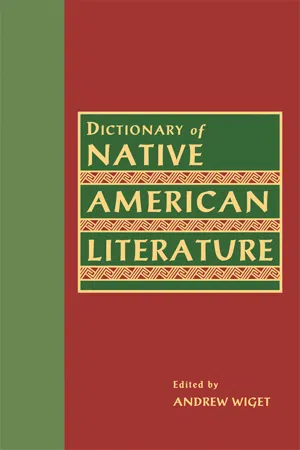
Dictionary of Native American Literature
About this book
The Dictionary of Native American Literature is a unique, comprehensive, and authoritative guide to the oral and written literatures of Native Americans. It lays the perfect foundation for understanding the works of Native. The book features reports on the oral traditions of various tribes and topics such as the relation of the Bible, dreams, oratory, humor, autobiography, and federal land policies to Native American literature. Eight additional essays cover teaching Native American literature, new fiction, new theater, and other important topics, and there are bio-critical essays on more than 40 writers ranging from William Apes (who in the early 19th century denounced white society's treatment of his people) to contemporary poet Ray Young Bear. Packed with information that was once scattered and scarce, the Dictionary of Native American Literature -a valuable one-volume resource-is sure to appeal to everyone interested in Native American history, culture, and literature.
Information
A Native American Renaissance: 1967 to the Present
Contemporary Native American Writing: An Overview
Roots of a Renaissance
What has been called the “Native American Renaissance” in writing is generally dated from the end of the 1960s with the publication of N. Scott Momaday’s House Made of Dawn (1968) and its subsequent Pulitzer Prize. Considering the importance and the effects of Momaday’s success, there is certainly some justification for choosing Momaday’s novel as the beginning of the modern period in American Indian writing. However, it might also be argued that the real beginnings of that so-called Renaissance are much earlier. Further, it might better be called a continuum than a renaissance since the issues have remained much the same for Indians and Indian writers not just over the last two decades, but for the last two centuries. The publication of Momaday’s novel and its critical recognition only served to bring the concerns of the Native American into sharper focus and to open wider the curtain of that stage where the work of Indian writers could be seen.
Just what was going on in Native American writing in the years after World War II, the period which gave birth to both the McCarthy era and the Beats, as well as the policy of Termination? As far as poetry goes, it seems that until the early 1970s, there was precious little. True, a few of the current generation of Native American writers, such as Maurice Kenny, whose first book of poems, Dead Letters Sent, was published in 1958 by Troubadour Press, were appearing in print well before Momaday. However, their works and even those earlier writers themselves were usually not, at that time, recognizably “Indian.” Kenny was himself peripherally involved with the Beat Generation, though he did not become a Beat poet. Though Carroll Arnett had poems in Poetry and Saturday Review in 1967, there was little evidence prior to the 1970s that he would later prove to be a significant Native American voice. One of the few recognizably Native American books of poetry published before the 70s was Gerald Vizenor’s Summer in the Spring: Lyric Poems of the Ojibway, published in 1965 by Nodin Press in a limited hardcover edition. In terms of fiction, the only truly visible figure was D’Arcy McNickle, a writer who was (and still is) underrated, though relatively well published in his day. Like most other “visible” Native American writers prior to Momaday, McNiclde was sometimes seen more as “spokesman” than literary figure. It was not until 1971 that a book of McNickle’s, his biography of Oliver La Farge, was nominated for a National Book Award, and his third novel, Wind from an Enemy Sky, was published only posthumously in 1978. Navajo writer Emerson Blackhorse Mitchell’s autobiography Miracle Hill was published in 1967 by the University of Oklahoma Press. Now out of print, Mitchell’s story was part of a long line of Native American autobiographies, stretching back well before the twentieth century. However, those works and Mitchell’s were generally regarded as something other than “literary.” A sociological curiosity, they were worthy of consideration in an anthropology course, but not as an important part of American literature. (That problem still exists today. Although works by a few writers such as Louise Erdrich, Leslie Silko, and Michael Dorris may be found on the poetry and fiction shelves of American bookstores, most works by Native American writers can be found only in the Social Sciences sections—even when those works are books of poetry. Hopi/Miwok poet Wendy Rose has innumerable stories to tell about the times she has found her books only on the Anthropology shelf.) In the 1950s and 1960s, an Indian writer was a voice crying unheard in the civilized wilderness of American letters.
There is no question that Momaday’s powerful novel and its recognition as a serious work of literature were extremely influential in changing the atmosphere in which the Native American writer could exist. Suddenly, with House Made of Dawn’s Pulitzer, it was possible that a Native American writer could be accepted by the literary establishment. Moreover, Native American writers could begin to see that they were not alone. For the first time, the possibility of Native American writing as something other than an isolated and isolating experience began to be a reality. Momaday’s highly visible success and the ways in which that success influenced publishers to open their doors to other Native writers—in particular through the publication of American Indian anthologies—would be significant factors in the formation of a community of new Native American writers.
So many of the writers after him have presented similar scenes of Native American life that it may seem that Momaday is even more influential than in fact he is. For example, the main character of his first novel is a person whose life is out of balance because of the conflict between “traditional ways” and the “modern world.” Healing the divisions without and within by a return to a spiritual path lit by the continuance of tradition (though that tradition may also show itself in new forms) is the road which Momaday’s Abel must take to survive. It is a path which later Native protagonists in novels by Leslie Silko, James Welch, Paula Gunn Allen, and Janet Campbell Hale (to name just a few examples) either take and thereby find redemption or miss and thereby face destruction. A critic lacking knowledge of earlier Native writers or oral tradition might conclude that all of these writers are copying Momaday. But many of those scenes and images had appeared before. Many of the images and situations in the novel are virtual archetypes, in part due to the debt the novel owes to the oral traditions of the Southwest. (Momaday, to his credit, has always been straightforward in acknowledging his debt to those oral traditions.) Certainly House Made of Dawn’s now familiar theme of the Indian who has been away from his or her people (at school, at war, in prison) and returning to his or her own people as a semi-outsider is central to Leslie Silko’s Ceremony, published in 1977. But it is also the central conflict in D’Arcy McNickle’s 1936 novel of Indian life, The Surrounded (and in non-Indian writer Frank Waters’s 1942 classic novel The Man Who Killed the Deer). It is not so much that Momaday did something new as it is that he did so many old things so well. Moreover, those things—those images, themes, and conflicts—were, are, and will continue to be central to Native American writers and Native American life.
The success which comes with a Pulitzer Prize could not have come to a more appropriate writer, in terms of helping open the door for a then unrecognized generation of new Native writers. Momaday refused adamantly to play the part of sole ethnic “spokesman for all of his people,” a trap in which more than one recent African American writer has been caught. By not presenting himself as the only legitimate voice of Native American writing, Momaday left room for other writers. Because of what he said in that first novel, what he accomplished in terms of mainstream recognition, and how he responded to that recognition, Momaday was a true pathfinder. His role has been acknowledged by many other Indian writers. In a 1983 interview published in Survival This Way, Paula Gunn Allen credits House Made of Dawn in the strongest possible way, saying, “I wouldn’t be writing now if Momaday hadn’t done that book. I would have died” (Bruchac 1987: 11).
Momaday’s The Way to Rainy Mountain was published in 1969. Through its threefold exploration of his own Kiowa roots—presenting tales from the Kiowa oral traditions, a comment by Momaday on each tale, and then a related personal or family story of his own—Momaday became one of the first of the new generation of Native American writers to present work directly from the folk traditions in a literary context. Such use of the folk traditions and retellings of traditional tales would continue throughout the next two decades by numerous other Indian writers. One example is Da kota writer Elizabeth Cook-Lynn’s Then Badger Said This in 1977. Leslie Silko’s collection of stories and narrative poems is entitled Storyteller. Storytelling and the various uses of storytelling traditions are vitally important and will, I am certain, continue to be so for Native American writers. In more ways than one, in fact, Momaday’s career to date may be seen as both a model and a reflection of some of the most vital aspects of contemporary Native American literature.
Of course, other things which would prove important for Native American writing were going on in America in the late 1960s besides the publication and recognition of one Indian author’s book. It was also in 1969 that the first Native American “media event” took place with the well-publicized takeover of Alcatraz Island by the “Indians of All Tribes,” who declared the island and its infamous abandoned prison to be Indian Land. Such events had happened before. One need only turn to non-Indian writer Edmund Wilson’s 1959 volume Apologies to the Iroquois for an example. In that nonfiction study of the lot of the Iroquois people in the 1950s, Wilson tells the story of the more-or-less ignored “occupation” of some land on Schoharie Creek near Amsterdam, New York, by a small group of Mohawks led by Standing Arrow. However, it was not until Alcatraz that the full weight of international television would be brought to bear on “militant” Indian concerns. And Alcatraz would prove to be only the first of a series of such demonstrations of Native American presence, strength, and declared sovereignty which would continue through the ‘70s and ‘80s and into the present. The takeover of Alcatraz by the “Indians of All Tribes” was also led by a Mohawk, a steelworker named Richard Oakes. Native Americans from all over the continent came to Alcatraz. Lakotas, Hopis, Senecas, Cherokees, and Chippewas were only a few of the tribal nations represented by the hundreds of Indians who visited or resided on that short-lived “Indian Land” over the next nineteen months until June 11, 1971, when the “Indians of All Tribes” were removed by federal marshalls, ending the occupation. Among those visiting or living on the island during the takeover were a number of Native American writers. Probably the two best known were Peter Blue Cloud (another Mohawk) and Wendy Rose, an urban Indian poet of mixed (Hopi/Miwok) Native descent from the Bay area.
One of the earliest of the Native American anthologies, Brother Benet Tvedten’s An American Indian Anthology, published in 1971 by Blue Cloud Quarterly Press, contained Peter Blue Cloud’s poem “Alcatraz Visions.” Peter Blue Cloud’s editing of Alcatraz Is Not an Island, published by Wingbow Press of Berkeley in 1972, was probably Blue Cloud’s most important work as a poet and editor to that point. The Alcatraz anthology contained essays by the “Indians of All Tribes” dealing with the takeover and with related Indian rights issues in California, an “Alcatraz Diary” written by Blue Cloud, and poems by Lydia Yellowbird, Raymond Lego, Jerry Hill, and Blue Cloud himself. The book strongly expressed the tone that the next two decades of Native American political resistance would take. It gave voice and form to a pan-Indian militancy which would combine calls to honor the treaties with a celebration of traditional culture. It was a militancy quite unlike that of black America. Native American “Red Power” was a militancy with a decidedly spiritual and environmental base. That tone would be heard to a greater or lesser degree in virtually all of the voices of the generation of Indian writers which began to emerge in the early 70s. The Indian “takeovers” at the BIA in Washington and at Wounded Knee in 1973, the activism of the American Indian Movement’s Dennis Banks and Russell Means, and the continuing struggle through the 1980s around the imprisonment of AIM activist Leonard Peltier can be found reflected in the poems and prose of contemporary Native Americans. It can also be found in the genre of Native American writing, which is overlooked by virtually all the modern anthologies—the lyrics of contemporary Native American songs written in the folk or country modes. (To my knowledge, the only literary publication which has given a forum to the lyrics of Native American writers is Blue Cloud Quarterly, which devoted an issue in the early ‘70s to Buffy Sainte-Marie.) The songs of Floyd Westerman, Buffy Sainte-Marie, Jim Pepper, Willy Dunn, David Campbell, Buddy Red Bow, A.Paul Ortega, and a number of others resonate with an awareness of the issues facing Native Americans today. The lyrics of many of their songs are, I feel, powerful poetry in their own right.
Although it can certainly be said that much of mainstream American writing has been and continues to be apolitical and that “political writing” has been branded as “mere propaganda” by many American critics, it can just as truly be said that much Native American writing seems to embrace the political as an integral ingredient. The roots of this political awareness in contemporary Indian writing have certainly been strengthened by the last three decades of political activities of Native American activists such as the take-overs and the fish-ins, the Longest Walk, and other demonstrations of Native unity and purpose. However, those political roots are, historically, very deep. The idea of governments being “of the people” comes as much from Native American traditions as it does from Europe, and Native American ideas of “women’s rights” were far in advance of Europe. Many oral traditions of Native America—such as the Iroquois story of the founding of the Great League of Peace—are deeply political. Words are powerful things, and language—as the Cherokees with their Sacred Formulas well knew—can both create and kill. American Indian writers maintain that traditional respect for the power of the word and the “political” role of the artist. They seem to be unanimous in describing their work as something much different from “art for art’s sake.” In the collection of autobiographical essays I Tell You Now, Dakota poet Elizabeth Cook-Lynn describes her writing as “an act of defiance born of the need to survive.” It is a question of both personal survival and the survival of cultures, an...
Table of contents
- Cover Page
- Title Page
- Copyright Page
- List of Figures
- Introduction
- Advisory Board and Contributors
- Native American Oral Literatures
- The Historical Emergence of Native American Writing
- A Native American Renaissance: 1967 to the Present
Trusted by 375,005 students
Access to over 1.5 million titles for a fair monthly price.
Study more efficiently using our study tools.
Frequently asked questions
Yes, you can cancel anytime from the Subscription tab in your account settings on the Perlego website. Your subscription will stay active until the end of your current billing period. Learn how to cancel your subscription
No, books cannot be downloaded as external files, such as PDFs, for use outside of Perlego. However, you can download books within the Perlego app for offline reading on mobile or tablet. Learn how to download books offline
Perlego offers two plans: Essential and Complete
- Essential is ideal for learners and professionals who enjoy exploring a wide range of subjects. Access the Essential Library with 800,000+ trusted titles and best-sellers across business, personal growth, and the humanities. Includes unlimited reading time and Standard Read Aloud voice.
- Complete: Perfect for advanced learners and researchers needing full, unrestricted access. Unlock 1.5M+ books across hundreds of subjects, including academic and specialized titles. The Complete Plan also includes advanced features like Premium Read Aloud and Research Assistant.
We are an online textbook subscription service, where you can get access to an entire online library for less than the price of a single book per month. With over 1.5 million books across 990+ topics, we’ve got you covered! Learn about our mission
Look out for the read-aloud symbol on your next book to see if you can listen to it. The read-aloud tool reads text aloud for you, highlighting the text as it is being read. You can pause it, speed it up and slow it down. Learn more about Read Aloud
Yes! You can use the Perlego app on both iOS and Android devices to read anytime, anywhere — even offline. Perfect for commutes or when you’re on the go.
Please note we cannot support devices running on iOS 13 and Android 7 or earlier. Learn more about using the app
Please note we cannot support devices running on iOS 13 and Android 7 or earlier. Learn more about using the app
Yes, you can access Dictionary of Native American Literature by Andrew Wiget in PDF and/or ePUB format, as well as other popular books in Literature & Literary Criticism. We have over 1.5 million books available in our catalogue for you to explore.