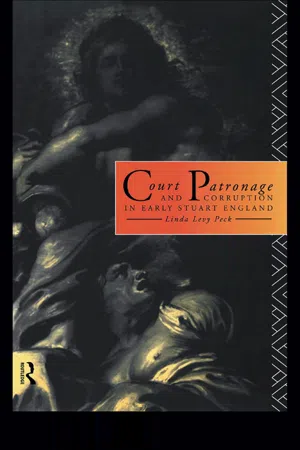
- 334 pages
- English
- ePUB (mobile friendly)
- Available on iOS & Android
eBook - ePub
Court Patronage and Corruption in Early Stuart England
About this book
This wide-ranging volume goes to the heart of the revisionist debate about the crisis of government that led to the English Civil War. The author tackles questions about the patronage that structured early modern society, arguing that the increase in royal bounty in the early seventeenth century redefined the corrupt practices that characterized early modern administration.
Chapter 1
The language of patronage: a discourse of connection
In the midst of the English Civil War in the 1640s, William Dobson painted portraits of royalists in Oxford. Amongst the Cavalier soldiers, he portrayed Sir Thomas Aylesbury, Master of Requests. Dressed in his official robes, Aylesbury symbolized his position by holding a petition inscribed “to the king’s most excellent majesty.” As a Master of Requests, he presented petitions to the king asking for redress of grievances or for personal advancement, in short, asking for royal bounty. As Dobson’s portrait signifies, such petitions were not merely the seedy clamoring of early Stuart courtiers but an open and important link between the monarch and the subject, one suitable for commemoration in portraiture. The painting makes concrete, even in the midst of civil war, the king’s traditional role as guarantor of justice and giver of favor. The king’s promise of justice dates from early Anglo-Saxon dooms and tenth-century coronation oaths; his giving of favor was just as old, immortalized in charter. The monarch’s giving of largesse had expanded with the Renaissance monarchy of the Tudors and it was embedded in the Senecan language of James I’s Trew Law of Free Monarchies, which spoke of the mutual benefits that flowed between monarch and subject.1
I
In his book On Benefits, the Stoic philosopher Seneca had described the good society in terms of the exchange of benefits among members of the commonwealth. Senecan ideas were important to early Renaissance humanists.
Neo-Stoic language and thought gained further circulation with the translation of Seneca’s works with commentary by Justus Lipsius in the 1570s. Thomas Lodge translated:
Of Benefits then we are to intreat, and to set down an order and direction in this venue, which chiefly concerneth humane societie: we are to prefixe and set down a law of living, least inconsiderate facilitie in giving, grow in favour under the colour of benignitie; least this observation, whilest it temperateth Hberalitie (which must neither be defective nor superfluous) restraine the same wholly. Men are to be taught to receive with thankfulnesse, and to restore with the same correspondence, and to procure (in regard to those that oblige them with any benefit) not only to be equall with them in will, but to over-come them with greater gratuitie: because that he who is obliged to acknowledge a good turne, requiteth not the same, except his remuneration exceede the givers merit.2
Such benefits, given freely, in moderation, and received gratefully, circulated throughout society.
Senecan language of benefits was central to the language of patronage.3 Thus, Sir Arthur Chichester defined a commonwealth as “nothing more than a commercement or continual suppeditation of benefits mutually received and done among men.”4 The exchange of such benefits was crystallized in contemporary practices of gift-giving. Moreover, at Renaissance courts the scale of such gifts increased dramatically.
King James VI of Scotland and I of England has long been criticized as a spendthrift, and his courtiers as sycophantic seekers of reward. While some aspects of that portrait are correctly drawn, the picture has remained unfocused because it omits the framework of contemporary beliefs and values.5
Virtue in the sixteenth and early seventeenth centuries included the giving of favor and reward. “For a King not to be bountiful were a fault” was a defense made by Robert Cecil, Earl of Salisbury to criticism of James I’s reward and spending in Parliament in 1610. He argued that the king held the same opinion as other learned authors, “that there is no greater a slave than money and not worthy to be accounted among wise men, it being good for nothing but for use.”6 Salisbury was not inventing an apology but echoing fifteenth-century humanist theorists who, in writing advice for princes (“mirror-for-princes literature”), stressed that “among the greatest virtues of all” were liberality and magnificence. Nevertheless, this was something of a change from the Senecan view in which benefit was seen to exist within boundaries.7 Erasmus, for instance, wrote that “kynges must so fere extende humanitee and favour towardes their subjectes, as thei maye in the meane tyme accordyingly upholde and maintein their authoritee and estate royal. For goodnesse and favour, without ende or measure shewed is many a tyme and ofte the mother of contempte.”8 Royal bounty coincided with and confirmed notions of the godlike nature of the king. In Renaissance Europe, as in archaic societies, honor and prestige were “closely bound up with expenditure.”9 Contemporaries declared “the king is free,“ and acting freely, the king rewarded his subjects.10
At the same time, contemporaries also believed that the granting of bounty was pan of a reciprocal relationship between king and subject. If Seneca articulated for Renaissance society the view that society was based on the exchange of mutual benefits, James I wrote in The Trew Law of Free Monarchies (1598) of the reciprocal and mutual duty “betwixt a free king and his natural subjects.”11 Salisbury went on to say “that duty is best and surest tried where it is rewarded, which is the cause and makes men the willinger to do service.”12 Indeed, the king’s rewarding of the political elite, especially the nobility, was essential because he thereby reinforced the reciprocal bonds established between the Crown and its most important subjects. Claude de Seyssel, the French humanist, served as master of requests to Louis XII. In The Monarchy of France, published in 1508, he emphasized
that the King should sustain and cherish the estate of the nobility, (which is the first everywhere), not only by maintaining its rights and preeminences but, further, by showing all the people of the estate that he especially loves and esteems them…men of this estate should always be preferred over those of every other…providing they are equally adequate or even where there is some slight advantage on the others’ side.13
James I accepted Seyssel’s views. In the Basilikon Doron, written in 1597 for his son Prince Henry, James laid out the classic case for royal bounty. Like God, the king gave freely to his people, much as he ensured justice. He honored the political elite by rewarding them with position and honors at court. While warning that the nobility must be made to keep the laws, James emphasized the importance of using court patronage to bind them to the crown.
The more frequently that your court can bee garnished with them; thinke it the more your honour; acquainting and employing them in all your greatest affaires; sen it is, they must be your armes and executors of your laws…as may make the greatest of them to thinke, that the chiefest point of their honour, standeth in striuing with the meanest of the land in humilitie towards you, and obedience to your lawes.
Like the mirror-for-princes theorists, James celebrated royal generosity: “Use trew liberalise in rewarding the good, and bestowing frankly for your honour and weale.”14
The liberal dispensation of royal bounty was, therefore, the Renaissance ideal espoused by monarchs and theorists alike, not merely the behavior of the Scottish king. This ideal posited the free giving of gifts and rewards because it was virtuous. Duty and deference would then follow from grateful recipients. Moreover, such an exchange reflected political reality. By dispensing royal bounty to local governors who ruled the countryside in the king’s name, the Crown made court patronage an important instrument of political control. Royal favor also rewarded royal officials to provide for their work in royal administration. These functions were crucial in the absence of a paid central or local bureaucracy and a standing army. The restoration of power to the monarchy achieved by the Tudors rested in part on the systematic use of royal patronage.
Courtesy books, guides to behavior, were popular in the late sixteenth and early seventeenth centuries; in them the symbolic behavior of the courtier was packaged and sold as a commodity.15 One popular volume was Angel Day’s The English Secretorie. orplaine and direct Method, for the enditing of all manner of Epistles or Letters. The book went through eleven editions between 1586 and 1639 and included letters of petition and letters of commendation, described as “the most ordinary of any sorts of letters.” Day included letters to and from patrons. One, from a nobleman on behalf of a client (1586 and 1592 editions) makes explicit the mutual benefits and duality of the patronage connection:
This bearer having of long time continued in my service, and therein at al times honestly, faithfully, and carefully behaved himselfe. I have thought good hereby to recommend unto your patronage…by reason of your office of Lord Governour of V. in her maiesties realme of Ireland, I am enformed there are many offices and places of great commodity remaining in your gift, uppon your followers to bee bestowed… I doe most hartely pray you, that you will not onely for my sake be contented to receave him into your service, but also…in any place of preferment about you, do him that benefite and furtherance… Herein if my request may prevaile… I shall finde my selfe both greatly occasioned to thanke you, and in like manner, in whatsoever you shall have meane to use me, bee most willing to requite you.
The letter’s language spells out the mutual benefits, the exchange and conditional nature of patron, client and broker relationships. Despite the letter’s peremptory nature, it was possible for the recipient to say no. Day followed it with three possible responses, the negative, the positive and the equivocal. Later editions, from 1599 on, omitted direct reference to patronage while retaining the letter’s references to tangible resources and to reciprocal benefit.
In the 1630s, an anonymous courtesy book appeared entitled The Mirrour of Complements. The volume provided several letters as exemplars for offering service to the king and his courtiers including such lines as “how much my academy,” it claimed to provide “the practice of the court…where…the soul doth thirst to do you service.” Billing itself as “a pleasant and profitable words of least importance are precogitate. Make thy profit of the present and attend the future.”16
Day’s model’s, at least, reflected court usage. James I wrote a letter to the King of France that sounds remarkably like Day’s exemplar. In the Elizabethan period Robert Beale compiled for his own use a formulary book for the Clerk of the Council that included models under such headings as styles of the prince’s letters to all kinds of noblemen and gentlemen, supplications, requests, complaints and petitions to the council, and appointments to royal service.17 In the 1620s a secretary to the Duke of Buckingham kept a useful group of forms, several of which concerned parliamentary elections and proxies, the creation of a bishop, the grant of the keeping of royal forests and wood sales.18
To fully understand early Stuart court patronage, we need to go beyond models, to enter the mental and linguistic world of the participants. The linguistic origin of the words “patron” and “client” is Roman, growing out of the word for father and meaning one who stood in relation to another as a father. “Client” and “clientage” too were Roman, deriving from the verb to hear or to listen, which came to mean a plebian who was under the patronage of a patrician.19 In medieval Latin, “patron” signified, in addition, patron saint, and lord and master. The order in which these meanings were taken over into English was not the same, however, as in Latin. Its first usage in English was religious not secular, referring to the patron of a church, in the thirteenth and fourteenth centuries, and the presentation to a benefice. In the fourteenth and fifteenth centuries, “client” was used generally to describe one under the influence of another. By the sixteenth century, it had changed significantly. It was applied to secular relationships, coming to mean aid to a client in return for certain services.20 In the sixteenth and seventeenth centuries, there was occasionally an identification of the client with a vassal or even a slave.21
To build up a picture of court patronage we need to see how the patron and client constructed and construed their relationship. Charles Cornwallis was ambassador to Spain in the first decade of James I’s reign. He provided official reports to Robert Cecil, Earl of Salisbury, the king’s chief minister. In addition he wrote letters to his patron, Henry Howard, Earl of Northampton, the Lord Privy Seal, and to Northampton’s nephew, Thomas Howard, Earl of Suffolk. In 1607, not having heard from Northampton for several months, Cornwallis wrote anxiously to inquire if he had offended him. Northampton reassured Cornwallis that only the press of council business had kept him from writing. In exaggerated rhetoric, Northampton conjured up an idealized vision of patron-client relations.
I made election of your worth so faithfully, I affected your own person so sincerely, I drew your love out of the bunch so particularly, I recommended you to the grace and favor of the best and highest so assuredly, I defended your good parts against your emulators and enviers so resolutely, embraced the profession of your vows so confidently, I undertook your cause so laboriously, I made your interest my own so indifferently, I settled on your faith so constantly, to change my love, my hope and trust without some such ground as from a person of [your] worth, integrity, and wit, I cannot expect, and therefore the condition of the contract standing still in force you need fear no forfeitures.22
Although deliberately playing on the word “contract,” this explicit statement of the patron’s obligations did not reflect a contract to buy and sell but a continuing exchange of benefits. While their relationship was asymmetrical, the patron acknowledged the standing and ability of the client. The general exchange of personal honor, love, hope and trust surrounded a specific exchange between court patron and client by which to gain access to royal bounty.23 Moreover, Northampton built a picture not only of the patron but also of the atmosphere of the court itself. For Northampton acted not only as Cornwallis’s patron but also as a court broker. He emphasized the heated competition for favor at court and, in referring to the more sinister side of court life, noted that he had defended Cornwallis against his enviers and emulators. Northampton reflected a vision of the Jacobean court as tense and competitive. This was indeed the portrait drawn by contemporary writers, but it also suggests the performance of a court patron trying to heighten the effect of the work he claimed to have undertaken for the client.
What is perhaps most illuminating is th...
Table of contents
- Cover Page
- Title Page
- Copyright Page
- Preface
- Introduction: The fountain of favor
- Chapter 1: The language of patronage: a discourse of connection
- Chapter 2: The structures of patronage and corruption: access and allocation
- Chapter 3: Court patronage networks
- Chapter 4: Court connections and county associations: the case of Buckinghamshire
- Chapter 5: Corruption and early modern administration: the case of the navy
- Chapter 6: Corruption and the economy
- Chapter 7: Corruption and political ideology
- Chapter 8: The language of corruption: a discourse of political conflict
- Conclusion
- Notes
- Selected Bibliography
Trusted by 375,005 students
Access to over 1.5 million titles for a fair monthly price.
Study more efficiently using our study tools.
Frequently asked questions
Yes, you can cancel anytime from the Subscription tab in your account settings on the Perlego website. Your subscription will stay active until the end of your current billing period. Learn how to cancel your subscription
No, books cannot be downloaded as external files, such as PDFs, for use outside of Perlego. However, you can download books within the Perlego app for offline reading on mobile or tablet. Learn how to download books offline
Perlego offers two plans: Essential and Complete
- Essential is ideal for learners and professionals who enjoy exploring a wide range of subjects. Access the Essential Library with 800,000+ trusted titles and best-sellers across business, personal growth, and the humanities. Includes unlimited reading time and Standard Read Aloud voice.
- Complete: Perfect for advanced learners and researchers needing full, unrestricted access. Unlock 1.5M+ books across hundreds of subjects, including academic and specialized titles. The Complete Plan also includes advanced features like Premium Read Aloud and Research Assistant.
We are an online textbook subscription service, where you can get access to an entire online library for less than the price of a single book per month. With over 1.5 million books across 990+ topics, we’ve got you covered! Learn about our mission
Look out for the read-aloud symbol on your next book to see if you can listen to it. The read-aloud tool reads text aloud for you, highlighting the text as it is being read. You can pause it, speed it up and slow it down. Learn more about Read Aloud
Yes! You can use the Perlego app on both iOS and Android devices to read anytime, anywhere — even offline. Perfect for commutes or when you’re on the go.
Please note we cannot support devices running on iOS 13 and Android 7 or earlier. Learn more about using the app
Please note we cannot support devices running on iOS 13 and Android 7 or earlier. Learn more about using the app
Yes, you can access Court Patronage and Corruption in Early Stuart England by Linda Levy Peck in PDF and/or ePUB format, as well as other popular books in History & British History. We have over 1.5 million books available in our catalogue for you to explore.