Mental health problems among asylum seekers and refugees are becoming a public issue, but awareness of this problem among the mental health community is relatively low. Although advances have been made in the provision of innovative mental health services for asylum seekers and refuges with PTSD, they are not systemized, and not widely known to professionals in the field. A publication offering practical guidelines for the treatment of torture victims and political refugees does not exist. Broken Spirits aims to bring together the works of the most respected mental health professionals - from the U.S. and abroad - and make available the most current knowledge on complex PTSD, forced migration and cultural sensitivity in diagnosis and treatment.
eBook - ePub
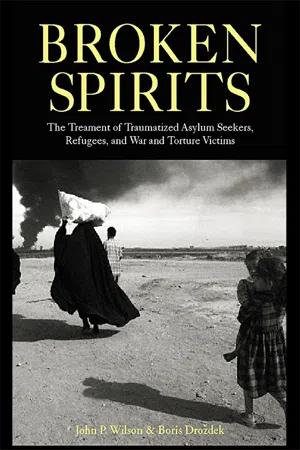
Broken Spirits
The Treatment of Traumatized Asylum Seekers, Refugees and War and Torture Victims
- 736 pages
- English
- ePUB (mobile friendly)
- Available on iOS & Android
eBook - ePub
Broken Spirits
The Treatment of Traumatized Asylum Seekers, Refugees and War and Torture Victims
About this book
Information
PART
I
Theoretical, Conceptual, and Sociocultural Considerations
Theoretical, Conceptual, and Sociocultural Considerations
Introduction
JOHN P. WILSON
Part I of this book contains five chapters; the first is an introduction by Vamik Volkan. These chapters present theoretical, conceptual, and sociocultural considerations for working with asylum seekers, refugees, and war and torture victims. As such, they establish a foundational framework by which to understand the complex and difficult work with people who have been uprooted from their homelands and thrust into the very uncertain world of seeking shelter, political status, and a niche in another country and culture. Asylum seekers, refugees, and war and torture victims have been cast adrift on the seas of fate and the mercy of God. As victims of war, political upheaval, or catastrophe, they journey from a home base of known certainties to unknown places in an unfamiliar culture. It is a process of uprooting, being dislodged from established patterns of daily living, and having a meaningful role in a community. The process of becoming, and later being, an asylum seeker and refugee is difficult at best and often traumatizing. However, the traumatizing effects of asylum seeking or being a refugee in a homeland or “strangeland” are overlayed by personal experiences of trauma. Many asylum seekers and refugees have layers of trauma — personal, familial, social, cultural, national, and spiritual. They bring the legacy of their own trauma experiences and personal losses (e.g., loved ones, home, family, country, job) with them to the country in which they seek acceptance and opportunities to build new lives with a tangible hope for a better future. For many, the journey from leaving homeland to becoming an asylum seeker is a journey of travel into psychological uncertainty and the darkness of the unknown that is experienced as living “in between” different worlds of reality; that which “was” and that which “exists” without a foreseeable future. Psychologically, it is the peril of the abyss (see Wilson, Chapter 6).
In the introductory chapter, Vamik Volkan presents a broad overview of the issues facing refugees and asylum seekers. He emphasizes the political processes within and between countries and their consequences for the lives of ordinary people who become the “pawns” and victims of malevolent political forces. Among the many themes discussed in the chapter, Volkan points out that issues of personal identity are paramount for asylum seekers. The identity question of “Who am I?” reigns at center stage in the course of adaptation. Asylum seeking and refugee status challenge the foundational basis of having a sense of self-sameness and continuity, for such feelings rapidly dissipate upon forced migration, dislocation, and the process of finding a new life and sense of meaning in an alien environment. The author notes that feelings of guilt over loss of parts of the self (i.e., the immigrant’s or the refugee’s previous identity, his or her investment in the language, culture, land, and people left behind, etc.) can complicate the mourning process. By identifying the presence of guilt reactions, the author correctly notes that they are linked to other psychological processes, which include depression, identity confusion, shame, helplessness, and culture shock. Moreover, culture shock embraces a large domain of adaptive processes, including emotional reactions of anxiety, depression, fear, uncertainty, anger, and rage. Culture shock also includes feelings of mourning for the lost culture but also the discomfort in understanding and adapting to a different culture. Volkan makes note that there is a form of culture shock known to mental health professionals who come from the “outside” to visit the misery of persons in refugee camps who are freshly traumatized. He also notes that the “outsider” brings his assumptive professional beliefs with him to the squalor and destruction of the camps and conceives of plans of intervention and assistance. But are these plans based on the assumptive beliefs of the “outsider” like trying to put a square peg into a round hole? In many cases, the answer is yes and illustrates that in working with asylum seekers and refugees, dual realities of understanding exist, those of help seekers and those of helpers in a role of power and influence who can direct the course of action taken on behalf of dislocated, uprooted, and disenfranchised persons seeking life in a new country. The themes illustrated by Volkan in the introductory chapter are amplified and developed in the subsequent chapters in Part I.
In Chapter 2, Derrick Silove provides perspectives on the global challenge of asylum seekers. This chapter provides an historical overview of the many issues associated with culturally displaced persons. This historical perspective places in relief the fact that refugees have always existed and, as such, present enduring and recurring problems to the host country. First, refugees have been used by host countries as advisors, double-agents (espionage), negotiators, slaves, indentured servants, and prostitutes. Second, refugees are often Janus-faced toward their host country, being seen as victims and heroes as well as intruders and leeches. This view of refugees reflects attitudes of ambivalence among those responsible for them in the host country. Silove traces the evolution of social policy and attitudes toward health care services and notes that the most significant advances were made post–World War II and the advent of the Holocaust. Among these historical developments was the growth of the United Nations High Commission on Refugees (UNHCR) and other international agencies and nongovernmental agencies (NGOs) that were created or commissioned to provide assistance to refugees and victims of war and catastrophe. Silove correctly notes in his chapter that the availability of scientific literature on stress, trauma, and PTSD provided more adequate paradigms by which to evaluate the mental health needs of refugees. Moreover, since trauma encompasses many forms of extreme experiences, Silove documents that these include human rights abuse, torture, starvation, political internment, and warfare. Further, he highlights that traumatic events occur at communal and individual levels and create unique problems of coping and adaptation for refugees. Finally, Silove suggests that refugees need advocates for their welfare, and that systematic scientific research is needed to advance understanding of the complexities they confront.
In Chapter 3, Jens Modvig and James Jaranson succinctly review the substantial and diverse literature on the effects of torture and political violence. As they note in the introduction to their chapter, they seek to “(a) review political violence and torture, including the atrocities, global occurrence, and impact on the health of individuals and populations; (b) discuss definitions of torture and organized violence; (c) provide a broad account of types of violence; (d) present briefly the current knowledge regarding interactions between threats and their biopsychosocial response mechanisms; and (e) review the available data about torture and posttraumatic stress prevalence among victims of torture and related human rights violations.” These stated objectives form the basis of the chapter and its contents. In the way of a concise summary, Modvig and Jaranson provide a step-by-step guide to understanding. First, there is a useful glossary of key concepts (i.e., stressor, traumatic event, violence, etc.). Second, they discuss the categories of political violence by duration, intensity, and target level (e.g., individual versus group). Third, they provide a condensed discussion of the methods of torture and their psychological consequences. Fourth, they review the studies on torture prevalence in different countries of the world. Finally, they discuss the mental health consequences of torture, including psychiatric disorders such as PTSD, depression, anxiety, and substance abuse.
In Chapter 4, Jorge Aroche and Mariano Coello provide a discussion of ethnocultural considerations in treatment. Ethnocultural refers specifically to ethnic and cultural factors that are important to consider when devising social policies and health care programs for refugees. Eth-nocultural factors include culture of origin, values, beliefs, rituals, practices, and assumptive worldview ideological systems. As the authors note in reference to communal and individual trauma, “[it] is not a disembodied construct, as suggested by DSM-IV, it is a cultural and historical reality that must be entered into by the clinician.” Given this framework, the authors discuss trauma and PTSD within an embedded cultural perspective and note that “most of the problems commonly exhibited by refugee and asylum seekers are the result of a dynamic interaction between trauma-related or posttraumatic issues, the stresses and demands of exile, migration and resettlement process, and other stressors that affect refugees much in the same way as they affect the rest of the population.” Having noted the dynamic interplay between sociocultural and individual factors in determining mental health outcomes, the authors delineate the ways to overcome barriers to effective service delivery.
The last chapter in Part I concerns the important question of the assessment of PTSD and dual diagnosis in asylum seekers and refugee patients. In Chapter 5, Alexander McFarlane concisely presents an overview of the critical factors that must be considered by professionals working with asylum seekers and refugees and who must make multiax-ial diagnoses per the DSM-IV or ICD-10 DCR.
McFarlane’s chapter raises important issues for consideration when making clinical assessments and diagnoses. We can list a few of these conceptual and clinical dilemmas in the form of questions: How do the culture and worldview of the patient affect how he or she processes and understands traumatic experiences? How do religious beliefs affect the processing and reporting of trauma (e.g., a Buddhist’s belief in states of karma)? How do ethnocultural beliefs affect the interpretation of extremely stressful experiences (e.g., “really strong men do not get PTSD in this culture”)? How does one adequately assess symptoms in culturally diverse clients? How does one use tools developed in Western countries for clients from non-Western countries?
In his chapter, McFarlane discusses many of the questions raised above. Moreover, he provides both a discussion and a table that shows the comparison between the DSM-IV and ICD-10 DCR diagnostic criteria for PTSD. This table allows international comparisons to be made for practitioners working in different cultural settings. Finally, McFarlane notes in agreement with Silove that “to leave psychiatric disorders such as depression and PTSD undiagnosed and untreated represents a considerable source of burden of suffering to the individual.”
CHAPTER
1
From Hope for a Better Life to Broken Spirits: An Introduction
VAMIK D. VOLKAN
BROKEN SPIRITS: A TIMELY AND TIMELESS TOPIC
After the collapse of the Soviet Union and the end of the Cold War, former U.S. President George Bush, Sr., introduced the idea of a “New World Order” and envisioned “kinder and gentler” times. This vision, as we all know, has by no means materialized. Massive human tragedies deliberately caused by “others,” people also usually known as “enemies,” occurred during and after his presidency, resulting in, among other disasters, tens of thousands of refugees and asylum seekers. Little more than a decade later, the former president’s son, George Bush, Jr. — and of course all of us — are more than ever aware of a “new” kind of international aggression, worldwide terrorism, and a “new” kind of ruthless response to it. The fact is that, when we do not deny it, we realize that the human psychology of individuals or large groups has not changed; what is changing with great speed is the mastery of technological challenges, which, among other things, has created more and more destructive weapons.
Humans will continue maiming and killing other humans, ruining their environments, and even destroying priceless art forms like those from the Bamian Valley in Afghanistan or in the National Museum of Baghdad, especially when such art forms are perceived as belonging to “others” or “enemies.” Humans will flee from massive disasters, thousands and millions will face forced immigration, and their spirits will, finally, be broken.
Anyone who visits one of the many refugee camps in the world today and truly listens to the stories of refugees and asylum seekers cannot deny the existence of aggression within human nature. Hearing from witnesses and victims what human beings are capable of doing to others for the sake of advancing security or for protecting their “large-group identity” (Volkan, 1997, 1999) only makes this aggression more incontestable.
Focusing on human aggression, however, should not overshadow the fact that humans also care for others, and that large groups seek not only “enemies” but also “allies” (Volkan, 1988). Because we “love” others, we also wish to repair and restore them. Those of us in the mental health field strive to understand those with broken spirits, to find methods of treatment, and to establish guidelines as a manifestation of the “healing” side of human nature. The chapters included in this book range from theoretical analyses of the psychological processes that refugees and asylum seekers experience to specific considerations, including concern for translators who accompany outsider helpers and who may become traumatized themselves. Understanding these issues necessitates a look at one essential aspect of the refugee or asylum-seeker’s experience — dislocation.
Voluntary Dislocation
The external and internal worlds of voluntary immigrants are vastly different from that of refugees or asylum seekers. Nevertheless, there are also common elements that underlie the psychology of both the “normal” (voluntary) immigrant and the traumatized forced immigrant, an asylum seeker, or a refugee. Since moving from one location to another involves loss — loss of country, friends, and previous identity — all dislocation experiences can be examined in terms of the immigrant’s ability to mourn and/or resist the mourning process. The extent to which the individual is able intrapsychically to accept his or her loss will determine the degree to which an adjustment is made to the new life (Volkan, 1993).
Feelings of guilt over loss of parts of the self (i.e., the immigrant’s or the refugee’s previous identity, his or her investment in the language, land and people left behind, etc.) may complicate the immigrant’s mourning process. When guilt is “persecutory” — the individual is driven by his or her guilt to expect punishment from others — the newcomer becomes prone to pathological mourning. If the individual acknowledges the loss of his or her past life intrapsychically and is able to accept the pain (Kleinians call this “depressive guilt”), the individual might exhibit sorrow, but he or she will still be able to retain reparative tendencies. The immigrant or refugee who has “depressive guilt” may be better equipped to adjust to a new life (Grinberg and Grinberg, 1989).
In the case of the refugee, the individual’s own psychological organization generates more persecutory guilt than may be found in the individual who becomes an immigrant by choice. After all, the refugee’s guilt is reinforced by his or her being a survivor, while relatives and friends remain in danger. If discrimination within the “host” society is faced by either the immigrant or the refugee, however, persecutory anxieties are kept alive and/or may be rekindled.
Garza-Guerrero (1974) states that initially, the immigrant experiences culture shock (Ticho, 1971) due to the sudden change from an “average expectable environment” — as described by Hartmann (1939/ 1958) — to a strange and unpredictable one. He or she may activate a fantasy that the past contained all “good” self-and object-representations, along with their gratifying affective links; when the reality of dislocation sets in, such representations are felt to be missing. At some point, the immigrant feels disconnected ...
Table of contents
- COVER PAGE
- TITLE PAGE
- COPYRIGHT PAGE
- FOREWORD
- ABOUT THE EDITORS
- CONTRIBUTORS
- ACKNOWLEDGMENTS
- PREFACE: BROKEN SPIRITS IN AN ERA OF TRAUMA, TERRORISM, AND GLOBALIZATION
- PART I: THEORETICAL, CONCEPTUAL, AND SOCIOCULTURAL CONSIDERATIONS
- PART II: BROKEN SPIRITS: TRAUMATIC INJURY TO CULTURE, THE SELF, AND PERSONALITY
- PART III: POSTTRAUMATIC TREATMENTS: GUIDELINES FOR PRACTITIONERS
- PART IV: NONVERBAL AND EXPERIENTIAL THERAPIES
- PART V: TREATMENT OF SPECIAL POPULATIONS: GENDER AND DEVELOPMENTAL CONSIDERATIONS
- PART VI: MEDICAL, SURGICAL, AND CLINICAL ISSUES IN THE TREATMENT OF REFUGEES AND TORTURE VICTIMS
- PART VII: LEGAL, MORAL, AND POLITICAL ISSUES IN THE TREATMENT PROCESS
Trusted by 375,005 students
Access to over 1.5 million titles for a fair monthly price.
Study more efficiently using our study tools.
Frequently asked questions
Yes, you can cancel anytime from the Subscription tab in your account settings on the Perlego website. Your subscription will stay active until the end of your current billing period. Learn how to cancel your subscription
No, books cannot be downloaded as external files, such as PDFs, for use outside of Perlego. However, you can download books within the Perlego app for offline reading on mobile or tablet. Learn how to download books offline
Perlego offers two plans: Essential and Complete
- Essential is ideal for learners and professionals who enjoy exploring a wide range of subjects. Access the Essential Library with 800,000+ trusted titles and best-sellers across business, personal growth, and the humanities. Includes unlimited reading time and Standard Read Aloud voice.
- Complete: Perfect for advanced learners and researchers needing full, unrestricted access. Unlock 1.5M+ books across hundreds of subjects, including academic and specialized titles. The Complete Plan also includes advanced features like Premium Read Aloud and Research Assistant.
We are an online textbook subscription service, where you can get access to an entire online library for less than the price of a single book per month. With over 1.5 million books across 990+ topics, we’ve got you covered! Learn about our mission
Look out for the read-aloud symbol on your next book to see if you can listen to it. The read-aloud tool reads text aloud for you, highlighting the text as it is being read. You can pause it, speed it up and slow it down. Learn more about Read Aloud
Yes! You can use the Perlego app on both iOS and Android devices to read anytime, anywhere — even offline. Perfect for commutes or when you’re on the go.
Please note we cannot support devices running on iOS 13 and Android 7 or earlier. Learn more about using the app
Please note we cannot support devices running on iOS 13 and Android 7 or earlier. Learn more about using the app
Yes, you can access Broken Spirits by John P. Wilson,Boris Drozdek in PDF and/or ePUB format, as well as other popular books in Social Sciences & History & Theory in Psychology. We have over 1.5 million books available in our catalogue for you to explore.