- 312 pages
- English
- ePUB (mobile friendly)
- Available on iOS & Android
eBook - ePub
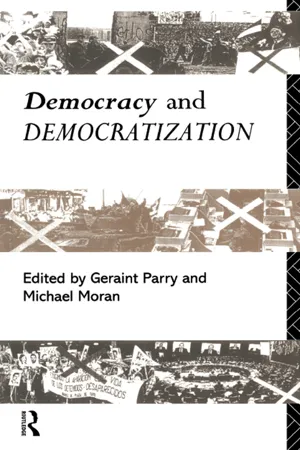
Democracy and Democratization
About this book
Following the collapse of the former regimes of Eastern and Central Europe and Latin America the choice of all of the democratising countries was to move towards liberal democracy. Likewise in Africa, many authoriatarian regimes seem to be in retreat, perhaps most significantly in South Africa. Democracy seems to be the only valued political system of the late twentieth century, so that even China for example, describes itself as the people's democratic dictatorship. So have we really, as Francis Fukuyama suggested, reached the end of history? Should we not look seriously at the tension between liberalism and democracy which have led to dissatisfaction with the liberal model in countries such as Britain and France? Is it not important to discuss the real problems of stabilisation and survival which the democratising countries are experiencing? This timely collection examines questions of central concern to scholars and practitioners of politics. It looks at both the concept of democracy and the process of democratisation, combining theoretical chapters by historians of ideas and political theorists, with empirical chapters on the process of democratisation in Eastern Europe, China, The Middle East and Latin America, as well as in established democracies such as Britain and France.
Information
Part I
Theories and explanations
Chapter 1
Democracy’s Mythical Ordeals: the Procrustean and Promethean paths to popular self-rule
More than any other form of government, democracy is nurtured by illusion, its mysteriously compelling principles deemed both unattainable in theory and at the same time inescapable in practice. So extensive is its prevalence in the modern world that it apparently cannot be overcome by any ideological dispute, not even between capitalism and socialism, since the People’s Democracies of the East and the liberal democracies of the West have proved indistinguishable and interchangeable in terms of it, inspiring the steadfast loyalty of their subjects, as well as the fervent zeal of dissidents determined to be rid of them, each in its name. This all but universal triumph of democracy over the past half-century or so may seem bewildering, since the predominant political doctrines that have shaped world affairs since the French Revolution, together with the great upheavals which in this age have scarred our history, owe their origin in large measure to the perceived failure of democratic policies and institutions. The parties and movements of modern nationalism, liberalism, socialism and communism, that is to say, were in each case built from the frustrations which democracy had spawned – for nationalists, with superficial systems of election bearing no relation to the real allegiances of kith and kin; for liberals, with the social uniformity and tyranny of majority rule which popular sovereignty engendered; for socialists and communists, with the abuse of ostensibly impartial state power in the interests of a predominant class. When the fascist, national socialist or imperialist regimes of Europe and the Orient took root in the 1920s and 1930s, they won a mass following in opposition to the democratic governments of the period, whose political decline and economic weakness after a relatively brief ascendancy made them seem already defunct, unsuited to the needs and aspirations of a new world order. Even today, when the cold war’s rival versions of democracy have almost everywhere, apart from China, been supplanted by the victorious West’s single system of competing parties in periodic elections, the fate of that system appears less and not more steady in consequence, the great fault lines of international politics having fractured in numerous cleavages of nationalities, class, race and religion which putatively democratic governments managed to conceal just a few years ago. Democracy’s undoubted triumph in the contemporary world, although impressive, does not really seem to be the fruit of durable conviction.
Part of its lack of truly profound credibility may well be due to its own character, since to subscribe to democracy is to accord equal respect to the views of others such that a person is bound to accept their judgement and hence the defeasibility of his or her principles in the face of superior numbers. This preference for an electoral victory even over one’s own beliefs – sometimes rather misleadingly termed the paradox of democracy1 – may seem to make fidelity to it a matter of procedure only, and therefore weaker than one’s attachment to substantive points of principle. But to value a legitimate procedure over the accomplishment of one’s own will is not irrational, and it may be just as likely that such forbearance and toleration add to democracy’s attractions as that they diminish it. At any rate, a conception of democracy as merely procedural rather than fundamental begs certain questions that will here be at issue and must not be prejudged. The broader and simpler point with which I should like to begin is that democracy has had a more ephemeral hold upon the public imagination than its institutional prevalence suggests because it depends so much upon disparate and all too commonly latent notions of what it is and should be. To subscribe to democracy is to hold certain views of human nature – of its essence or plasticity, its base or noble motives, its confined or limitless prospects – and these perspectives, ranging from sceptical mistrust of that nature to unbounded enthusiasm for it, generally distinguish democracy’s conflicting denominations.2 Perhaps no other political doctrine or practice is so infused by diverse underlying beliefs which inform its principles and expectations of how they work or fail. Allegiance to or suspicion of democracy provide fundamental clues of the ways in which we interpret the whole nexus of men’s moral, social and political relations and the manner in which individual and collective goals may be realized or must be frustrated. They are formed from illusions about human potentialities or about the unavoidable constraints which curtail them. They depend upon myths, some so deeply ingrained in our civilization that they are taken for granted and their details forgotten except by others who contest them, even while subscribing, perhaps with equal oblivion, to alternative myths. All myths, in their extravagance, articulate and embellish only fragmentary truths. In highlighting certain features of a moral landscape, they flatten and obscure the rest.
Among the most striking of such myths is the widespread conviction that democracy as we know it is of ancient Greek, predominantly Athenian, derivation, epitomized perhaps in Isocrates’ Areopagiticus, where he describes the Lacedaemonians as the best governed, because most democratic, of all peoples, or in Pericles’ illustrious funeral oration for the first victims of the Peloponnesian War, as reconstructed by Thucydides in his account of its history. There, apparently, can be found the locus classicus of democratic theory and practice – a constitution which, according to its leading citizen, applauds talent, rewards merit, tolerates diversity but disregards poverty; a political association in which persons are free and equal under the law; above all, a government which entrusts power not to a minority but to the whole people, whose public-spirited and well-informed deliberations give Athens its peculiar strength and make it a model worthy of imitation by other states. What a splendid spectacle, acclaimed by all mankind! Nothing owed to Greece by modern civilization – not our debt to its philosophy, art or science which by contrast have exercised only a parochially Western influence – seems so universally applauded as are the exemplary democratic practices of ancient Athens.3
But is this really the case? How many states in human history have emulated the principal institutions of that democracy – the popular law courts, the rotating Council of Five Hundred selected by lot, the outdoor assembly of an adult male population whose citizenship and freedom depended in no small measure upon a politically excluded economic infrastructure of slaves, women and permanently unenfranchised residents? Although our term democracy is derived from the Greek for ‘popular government’, some of its central features may have been of ancient Phoenician origin4 before they came to be adapted and modified by the Greeks, and since the ultimate demise of its classical Athenian form in 322 BC, hardly any of its exceedingly few manifestations have acknowledged even the remotest debt to its Greek sources in the course of their own brief and fitful democratic careers. Neither the Italian republics of the twelfth and thirteenth centuries, with their principles of elective government under officials of limited tenure, nor the Congregatio fidelium of a Church which embraced the laity in General Council as endorsed by Marsilius and others in the fourteenth century, drew inspiration expressly from the example of Greece, although the predominantly small-scale, urban settings and commercial systems of the first, and the public assembly characteristics of the second, might have been expected to suggest Athenian models and parallels. But before Aristotle’s Politics came to be recirculated in Latin in the mid-thirteenth century, little was known in Europe of the government of Athens, and his strictures on democracy, which Aristotle identified as a corrupt form of rule by the multitude, did not offer good grounds for emulating its achievement. Medieval republicanism owed much to the civic culture of ancient Rome as illuminated by Cicero and recorded by Sallust and Livy, but precious little to the democracy of classical Athens.5
Neither did the Levellers of the seventeenth century in their advocacy of political equality. They sought the abolition of ranks, if not of property, and subscribed to what would today be called the principle of ‘one man, one vote’. For these reasons above all they have often been judged democratic; yet they found little to applaud in Hellenic civilization, never addressed their attention to Athens and never even termed their ideal a democracy. The subjects of Rhode Island, with more modest aspirations of a freeholders’ voluntary association, did do so in their 1647 constitution, which may thus be said to mark the birth of democracy in America. But these religious dissenters, inspired more by faith in Providence than by any attachment to the civil rights of man, aspired to a strictly regulated government of a kind which neither ancient nor modern democrats have approved, and which exercised precious little influence upon the framers of the American Constitution 140 years later.6
By and large, for two thousand years after the golden age of Athens, democracy seemed a spent force, a generally discredited form of government, unstable, unprincipled, specially subject to violence, corruption and revolution. Even the democratic constitution of Athens was perceived at best as a decidedly mixed blessing. Notwithstanding the praise lavished upon it by Isocrates and Pericles, its most memorable achievement for educated persons of liberal temper appeared to be its judicial murder of Socrates. Its chief adherents in ancient Greece had not been the great philosophers – Plato, who abhorred its disorder and assignment of authority to the ignorant, or Aristotle, who mistrusted its abuses under the covetous poor – but rather some of the Sophists that thrived within it, among them Protagoras and perhaps Gorgias, as well as Gorgias’s pupil, Isocrates, whose reputations have never recovered from Plato’s portrayal of their collective deference to common opinion and in certain instances even their unprincipled glibness as spokesmen on behalf of the people instead of the truth.7 It may seem odd that the idea of democracy, that is, the subjection of government to popular control, long predates the modern invention of the state. But it is salutary to recall that until the Enlightenment it was a form of government only seldom deemed worthy of esteem. Democracy may have been nurtured in ancient Greece, but in the modern world there was no influential class of persons who zealously campaigned for or subscribed to it – there were no truly notable democrats, that is – until the late eighteenth century, when the term democrat itself first gained currency.8
Its resurgence in that period accompanied the two great political movements which have most shaped modern history – the establishment, in America, of the first new nation in a New World, and the comprehensive transformation, in France, of an old into a new social order. With the revolutions that gave birth to these new republics, ancient democracy was recast in a fresh framework, whose resilience in accommodating the massive forces of industry, commerce and class conflict over the succeeding two hundred years has given it a viability and international dominance which the precariously isolated and beleaguered democratic outposts of antiquity and early modern Europe never enjoyed. The democracies of America and France, however, did not take on the attributes of an atavistic system in belated rediscovery of the Greek experience. They did not spring fully armed like the goddess Athena from Zeus’s head. They were, rather, mutant or hybrid varieties – a compound such as Montesquieu introduced with his conception of the democratic republic, or ‘representation ingrafted upon democracy’, as Paine remarked about America9 – established piecemeal from ingredients unknown to the democrats of antiquity. When the American colonists of the 1760s and 1770s called for freedom from English tyranny, they pursued their cause in terms of the authentic meaning of representation and not of democracy; they sought, that is, to be actually represented by their own members of Parliament rather than virtually represented by persons with unaccountable authority to act on their behalf. When in 1787 they framed a federal Constitution for their now liberated state, they aspired to protect their freedom, not by invoking ancient principles of democratic engagement, but rather, in following Montesquieu’s ingenious account of the political institutions of modern England, by distinguishing and separating the branches and functions of their government, so as to ensure that political power could never be concentrated and abused. Their constitution did not pass power to the people but instead diffused it as thinly as possible among the people’s political officers. It owed next to nothing to the constitution of Athens, which its American counterpart resembled only in its deliberate exclusion from citizenship of most of the people who inhabited that country – above all, slaves.10
The newly-constructed democratic institutions of France proceeded along almost the opposite path, towards a concentration of power in the hands of the people as a whole, whose collective identity as the nation was acknowledged by the third article of the 1789 Declaration of the Rights of Man to be ‘the source of all sovereignty’. As Robespierre proclaimed to the Convention on 5 February 1794, ‘Democracy is a state of affairs in which the sovereign people … effects for itself all that it can do well’. This notion of sovereignty, devised in the sixteenth and seventeenth centuries by Bodin and then Hobbes principally in defence of monarchical power against threats of civil war, owed as little to the Greeks as did the separation of powers in America, and Robespierre, quite aware of his countrymen’s innovation, plainly took pride in the fact, as he put it, that ‘the French are the first people in the world to have established true democracy’ (Robespierre 1956–58: iii.113 and 115). But in accordance with that idea of popular sovereignty, democracy embraced representation as well, and especially under the Jacobin Committee of Public Safety, the sovereign nation of France found that its government, acting on behalf of the people and their true interests, promoted a regime of terror for the sake of virtue, which was soon to cost Robespierre his own life and would thereafter colour the popular perception not only of the French Revolution but of the despotic tendencies of democracy as well. The founders of modern liberalism – Constant, Mme de Staël and their followers – perceived the Jacobin experiment as a misguided attempt to rekindle the enthusiasm of public commitment which had fired civic virtue in ancient Sparta and Rome, les engagés having all too quickly become les enragés when confronted by recalcitrant political practices that failed to yield to the zealous enthusiasm of their ideals. Within the complex network of interpersonal relations characteristic of commercial society, freedom required, not solidarity, but security and protection, they supposed. It necessitated a respect for human differences and for individual rights whose inviolability it was one of the primary functions of the state to ensure. But the exercise of popular sovereignty did not safeguard such rights; it overran them.
Thus was French Revolutionary democracy confronted by modern liberalism.11 Yet it was not construed correctly by liberals when they identified it as a graft of a pure species of government transported from the ancient world, unfit for contemporary civilization’s denser soil. The idea of popular sovereignty which lies at its heart depends upon a certain conception of the state and the extent of its legal powers which may invert the form but still accepts the substance of the arguments of Bodin and Hobbes. It is a predominantly modern doctrine, whose articulations accompanied and were designed to grant legitimacy to political institutions unknown to the Greeks. The separation of the powers of government in America, equally, was of recent invention, intended to secure liberty in quite another way, of course, but again with reference to spheres of competence and patterns of authority which reflected the development of the contemporary state. Systems of representation so central to both American and French democracy had no place at all in the political world of the ancient Athenians. Theirs was a democratic constitution essentially because it was direct, and the inescapable prevalence today of indirect or representative forms of government only confirms the fanciful nature of the debt which these modern democracies ...
Table of contents
- Cover
- Half Title
- Title Page
- Copyright Page
- Table of Contents
- Contributors
- Acknowledgements
- Introduction: problems of democracy and democratization
- Part I Theories and explanations
- Part II States of democracy
- Part III Conclusion
- Index
Trusted by 375,005 students
Access to over 1.5 million titles for a fair monthly price.
Study more efficiently using our study tools.
Frequently asked questions
Yes, you can cancel anytime from the Subscription tab in your account settings on the Perlego website. Your subscription will stay active until the end of your current billing period. Learn how to cancel your subscription
No, books cannot be downloaded as external files, such as PDFs, for use outside of Perlego. However, you can download books within the Perlego app for offline reading on mobile or tablet. Learn how to download books offline
Perlego offers two plans: Essential and Complete
- Essential is ideal for learners and professionals who enjoy exploring a wide range of subjects. Access the Essential Library with 800,000+ trusted titles and best-sellers across business, personal growth, and the humanities. Includes unlimited reading time and Standard Read Aloud voice.
- Complete: Perfect for advanced learners and researchers needing full, unrestricted access. Unlock 1.5M+ books across hundreds of subjects, including academic and specialized titles. The Complete Plan also includes advanced features like Premium Read Aloud and Research Assistant.
We are an online textbook subscription service, where you can get access to an entire online library for less than the price of a single book per month. With over 1.5 million books across 990+ topics, we’ve got you covered! Learn about our mission
Look out for the read-aloud symbol on your next book to see if you can listen to it. The read-aloud tool reads text aloud for you, highlighting the text as it is being read. You can pause it, speed it up and slow it down. Learn more about Read Aloud
Yes! You can use the Perlego app on both iOS and Android devices to read anytime, anywhere — even offline. Perfect for commutes or when you’re on the go.
Please note we cannot support devices running on iOS 13 and Android 7 or earlier. Learn more about using the app
Please note we cannot support devices running on iOS 13 and Android 7 or earlier. Learn more about using the app
Yes, you can access Democracy and Democratization by Michael Moran,Geraint Parry in PDF and/or ePUB format, as well as other popular books in Politics & International Relations & Comparative Politics. We have over 1.5 million books available in our catalogue for you to explore.