- 264 pages
- English
- ePUB (mobile friendly)
- Available on iOS & Android
eBook - ePub
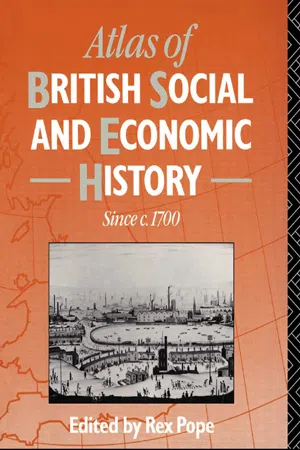
Atlas of British Social and Economic History Since c.1700
About this book
All students of history use maps. This atlas is designed specifically to enhance the understanding of British history since 1700, as well as emphasizing social as well as economic change. The contributors are all subject specialists who have taught in higher education institutions, and a large proportion of both maps and text is based on their own original research. The combination of maps and text is intended to illustrate not only historical developments, such as the spread of agriculture or the growth of an integrated transport system, but also regional contrasts at points in time. The end product offers support for those historians who question the usefulness of thinking in terms of national economic histories.
Information
Subtopic
Economic HistoryIndex
History1: AGRICULTURE
Peter Dewey
English open-field farming c. 1700
At the beginning of the eighteenth century, large areas of England were still cultivated under the system of ‘open’ fields. This system, which predated the Norman Conquest, involved organizing the arable land around a village into two or three large fields. In order to ensure an equitable distribution of land of differing qualities, each farmer worked a number of strips of land which were widely scattered about the large fields. Usually, one of the fields would be devoted to fallow, and the other(s) to corn crops. There resulted a two- or three-course rotation, which served to maintain crop yields. Animals would be kept on the common land of the village, on the stubbles left after harvest, and on any available waste land.
This system had never been universal. Its heart was the lowland region of central and southern England (see Map 1.1), and this remained true on the eve of the parliamentary enclosure movement of the eighteenth century. But there were large tracts of England where it had never been in force, or only on a modest scale. The reasons for this are conjectural. In areas where much of the new land for medieval farming was obtained by clearing woodland (Devon, Kent, Essex, Suffolk), the creation of new farms was bound to be a piecemeal process, leading to the formation of individual farmsteads and hamlets rather than the large fields and nucleated villages of the Midlands. In other areas, the small-farm nature of pastoral agriculture or regional inheritance systems may have played a part. Whatever the reason, there existed in the late Middle Ages a peripheral belt, concentrated in the South-east, South-west and North-west, where the open-field system was of little importance.
In the ensuing centuries this belt grew, as existing open fields were enclosed into individual holdings by a process of agreement amongst farmers. By 1600, Essex, Kent, Suffolk, Hertfordshire, Surrey, and Sussex were largely enclosed, as were the coastal lowlands of Durham, Cumberland, Lancashire, and Cheshire. In addition, much of the Welsh border land was enclosed, as was Somerset, apart from its unreclaimed wastes. While the motives for enclosure varied, the main one before 1700 was probably the demand for pasture; this would certainly seem to be the spur to the much-discussed enclosures of the fifteenth and sixteenth centuries. More generally, the spread of enclosure may be seen as the response to population and market growth, entailing a shift away from a system whose rationale was to provide adequate land for subsistence farming, to one more oriented to providing opportunities for success in an expanding market. The result was that, by 1700, only about half of the agricultural land of England was still farmed on the open-field system.

Parliamentary enclosure
Between the early eighteenth and the midnineteenth century there occurred the greatest agrarian reorganization since the Norman Conquest: the enclosure of the remaining open fields of England. After 1850, only a handful of unenclosed villages remained. There is now only one (Laxton, Nottinghamshire), preserved only with the aid of the Ministry of Agriculture. While in the early part of the eighteenth century, enclosure still proceeded by agreement, this soon gave way to the use of Acts of Parliament, and the bulk of enclosure after c. 1750 was by Act. The scale of the movement was enormous; some 5,300 Acts were passed (from the first in 1614), the bulk falling in the period 1750–1850. About 3,100 dealt with cases involving some proportion of arable land, and the remainder dealt with commons and wastes. The total area involved was about 6.8 million acres (4.5 million being arable, the rest commons and wastes), or about one-fifth of the land area of England. The result was not just an agrarian reorganization, but also a topographical one, in which the enclosed areas (chiefly the Midland plain) acquired their large fields, straight hedgerows, and farmsteads separated from the village, lying in the newlycreated enclosed fields.
The general reasons for the spread of enclosure were the same as they had always been; the desire to free the individual farmer from the constraints of scattered strips and communal practices. On the livestock side, enclosure made possible the evolution of herds and flocks of more uniform quality than was possible under the old intercommoning which accompanied the open fields. Likewise, the spread of disease was limited. Perhaps of most immediate importance for farmers was that enclosure made possible a rapid expansion in the grazing area, which previously had been confined to the commons, wastes, and the post-harvest stubbles of the open fields. On the arable side, consolidation of lands under enclosure avoided the loss of time and energy involved in working scattered strips of ploughland, and reduced the possibility of damage from straying animals and weeds from neighbouring farmers’ strips. Most importantly in the long run, it permitted farmers to experiment with the new fodder crops of the ‘Agricultural Revolution’ such as ‘artificial’ grasses (clover, lucerne, sainfoin) and turnips, which permitted a higher stock/land ratio. This in turn led to a larger supply of natural manure, and thus to higher corn yields per acre.
While the years 1750–1850 saw the greatest recourse to parliamentary enclosure, it was not spread uniformly over the century. In particular, two peaks stand out; the 1760s and 1770s, and the war years 1793–1815. These were roughly two comparable periods of about twenty years, in each of which about 40 per cent of all parliamentary enclosure took place, so that about 80 per cent of all parliamentary enclosure took place in those forty years. While in both periods it was mainly open-field arable land which was being enclosed, a certain proportion was of commons and waste, and this became somewhat more important during the war years; before 1793, 1.85 million acres of open-field and 0.71 million acres of commons and wastes were enclosed, whereas from 1793 to 1815 the figures were 1.99 and 0.91 million acres respectively.
Maps 1.2 and 1.3 reveal substantial differences between the counties affected by open-field arable and commons/waste enclosure. The former were, as might be expected, concentrated in the pre-existing Midland open-field belt, the chief counties affected being Oxfordshire, Northamptonshire, Bedfordshire, Huntingdonshire and Cambridgeshire. Surrounding these counties lay a further belt of intensive enclosure, stretching in the South to include Wiltshire, and in the North-east to include the East Riding of Yorkshire. By contrast, it was the peripheral counties which were most affected by the enclosure of commons and wastes. In some, especially during wartime, the enclosure movement was almost entirely concerned with commons and wastes; this was so in Cheshire, Cornwall, Devon, Durham, Kent, Lancashire, Monmouthshire, and Westmorland. It was largely the case also in Cumberland, Northumberland, Salop, Staffordshire, and the North Riding of Yorkshire. Yet it was even a factor in southern, largely arable counties such as Hampshire and Surrey, which still had notable examples of common or waste land.

The specific reasons for the spectacular peaking of the enclosure movement between 1750 and 1850 are still controversial. Generally, this was a period when the population was growing at an unprecedented rate. In addition, the beginning of the industrial revolution may have contributed to the pressure by stimulating a rise in money incomes (and perhaps also real incomes in its early stages). More specifically, the wars of 1793–1815 led to a startling rise in food prices (the price of wheat more than doubled between 1790 and the peaks of 1800/ 1 and 1812/13). The financial incentive to increase output by means of enclosure was thus considerable, and private Acts of Parliament provided the method of expediting the process.

The agricultural depression of the late nineteenth century
The period from the early 1870s until the late 1890s was widely regarded by contemporaries as one of national economic depression. Strictly, this was not the case; national output rose substantially, and, although the average level of unemployment was slightly higher, it was scarcely at a level to constitute a depression. What was occurring was rather a general period of price deflation, as a result of increased industrial development and international competition.
In this situation, the greatest sufferers were entrepreneurs and investors, rather than workers and consumers. There seems little doubt that farmers were the hardest hit of all entrepreneurs. Unlike industrial producers, their market was not expanding, due to the inroads of foreign competition on the domestic market. In addition, they had to cope with price falls which, in some important cases, were much greater than the national average. This was particularly the case for crops, and especially wheat, the largest of the corn crops. Thus, while the general national price level fell by 31 per cent between 1874/5 and 1892/3, the price of wheat fell by almost 60 per cent, barley by 46 per cent, and oats by 43 per cent. The price of livestock fell less, by an average of about 15 per cent, as probably did the price of milk (although the information on these products is imperfect).
The effect on farms was to reduce incomes and profits substantially. While regional variations in these are not precisely known, some indication of the regional impact of the depression can be gained from mapping the reductions in rent which landowners were obliged to offer to their tenants. These are reflected in the assessments for income tax (Schedule B), which are shown in Map 1.4. Overall, they show that rents had fallen by 17 per cent in Britain between 1874/5 and 1892/3. However, this was largely an English experience; English rents fell by 18 per cent, while Scottish rents only fell by 8 per cent, and Welsh rents actually rose, by 5 per cent. The more favourable experiences of Scotland and Wales may be attributed to a lesser reliance on cereals and a keen competition for farms (especially in Wales), which the depression seems hardly to have affected. The latter factor may also have operated in Cornwall, the only English county to show a rise in rent, and one noted for its large number of small farmers. The most severely affected were certain Midland and eastern counties, especially Cambridgeshire, Huntingdonshire, Essex and Wiltshire, where rents fell by 40 per cent or more. The least affected were the northwestern counties of Lancashire , Cheshire , Westmorland and Cumberland, all noted for stock-raising and dairying rather than cereals, and not far from the expanding urban markets for meat and milk to be found in Lancashire and the West Riding of Yorkshire . In addition, livestock producers benefited in one important respect from the general deflation, since i t lowered the cost of purchased animal feed and so cheapened production. For the cereal producer, however, the largest cost was labour, and money wages did not fall in the same proportion as product prices.

The changing product structure, 1870–1914
From the 1870s until the First World War, British farming underwent a substantial transformation. The main reason for this was a large increase in foreign competition, chiefly in the form of cereals from the USA; by 1914, only about one-fifth of the British bread supply came from domestic sources. Competition was also felt in the meat and dairy trades, although to a lesser extent. Milk, however, was almost immune to foreign competition and faced a rising demand from the rapidly growing urban population.
These factors lay behind the large changes which farmers were forced to make in this period. The greatest, and most apparent to contemporaries, was the fall in the cereal area. Between 1870 and 1914, the area of corn crops fell by 2.4 million acres (27 per cent). This was largely due to the fall in the wheat area, but barley also declined. This process was offset to some extent by a slight rise in oats, a response to the growing number of urban horses and an increasing reliance by farmers on horse-drawn implements. The decline in corn (see Map 1.5) was greatest in South Wales, certain Midland counties, and Northumberland, but most southern and Midland counties were seriously affected. The least affected were the large-farm areas of eastern England, where wheat was climatically suitable, and economies of scale could be achieved. In Lancashire and Cheshire, the decline in wheat was largely offset by the expansion of oats. In the Scottish Highland counties, the small reduction in corn is explained by the overwhelming predominance (for climatic reasons) of oats, against which even large reductions in wheat and barley could not have much effect.
Dairying, which was largely unaffected by foreign competition, was the most dynamic element in British farming in this period, when the milking herd grew by one-third. However, this was unevenly distributed (see Map 1.6). The main influences were the proximity of large towns and the existence or absence of rail links. While the traditional western dairying districts remained important, and expanded to meet the rising demand of towns like Manchester, Birmingham, and Leeds, the largest and most rapidly expanding market was London. This led to the fastest growth in dairying being in the southern and southeastern counties, although Lincolnshire and Northamptonshire also showed rapid growth. In Scotland, the border counties proved most adept at responding to the rising demand of Edinburgh and Glasgow. Conversely, West Wales and certain northern and Scottish counties, disadvantaged by poor rail links and a limited capacity to grow their own fodder, failed to hold their own.


Regional agricultural wages, 1902
Nineteenth-century industrialization, which had brought changes in the way of life and economic position of farmers and landowners, also affected the agricultural labourer. There were two aspects to this change: agricultural earnings fell below those of other groups, and there were considerable regional differences in farm wag...
Table of contents
- Cover Page
- Title Page
- Copyright Page
- Maps and Diagrams
- Introduction
- Acknowledgements
- 1: Agriculture
- 2: The Textile and Chemicals Industries
- 3: Metal, Vehicle, and Engineering Industries
- 4: Coal, Gas, and Electricity
- 5: Transport and Trade
- 6: Demographic Changes 1701–1981
- 7: Employment and Unemployment
- 8: Urbanization and Living Conditions
- 9: Labour Movements
- 10: Education: Late Nineteenthcentury Disparities in Provision
- 11: Religion
- 12: Leisure
- Further Reading
Trusted by 375,005 students
Access to over 1.5 million titles for a fair monthly price.
Study more efficiently using our study tools.
Frequently asked questions
Yes, you can cancel anytime from the Subscription tab in your account settings on the Perlego website. Your subscription will stay active until the end of your current billing period. Learn how to cancel your subscription
No, books cannot be downloaded as external files, such as PDFs, for use outside of Perlego. However, you can download books within the Perlego app for offline reading on mobile or tablet. Learn how to download books offline
Perlego offers two plans: Essential and Complete
- Essential is ideal for learners and professionals who enjoy exploring a wide range of subjects. Access the Essential Library with 800,000+ trusted titles and best-sellers across business, personal growth, and the humanities. Includes unlimited reading time and Standard Read Aloud voice.
- Complete: Perfect for advanced learners and researchers needing full, unrestricted access. Unlock 1.5M+ books across hundreds of subjects, including academic and specialized titles. The Complete Plan also includes advanced features like Premium Read Aloud and Research Assistant.
We are an online textbook subscription service, where you can get access to an entire online library for less than the price of a single book per month. With over 1.5 million books across 990+ topics, we’ve got you covered! Learn about our mission
Look out for the read-aloud symbol on your next book to see if you can listen to it. The read-aloud tool reads text aloud for you, highlighting the text as it is being read. You can pause it, speed it up and slow it down. Learn more about Read Aloud
Yes! You can use the Perlego app on both iOS and Android devices to read anytime, anywhere — even offline. Perfect for commutes or when you’re on the go.
Please note we cannot support devices running on iOS 13 and Android 7 or earlier. Learn more about using the app
Please note we cannot support devices running on iOS 13 and Android 7 or earlier. Learn more about using the app
Yes, you can access Atlas of British Social and Economic History Since c.1700 by Mr Rex Pope,Rex Pope in PDF and/or ePUB format, as well as other popular books in History & Economic History. We have over 1.5 million books available in our catalogue for you to explore.