At the threshold of the 21st Century many people are faced with a spiritual dilemma, where neither secularism nor religion seem adequate.
The Psychology of Mature Spirituality addresses this dilemma. In each of the book's three sections - integrity, wisdom, and transcendence - distinguished contributors describe and analyse a mature form of spirituality that will be a hallmark of future years. This timely volume will appeal to those involved in psychology, psychoanalysis and religious studies.
eBook - ePub
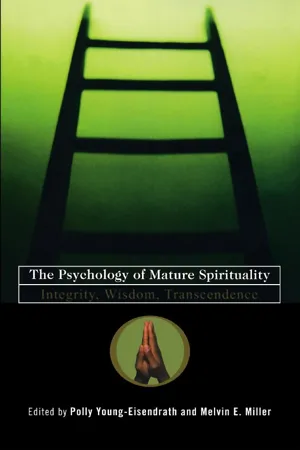
The Psychology of Mature Spirituality
Integrity, Wisdom, Transcendence
- 224 pages
- English
- ePUB (mobile friendly)
- Available on iOS & Android
eBook - ePub
The Psychology of Mature Spirituality
Integrity, Wisdom, Transcendence
About this book
Information
PART I
Integrity
Chapter 1
The place of integrity in spirituality
John Beebe
If integrity could be reduced to purity, then its relation to spirituality would be obvious. Purity of heart, as Kierkegaard famously told us, is to will one thing, and the pure heart that wills only the relation to God is by definition securely on the spiritual path. However, ‘integrity is a complex notion’ (Kekes, 1989: 219, 222–30). After Freud and Jung it must include an orientation toward responsible integration of unacceptable desires—Jung’s shadow and Freud’s id.
As a Jungian analyst, I am concerned to bring all of the parts of the person into view, not just the strivings towards being a better individual. Yet I do not consider the practice of depth psychotherapy simply an X-ray or MRI of the stationary soul in which the only attitude that matters is to see it all as clearly and with as much texture as possible. I am ever trying to foster an attitude in my patient and myself that seeks to find the right relation to each new and sometimes disturbing revelation of the self. I have learned that on my part neither a strongly moralistic conscious stance nor the neutral, non-judgmental posture of the traditional, analytically oriented psychotherapist brings forth the attitude from the unconscious that I am seeking.
What works, I have discovered, is a nearly continuous monitoring of the psyche for its ethical intentions. That is, it is necessary in the midst of listening to any feeling or account of behavior to consider the impact of that feeling or behavior on some object, for the psyche is nothing if not a subjectivity that intends to do something with and to its objects. Different psychological theories, using different languages, seem to be converging in agreement that all psychic life implies a dialectic between self and other. It is no longer possible to imagine an effective therapy of this dialectic that would consider only one of these at the expense of the other pole. Yet depth psychology has tended to describe the discovery of self in therapy in a moral vacuum, assuming that those who learn to be true to themselves will automatically avoid dealing falsely with others.
My own work has been an effort to consider the impact on the implied other of the various states of self that Jung describes as archetypal. It has led me finally to consider the nature of what I have called moral process, meaning particularly the way in which the responsibility to other is imagined and lived by the self. In my book Integrity in Depth (1992), I refer to certain philosophers who have been motivated to push philosophy past its usual concerns with ontology (the nature of being) and epistemology (the way we know things) into a more practical focus on the impact of persons as moral agents. The new moral psychology has much in common with contemporary interactional depth psychology, and I believe the common ground lies in the concern for the self’s accountability. That accountability is described by names like sincerity, responsibility, morality, and ethics, but I have found the best word to be integrity.
As the moral philosopher Calhoun has noted, integrity means ‘standing for something’ beyond ‘the integration of “parts” of oneself into a whole,’ ‘fidelity to those projects and principles which are constitutive of one’s core identity,’ and ‘maintaining the purity of one’s own agency, especially in dirty-hands situations.’ Integrity is a ‘social virtue’ (Calhoun 1995: 235, 258). This view goes back in the West at least as far as Hegel, who understood integrity as an aspect of good citizenship (Crittenden 1992: 254), but in the East we can find it in the Analects of Confucius.
What has given new impetus to the social dimension of integrity in the West is the crisis of recognition that human beings carry the power to destroy the planet on which they live. Integrity involves a willing sensitivity to the needs of the whole, an ethic that combines caring for others in the world with a sense of justice in insisting that others treat us and we treat them as we would all like to be treated. The psychological question is how such sensitivity may be nurtured.
Psychotherapy has much experience to share if it can recognize that it is a practice that promotes integrity. The simple act of trying to put feelings into words is itself an act of integrity. We should note that with the verbalization of affect two very different things are brought into relationship. One is a psychological function which directly experiences and gives value to affect or emotion without the intercession of words, exactly as one registers the impact of music. Jung, following a long tradition that he also clarifies, calls this the feeling function of human consciousness. The act of naming, on the other hand, which he calls thinking, is a cognitive procedure that invokes the discriminated use of language to give a defined meaning to the emotion. According to Jung’s landmark book, Psychological Types (1971), thinking and feeling are opposites on a rational axis that permits the discrimination of givens in experience. When the two poles of this axis are brought together, as in that moment when an upsetting feeling is appropriately named, a small miracle occurs: a union of opposites in which a whole is sensed. Psychotherapists call this insight and, tracking such moments of heightened consciousness over the course of an analytic hour, take the pulse of individuation.
The Jungian ideal of individuation is that the consciousness of the person will become psychologically undivided, with no part of the self so split off in the unconscious that it is inaccessible to dialogue with the ego. In analysis, the analyst is looking for a self-coherent narrative in the patient undergoing treatment. Unfortunately, this not unreasonable expectation can be confused with the utopian ideal of personality as a continuous state of consciousness in which no characterologic defenses are evident. This goal is surely impossible, because, as depth psychology has shown, it is the continuing fate of any human being to experience at least some psychopathology (Hillman 1975: 55) in which split-off complexes set up ‘a shadow government of the ego’ (Jung 1966a: 87) or what Jungians often call a state of ‘possession by complexes’ (Sandner and Beebe 1995: 317).
INTEGRITY AS THE HOLDING ENVIRONMENT
What actually individuates is not the total personality, with its inevitable blind spots, but the willingness of the person being analyzed to face them. In a previous essay, I have written:
Character as a whole does not individuate, although we may make great progress in overcoming our susceptibility to possession by particular complexes and thus [become] more aware of our character. Character belongs to our embodied nature, and has a structure which allows for permanent strengths and permanent shadow attributes. Parts of our character may develop, but its basic nature is present in us very early . . . What can individuate out of a person’s character is integrity, that accountability which makes the work on the rest of character— recognizing it, allowing for it, compensating it, training it—possible.
(Beebe 1998: 60)
Another way to say this is that integrity ‘holds character.’1
Within psychoanalysis, Winnicott was the first to conceptualize psychotherapy as a holding environment. His use of the word holding was an analogy to child-rearing, which as a pediatrician he had had long occasion to observe. ‘“It took a long time,” he wrote, “for the analytic world . . . to look, for example, at the importance of the way a baby is held and yet when you come to think of it, this is of primary significance. The question of holding and handling brings up the whole issue of human reliability”’ (Winnicott quoted in Phillips 1988: 30).
The image of holding can also apply to the need to carry an awareness of one’s moral responsibility to others, as in the healthy development of a sense of shame. The ancient Chinese classic, the I Ching, which is essentially a manual of how to think about integrity across a range of human situations, speaks in a recent translation of ‘embracing the shameful’ (Wu 1998: 97). The more familiar translation of this line is ‘They bear shame’ (Wilhelm and Baynes 1967: 54). The actual pictographs in the Chinese text are bao, which ‘shows a fetus in the womb, a symbol for holding and caring for what is within,’ and xiu, which ‘shows an offering of a sacrificial sheep’ (Wu 1991: 86). Bringing this image into Western idiom, I tend to think of it as holding sheepishness close to oneself, as when one allows oneself to feel ashamed or guilty when one has mishandled another. The line is traditionally interpreted as a sign of a turn for the better, since it suggests that people who have been using their power illegitimately are beginning to feel that expiation is called for.
Recently, the integrity of the United States has been challenged to come to terms with an admitted character defect in its President. From the beginning of President Clinton’s emergence on the national scene, the word ‘character’ has been invoked by his opponents to convey anxiety about his fitness for office. When finally the President admitted not only to an extramarital affair, but to lying about it to his wife and members of the Cabinet even after it had become exposed, many felt that the ‘smoking gun’ had surfaced which would surely doom his popular reputation. Strangely, the President’s approval ratings did not drop. Instead, the major leader of the opposing party, who had campaigned on a platform of moral indignation, was forced to resign after the midterm Congressional elections failed to produce a mandate for his party. Many people were perplexed by this outcome—as they were later when the Republican leadership failed in its effort to have the President removed from office—and wondered if it represented a moral indifference on the part of the populace.
I think it did not. America remains the most church-going nation in the world, and a country in which extra-marital affairs are still widely disapproved of. Rather the way in which the country held the President’s shadow seems to me to illustrate a psychological process in which the people, without denying the character problem of the President, elected silently to carry it in consciousness without being drawn into the kind of punitive reaction which makes the sinner both a scapegoat and a martyr. The people seemed to be reacting with great discrimination at a feeling level, approaching the commonly stated ideal of hating the sin and loving the sinner. A leading novelist even suggested that Clinton’s own ‘tolerance for ambiguity within the self’ made Clinton a more ‘rounded’ character in the moral imagination than his prosecutor, the ‘flat’ Ken Starr, with his ‘zealous and chillingly unambiguous morality’ (Canin 1998: 39).
This is obviously a more complex stance than the superego attitude that Bennett recommended in The Death of Outrage, his angry response to what he viewed as a failure of American morality (Bennett 1998). Interestingly, President Clinton began to speak of his need to work on his character through spiritual ministry and to atone for the damage he caused to his family and to the public trust. Never previously had this President admitted a defect in himself that needed work, and in some ways this was a first for the Presidency itself.
THE IMPORTANCE OF SHADOW IN SPIRITUAL MATURITY
It is impossible to know very much about what actually happens in the lives of public figures, but such collective dramas have always been the stuff of our culture’s fantasies about the nature of human transformation. The lesson of our literary tradition seems to be that it is not the particular character flaw that a hero may possess, but rather the attitude toward it that matters. There seems to be something especially attractive, spiritually speaking, about owning of the parts of oneself that do not fit into the usual gestalt of one’s moral identity.
Jung taught that the god of Western Europe is Respectability (Jung 1989: 68) and that respectability’s archetype is persona, that mask with which we so frequently confuse ourselves. Under the spell of the persona, the shadow is truly other to the ego. When the shadow is held in consciousness, an opportunity for spiritual development presents itself. Jung says as much in his essay, ‘The Philosophical Tree,’ when he writes, ‘Filling the conscious mind with ideal conceptions is a characteristic feature of Western theosophy, but not the confrontation with the shadow and the world of darkness. One does not become enlightened by imagining figures of light, but by making the darkness conscious’ (Jung 1967: 265, para. 335).
This is not naively to equate shadow with spirit or the unconscious with God, although Jung teaches that spirit enters the psyche through the shadow. This is one way to understand Jung’s enormous difference from Freud, which Jung unsparingly articulated on the occasion of Freud’s death amidst otherwise quite appreciative reflections on his former teacher’s contributions to the Western understanding of psyche:
Ludwig Klages’ saying that ‘the spirit is the adversary of the soul’ might serve as a . . . motto for the way Freud approached the possessed psyche. Whenever he could, he dethroned the ‘spirit’ as the possessing and repressing agent by reducing it to a ‘psychological formula.’ . . . In a crucial talk with him I once tried to get him to understand the admonition: ‘Try the spirits whether they are of God’ (1 John 4:1). In vain . . .
Freud’s ‘psychological formula’ is only an apparent substitute for the daemonically vital thing that causes a neurosis. In reality, only the spirit can cast out the ‘spirits’—not the intellect, which is at best a mere assistant . . . and scarcely fitted to play the role of an exorcist.
(Jung 1966b: 48–9)
Jung implies here that Freud fell victim in some way to the shadow that Freud was the first to investigate, because he could not discover his own purpose in investigating it. We know from many biographers that the key motivation Freud himself offered was ‘ambition’ (Gay 1988: 442), the ambition of a discoverer and liberator, which was linked in his imagination to the heroic figure of Oedipus saving Thebes by answering the Sphinx’s riddle. Hillman has pointed out that Freud’s very methods were Oedipal: ‘inquiry as interrogation, consciousness as seeing, dialogue to find out, self-discovery by recall of early life, oracular reading of dreams’ (Hillman 1991: 130–1). But Jung was wary of Freud’s assumption that the unconscious was simply a Sphinx’s riddle to be deciphered and mastered by a heroic ego. Jung felt that an effective solution to the problem of the unconscious required an active willingness to consider the possibility that what comes from the unconscious to interfere with our conscious functioning may have a positive, transformative purpose. Thus, his insistence on the psychological value of the religious idea that we must inquire of a possessing spirit (what Jung would have called a complex) whether it be ‘of God.’
To get to the point that one can inquire of the spirits what source they spring from and what they intend is a major purpose of the spiritual exercises of St Ignatius of Loyola, which Jung was lecturing on at the time he composed his memorial to...
Table of contents
- COVER PAGE
- TITLE PAGE
- COPYRIGHT PAGE
- DEDICATION
- FIGURES AND TABLES
- THE CONTRIBUTORS
- INTRODUCTION BEYOND ENLIGHTENED SELF-INTEREST THE PSYCHOLOGY OF MATURE SPIRITUALITY IN THE TWENTY-FIRST CENTURY
- PART I: INTEGRITY
- PART II: WISDOM
- PART III: TRANSCENDENCE
Trusted by 375,005 students
Access to over 1.5 million titles for a fair monthly price.
Study more efficiently using our study tools.
Frequently asked questions
Yes, you can cancel anytime from the Subscription tab in your account settings on the Perlego website. Your subscription will stay active until the end of your current billing period. Learn how to cancel your subscription
No, books cannot be downloaded as external files, such as PDFs, for use outside of Perlego. However, you can download books within the Perlego app for offline reading on mobile or tablet. Learn how to download books offline
Perlego offers two plans: Essential and Complete
- Essential is ideal for learners and professionals who enjoy exploring a wide range of subjects. Access the Essential Library with 800,000+ trusted titles and best-sellers across business, personal growth, and the humanities. Includes unlimited reading time and Standard Read Aloud voice.
- Complete: Perfect for advanced learners and researchers needing full, unrestricted access. Unlock 1.5M+ books across hundreds of subjects, including academic and specialized titles. The Complete Plan also includes advanced features like Premium Read Aloud and Research Assistant.
We are an online textbook subscription service, where you can get access to an entire online library for less than the price of a single book per month. With over 1.5 million books across 990+ topics, we’ve got you covered! Learn about our mission
Look out for the read-aloud symbol on your next book to see if you can listen to it. The read-aloud tool reads text aloud for you, highlighting the text as it is being read. You can pause it, speed it up and slow it down. Learn more about Read Aloud
Yes! You can use the Perlego app on both iOS and Android devices to read anytime, anywhere — even offline. Perfect for commutes or when you’re on the go.
Please note we cannot support devices running on iOS 13 and Android 7 or earlier. Learn more about using the app
Please note we cannot support devices running on iOS 13 and Android 7 or earlier. Learn more about using the app
Yes, you can access The Psychology of Mature Spirituality by Polly Young-Eisendrath, Melvin Miller, Polly Young-Eisendrath,Melvin Miller in PDF and/or ePUB format, as well as other popular books in Theology & Religion & Mental Health in Psychology. We have over 1.5 million books available in our catalogue for you to explore.