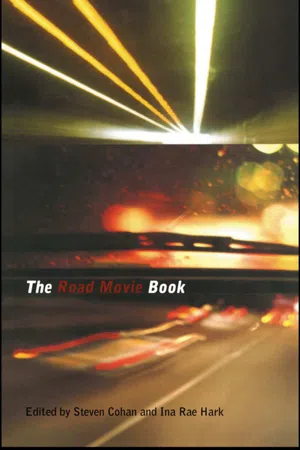
The Road Movie Book is the first comprehensive study of an enduring but ever-changing Hollywood genre, its place in American culture, and its legacy to world cinema. The road and the cinema both flourished in the twentieth century, as technological advances brought motion pictures to a mass audience and the mass produced automobile opened up the road to the ordinary American. When Jean Baudrillard equated modern American culture with 'space, speed, cinema, technology' he could just as easily have added that the road movie is its supreme emblem.
The contributors explore how the road movie has confronted and represented issues of nationhood, sexuality, gender, class and race. They map the generic terrain of the road movie, trace its evolution on American television as well as on the big screen from the 1930s through the 1980s, and, finally, consider road movies that go off the road, departing from the US landscape or travelling on the margins of contemporary American culture.
Movies discussed include:
* Road classics such as It Happened One Night, The Grapes of Wrath, The Wizard of Oz and the Bob Hope-Bing Crosby Road to films
* 1960's reworkings of the road movie in Easy Rider and Bonnie and Clyde
* Russ Meyer's road movies: from Motorpsycho! to Faster Pussycat! Kill! Kill!
* Contemporary hits such as Paris Texas, Rain Man, Natural Born Killers and Thelma and Louise
* The road movie, Australian style, from Mad Max to the Adventures of Priscilla, Queen of the Desert.
- 400 pages
- English
- ePUB (mobile friendly)
- Available on iOS & Android
eBook - ePub
The Road Movie Book
About this book
Information
Part I
MAPPING BOUNDARIES
1
“ HITLER CAN ’ T KEEP ’
EM THAT LONG ”
The road, the people
Bennet Schaber
Hitler has a passion for movies – including the products of Hollywood. (Two of his favorites were It Happened One Night and Gone with the Wind.)
William L. Shirer, Berlin Diary, Dec 1, 1940
That was the first bad thing I’d heard about [It Happened One Night]. I was shocked and started to analyze it, but I gave it up. But I resent it like the devil.
Frank Capra, 1941
In an entry from his diary for November 5, 1939, William Shirer makes the following observations, worth quoting at some length.
Hitler is a fiend for films, and on evenings when no important conferences are on or he is not overrunning a country, he spends a couple of hours seeing the latest movies in his private cinema room in the Chancellery. News-reels are a great favorite with him, and in the last weeks he has seen all those taken in the Polish war, including hundreds of thousands of feet which were filmed for the army archives and will never be seen by the public. He likes American films and many never publicly exhibited in Germany are shown him. A few years ago he insisted on having It Happened One Night run several times. Though he is supposed to have a passion for Wagnerian opera, he almost never attends the Opera here in Berlin. He likes the Metropol, which puts on tolerable musical comedies with an emphasis on pretty dancing girls. Recently he had one of the girls who struck his fancy to tea. But only to tea. In the evening, too, he likes to have in Dr. Todt, an imaginative engineer who built the great Autobahn network of two-lane motor roads and later the fortifications of the Westwall. Hitler, rushing to compensate what he thinks is an artistic side that was frustrated by non-recognition in his youthful days in Vienna, has a passion for architects’ models and will spend hours fingering them with Dr. Todt. Lately, they say, he has taken to designing new uniforms. Hitler stays up late, and sleeps badly, which I fear is the world’s misfortune.
(244)
Shirer compiled these notes for “a picture of Hitler at work during war-time,” to be broadcast on CBS radio. That picture is worked up through Shirer’s rather wry humor, which traces a kind of fault-line on one side of which is Hitler-the-man (he “stays up late”), on the other, Hitler-the-political-leader (“the world’s misfortune”). Film, however, runs directly down, or, at least, on both sides of that line. On the one side there is the man who loves the latest movies, on the other the Chancellor watching film from the army archives. Of course, this imaginary line was untenable and Shirer knew it. Capra seems to have known it as well and it irked him. Untenable and irksome because film here realizes the Führer as both contemplator and creator of images. Hence the repeated trajectories of Shirer’s “portrait”: from watching the news to making the news, from watching the girl to taking tea with the girl, from gazing to “fingering,” etc.
Indeed, what one witnesses in this portrait is a small trace of the many ways in which National Socialism realized itself in competition with Hollywood. Capra himself was well aware of the struggle, and well before the making of Why We Fight and the revelation that It Happened One Night (1934) was one of Hitler’s favorites. “I never cease to thrill at an audience seeing a picture. For two hours you’ve got ’em. Hitler can’t keep ’em that long. You eventually reach even more people than Roosevelt does on the radio. Imagine what Shakespeare would have given for an audience like that!” (McBride: 432). One might detect in Capra’s bombast something of Shirer’s wryness. After all, Hitler’s only watching movies when he’s not “overrunning countries,” as it were. But there is a hint here that between film and the most aggressive politics, there is less a relation of choice than of extension. Film belongs to its own overrunning. Film is extensive; it “reach[es] more people than Roosevelt,” etc. Extensive and grasping, film not only reaches, it holds. It practices its own specific kinds of domestic and foreign policies. This is why it is essential to situate it not only within its contemporary political setting but within a nexus of political technologies: the metropolis, the autobahn, the newsreel, the lightning war, etc. The quotations from Shirer and Capra have the advantage (with their obvious differences) of doing just this. They invoke time and motion as political-cinematic questions.
The problem this essay sets for itself, then, has less to do with Hitler’s personal filmic proclivities (it has more to do with Capra’s recognition of them, and anyway, so what if the Führer secretly identified with Clark Gable?) than with the ways in which a seemingly innocent road film like It Happened One Night could get itself mixed up in and with a series of larger political questions. Hence the principal emphasis of this essay will be a consideration of the road movie as political in the broadest sense of the term. Capra’s words, from which the essay’s title is drawn, powerfully represent the director’s sense of the massive political stakes of film-making (hence his resentment at finding out about Hitler’s love of It Happened One Night strikes me as both appropriate and somewhat disingenuous). Indeed, it seems to me that Capra’s prewar career is characterized by an increasing awareness of the interplay of populism, capitalism and fascism and the fact that film can represent these tendencies only at the risk of flirting with them (culminating in Meet John Doe, 1941).
What is at stake here is precisely “the people.” And “the road” is very much the locus of the revelation of this people. In It Happened One Night, Gable will take on the weight of becoming the very image of the people, revealing them in the process of revealing himself to the upper-class Claudette Colbert and, later, her father. And seven years later, Capra returns to the road, when in Meet John Doe Gary Cooper and Walter Brennan, the two musical tramps, stage the meeting of the road with the image factory of the newspaper industry, with Barbara Stanwyck unwittingly furthering the fascist designs of Edward Arnold. Preston Sturges, more clever, wittier, smarter, and more cynical (but also and decisively less visionary) than Capra, would simply cut to the chase: in Sullivan’s Travels (1941) Hollywood sets out explicitly to give the road and its people their definitive image as Joel McCrea’s Sullivan sets out to make a film “like Capra.”
The road, the people: this is the equation I wish to ponder. Who are these people? Are they a subject (of history, for example) or merely subjected? An image it is the duty of cinema to discover, or to invent? Obviously Capra is not the only prewar director to pose this question. We have already glimpsed it in Sturges, and it is there in Ford as well (to mention only the big three in the US). To be on the road is to be in the presence of the people, and this constitutes what Gilles Deleuze (216) has expressed as the “unanimism” of prewar American film. The people are present and real but also virtual and ideal: the summation of a real history which they unify, the seed, soul, or spirit (anima) of a greater people to come. The image of the people, then, is pregnant with its own political arrival. And this is where the Hitlerian threat makes itself most acutely felt, when the image through which the people finds itself and its freedom is reversed and becomes the instrument of its subjugation.
The burden of my essay is twofold. In the first section I hope to demonstrate some of the ways in which prewar films, predominately although not exclusively products of Hollywood studios, deployed the road as a cinematic vehicle for the coming-to-presence of the people. This coming-to-presence implied a specific practice of images the variety of which can be usefully cataloged according to the directors responsible for them. For example, John Ford films images relating a solitary, vertical figure to a vast horizon, or of simple exchanges of looks among ordinary people as they register and acknowledge an act of generosity. However, it is not my contention that the people become a single, unified image; rather, that they are given as simultaneously present and possible, a presence with both a being and a destiny.
In the second section I hope to demonstrate some of the ways in which postwar films, predominately although not exclusively products of independent American and European cinemas, deployed the road experimentally, as it were, with the result being various practices of images both of and in the absence of the people. For example, Jim Jarmusch films a forking road without an horizon, while Wim Wenders films a hand holding a photograph of a house that will not find its address. Unable to find a practice of images capable of bringing them to presence, the people discover their being-in-common through the various ways in which images communicate among themselves.
If we imagine, and no doubt we must, the people as a community, then the difference I am describing can be given as simply this. Before the war, on film, the road presents the community to itself, becomes a vehicle of self-presentation constitutive of the people, in two major modalities: dialectically, insofar as the relation of the one to the many becomes the unified being or oneness of the many; narratively, insofar as the deployment of redemptive scripts or texts enables the people to cross a boundary or obstacle and thus enter into its own fullness. After the war, the community progressively defies its own self-presentation; it literally cannot be presented, at least honestly, with its own proper image. Its presentation, then, is the channels of communication through which its members expose themselves one to another. These are the communities recent social theory has called unworking, unavowable, or arriving.1
Throughout my essay, which amounts to an extended meditation, I have tried to mark some of the salient differences between pre- and postwar road films by calling attention to their pervasive use of Biblical rhetoric – Exodus for the prewar films, Apocalypse for the postwar. But this distinction is never hard and fast. In my last section I will turn my attention to a single image, the desert, at once the place of a gathering and the promise of a new homeland, but also the site of a new diaspora, a dispersion of the people and of the filmic image itself.
I
In his image of Hitler at the movies, Shirer made the connection between National Socialism and cinema. No doubt Capra had intuited this connection before reading those words; and he spent a good part of his career working through the relation of film to totalitarianism. Although this is hardly the place for an extended analysis, it is nevertheless crucial to point out just how strongly National Socialism was wed, not only to a specific repertoire of images, but to specific technologies of image production. One need only recall Leni Riefenstahl’s Triumph of the Will to recognize the ways in which the camera not only insinuates itself into the advent of the Nazi event but realizes itself as an indispensable component in the very being of the event. Indeed, the camera grounds the dialectical play of being-with-the-people and the being-of-the-people, not only by juxtaposing the single face or figure with the massive phalanx, the single voice with the symphonic chorus (notably in the Sprechchor of the Arbeitsdienst), but by physically making available the one to the other. Now, this dialectic is procured through a relation of motions to a series of returns to rest (all in the service of making perfectly clear a series of hierarchical equivalences: the Führer is the people is the land is the nation, etcetera ad infinitum). The camera encounters Nuremberg through the clouds, in flight aboard a plane; it comes to rest outside the plane to witness Hitler’s disembarkation. It encounters the people on the road, in a moving car through the city streets, and comes to rest outside the Deutscher Hof, Hitler’s hotel, newly remodeled with the Führer’s name in lights, recalling a Broadway or Hollywood marquee (the Nazi–Hollywood competition that haunts the film). The people, at march or at play, encounter the camera in ceaseless motion: it either penetrates their ranks or they parade past it. They encounter themselves when the camera comes to rest with the Führer, aligns itself with his gaze (which is also a gaze that gazes upon itself). This is Nazi “unanimism”: Ein Volk, ein Führer, eine Kamera. It is not precisely that the camera manufactures events (propaganda in the simplest sense) but that the events themselves are conceivable only in the presence of the camera (given its outward and objectified double in the famous nighttime rally, the sea of flags in an architecture of light, the latter phrase at least a partial designation of cinema, of political life affirming itself in the presence of and as film).
The year 1934, the date of the fourth Nazi Party Rally at Nuremberg, the subject of Riefenstahl’s film, brings us full circle, back to Capra and It Happened One Night, also made that same year. And, like Riefenstahl’s film, Capra’s too means to think through the emergence of the people in the presence of the camera. But it does so in a completely different way, on the road, as it were, which requires of the camera not a coming to rest but a certain restlessness.2 And this is sometimes literalized, for example near the film’s conclusion, with a shot of the cameramen pursuing Claudette Colbert across the lawn of her father’s estate. This is important to notice. Unlike Riefenstahl, Capra does not so much set the camera in motion as set it the task of discovering and recording a relation of cameras and motions. Indeed, the only really interesting shot-in-motion occurs as Gable watches, from his car, the entourage of vehicles carrying Colbert off toward the horizon. But this is the only point at which Capra encounters the road in one of its essential visual/filmic modalities – its vanishing3 (Ford is the great American master of this image/insight, and this no doubt because of the experience of the Western).
Capra might be said to have inaugurated the road film with It Happened One Night. The film seemed to sketch the contours of a remarkably open, fluid genre which could nevertheless maintain its conditions of recognizability even across a series of finely layered wagers (what the film, finally, would be about: love, class, travel, communication, nation, sex, technology, etc.). The film includes a visual account of nearly every possible means of transportation: from walking to boats, buses, cars, motorcycles, planes, autogyros, and trains, even swimming). Horses are metaphorically included when Gable refers to the entire caprice as a “buggy ride.” Only bicycles seem neglected. The list can be expanded if one adds to it the transport of communication: phone, telegraph, mail, newspaper, newsreel, radio, intercom, all points bulletin. This is Capra’s restless nation, and the camera casts about (and sometimes tags along) for as many of these images as it can possibly find, only coming to rest, generally, only at motor camps, rest stops for the restless. The film throws down the gauntlet, so to speak, so that, by the time Sturges inherits it, the rather simple halts of Capra’s buses (by the police or by the elements) have been transformed into full-scale, catastrophic and slapstick motions (sometimes accompanied by special effects, notably slow motion) in “land yachts” and “whippet tanks.” And Sturges opens Sullivan’s Travels with film footage of a gunfight atop a moving train on a bridge over a rushing river. Hence for the road movie, as originally conceived and constructed, any political wager finds its primary condition in an analysis of film and motion.
Bodies at rest, bodies in motion: the road film could be likened to an entire physics. And it is the road film itself that perha...
Table of contents
- COVER PAGE
- THE ROAD MOVIE BOOK
- TITLE PAGE
- COPYRIGHT PAGE
- PLATES
- CONTRIBUTORS
- INTRODUCTION
- PART I: MAPPING BOUNDARIES
- PART II: AMERICAN ROADS
- PART III: ALTERNATIVE ROUTES
Trusted by 375,005 students
Access to over 1.5 million titles for a fair monthly price.
Study more efficiently using our study tools.
Frequently asked questions
Yes, you can cancel anytime from the Subscription tab in your account settings on the Perlego website. Your subscription will stay active until the end of your current billing period. Learn how to cancel your subscription
No, books cannot be downloaded as external files, such as PDFs, for use outside of Perlego. However, you can download books within the Perlego app for offline reading on mobile or tablet. Learn how to download books offline
Perlego offers two plans: Essential and Complete
- Essential is ideal for learners and professionals who enjoy exploring a wide range of subjects. Access the Essential Library with 800,000+ trusted titles and best-sellers across business, personal growth, and the humanities. Includes unlimited reading time and Standard Read Aloud voice.
- Complete: Perfect for advanced learners and researchers needing full, unrestricted access. Unlock 1.5M+ books across hundreds of subjects, including academic and specialized titles. The Complete Plan also includes advanced features like Premium Read Aloud and Research Assistant.
We are an online textbook subscription service, where you can get access to an entire online library for less than the price of a single book per month. With over 1.5 million books across 990+ topics, we’ve got you covered! Learn about our mission
Look out for the read-aloud symbol on your next book to see if you can listen to it. The read-aloud tool reads text aloud for you, highlighting the text as it is being read. You can pause it, speed it up and slow it down. Learn more about Read Aloud
Yes! You can use the Perlego app on both iOS and Android devices to read anytime, anywhere — even offline. Perfect for commutes or when you’re on the go.
Please note we cannot support devices running on iOS 13 and Android 7 or earlier. Learn more about using the app
Please note we cannot support devices running on iOS 13 and Android 7 or earlier. Learn more about using the app
Yes, you can access The Road Movie Book by Steven Cohan, Ina Rae Hark, Steven Cohan,Ina Rae Hark in PDF and/or ePUB format, as well as other popular books in Media & Performing Arts & Film History & Criticism. We have over 1.5 million books available in our catalogue for you to explore.