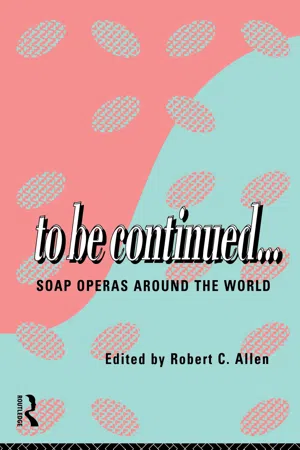
To Be Continued... explores the world's most popular form of television drama; the soap opera. From Denver to Delhi, Moscow to Manchester, audiences eagerly await the next episode of As the World Turns, The Rich Also Weep or Eastenders. But the popularity of soap operas in Britain and the US pales in comparison to the role that they play in media cultures in other parts of the world.
To Be Continued... investigates both the cultural specificity of television soap operas and their reception in other cultures, covering soap production and soap watching in the U.S., Asia, Europe, Australia and Latin America. The contributors consider the nature of soap as a media text, the history of the serial narrative as a form, and the role of the soap opera in the development of feminist media criticism.
To Be Continued... presents the first scholarly examination of soap opera as global media phenomenon.
- 408 pages
- English
- ePUB (mobile friendly)
- Available on iOS & Android
eBook - ePub
About this book
Information
1
Doubtless to be continued
A brief history of serial narrative
Roger Hagedorn
Introduction
In a section of S/Z entitled “contract-narratives,” Roland Barthes asserts that narrative is not only production (the story as it “unfolds”) but product. As such, it is “legal tender, subject to contract, economic stakes, in short, merchandise, barter.” Narrative’s material basis is an often overlooked fact. When it comes to serial narrative, however, this fact cannot be ignored because it is at the heart of what distinguishes a serial, to what purposes serials have traditionally been put, and how this narrative form developed.1
Contrary to popular belief, the serial is not limited to a particular medium nor genre. Consider for a moment the following example serials: Pickwick Papers and Les mystères de Paris; The Perils of Pauline and The Phantom Rider; Amos ’ n’ Andy and Ma Perkins; Buck Rogers and Little Orphan Annie; NYPD Blue, All My Children, and Wild Palms. The first thing one may notice is the variety of media represented: part-issue print publications and newspapers, film, radio, newspapers again, and television. The reader may also recognize the diversity of narrative types invoked: novels, fiction films, comic strips, long-running radio and television programs, and the television miniseries. As for the traditional narrative category of genre, one can easily identify yet another degree of difference. Among serials, one finds comedies (Soap), mysteries (Twin Peaks), westerns (Railroad Raiders), courtroom dramas (L.A. Law), adolescent adventure tales (Jack Armstrong, the AllAmerican Boy), science fiction (Flash Gordon), political satire (Amerika), erotica (The Pearl), and domestic melodramas (Search for Tomorrow). All things considered, it may appear as though serials have no particular narrative specificity. Certainly this is true in so far as surface narrative content, generic affiliation, and medium are concerned.
Serials are distinguished as a narrative form by the discourse they trace between the producing industry and the readers/spectators/listeners who consume them. In other words, one must look to the mode of production, distribution, and consumption of serials; that is, how and when individual texts are materially presented to the consuming public. Serials are defined through the practice of offering a narrative text to consumers in isolated, materially independent units available at different but predictable times: in a word, in successive episodes. Episodicity is the crucial trait which distinguishes the serial (and the series) from the “classic” narrative text – that is, the single-unit realistic narrative, including the novel in book form, the feature film, the radio play, and so on. While a classic text can be consumed however the consumer wishes, because he or she generally has material control over the text in its entirety before beginning to consume it, serials’ mode of presentation places consumers at the whim of the medium that presents them (or, more precisely, at the whim of those who command the medium that presents serial texts). Episodicity functions as a textual sign of the serial’s material existence as merchandise and, therefore, of the discourse established between the producing industry and the consuming public.
Episodicity works in conjunction with reified forms of the two sequential codes Barthes elaborates in S/Z in such a way that serials break with the three classical unities. Multiplying the elements of time, space, and character allows for infinitely greater narrative complication. Furthermore, serials differ from classic narratives in multiplying the number of narrative enigmas as well as partial answers, snares, delays, and so on that are activated in the course of the narrative. A more striking difference is in regularly setting up delays across the narrative breaks which result from the serial’s episodic presentation. This kind of suspension functions obviously to stimulate consumption of later episodes. Though by no means the only kind of enigmas activated by a serial, the suspension of predication across the various narrative breaks is behind the colloquial term for the serial, the “cliffhanger.” It is precisely the way in which what Barthes calls narrative’s “instinct for preservation” is mobilized over textual breaks that allows us to account for the difference between the classic text and the serial.2
These differences between classic texts and serials are not particularly radical, which prompts the question: why do serials exist? In a word, because from their beginnings, serials have been used to accomplish three tasks. At the most basic level, an episode of any one particular serial functions to promote continued consumption of later episodes of the same serial, which is specifically why the cliff-hanger ending was developed. In addition to selfpromotion, serials have traditionally functioned to promote product loyalty. For example, any Pathé film serial in effect promotes all other Pathé serials or, to offer a contemporary example, the broadcast of a television mini-series such as Menendez: A Murder in Beverly Hills includes heavy promotion of the network’s regularly scheduled programming.
It is serials’ public which has consistently provided the dependable mass of consumers essential to any “mass media.” Obviously, individual serials function to increase newspaper circulation, the sale of theater tickets, or provide audiences for advertising spots. More significantly but indirectly, in attracting a large audience to a particular medium, serials also serve to promote the very medium in which they appear. This explains why serials have been introduced into every medium precisely at the point at which they are emerging as a mass medium: because they constitute a remarkably effective tool for establishing and then developing a substantial consuming public for that medium. Once attracted, that audience is then available and predisposed to consume other texts the particular medium provides. And for this same reason, serials have also been used to expand an existing audience base by targeting specific subgroups of the population, generally women or children. When a medium needs an audience, it turns to serials.
Long before the development of serial fiction, many narrative works contained elements associated with serials. For example, the Arabian Nights is not merely episodic but includes stories embedded in other stories and its characters appear in several levels of discourse, the effect of which is to create a diegetic world inhabited by a large cast of recurring characters, some of whom talk to or of others (much like the gossip one finds in contemporary soap operas). The visual arts too offer precursors to serial narrative. Greek and Roman reliefs, for example, present elaborate narratives in fragmented, horizontal bands which must be read sequentially, much like strip serials. Yet none of these is a serial. What is lacking is the production and distribution of fragmented narrative in a mass medium that is consumed at regular intervals. Historically, for this to occur, one needs a social context characterized by three essential elements: a market economy, a communications technology sufficiently developed to be commercially exploited, and, as Barthes suggests, the recognition of narrative as commodity.
Publishing mysteries: part-issue print, magazine, and newspaper serials
The first such technology to be exploited was the printing press. Serial publication has existed for centuries, having proved itself a viable technique for circulating voluminous episodic narratives such as L’Astrée and Le Grand Cyrus. Despite increased commercial use of movable type printing in the seventeenth and eighteenth centuries, books remained a premium item available to only a select few. So to reduce the purchase price, expand the market, and thereby increase profits, publishers produced editions of large works in fascicles available to subscribers in low-cost installments. This practice became known as part-issue or publication in numbers.3
The earliest instance of this practice was the publication in England of Joseph Moxon’s Mechanik Exercises; or The Doctrine of Handy-Works in 1678. Part-issue publication initially made available histories, geographies, encyclopedias, romances, and the Bible. By the nineteenth century, however, the mainstay of part-issue publication was original fiction, beginning in 1836 with the publication of Charles Dickens’s Pickwick Papers. Monthly periodicals quickly followed suit. Throughout the century authors, including Anthony Trollope and Thomas Hardy, offered completed works or contracted to write original fiction which was serialized in magazines like Graphic and Cornhill Magazine . 4
The first acknowledged production of a newspaper serial also occurred in England. The Stamp Act of 1712 imposed a halfpenny tax on half-sheet newspapers and a penny tax on fullsheet newspapers, but classified all publications larger than one page but not of book-length as pamphlets subject to only a 2 shillings per page tax. Capitalizing on this legal loophole, many publishers produced one and a half page newspapers, identifying them as pamphlets. When news articles did not fill the additional space, publishers often reprinted fiction. By the time Parliament revised the Stamp Act in 1724, closing the loophole, readers had developed a taste for daily installments of fiction, so publishers continued the practice as a means of maintaining readership.5
The introduction of this practice in France completely revolutionized French newspapers and made newspaper serials a worldwide phenomenon. Until 1830 French newspapers were “journaux d’opinion” which promoted various political positions. As such, their circulation depended upon the relative influence of the position they represented and was, in the main, stable. Between 1830 and 1845, however, the French press was radically transformed by the repeal of official censorship. Journaux d’opinion were gradually replaced by anonymous commercial ventures whose raison d’ être was simply the development of capital revenue through purely commercial means.6
This transformation came about largely due to the rivalry between two publishers: Emile de Girardin and Armand Dutacq. On July 1, 1836 Girardin launched La presse. On the same date Dutacq, who had collaborated with Girardin during the planning phase of his paper, turned rival and began publishing Le siècle. Rather than charging the going subscription rate, both papers were conceived as “2 penny papers” whose subscription rate was half that of competing papers.7
Girardin’s strategy was to cut prices while expanding production and sales. In order to offset the fall in the profit margin per unit sold, Girardin counted on substantially increasing the number of subscriptions sold and selling advertising space. The catch was to develop a broader reading public by providing non-political, hitherto unavailable material. He chose to exploit original fiction in serial form. To ensure the success of this gambit, Girardin approached the most famous novelist of the period, and Honoré de Balzac’s La vieille fille began its run in La presse on October 23, 1836. Its success was quickly imitated by other newspapers and by 1842 the serial publication of original fiction had become an integral component of every newspaper in France.8
The most famous French newspaper serial is Eugène Sue’s Les mystères de Paris, which set the standard for successful serial writing. Its 147 installments, appearing in Le journal des débats during 1842–1843, drew literally thousands of new subscribers. A rival publisher quickly bought Sue’s Le juif errant and saw his circulation rise from 3,600 subscribers to approximately 23,000. Sue’s phenomenal success was due in part to the author’s sensational subject – matter, which included convicts, suicides, murders, foundling children, conspiracies, and a mysterious avenging angel; it was also due to his elaboration of the serial narrative technique.9
Les mystères de Paris is a multiple focus “roman-fleuve” that exploits an enormous cast of characters and shifts the space of action frequently, creating an effect much like cross-cutting in film. As a consequence, readers become involved with dozens of characters and the incredible amount of action they are involved with at any one time. Furthermore, Sue’s narrative strategy successfully exploits the inherent formal limitation of serial publication: each installment ends at a point of unresolved narrative tension, precisely in order to leave the readers in suspense. Sue cannot take credit for having invented the cliff-hanger, but he can for being the first to exploit it so elaborately and consistently. Finally, Sue and his editors also established the pattern of writing at the same rate as the novel was published so that its course could be modified according to reader reaction.10
Sue’s work demonstrated the importance of serials in expanding newspaper circulation in general and daily newspapers in particular. It also made clear serials’ ability to stimulate truly mass appeal, especially among people who might not otherwise purchase a newspaper. Not only did businessmen and lawyers consume his fiction; so too did chambermaids, domestic cooks, shopkeepers, and day laborers. Although countless authors wrote successful serials, including Alexandre Dumas and Emile Zola, Sue first demonstrated the potential for mass consumption of serial narrative and the profits that could be made by publishing it. So successful were his works that when translated and published throughout Europe and South America, they incited an international vogue for serial fiction in newspapers which lasted until the First World War.11
Illustrating humor: the comic strip
An industry rivalry resembling that between Dutacq and Girardin was also responsible for the development of the comic strip. The invention of photoengraving in 1873 made possible inexpensive newspaper illustration and newspaper publishers including William Randolph Hearst, Joseph Pulitzer, and James Gordon Bennet, Jr quickly harnessed its potential by incorporating illustrations into their papers. Then in 1895, Hearst acquired the New York Morning Journal. In order to outsell his rivals, Hearst determined that the Journal would feature the first complete comic supplement – “eight pages of polychromatic effulgence that make the rainbow look like a lead pipe” – and he lured Richard Felton Outcault away from Pulitzer to develop a series...
Table of contents
- Cover Page
- Title Page
- Copyright Page
- Contributors
- Acknowledgments
- Introduction
- 1: Doubtless to be continued: A brief history of serial narrative
- 2: The role of soap opera in the development of feminist television scholarship
- 3: Social issues and realist soaps: A study of British soaps in the 1980/1990s
- 4: National and cultural identity in a Welsh-language soap opera
- 5: Global Neighbours?
- 6: The end of civilization as we knew it: Chances* and the postrealist soap opera
- 7: “I’m not a doctor, but I play one on TV”: Characters, actors and acting in television soap opera
- 8: Plotting paternity: Looking for dad on the daytime soaps
- 9: “They killed off Marlena, but she’s on another show now”: Fantasy, reality, and pleasure in watching daytime soap operas
- 10: “There’s a queer in my soap!”: The homophobia/AIDS story-line of One Life to Live
- 11: The consumption of soap opera: The Young and the Restless and mass consumption in Trinidad
- 12: Not all “soaps” are created equal: Toward a cross-cultural criticism of television serials
- 13: Our welcomed guests: Telenovelas in Latin America
- 14: Memory and form in the Latin American soap opera*
- 15: Montezuma’s revenge: Reading Los Ricos También Lloran in Russia
- 16: The melodrama of national identity in post-Tiananmen China
- 17: All in the (Raghu) family: A video epic in cultural context*
- 18: Sacred serials, devotional viewing, and domestic worship: A case-study in the interpretation of two TV versions of The Mahabharata in a Hindu family in west London
- Select bibliography
Trusted by 375,005 students
Access to over 1.5 million titles for a fair monthly price.
Study more efficiently using our study tools.
Frequently asked questions
Yes, you can cancel anytime from the Subscription tab in your account settings on the Perlego website. Your subscription will stay active until the end of your current billing period. Learn how to cancel your subscription
No, books cannot be downloaded as external files, such as PDFs, for use outside of Perlego. However, you can download books within the Perlego app for offline reading on mobile or tablet. Learn how to download books offline
Perlego offers two plans: Essential and Complete
- Essential is ideal for learners and professionals who enjoy exploring a wide range of subjects. Access the Essential Library with 800,000+ trusted titles and best-sellers across business, personal growth, and the humanities. Includes unlimited reading time and Standard Read Aloud voice.
- Complete: Perfect for advanced learners and researchers needing full, unrestricted access. Unlock 1.5M+ books across hundreds of subjects, including academic and specialized titles. The Complete Plan also includes advanced features like Premium Read Aloud and Research Assistant.
We are an online textbook subscription service, where you can get access to an entire online library for less than the price of a single book per month. With over 1.5 million books across 990+ topics, we’ve got you covered! Learn about our mission
Look out for the read-aloud symbol on your next book to see if you can listen to it. The read-aloud tool reads text aloud for you, highlighting the text as it is being read. You can pause it, speed it up and slow it down. Learn more about Read Aloud
Yes! You can use the Perlego app on both iOS and Android devices to read anytime, anywhere — even offline. Perfect for commutes or when you’re on the go.
Please note we cannot support devices running on iOS 13 and Android 7 or earlier. Learn more about using the app
Please note we cannot support devices running on iOS 13 and Android 7 or earlier. Learn more about using the app
Yes, you can access To Be Continued... by Robert C. Allen in PDF and/or ePUB format, as well as other popular books in Social Sciences & Feminism & Feminist Theory. We have over 1.5 million books available in our catalogue for you to explore.