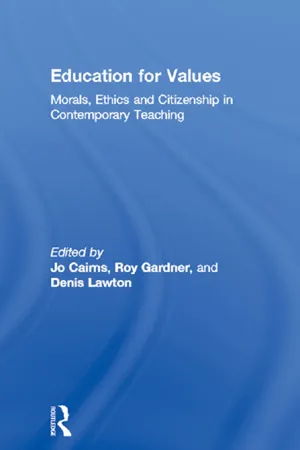
eBook - ePub
Education for Values
Morals, Ethics and Citizenship in Contemporary Teaching
- 356 pages
- English
- ePUB (mobile friendly)
- Available on iOS & Android
eBook - ePub
Education for Values
Morals, Ethics and Citizenship in Contemporary Teaching
About this book
Values in education - how they are taught, the ethics of teaching itself, plus their role in the education of educators - is an area of lively and passionate debate. This book provides an essential resource of ideas, issues and current practice for all those with an interest in this area of education.
Presenting a range of critical writing, this book deals with issues relating to education in values; approaches to teaching values; teacher education and values; research for education in values; and international comparative studies. Highly regarded when it was first published in hardback in 2000, the book now appears in paperback for the first time with a new introduction, which updates the main ideas and themes of the book.
Information
Chapter 1
Morals, Ethics and Citizenship in Contemporary Teaching
Introduction
The task of schools, in partnership with the home, is to furnish pupils with the knowledge and ability to question and reason which will enable them to develop their own value systems and to make responsible decisions on such matter. (NCC, 1993:5)…but may I remind you that the problem facing teachers is a very serious and deep one. Unless the society in which they live and work gives some coherent account of what it considers important in human life then teachers have no real framework in which to operate… (Sutherland in Sacks and Sutherland, 1996: 48–49)
An unresolved dilemma for teachers since 1944 has been the definition of their role in relation to the developing values of their pupils. In the White Paper (1943) preceding the 1944 Education Act, schools and religious education had been charged with ‘reviving the personal and spiritual values of the nation’. The Education Reform Act 1988 called upon the whole curriculum to promote the spiritual, moral, social and cultural development of pupils and of society. In 1992 the National Curriculum Council reminded schools that their ‘values lie at the heart of the school's vision of itself and itself as a community’. While in 1998, teachers were told in the Green Paper that ‘pupils will need education for a world of rapid change in which both flexible attitudes and enduring values will have a part to play’ (DfEE, 1998: 12).
The need for education to promote both individuals and a society equipped to compete in globally challenging markets has led to the present Government's current rationale for change in educational purpose and activity. The consequences of such change are the subject of the following analysis by Morley and Rassool (1999):
Educators have had to negotiate a litany of changes: new managerialism; new forms of assessment; new partnerships eg with school governors, employers and parents. Teachers are held responsible for alleged falling education standards, plus a range of social ills such as youth crime, violence, young people's alienation and disaffection. Paradoxically teachers are being burdened with enormous social responsibility, while simultaneously being constructed as professionally wanting. (p 5)
Against this background of unrelenting change, biting criticism and the ever-expanding fields of knowledge and technical developments that comprise the teacher's tool-kit, those concerned with the core business of schools, namely the learning of the pupils, demand a clarity of role and responsibilities. To assist in this process the Institute of Education, University of London, held a conference to discuss a major component of this process, values and the curriculum. The theme of this book was central to the deliberations of the conference and most of its chapters began life as papers there. Our purpose is to present possible networks of concepts, arguments and processes which will lead to intellectually and emotionally challenging foundations for the consideration, articulation and implementation of values teaching and acquisition in and through the curriculum of our schools in 2000 and beyond.
The Education Reform Act of 1988 and the National Curriculum which it introduced for England and Wales ushered in an era of curriculum change and evaluation. Before the ERA the curriculum of the primary phase was left in trust to the schools themselves and it contained approximately the same mix of subjects as exists now in the National Curriculum. The secondary system was guided and directed by the examination boards but again the programme of subjects offered differed little from that offered today.
There was a general professional consensus, with some notable exceptions in professional practice, of the nature of the school provision. It was an academic focused course of study which might be best represented by Young's (1999) view of curriculum as fact. This is a curriculum based on knowledge which appeared to have an existence of its own and to which the learner had to relate in order to be judged educated and successful. Young (1971) had long argued that knowledge should be seen as a cultural construct which should be viewed within the cultural context in which it was taught and acquired. Knowledge, therefore, could not have universal features that could lead to the assessment of its quality transnationally. The quality of learning and its knowledge base needed to be assessed in the light of the community in which the individuals lived and could be expected to continue to do so.
Such a view of knowledge opens important questions of what should be taught in schools in England and Wales but these were not explored in the development of the National Curriculum which in adopting a subject-based pattern reflected the inherited structure of the school's timetable and basis of professional practice in the schools. The opportunity was missed to devise new and innovative approaches to curriculum design in favour of the tried and tested curriculum which had been devised in the 19th century as a reflection of academic life at the university. Within this design there were many opportunities to emphasize measurable outcomes in terms of pupil achievement through pass rates, examination successes and progression to higher levels of education. What was missing was an overt statement of the potential impact on the growth and development of the pupils as individuals with all their varying characteristics, personalities and foibles. As Lawton (1996) has argued when considering the nature of young people's learning about the nature of society:
England is a complex society with a very elaborate political and social structure. But most people leave school almost entirely ignorant of the socio-political system… England is a democratic society with a high rate of social mobility, but schools tend to divide the young socially, academically and culturally, rather than to encourage co-operation, social harmony and a common culture. (p 33)
So no statement on outcomes has appeared which related to the nature of the graduand of the education system as an individual in his/her own right, as a member of the community of the school, of the family, of the community at large nor of his/her awareness of the rights and obligations of the individual within a modern society.
Curriculum guidelines issued since 1988 have placed emphasis on the provision of Personal and Social Education and on Spiritual, Moral, Social and Cultural development. Instructions for inspections carried out on behalf of OFSTED have also required there to be assessments of the school's provision for the development of broader aspects of education provided. The Crick Report (1998) stressed the need for education for Citizenship and in particular included the teaching of democracy within its remit. Most significantly, as part of the revision process of the National Curriculum, the Qualifications and Curriculum Authority (QCA) declared that ‘there is a need to develop a much clearer statement about the aims and priorities of the school curriculum as a necessary preliminary to any review’ (QCA, 1997: 1). The publication of the Consultation Material May-June 1999 of the national curriculum saw the revised curriculum as having four key functions:
- establishing an entitlement;
- establishing standards;
- promoting continuity and coherence;
- promoting public understanding.
Issues about the nature and scope of the existing curriculum were not therefore addressed. Rather the status quo was maintained, with only limited opportunities for a slimmed-down curriculum and opportunities for curriculum innovation in Education Action Zones etc. A thorough-going review of the content of the curriculum and its processes in relation to the newly stated aims, namely, ‘to provide opportunities for all pupils to learn and to achieve’ and ‘to prepare all pupils for the opportunities, responsibilities and experiences of life’ is significantly missing.
In short, the revised curriculum mainly sets about the task of:
- defining more sharply the processes in which schools and pupils must participate if all pupils are to receive their entitlement to achieve their best;
- establishing a flexible and coherent framework which can most readily and quickly meet the needs of all pupils.
Both processes are important. On the one hand the present curriculum has failed both ends of the ability spectrum, with 8 per cent of pupils leaving school with no qualifications and no commitment to an ongoing learning agenda, while at the same time special classes and summer schools are organized for the gifted pupils. Nor has the present curriculum provided a comfortable home for the embedding of the Code of Practice or sometimes for those pupils and teachers from minority cultures.
A curriculum for learning or a curriculum to be learnt?
Colleagues in the field of Special Educational Needs have argued cogently that the legislated curriculum is the chief deliverer of the matching of learning experiences to the individual learning needs of the pupil; see, for example, Carpenter et al, 1996. As a result, at this time of revision of the national curriculum it is crucial that the values underpinning its aims, content, implementation and practice must be addressed and moreover be open to public scrutiny and comment. Indeed the need for public vigilance in overseeing and subscribing to the purpose and framework of a revised curriculum is particularly significant at a time when:
- one of the greatest education crises of the post-modern age has arisen, namely the collapse of the common school—a school tied to its community and having a clear sense of the social and moral values it should instil;
- the cafeteria curriculum of widened choice, an attempt to accommodate the more diverse needs of a broader secondary school population with increased diversity, brought with it only chronic incoherence in curricular experience and the decline of any sense of community or common purpose in the bureaucratic, fragmented world that secondary schools have become (Hargreaves, 1994, p 57).
The pupils' voices at this time can also be heard demanding change. Reviewing the data they had collected, Rudduck et al (1996) reflected:
Pupils are urging us to review some of the assumptions and expectations that serve to hold habitual ways of teaching in place—we have to take seriously young pupils' accounts, and evaluations of teachers and learning and schooling. (pp 177–78)
Mary Marsh, head teacher of Holland Park School when speaking on the publication of Opening Minds (RSA, 1999) has also commented, ‘I think it is very welcome that someone is asking some radical questions about the way our children are taught. Far too much of what has happened in schools has been incremental and built on what was there already’ (The Guardian, education section, 15 June 1999).
What the consultation materials offer by way of change are two overarching aims for the curriculum by which all pupils' standards of attainment are to be raised. Thus the school curriculum should aim to:
- provide opportunities for all pupils to learn and to achieve;
- prepare all pupils for the opportunities, responsibilities and experiences of life (p 5).
Learning for life is thereby equated with learning for achievement. There is nothing inherently problematic about this. As Rutter (1979) found, pupils are most likely to achieve when there is strong emphasis on success. The context however of the learning remains the traditional curriculum; a curriculum which has been fiercely contested, not least in its effectiveness in the preparation of young people for adult life (Lawton, 1999). A curriculum for 2000 and beyond must surely incorporate a more radical overhaul than this one, which has simply been topped and tailed, with aims precariously tacked on to old material. For the curriculum demands the integration of the young into the existing adult world which is fast expanding its knowledge-base, is global and ever-changing. There has rarely been a time when the need to consider, reflect and pilot the values and processes underlying a child's learning was more crucial. We might again here agree with Lawton (1996:120–21) when he commends Ranson's (1994) more ambitious plans for a future ‘learning society’:
In periods of social transition, education becomes central to our future well-being. Only if learning is placed at the centre of our experience can individuals continue to develop their capacities, institutions be enabled to respond openly and imaginatively to periods of change and the different communities become a source of reflective understanding. The challenge for policy makers is to promote the conditions for such a learning society—preoccupations with ...
Table of contents
- Cover
- Half title
- Full title
- Copyright
- Contents
- The Contributors and Editors
- Introduction
- 1. Morals, Ethics and Citizenship in Contemporary Teaching
- PART I: APPROACHES TO TEACHING VALUES
- PART II: ISSUES IN EDUCATION IN VALUES
- PART III: TEACHER EDUCATION AND VALUES
- PART IV: RESEARCH FOR EDUCATION IN VALUES
- PART V: COMPARATIVE STUDIES
- Index
Trusted by 375,005 students
Access to over 1.5 million titles for a fair monthly price.
Study more efficiently using our study tools.
Frequently asked questions
Yes, you can cancel anytime from the Subscription tab in your account settings on the Perlego website. Your subscription will stay active until the end of your current billing period. Learn how to cancel your subscription
No, books cannot be downloaded as external files, such as PDFs, for use outside of Perlego. However, you can download books within the Perlego app for offline reading on mobile or tablet. Learn how to download books offline
Perlego offers two plans: Essential and Complete
- Essential is ideal for learners and professionals who enjoy exploring a wide range of subjects. Access the Essential Library with 800,000+ trusted titles and best-sellers across business, personal growth, and the humanities. Includes unlimited reading time and Standard Read Aloud voice.
- Complete: Perfect for advanced learners and researchers needing full, unrestricted access. Unlock 1.5M+ books across hundreds of subjects, including academic and specialized titles. The Complete Plan also includes advanced features like Premium Read Aloud and Research Assistant.
We are an online textbook subscription service, where you can get access to an entire online library for less than the price of a single book per month. With over 1.5 million books across 990+ topics, we’ve got you covered! Learn about our mission
Look out for the read-aloud symbol on your next book to see if you can listen to it. The read-aloud tool reads text aloud for you, highlighting the text as it is being read. You can pause it, speed it up and slow it down. Learn more about Read Aloud
Yes! You can use the Perlego app on both iOS and Android devices to read anytime, anywhere — even offline. Perfect for commutes or when you’re on the go.
Please note we cannot support devices running on iOS 13 and Android 7 or earlier. Learn more about using the app
Please note we cannot support devices running on iOS 13 and Android 7 or earlier. Learn more about using the app
Yes, you can access Education for Values by Jo Cairns,Roy Gardner,Denis Lawton in PDF and/or ePUB format, as well as other popular books in Education & Education General. We have over 1.5 million books available in our catalogue for you to explore.