eBook - ePub
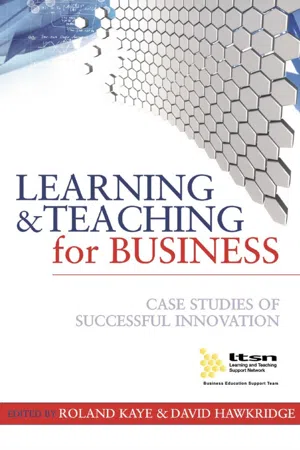
Learning and Teaching for Business
Case Studies of Successful Innovation
- 240 pages
- English
- ePUB (mobile friendly)
- Available on iOS & Android
eBook - ePub
About this book
This collection of best practice examples of business teaching should inspire and inform those involved in the improvement of teaching in higher education. Assembled by the Learning and Teaching Support Network the examples are drawn from institutions throughout the UK including: The Open University, Sheffield Hallam, City University, St Andrews, Brighton, De Montfort, Liverpool John Moores, Glasgow, Leeds Met and Plymouth. Individual case studies focus on everything from the use of action learning, resource based learning, using technology and peer assessment to the development of a knowledge management system.
Information
Chapter 1
Success in the new world of learning and teaching
Roland Kaye and David Hawkridge
This book contains what we have called the ‘BEST stories’, case studies of successful innovation in the new world of learning and teaching in business schools. BEST is the Business Education Support Team, of which we are members. BEST is the UK Learning and Teaching Support Network’s node for the disciplines of business, management and accounting in higher and further education. BEST’s Web-based survey of opinions of deans and heads of department in UK business schools in late 2000 provided leads to 126 innovations in learning and teaching. Our searches located ‘success stories’ among these innovations, and BEST invited the authors to write these up for publication as examples of good practice. The stories range across business, management and accounting. Some draw on information technology but others do not. Most are from newer universities and colleges. Some are tried and tested over 5–10 years; others are more recent All employ methods of learning and teaching that are transferable to other business school settings.
In this chapter we describe briefly the methods and criteria we used in the searches. We summarize each story to give an overview, and then explain how the innovations chosen for the stories differ from those excluded. Lastly, we discuss the evidence of success (and failure).
The Web-based survey
BEST’s first national landscape survey of views about learning and teaching the academic disciplines of business, management and accounting was in November 2000. With help from the Association of Business Schools, we sent a letter to several hundred deans and heads of department asking them, or their nominated representatives, to answer a short questionnaire on a Web site at the Open University. After e-mail follow-up of non-respondents, we received responses from 71 individuals at 49 universities and five institutions of higher or further education.
Our respondents gave us their opinions on many current major issues and concerns. They also furnished us with a large set of ‘elevator pitches’ they would make to important stakeholders—see BEST’s annual report (http://www.business.ltsn.ac.uk/) or the executive summary, Managing Better (BEST, 2002). This book, however, is based on some of the 126 innovations in learning and teaching that they considered newsworthy and ‘wrote in’ for us. We grouped these as in Table 1.1.
Changing the curriculum, teaching and assessment
Many of the 59 listed innovations in curriculum were new programmes of study, mostly at the post-graduate level, some for doctorates. Entrepreneurship, strategic management and leadership were the most frequently mentioned topics, but there were also programmes aimed at niche markets in creative management, leisure management, insurance management and management accounting. Others sought to increase relevance by building strong links with companies and incorporating work experience of various kinds. A few claimed to be grounded in research.
Among the innovations in teaching (other than those involving ICT—see below), problem-based learning, action learning, portfolios, case studies and simulations were prominent, together with provision of learning materials. Innovations in assessment were seldom listed but focused on peer assessment.
Table 1.1 Groups of innovations in learning and teaching
Using information and communication technology for learning
Our respondents listed 41 innovations that used ICT for learning. Among them were instances of teaching materials being delivered to students on CD ROM or the Web. Interactive Web sites featured in many, although there was no indication of whether these sites achieve economies of scale; some required students to use commercial software such as Lotus Learning Space and Blackboard, or UK-developed software (eg Byzantium). A few instances of national or international videoconferencing were mentioned.
Changing student attitudes and improving their skills
We noticed that serious concern about student attitudes was reflected less in the 24 innovations listed than was the desire to improve students’ skills. Many examples involved teaching relevant study and ICT skills or providing support services for students. Others were aimed at enabling students to work in teams or groups. A few tested students’ abilities on admission.
Staffing
Among the four innovations in this group, one involved recruiting appropriately qualified staff. The other three were aimed at staff development: the topics included improving lecture delivery, training tutors well and teaching e-learning competencies.
Dealing with competition and rivalry
Only three innovations fell clearly into this group. One involved international taught doctorates, another was based on partnership with overseas companies and the third gave students opportunities for consultancies in a multinational company.
Assuring quality of provision
Although many of the innovations may well contribute to improved quality, only two were aimed specifically at quality assurance. One involved the use of focus groups to explore quality considerations within units. The other involved accreditation of an innovative accounting course.
The search for ‘newsworthy’ stories
In early 2001 we started a search for further information on the innovations, with a view to creating and publishing ‘success stories’ in partnership with the authors concerned. The search was not easy. For the 126 innovations, there were 134 contacts. Some contacts were unreachable owing to wrong e-mail addresses. Some were the wrong contacts. Some had no e-mail addresses. So much for the accuracy of a few of our informants!
We told each e-mail contact that BEST was trying to find out more about the newsworthy innovations listed by the respondents. We asked the contacts to post to us any published or unpublished papers—or CDs/videos!—they had that described and/or evaluated that particular innovation. We said we would like internal committee papers, student handbook entries, student guides or course award documentation if these were available. We accepted them electronically as well as by snail mail. We also told the contacts that BEST might invite them to prepare a case study for national dissemination.
The next stage was to read and/or view what was sent and get back to the contacts to find out more details if necessary. When we had enough information, we compiled summaries of about 40 of the better ones and asked senior BEST members to choose the most newsworthy among these. In the end, we selected 12 innovations. We invited the authors of these to write them up for publication as examples of good practice, in return for the publicity, sharing the copyright and a modest honorarium.
For the authors chosen by BEST, writing up included adopting (in most cases) a straightforward rubric with a set of headings. Authors also agreed to work with the editors in ‘telling the story’, clarifying meaning and meeting a word limit of 6,000 words. In fact, this arrangement worked very well.
Our original plans for publishing the BEST stories were that, first, they would go on the BEST Web site (http://www.business.ltsn.ac.uk/); second, they would be printed by BEST as a series of individual booklets, complete with ISBNs, and, third, they would appear in a book. The first two stages have been completed, and this book is the third.
Since innovation is occurring continuously, further innovations in learning and teaching come to light each year. We started the search for more success stories when we decided to follow up on innovations reported as still in the early stages of development in 2001. But we also mounted a second Web-based survey. In BEST’s first survey respondents prioritized 11 potential tasks for BEST (see Table 1.2).
The top priorities by far were 1) the use of electronic resources for learning and teaching, and 2) adding or switching to e-learning and e-teaching, followed by 3) improving student assessment strategies and methods. As we had already collected quite a few stories relating to the first two priorities, BEST decided that the second survey, in late 2001, would focus on innovations in assessment of student performance. We used BEST’s own extensive database of postal addresses. As before, a letter invited respondents or their representatives to go to a Web site at the Open University On the site was a short questionnaire asking about the range of assessment methods in use and any newsworthy innovations. We received 42 leads, and sought further information about each innovation. In particular we wanted any papers, published or unpublished, written about these and any other innovations in this field. This search did not yield any additional BEST stories, however. Instead, Chapter 14 summarizes the findings, including some interesting minor innovations in assessing students’ achievement.
Table 1.2 Ranking of potential tasks for BEST
The stories so far
We say ‘so far’ because we are sure there are more stories worth telling and the search will continue as long as funds are available through the Learning and Teaching Support Network. The 12 newsworthy stories in this book, BEST’s first set, range across business (4), management (5) and accounting (3). Some draw on information and communication technology but others do not. Most are from newer universities and colleges. Some are tried and tested over 5–10 years; others are more recent. The stories are accessible on the BEST Web site (http://www.business.ltsn.ac.uk/). All employ methods of learning and teaching that are transferable to other business school settings. Our summaries follow, in the order in which they were published and in which they appear in this volume.
Chapter 2, Resource-based learning in the business environment, by Roger Ottewill and Ann Wall, School of Business and Finance, Sheffield Hallam University
This is the story of how tutors responsible for a business environment unit of study, driven by the desire to enhance the quality of their students’ learning experience and under pressure to secure efficiency gains, provided an innovative formof resource-based learning. Their students gained access to four types of resourceto support them in achieving learning outcomes: a unit learning scheme; learningsupport materials; a Web site; and timetabled weekly ‘learning encounters’ with tutors. Assessment was through a seamless web of coursework and examinationtasks, the former being both formative and summative. The unit was wellreceived and greatly valued by students, and the delivery mode enabled tutors toplay to their strengths while ensuring equivalent experience for all students.
Chapter 3, From leading edge to mainstream: the evolving Brighton Business School intranet, by Becci Newton, Cameron Paine and Stephen Flowers, Brighton Business School, University of Brighton
An intranet is an ‘in-house’ computer network that facilitates information and file sharing within a closed group of users. An intranet in an educational context is an innovation that enhances student access to information relating to their studies. A pilot intranet was introduced in Brighton Business School in late 1997. A second version using industry-standard software went operational in September 2000. This story is about the school when the system first arrived and compares it with the context in 2001, tracing changes in the system’s conceptual design and underlying technology. It analyses student and staff reaction at the two release dates. Finally, it discusses how such a project, in an established school with established learning and teaching methods, can be evaluated.
Chapter 4, The International Consultancy Assignment, by David Edelshain, Sir John Cass Business School, City University, and New York University in London, and Carol Vielba, Sir John Cass Business School, City University
This story is about the development and introduction of an innovative course taught jointly by City University Business School (CUBS, now Sir John Cass Business School) in London and Fordham Business School in New ‘York, originally in conjunction with Chase Manhattan Corporation. The course ran in 1998, 1999 and 2000, and is continuing in expanded form. Fordham Business School wanted to develop international links with other schools and approached CUBS. At that time the authors were directing the MBA programme at CUBS and had been developing international business as a prime feature of it. The two schools set up a joint course that would stress learning of knowledge and skills needed for international business. Read the story to find out how students from both schools were briefed and worked together before presenting their work to each other. The practical assignment topic for 1998 was the euro; in later years, e-commerce. The project’s style shifted from research on behalf of a client to an international consultant’s assignment. Like many innovations, this one raised pedagogical and academic issues.
Chapter 5, Introducing action learning into a business school, by Tom Bourner and John Lawson, Brighton Business School, University of Brighton
This story is about action learning in the business school at the University of Brighton. The authors tell how action learning began, and, following its successful introduction, how the innovation spread throughout the school and beyond. They analyse its development and application as self-managed action learning. They reflect on the worst and best aspects of its introduction, and what they might have done differently to ensure its wider adoption in the business school. Finally, they consider what helped and hindered the overall establishment of action learning.
Chapter 6, Byzantium for learning accounting in English business schools, by Ashok Patel, De Montfort University, Anne Cook, Liverpool John Moores University, and Tudor Spencer, University of Hertfordshire
Byzantium is interactive computer-aided learning software for introductory financial and management accounting. Innovatively, it emulates a human tutor and enables business school students to learn, practise and test their skills. Byzantium was developed by a consortium of six universities within the Teaching and Learning Technology Programme of the Higher Education Funding Councils of the United Kingdom (1993–97). This story is about Byzantium’s design, development and evaluation, and how students and staff can use the software. It includes details of Byzantium’s successful use at business schools in two English universities, Liverpool John Moores University and the University of Hertfordshire.
Chapter 7, Using Monopoly© as an introduction to financial accounting, by Graham Clayton, Department of Accounting and Law, University of Plymouth Business School
Playing the board game Monopoly© enables students to run their own property businesses and, thereby, create their own financial transactions. At Plymouth, students are actively involved in this innovation. Theory and practice meet. As a result basic financial accounting techniques are assimilated very effectively and students develop as autonomous learners. The authors have used Monopoly© since 1998 for the initial stages of a first-level financial accounting module. The module leader’s main role is to plan and administer the exercise. The students, to a large extent, run each session themselves. The students prepare balance sheets and profit and loss accounts for four trading periods. In addition, the exercise demands that they can interpret, at a basic level, their own and their peers’ financial statements. In playing the game, they develop a range of personal skills. They have greeted Monopoly© with much enthusiasm and feedback has been very positive. They enjoy being actively involved. Creating and recording their own financial transactions is an effective way of developing an understanding of how to draft simple financial statements. Adding a ‘betting’ element helps to develop the students’ skills in interpreting financial statements. Because of the success of this approach, Monopoly© is now also used on other modules at both undergraduate and postgraduate level. Again the impact on, and feedback from, students has been positive.
Chapter 8, Peer assessment and enhancing students’ learning, by Anne Gregory, Liz Yeomans and Joanne Powell, Leeds Business School, Leeds Metropolitan University
This is the story of how the authors innovatively used peer assessment in a pivotal module in their BA in Public Relations. They show how peer assessment relates directly to their learning, teaching and assessment philosophy for the course. A group assignment, addressing a typical public relations scenario, was the most appropriate form of assessment, because it could simulate types of campaigns and working practices in the public relations industry. The authors introduced peer assessment of individual students’ contributions to encourage cooperative working and to ensure fairness in marking. The authors also knew there were numerous objections to peer assessment, and that the principles and processes essential to making it acceptable to and successful with students required careful introduction, transparency and constant reinforcement. Used properly, peer assessment has proved valuable in rewarding appropriately individual students’ and groups’ contributions. It facilitates students’ ownership of the assessment process and encourages them to take responsibility for their own learning. Informal and formal evaluations of the module show that students give it the highest rating of any core module in the degree. Although peer assessment does not remove all student objections to group work, it has proved effective in reducing what they perceive as unfairness in group marks, and in encouraging careful reflection on individual and group contributions and performance.
Chapter 9, Group work and the Web: FINESSE and TAGS, by Rosa Michaelson, Christine Helliar, David Power and Don...
Table of contents
- Cover Page
- Title Page
- Copyright Page
- Figures
- Tables
- Contributors
- Foreword
- Acknowledgements
- Chapter 1 Success in the new world of learning and teaching
- Chapter 2 Resource-based learning in the business environment
- Chapter 3 From leading edge to mainstream: the evolving Brighton Business School intranet
- Chapter 4 The International Consultancy Assignment
- Chapter 5 Introducing action learning into a business school
- Chapter 6 Byzantium for learning accounting in English business schools
- Chapter 7 Using Monopoly© as an introduction to financial accounting
- Chapter 8 Peer assessment and enhancing students’ learning
- Chapter 9 Group work and the Web: FINESSE and TAGS
- Chapter 10 Using learning technology resources in teaching management accounting
- Chapter 11 Creating a Web site for studying strategic management
- Chapter 12 The live consultancy case study
- Chapter 13 Building and maintaining distributed communities of practice: knowledge management in the OUBS MBA
- Chapter 14 Assessing student performance
- Chapter 15 Learning from success
Trusted by 375,005 students
Access to over 1.5 million titles for a fair monthly price.
Study more efficiently using our study tools.
Frequently asked questions
Yes, you can cancel anytime from the Subscription tab in your account settings on the Perlego website. Your subscription will stay active until the end of your current billing period. Learn how to cancel your subscription
No, books cannot be downloaded as external files, such as PDFs, for use outside of Perlego. However, you can download books within the Perlego app for offline reading on mobile or tablet. Learn how to download books offline
Perlego offers two plans: Essential and Complete
- Essential is ideal for learners and professionals who enjoy exploring a wide range of subjects. Access the Essential Library with 800,000+ trusted titles and best-sellers across business, personal growth, and the humanities. Includes unlimited reading time and Standard Read Aloud voice.
- Complete: Perfect for advanced learners and researchers needing full, unrestricted access. Unlock 1.5M+ books across hundreds of subjects, including academic and specialized titles. The Complete Plan also includes advanced features like Premium Read Aloud and Research Assistant.
We are an online textbook subscription service, where you can get access to an entire online library for less than the price of a single book per month. With over 1.5 million books across 990+ topics, we’ve got you covered! Learn about our mission
Look out for the read-aloud symbol on your next book to see if you can listen to it. The read-aloud tool reads text aloud for you, highlighting the text as it is being read. You can pause it, speed it up and slow it down. Learn more about Read Aloud
Yes! You can use the Perlego app on both iOS and Android devices to read anytime, anywhere — even offline. Perfect for commutes or when you’re on the go.
Please note we cannot support devices running on iOS 13 and Android 7 or earlier. Learn more about using the app
Please note we cannot support devices running on iOS 13 and Android 7 or earlier. Learn more about using the app
Yes, you can access Learning and Teaching for Business by David Hawkridge,Roland Kaye in PDF and/or ePUB format, as well as other popular books in Education & Education General. We have over 1.5 million books available in our catalogue for you to explore.