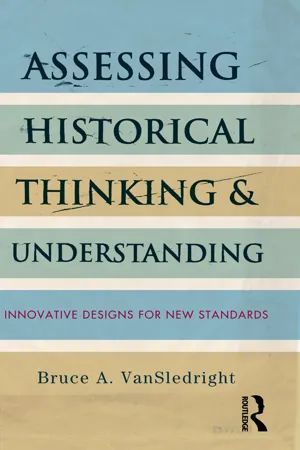
Assessing Historical Thinking and Understanding advocates for a fundamental change in how educators think about making sense of learners' developing cognition and understanding in history. Author Bruce VanSledright argues that traditional and typical standardized testing approaches are seldom up to the task of measuring the more complex understandings students are asked to attain, as they cannot fully assess what the student knows. Rather, he points forward along a path toward changes in learning, teaching, and assessing that closely aligns with the Common Core State Standards. He delves into the types of history knowledge the standards require, illustrates how they can be applied in-use in history learning contexts, and theorizes how the standards might fit together cognitively to produce deep historical understandings among students in teaching-learning contexts. By providing a variety of assessment strategies and items that align with the standards, and identifying rich, useful assessment rubrics applicable to the different types of assessments, he offers an important resource for social studies teachers and curriculum writers alike.
eBook - ePub
Assessing Historical Thinking and Understanding
Innovative Designs for New Standards
- 144 pages
- English
- ePUB (mobile friendly)
- Available on iOS & Android
eBook - ePub
Assessing Historical Thinking and Understanding
Innovative Designs for New Standards
About this book
Information
1
THE NEED FOR NEW ASSESSMENTS IN HISTORY EDUCATION
In a book dealing with assessment in history education, it might make sense to begin with a short history test. So test your mettle with the one that follows. Grab a writing tool and read the directions, then assess yourself on these 12 straightforward questions. At the end of the test, you will find an answer key. That will allow you to check how well you fared. Now don't cheat by looking at the answers beforehand.
U.S. HISTORY TEST1
Directions: Read Each Question Carefully. Then Circle the Correct Answer.
1.An important part of President Woodrow Wilson's Fourteen Points was that
| A | A League of Nations was to be created. |
| B | Germany had to surrender all its colonies. |
| C | Reparation for war damages had to be paid to the Allies. |
| D | The German Navy and Air Force had to give up the fight. |
2.Which of the following best describes an impact of European settlement during the colonial period on American Indians (First Americans)?
| A | Many American Indians died from European diseases. |
| B | Many American Indian tribes used European military tactics to retain their lands. |
| C | Many American Indians were educated in reservation schools. |
| D | European settlers were unable to convert American Indians to Christianity |
3.Immigrants in the late 19th century would most likely have been employed in which type of job?
| A | Manager |
| B | Specialized craft worker |
| C | Unskilled factory worker |
| D | Salesperson |
4.After the Stock Market Crash in October 1929, there was
| A | A decrease in demand for consumer goods |
| B | An increase in loans for buildings and factories |
| C | A decrease in business failures |
| D | An increase in industrial production |
5.What was the main reason for African American migration north between 1915 and 1925?
| A | Land prices fell in Midwestern states. |
| B | Food prices were lower in urban areas. |
| C | Immigrant communities were leaving Northern cities. |
| D | Job opportunities increased in factories. |
6.Henry Ford's development of the assembly line led most directly to the growth of:
| A | City slums |
| B | Child labor |
| C | Industrial production |
| D | Pollution problems |
7.The United States' involvement in the Korean War was an example of the postwar policy of
| A | Appeasement |
| B | Neutrality |
| C | Isolationism |
| D | Containment |
8.Which of these immigrant groups came to America late in the 19th century and helped build the railroads?
| A | Germans |
| B | Chinese |
| C | Polish |
| D | Haitians |
9.The economy of the Southern colonies was based primarily on which of the following?
| A | Agriculture |
| B | Fishing |
| C | Manufacturing |
| D | Mining |
10.Which type of economic system is based on private ownership of property and the profit motive?
| A | Traditional |
| B | Command |
| C | Subsistence |
| D | Capitalism |
11.Money paid to the federal government by individuals comes mostly from taxes on
| A | Their homes |
| B | Their income |
| C | Their gasoline purchases |
| D | Their food purchases |
12.Which was a common characteristic of Nazi Germany, fascist Italy, and the Soviet Union?
| A | They had similar economic policies. |
| B | They had the same religious beliefs. |
| C | They were ruled by dictatorships. |
| D | They had fought on the same side in World War I. |
| Answer key: | 1.A | 4.A | 7.D | 10.D |
| 2.A | 5.D | 8.B | 11.B | |
| 3.C | 6.C | 9.A | 12.C |
Putting how you scored aside for the moment, I would like to begin by making a series of observations about this “U.S. History Test” and particularly the items within it. First, this cluster of questions is drawn from the state of Virginia's Standards of Learning (SOL) year-end, high-stakes U.S. History test given to secondary students. These particular items come from those that the state has released. Second, as I am certain you noticed, the items sample across a temporal range extending from early British exploration and colonialism in North America through World War II. A few items also attempt to sample ideas about how capitalism is defined and where the federal government obtains the largest share of its revenue. In these senses, the range of items is designed to test students (and now you, if you took the test) not only for what they remember about historical events in America's past, but also about at least two concepts directly.
Third, I want to observe how familiar this test must seem. It is structured using the typical, traditional multiple-choice format, with three “wrong” options and only one “correct” one. Anyone currently living and who has been to school in the United States has undoubtedly taken a test at some point that looks something like this one, and likely more than once. They are simply ubiquitous. And fourth, I want to stress how scores on such tests, in Virginia and many other states as well, are used to make eventual decisions about whether students will receive a high school diploma, or instead will stand in line to receive some sort of remediation, including being held back.
Now I want to look more closely at what exactly such tests sample by way of historical knowledge, understanding, and thinking capability. The latter of these three represents the quality of being able to actually do something with the former two.
Because the ostensibly correct answer is supplied among the four options, this is more a test of a student's ability to identify or recognize that correct option. It is not much of a test of recall in the way someone might ask you at a social event who the 16th president of the United States was. If, therefore, a history student learns to become an astute test-taker, she can study the question prompt and attempt to ferret out the correct answer via textual context clues among the options. In this way the test is as much a measure of reading comprehension as it is a test of historical knowledge—and perhaps more so. However, if we put this concern on the sidebar for the moment, we can ask about what sorts of historical knowledge this 12-item test does sample.
Research over the past several decades on the nature of what it means to learn history is useful here.2 Although not all history education researchers employ the following typology in exactly the same way, it does serve as a constructive guide for my purposes here. Knowledge in the domain of history can be roughly divided into two types: substantive (what, where, when, etc.) and strategic (how to get to the what, where, when, etc.). The division is only illustrative, however, because in learning history, each type of knowledge depends on the other and the boundaries separating them are decidedly porous. My brief treatment of these types of knowledge must suffice here, but I will return to them in more detail in the next chapter.
Substantive knowledge in history can be construed in two ways, again primarily for clarity and illustrative purposes. The first type is knowledge of who, what, where, when, how, and why questions (some call this first-order knowledge).3 It also involves understanding definitions of such terms as revolution, democracy, and dictatorship that can serve as shorthand for larger clusters of ideas. This type of knowledge enables what we might call small- and big-picture narrativized or story-like understandings of the past, such as what the causes and consequences were for the Civil War or the Industrial Revolution.4 The second type hinges on working with conceptual ideas that historical investigators impose on an unruly, complex past to bring some (artificial?) coherence to it in ways that enable deeper understanding. These include ideas such as progress/decline, change/continuity, historical significance, evidence for claims, and moral judgment. They are sometimes called second-order concepts. They have procedural components and so, in use, they bridge strategic and substantive knowledge. Therefore, some refer to them as substantive procedural concepts.5
Strategic knowledge involves possessing and deploying domain-specific strategies (i.e., thinking historically, the how to) for posing and answering rich historical questions that result in deeper understandings of the past. In other words, this means doing history, engaging in those cognitive efforts—searching out evidence, assessing the sources for what they may offer, making sense of the perspectives of the sources' authors, judging an author's reliability in making reputable claims—in service of answering historical questions of interest. Notice the active nature of doing here, represented in the italicized words. This thinking process also involves, as I noted, working with and applying second-order concepts to help manage and discipline that process. The result is first-order understanding—that is, knowing who, what, where, when, how, and why. Historical thinking, therefore, becomes the sine qua non of historical knowledge development and understanding.6
If we can return again to the “U.S. History Test” you just took, we can begin to see how much of this range of different types of knowledge it samples. If you look closely again at each item you will see that, at best, only a third of the types of knowledge I just described are tested. In fact, the 12 items sample exclusively first-order understandings: Wilson's “Fourteen Points,” encounter impacts, 19th-century immigrant job types, consequences of the 1929 stock market crash, and so on. There are no items that test explicitly for knowledge of second-order concepts such as progress/decline, historical significance, or what constitutes historical evidence. Nor are there are items that test the capacity to think historically, such as how to arbitrate between two or three sources that offer conflicting testimony about what occurred at some seminal historical incident.
Based on this analysis and its subsequent observations, we might conclude that the test would produce an impoverished gauge of student understanding in history, at least the way the resea...
Table of contents
- Cover
- Half Title
- Title Page
- Copyright Page
- Table of Contents
- Preface
- 1 The Need for New Assessments in History Education
- 2 A Sociocultural Cognitive Model for Learning History
- 3 Mapping Assessment Tasks to the Learning Model
- 4 Interpreting Assessment Tasks
- 5 Standards, Assessments, Testing, and Questions of Alignment
- Appendix
- Index
Trusted by 375,005 students
Access to over 1.5 million titles for a fair monthly price.
Study more efficiently using our study tools.
Frequently asked questions
Yes, you can cancel anytime from the Subscription tab in your account settings on the Perlego website. Your subscription will stay active until the end of your current billing period. Learn how to cancel your subscription
No, books cannot be downloaded as external files, such as PDFs, for use outside of Perlego. However, you can download books within the Perlego app for offline reading on mobile or tablet. Learn how to download books offline
Perlego offers two plans: Essential and Complete
- Essential is ideal for learners and professionals who enjoy exploring a wide range of subjects. Access the Essential Library with 800,000+ trusted titles and best-sellers across business, personal growth, and the humanities. Includes unlimited reading time and Standard Read Aloud voice.
- Complete: Perfect for advanced learners and researchers needing full, unrestricted access. Unlock 1.5M+ books across hundreds of subjects, including academic and specialized titles. The Complete Plan also includes advanced features like Premium Read Aloud and Research Assistant.
We are an online textbook subscription service, where you can get access to an entire online library for less than the price of a single book per month. With over 1.5 million books across 990+ topics, we’ve got you covered! Learn about our mission
Look out for the read-aloud symbol on your next book to see if you can listen to it. The read-aloud tool reads text aloud for you, highlighting the text as it is being read. You can pause it, speed it up and slow it down. Learn more about Read Aloud
Yes! You can use the Perlego app on both iOS and Android devices to read anytime, anywhere — even offline. Perfect for commutes or when you’re on the go.
Please note we cannot support devices running on iOS 13 and Android 7 or earlier. Learn more about using the app
Please note we cannot support devices running on iOS 13 and Android 7 or earlier. Learn more about using the app
Yes, you can access Assessing Historical Thinking and Understanding by Bruce A. VanSledright in PDF and/or ePUB format, as well as other popular books in Education & Education General. We have over 1.5 million books available in our catalogue for you to explore.