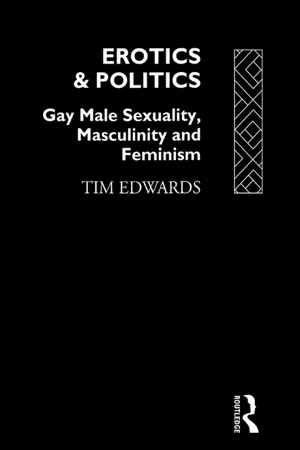
Erotics and Politics provides an interface between the study of sexuality (particularly gay male studies) and gender (primarily feminism). In doing so it covers a wide range of issues of concern to gay and feminist movements over the past twenty five years including gay liberational sexuality, sado-masochism, pornography, promiscuity, personal relationships, AIDS and postmodernity. The central focus of attention throughout is the nature, development and consequence of gay male sexuality and masculinity. This book is unique in its coverage of a wide range of issues and connecting subjects which are typically examined separately.
- 208 pages
- English
- ePUB (mobile friendly)
- Available on iOS & Android
eBook - ePub
About this book
Information
CHAPTER 1
Coming out, coming
together
Coming out is a modern concept, yet its practice involves levels of difficulty that have a very long history: fears of rejection, isolation, confusion, categorisation, of making the wrong decision, of the limits of identity. Coming out for me was a slow, often painful, often confusing, sometimes exhilarating process of experience: not a sudden development. My parents suspected I was not the latest edition of contemporary heterosexual conformity soon after I entered primary school as I stubbornly dumped footballs, played with little girls instead of little boys, and developed a talent at drawing pictures. Consequently, homosexuality was a possibility prior to puberty, a probability during adolescence as girlfriends never did appear, and definite, if difficult, after it. The difficulty was my infatuation with women emotionally and my constant hankering after first one man and then another sexually. Isolation ensued The solution of sorts came to me, like many others of my middle-class, well-educated generation, in going to university. As an undergraduate, I joined the gay soc and went on the scene and, as a postgraduate, I threw the closet door open completely, launched myself into gay studies and proclaimed myself as an openly gay student and class teacher. The support of a gay supervisor, other gay or lesbian lecturers and students and, overall, a tolerant or ‘right on’ department more than helped I also stopped living in households where there was less than support or acceptance of homosexuality which usually meant living with other gay men. Following this through into the ‘real world’ of work and ‘making it’ as a single man with, discrimination and without some of the economic benefits of heterosexual coupledom is a problem, not insur-mountable, but a problem…
Homosexuality is perceived to be a ‘problem’ for society. Similarly, society is perceived to be a ‘problem’ for homosexuals and homosexuality. Something, apparently, has to be done about them and something, consequently, has to be done by them about the problems imposed upon them, and this is the double bind of this book.
The making of the modern homosexual
Homosexuality in this culture is a stigma label. To be called a ‘homosexual’ is to be degraded, denounced, devalued or treated as different. It may well mean shame, ostracism, discrimination, exclusion or physical attack. It may simply mean that one becomes an ‘interesting curiosity of permissiveness’. But always, in this culture, the costs of being known as a homosexual must be high.(Plummer, 1975:175)
The state does not create homosexuality, yet it does seek to construct its significance, regulate and control it and indeed, all sexuality, though most vehemently male homosexuality. Male homosexual practices have occurred across all centuries in all societies, yet the male homosexual identity and more particularly the gay man and the gay community are a more recent phenomenon.1 Importantly, the universality of male homosexuality has received the most culturally specific of societal reactions from mild legitimation to wild damnation. Male homosexuality has, however, never received an acceptance, parity, or an equality with heterosexuality. The irony of identity politics is that in creating an opposition to state oppression, the state's power to define and regulate sexuality is inadvertently increased; yet not to have an identity is to retreat into defeat, retire into obscurity, or even vanish into invisibility. Consequently, the question becomes one not of ‘identity or not’ but of ‘what identity, where, why and how’? Most of the contemporary literature on sexual politics and male homosexuality sees identity as a culturally specific necessity and the question of causality or consequence constantly collapses into a mere lauding of identity, or at least a plurality of identities, per se.2 It is to this question, then, of the hows and whys, rights and wrongs, pros and cons, of identity which I will most particularly consider here.
The history of homosexuality
Homosexuality has existed throughout history, in all types of society, among all social classes and peoples, and it has survived qualified approval, indifference and the most vicious persecution. But what have varied enormously are the ways in which various societies have regarded homosexuality, the meanings they have attached to it, and how those who were engaged in homosexual activity viewed themselves.(Weeks, 1977:2)
The history of homosexuality is highly loaded with anachronistic, technical and interpretive difficulties on several levels. First, in the question of definition and conceptualisations of sexuality, as already pointed out, they are culturally specific and located in time and space. Consequently, what's ‘gay’ today wasn't yesterday or isn't in another society and so on. Second, this leads on to a question of reinter-pretation of the past, or even reinvention, when the actors concerned are silenced and can no longer speak and give their meanings and interpretations of themselves and their situation. Third, this leads to a difficulty concerning actual sources which increase in sparsity and speciousness the further afield one steps or the further one rewinds the clock.
However, a couple of texts in particular have tried to provide an overall perspective on the whole history of homosexuality: first, David Greenberg's The Construction of Homosexuality (1988); and second, Duberman et al.'s edited collection Hidden from History (1989). The difficulty of each lies in the potential loss of perspective across such a wide canvas. Consequently, the question then centres on more specific studies of sexuality and these include work on the Greco-Roman empire's forms of sexual practice (Eglinton, 1971) and Medieval and Renaissance England (Bray, 1982).
Moreover, far and away the most well-documented period of history is that of approximately the past one hundred years in England and America and, to a slightly lesser extent, Europe, primarily through the work of new social historians (Adam, 1987; Altman, 1971, 1982; D'Emilio, 1983; Katz, 1976; Weeks, 1977, 1981, 1985), all of whom share varieties on the same socially constructionist perspective on sexuality and tend to highlight similar sets and points of development although they may emphasise the importance of different points in time and space.3
To summarise this study, the history of homosexuality in western society over the previous century is crudely classified here, using my terminology, into five interrelated phases or developments: damnation, criminalisation, medicalisation, regulation, and reform. Moreover, there is perhaps a sixth developing at present following the medico-political impact of the AIDS epidemic (see Chapter 7). Importantly, all of these phases or developments not only interact and connect, they, to an extent at least, coexist and are all in evidence, alive and kicking, in today's contemporary society. The question centres then, more on the rise and fall of these developments and of their dominance or decline. Consequently, artificial as they are, they remain valid heuristic devices.
Damnation
The history of the sacred control of sexuality is sparse to say the least and distinctly anachronistic, though nonetheless often considered significant.4 Consequently, the rise of Judaeo-Christian religions and, in particular, Protestantism and Catholicism, is often seen as instrumental in forming some of the first moves in legitimating certain forms of sexuality and condemning others, fostering fears and fuelling hostilities towards those ‘other’ sexualities.
This essentially started with the Reformation of the Church in the early part of the second millennium. In aiming to control and regulate its own wayward activities it inadvertently led to later control and regulation of activities throughout the rest of the society. Specific codes and condemnation depended on the conditions of the particular doctrine in question, though what they all had in common was a series of prohibitions against non-procreative forms of sexuality such as sexual pleasure per se, prostitution, extramarital sex, and (male) homosexuality in the form of same-sex practices and particularly sodomy. Women's sexuality was controlled more through marital mores, male power and prostitution, and effectively rendered nonexistent unless directed towards men, although the persecution of witches in the fifteenth and sixteenth centuries is frequently regarded as indicative of control of women's sexuality.5 Consequently, this meant that homosexuality was a sin, an abomination, a crime against nature and worthy of damnation. It is important to point out, though, that this applied to practices and not people: there were no ‘homosexuals’ and practices were also defined retrospectively as ‘homosexual’ in terms involving same-sex relations and, in particular, sodomy.
Criminalisation
From 1885 to 1967 all male homosexual acts and male homosexuality in England and Wales as set out in law were completely illegal. The criminalisation of male homosexuality came with Section 11 of the Criminal Law Amendment Act of 1885 which sought to reaffirm moral and social order within an outbreak of concern over national identity in the uproar over Home Rule for Ireland and the decline of the Empire, city lifestyles and contamination, and the overall political perception of sexual depravity. Male homosexuality was one target among many, the others particularly including prostitution, soliciting, and an outcry over public decency and public health following the Contagious Diseases Acts of the 1860s. Underlying all of this were patterns of development in industrialisation, urbanisation and social stratification. The working class were increasingly militant, middle-class women involved in purity campaigns were increasingly opposed to male sexuality, and cities were creating their own problems in maintaining order and decency in anonymity.
Prior to the Amendment, the only act of law which applied in any way directly to homosexuality was the law on sodomy, part of the 1533 Act of Henry VIII, a law which was applied with varying degrees of vigilance in convictions and sentences due to the need to produce proof of entry and ejaculation, a situation which was worsened in the early nineteenth century when Sir Robert Peel dropped the need to prove ejaculation and reinstated the death sentence in 1826. Curiously, sodomy was still an ill-defined concept, on occasions conflated with concepts of procreation, contraception or oral sex. The death sentence was effectively outlawed from the 1930s onwards having been removed from the statute book in 1861 and replaced by hard labour, particularly for those in the armed services commonly seen as a particular problem in maintaining social order due to the ideologies of contagion and seduction surrounding confined same-sex environments.6 The death penalty was, however, only dropped completely in the nineteenth century to make way for a wider net of state regulation of sexuality.
Medicalisation
More or less simultaneously with the criminalisation of male homosexuality, came its medicalisation. Whilst homosexual practices had existed for centuries, the notion of a specific homosexual person did not appear until the late nineteenth century when a Swiss doctor, Karoly Maria Benkert, formally coined the term in 1869 and it developed into more common parlance in the 1890s. At the same time, clinical psychology was expanding its role as a science seeking to explain human variations in sexuality through experiments and studies of patients in terms of medical-psychological models of causality. Krafft-Ebing's Psychopathia Sexualis (1886) was a classic in this sense as a series of clinical case studies used to develop a scientific understanding of sexuality. Consequently, a whole series of codes and categories were created to cover every perversion, fetish and sexual turn-on, from fetishism to sado-masochism, and from precept to practice.
Significantly, sexual orientation in itself and sexual orientations were in the making and these included homosexuality. Havelock Ellis, the most significant sex scientist in England at the time, created the notion of Sexual Inversion (1897) used to define male homosexuality in a similar way to Karl Heinrich Ulrich's coining of the term ‘Urning’ or ‘Uranian’ in Germany to categorise the situation of having a ‘feminine soul in a male body’.
In addition, the problematic implication of this was the conjunction of male homosexuality with effeminacy, conflating sexuality and gendered identity. Thus, these theories tended to, on one level, pathologise the homosexual as someone sick or medically ill or in need of treatment: ‘If the law and its associated penalties made homosexuals into outsiders, and religion gave them a high sense of guilt, medicine and science gave them a deep sense of inferiority and inadequacy’ (Weeks, 1977:31).
This similarly also led to governmental regulation of sexuality, particularly in high places, and the Oscar Wilde trials of the late nineteenth century were a prominent example of a political moral panic simultaneously stigmatising, pathologising and regulating the newly defined male homosexual as part of maintaining the status quo of sexual and class inequality.
Regulation
The two world wars created a crisis economically and socially in recreating national wealth and reasserting social order. In addition, they had contradictory effects on homosexual communities. On one level, they inadvertently fuelled the homosexual community in creating the opportunity for furthering same-sex relations within the confines of specific collectivities.6 However, on another level, the second world war led to the decimation of some gay communities, particularly in Germany under the Third Reich and concentration camps where the pink triangle was used to signify homosexuality and implied a high placing on the list of exterminations and, moreover, meant above-averagely barbaric behaviours against homosexuals nationwide documented powerfully in Richard Plant's The Pink Triangle (1987). The pink triangle is now an international gay and lesbian symbol of both grieving for lost brothers and sisters and of opposition to oppression.7
The Wolfenden Committee and its report in 1957, recommending the decriminalisation of male homosexuality and imposing in turn its regulation through ‘privatisation’ (i.e. legalising it in private only) and limiting the age of consent to twenty-one, therefore protecting innocent minors and children, was a reaction to the problem of reasserting social order as part of an economic and political moral panic. The lead up to Wolfenden was one of increasing change: gradual acceleration of economic growth, the changing form of family life to more and smaller households, the increasing participation of women in the workforce, the separation of sex from procreation through the developing production of contraception finalised in the pill in the 1960s, and the development of sexual consumerism, marketing and recreation.
In addition, a political time bomb went off when Burgess and Maclean, two known homosexual diplomats, defected to the Soviet Union. On top of this, the high public profile of the MontaguWildebloode trial created a political panic and an explosion of consciousness and concern over sexuality, particularly in high diplomatic places.
Similarly, Kinsey and his associates' notorious reports and publication...
Table of contents
- Cover
- Half Title
- Critical studies on men and masculinities
- Full Title
- Copyright
- Dedication
- Contents
- Acknowledgements
- Introduction
- 1 Coming out, coming together
- 2 Sexual politics and the politics of sexuality
- 3 Gender and generation
- 4 Sado-masochism, masculinity and the problem of pornography
- 5 Public sex: the eroticisation of an oppressed position
- 6 Private love: an alternative?
- 7 The AIDS dialectic
- 8 Politics, plurality and postmodernity
- Conclusion: erotic politics
- Notes
- Bibliography
- Index
Trusted by 375,005 students
Access to over 1.5 million titles for a fair monthly price.
Study more efficiently using our study tools.
Frequently asked questions
Yes, you can cancel anytime from the Subscription tab in your account settings on the Perlego website. Your subscription will stay active until the end of your current billing period. Learn how to cancel your subscription
No, books cannot be downloaded as external files, such as PDFs, for use outside of Perlego. However, you can download books within the Perlego app for offline reading on mobile or tablet. Learn how to download books offline
Perlego offers two plans: Essential and Complete
- Essential is ideal for learners and professionals who enjoy exploring a wide range of subjects. Access the Essential Library with 800,000+ trusted titles and best-sellers across business, personal growth, and the humanities. Includes unlimited reading time and Standard Read Aloud voice.
- Complete: Perfect for advanced learners and researchers needing full, unrestricted access. Unlock 1.5M+ books across hundreds of subjects, including academic and specialized titles. The Complete Plan also includes advanced features like Premium Read Aloud and Research Assistant.
We are an online textbook subscription service, where you can get access to an entire online library for less than the price of a single book per month. With over 1.5 million books across 990+ topics, we’ve got you covered! Learn about our mission
Look out for the read-aloud symbol on your next book to see if you can listen to it. The read-aloud tool reads text aloud for you, highlighting the text as it is being read. You can pause it, speed it up and slow it down. Learn more about Read Aloud
Yes! You can use the Perlego app on both iOS and Android devices to read anytime, anywhere — even offline. Perfect for commutes or when you’re on the go.
Please note we cannot support devices running on iOS 13 and Android 7 or earlier. Learn more about using the app
Please note we cannot support devices running on iOS 13 and Android 7 or earlier. Learn more about using the app
Yes, you can access Erotics and Politics by Tim Edwards in PDF and/or ePUB format, as well as other popular books in Ciencias sociales & Estudios de género. We have over 1.5 million books available in our catalogue for you to explore.