Psychology has traditionally examined human experience from a realist perspective, focusing on observable 'facts'. This is especially so in areas of psychology which focus on the body, such as sexuality, madness or reproduction. In contrast, many sociologists, anthropologists and feminists have focused exclusively on the cultural and communicative aspects of 'the body' treating it purely as an object constructed within socio-cultural discourse.
This new collection of sophisticated discursive analyses explores this divide from a variety of theoretical standpoints, including psychoanalysis, social representations theory, feminist theory, critical realism, post-structuralism and social constructionism.
Body Talk reconciles the divide by putting forward a new 'materialist-discursive' approach. It also provides an introduction to social constructionist and discursive approaches which is accessible to those with limited previous knowledge of socio-linguistic theory, and showcases the distinctive contribution that psychologists can make to the field.
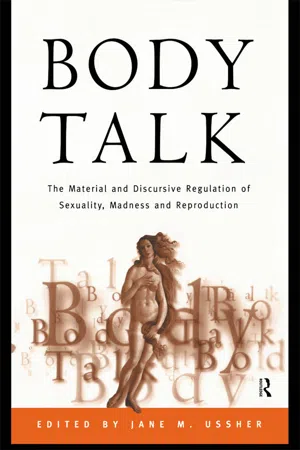
eBook - ePub
Body Talk
The Material and Discursive Regulation of Sexuality, Madness and Reproduction
- 272 pages
- English
- ePUB (mobile friendly)
- Available on iOS & Android
eBook - ePub
About this book
Information
Subtopic
History & Theory in PsychologyIndex
Psychology1 Introduction
Towards a material–discursive analysis of madness, sexuality and reproduction
Jane M. Ussher
‘BODY TALK’: WHAT DOES THIS MEAN?
To talk of the body is to talk of corporeality, action and flesh. Or so it is said in science, psychology and the law.
Or:
To talk of the body is to talk of discourse, of signs and signifiers, of representations of fantasy and desire. So say poststructuralist, semiotic and psychoanalytic theorists.
Which is the truth? Which way should we turn?
This is the perennial material-discursive divide. Those who stand on the ‘material’ side focus on the physical aspects of experience – on the corporeal body, the literal implementation of institutional control, the impact of the social environment, or on factors such as social class or economic status. Those who focus on the ‘discursive’ look to the social and linguistic domains – to talk, to visual representation, to ideology, culture and power. Theorists and critics from each side of the divide have seen the body as their rightful domain. To one camp it is a matter of physical flesh, to the other it is a matter of symbols and signs. So, again, which is the truth, which way should we turn?
This book explores a range of answers to these questions, from a variety of theoretical positions and epistemological standpoints, including psychoanalysis, social representations theory, feminist standpoint theory, critical realism, poststructuralism and social constructionism. Those who are looking for a battle of wills (or of words), or a rerun of either the nature–nurture or the realist– relativist debate should stop at this point. You will not find it here. For at one level the solutions to the material-discursive dilemma which are offered in this book are all the same. The view that we need to move away from the binary divide between material and discursive analyses of the body, towards a position which allows us to recognise the interaction and interrelationship between the two, is what unifies the individual contributions. What distinguishes them from each other is the way in which the material-discursive question is addressed, and the suggestions for future developments in research or theory which arise from the arguments that are outlined. A number of the contributors focus on theory and critique, outlining the problems in adopting either a solely material or discursive critique, then outlining the solutions that they have adopted in their own work. Others focus on empirical work, illustrating the way in which the material body is constructed and interpreted through discourse, and outlining the implications of this for understanding the supposed truths of sex, madness or reproduction. Some of the contributors do both.
Those who argue for an entirely materialist analysis or, in contrast, take up the view that ‘there is nothing beyond the text’, are not amongst the contributors to this book. Their views may be implicitly evident – indeed it is the acknowledgement of the presence and power of these divided positions which underpins all of the analyses and arguments that are being put forth here – but the detailed exposition of each of these conflicting standpoints has already been conducted elsewhere. For those who require a brief introduction, I will outline the basic tenets of each position below.
THE MATERIAL-DISCURSIVE DIVIDE
Focusing on the material
Science, psychology and the law have traditionally examined all human experience from a realist perspective, within a positivistic framework which focuses on observable ‘facts’. The aim of the expert has been to uncover objective ‘truth’, and to narrowly delineate the boundaries of the scientific or legal gaze. This is never more clear than in areas of expertise which focus on sexuality, madness or reproduction, where the material body stands at the centre of the scene. So sexuality is being reduced to instinctual drives, physiological arousal, penile pulse amplitude or vaginal swelling; reproduction to evolutionary concepts of mating, hormones or to the physical machinations of the womb; and madness to observable symptoms, inherited disorders or to the action of the brain. The classificatory systems, such as the Diagnostic and Statistical Manual of the American Psychiatric Association (DSM) which provide the boundaries for both research and clinical intervention in these areas, act to reify a positivist approach. The categorisation of sexual, reproductive or mental health disorders is based entirely on what can be measured or observed, thus reinforcing the focus on material phenomena in these different spheres. Equally, aetiological theories which have been developed to explain anything which falls outside of the norm have tended to remain within a reductionist domain. So, for example, phenomena as far-ranging as depression or schizophrenia, premenstrual or menopausal symptoms, deviant desires or sexual dysfunctions, homosexuality or male sexual mastery, have been attributed to internal hormonal or biochemical factors. These aetiological theories focus on the physical body as if that is all there is. As a consequence, any person who turns in this direction for help will find that attention to the body is all that they will get.
Take the case of sexuality. Within mainstream sex research male sexuality is reduced to testosterone and androgens, to the functioning of the penis, to erection and ejaculation; female sexuality to ‘vaginal pulse amplitude’, orgasmic responses, and the female arousal cycle. ‘Sex’ is unproblematically defined as heterosexual performance or response; attention focused on the actions of the penis in heterosexual intercourse. These easily observed and measured bodily ‘realities’ are dissected, explored, in the quest to finally uncover the mysteries of sex. Biological theories are offered as explanations for sexual violence, sexual problems and sexual deviation – as well as for the vagaries of ‘normal’ sex. All are deemed traceable to instincts, drives or to hormonal (im)balances; to the influence of a particular gene.
For example, one sexual scientist, Simon Le Vay, demonstrates this simple reductionist analysis of sex in his description of heterosexual intercourse, which he describes as such a simple behaviour that ‘one hardly needs a brain to do it’ (Le Vay, 1993: 47). Here is his description of the ‘basic components’ of ‘coitus’, step by step:
(1) erection of the penis; (2) engorgement of the walls of the vagina and the labia majora, lubrication of the vagina by glandular secretions and transudation, and erection of the clitoris; (3) insertion of the penis into the vagina; (4) pelvic thrusting by one or both partners; (5) elevation of the uterus, with a consequent forward and upward rotation of the mouth of the cervix; (6) ejaculation of semen into the vagina; and (7) orgasm, the intensely pleasurable sense of climax and release, often accompanied by increases in heart rate, flushing of the skin, muscle spasms, and involuntary vocalizations.
(Le Vay, 1993: 47)
Le Vay unquestioningly puts forward the notion of ‘sex’ as heterosexual intercourse. As in traditional sociobiological theories of sex, the woman’s response follows that of the man – it is assumed that male arousal (and orgasm) comes first. Equally, female arousal is only considered here as vaginal response. Le Vay implicitly negates the symbolic domain, unconscious factors, or indeed any other form of sexual stimulation, or desire, as well as the social and discursive construction of ‘sex’. This gives the material body pre-eminent status, and reinforces the power of the sexual scientist, whose theories and therapies are positioned as ‘truth’. The fact that these theories reinforce phallocentric notions of ‘sex’ and of gendered power is ignored (Ussher, 1997).
In a similar vein, sexual problems are signified by a dysfunctional body. Take the case of male sexual dysfunction as it is classified in the DSM. With the exception of ‘disorders of desire’, where the problem is manifested by absence of interest or aversion to sex, it is the functioning of the material body, in this case the penis, which is at issue here. So the DSM-IIIR classifies male sexual problems as falling into the categories of male erectile disorder; inhibited male orgasm, and premature ejaculation. This perhaps explains why treatment for male sexual problems often focuses entirely on the material body, and why physical interventions, such as penile implants, are such a popular treatment for erectile problems in both Britain and the United States (see Teifer, 1986). These diagnostic categories and treatments also position sexual problems within an individualising framework, denying the fact that ‘sex’ is for the most part a dyadic activity, and that the responses and subjective experience of the man’s partner are as relevant and significant as his own. They ignore the social meaning of sex (and of sexual ‘failure’), as well as the importance of the discursive construction of the body and of desire.
Similar criticisms have been made about materialist analyses of madness and reproduction: The physical body is at the centre of theorising and of ‘cure’; realist thinking leads to a negation of the meaning of symptomatology, or of aetiological factors based in the social domain; the power of the expert is preeminent (see Foucault, 1976; Ingelby, 1982; Ussher, 1991). In order to address some of these critiques, in recent years those working within a ‘bio-psychosocial’ framework, or those interested in social and psychological aspects of experience, have ‘added on’ a psychosocial-dimension to the traditional material interpretations of sex, madness or reproduction. However, the majority of scientists and clinicians working within this field still rely on realist assumptions, failing to question the social or discursive construction of bodily experience, the influence of their own subjectivity or ideological standpoint on the theories or therapies they develop, and the role of scientific or legal discourse associated with the body in social regulation and control (for an elaboration of these arguments applied to PMS, see Ussher, in press).
The turn to language
In contrast, many social theorists – including sociologists, anthropologists, social psychologists and feminists – have turned their attention exclusively to the cultural and communicative aspects of ‘the body’, often treating it as a phenomenon virtually unrelated to the biological processes traditionally studied in science and psychology. Here, the physical body appears as an object constructed within sociocultural discourses and practices; it stands as a symbol or a sign.
For example, in recent years, largely due to the influence of poststructuralist theorising, critical feminist attention has shifted to the power of symbolic representations of the sexuality of ‘woman’ and their role in the social regulation of women. This has led to critical analyses of how ‘woman’ is portrayed in a range of discursive contexts – from art (Pollock, 1988), film (Kaplan, 1983), popular culture (Douglas, 1994), literature (Gilbert and Gubar, 1979), pornography (Segal and McIntosh, 1993), to science and the law (for an analysis of the relationship between these different genres, see Ussher, 1997). The focus here has been on the regulatory power of discourse – control through that which Foucault termed the ‘intelligible body’. Many of these critiques focus on that which semiotic theorists would term ‘woman as sign’,1 the analysis of what ‘woman’ signifies or symbolises at a mythical level2 – the representation of woman as object, or as fetish, and the splitting of ‘woman’ into Madonna or whore. These representations have been seen to maintain the position of woman as object or ‘Other’, in contrast to man who is subject or ‘One’, as representation plays a central role in the formation of subjectivity. As one critic commented, ‘one becomes a woman in the very practice of signs by which we write, speak, see . . . This is neither an illusion nor a paradox. It is a real contradiction – women continue to become woman’ (Blumm, 1984). Rather than sexuality being pre-given or innate, here it is seen as something which is performed or acquired. In the process of becoming ‘woman’, women follow the various scripts of femininity which circulate in the symbolic sphere, negotiating the contradictory representations and repertoires which are hegemonic at any point in time, in order to find a fit between what they wish to be and what is currently allowed (Ussher, 1997). The fact that women invariably take up (a few reject) the position of sexualised ‘woman’, who is always seen in relation to ‘man’, is attributed to the dominance of phallocentric discourse and the fact that gender is constructed within a heterosexual matrix (Butler, 1990).
These critical discursive or representational analyses have also had an impact on the way in which theorists and researchers conceptualise and research madness (Foucault, 1967; Gilman, 1988), reproduction (Ussher, 1989; Martin, 1989) and male sexuality (Segal, 1993; Frosh, 1994), with a number of significant consequences in terms of theory and clinical practice. For example, taxonomic categories of deviance or illness, which have been unconditionally accepted within science and psychology, have been deconstructed: the notion of the ‘homosexual’ or ‘heterosexual; of ‘paraphilias’; of sexual crimes; of vaginal penetration as ‘sex’ (and failure in this sphere as ‘dysfunction’); of disinterest in sex or premenstrual distress as a ‘problem’. These arguments fit neatly into a liberal or libertarian framework, and are in many ways parallel to the arguments made in the 1970s about the need to deconstruct categories of mental illness – the danger in labelling someone as ‘schizophrenic’ or ‘depressed’, and assuming that these are ‘real’ illnesses which are just waiting to be found, rather than being social categorisations placed on sets of symptoms or behaviours which deviate from the ‘healthy norm’; a pathologising of those that threaten the status quo, and the peace or power of dominant social groups (Ingelby, 1982; Ussher, 1991).
Yet there is a down side to this deconstruction. Where we question the validity of social categories and the ideological intent behind them, we can be left with a scenario where nothing is ‘real’, everything is just a social label; an invention of those in power. So there is no such thing as a sexual problem, a sexual crime, or perversion. There is no such thing as a ‘homosexual’ or a ‘heterosexual’. There is no such thing as a ‘woman’ or a ‘man’. This can be seen to dismiss the experiences of many women and men. Women who suffer anxiety and stress associated with sexuality, who experience changes in mood across the menstrual cycle, are not delighted to be told that these are mere ‘social constructions’, not valid problems. Men who cannot obtain an erection, or who can only do so when dressed in particular clothes, may feel similarly. Equally, telling a gay man or lesbian that ‘homosexuality’ as an identity was an invention of the sexologists will invariably be met with derision. The positive adoption of a gay or lesbian identity has been one of the ways in which many men and women have celebrated and made positive their position as sexual outsiders. The difference between heterosexuals and homosexuals is often emphasised rather than ignored.
One of the more worrying consequences of this line of argument is the recent move to take social constructionist arguments concerning the age of consent – the idea that there is no absolute age when it is natural to first have sex with a child, so the definition of such sex as ‘abuse’ is arbitrary – to support the sexual activities of paedophiles. At a recent conference on sexuality, the veteran sex researcher John Money deconstructed the notion of paedophilia by ironically drawing attention to the number of men suffering from ‘twentyphilia’ or ‘thirtyphilia’ – attraction to women in their twenties or thirties. Implying that there was no distinction to be made between those who are specifically attracted to women of a certain age (or women of a certain body type), and those who were specifically attracted to children, he went on to argue that many men who became sexually engaged with children were positive and loving in their relationships with them. In a social context where sex with children was normal,...
Table of contents
- COVER PAGE
- TITLE PAGE
- COPYRIGHT PAGE
- CONTRIBUTORS
- ACKNOWLEDGEMENTS
- 1 INTRODUCTION
- 2 WOMEN’S BODIES, WOMEN’S LIVES AND DEPRESSION
- 3 MENTAL HEALTH, CRITICAL REALISM AND LAY KNOWLEDGE
- 4 AIDS PANIC
- 5 SCREAMING UNDER THE BRIDGE
- 6 ADOLESCENT BODIES
- 7 THE DISCURSIVE CONSTRUCTION AND REGULATION OF DISSIDENT SEXUALITIES
- 8 FRAMING THE SEXUAL ‘OTHER’
- 9 INTIMACY AND LOVE IN LATE MODERN CONDITIONS
- 10 READING THE BLEEDING BODY
- 11 MENOPAUSE
- 12 ANOREXIC BODIES AND THE DISCURSIVE PRODUCTION OF FEMININE EXCESS*
Trusted by 375,005 students
Access to over 1.5 million titles for a fair monthly price.
Study more efficiently using our study tools.
Frequently asked questions
Yes, you can cancel anytime from the Subscription tab in your account settings on the Perlego website. Your subscription will stay active until the end of your current billing period. Learn how to cancel your subscription
No, books cannot be downloaded as external files, such as PDFs, for use outside of Perlego. However, you can download books within the Perlego app for offline reading on mobile or tablet. Learn how to download books offline
Perlego offers two plans: Essential and Complete
- Essential is ideal for learners and professionals who enjoy exploring a wide range of subjects. Access the Essential Library with 800,000+ trusted titles and best-sellers across business, personal growth, and the humanities. Includes unlimited reading time and Standard Read Aloud voice.
- Complete: Perfect for advanced learners and researchers needing full, unrestricted access. Unlock 1.5M+ books across hundreds of subjects, including academic and specialized titles. The Complete Plan also includes advanced features like Premium Read Aloud and Research Assistant.
We are an online textbook subscription service, where you can get access to an entire online library for less than the price of a single book per month. With over 1.5 million books across 990+ topics, we’ve got you covered! Learn about our mission
Look out for the read-aloud symbol on your next book to see if you can listen to it. The read-aloud tool reads text aloud for you, highlighting the text as it is being read. You can pause it, speed it up and slow it down. Learn more about Read Aloud
Yes! You can use the Perlego app on both iOS and Android devices to read anytime, anywhere — even offline. Perfect for commutes or when you’re on the go.
Please note we cannot support devices running on iOS 13 and Android 7 or earlier. Learn more about using the app
Please note we cannot support devices running on iOS 13 and Android 7 or earlier. Learn more about using the app
Yes, you can access Body Talk by Jane Ussher in PDF and/or ePUB format, as well as other popular books in Psychology & History & Theory in Psychology. We have over 1.5 million books available in our catalogue for you to explore.